New Pepsi campaign with Messi and Salah

A great honor for Egyptian star striker Mohamed Salah of FC Basel: Salah will appear alongside soccer superstar Leo Messi and 17 other world-class soccer players in Pepsi's new global TV campaign.

Pepsi unveiled details of its 2014 Football Superstar Team in a statement on Thursday, bringing together 19 of the best international footballers to form a team. The 19 footballers from five continents are intended to inspire fans worldwide in line with the motto "Live For Now".

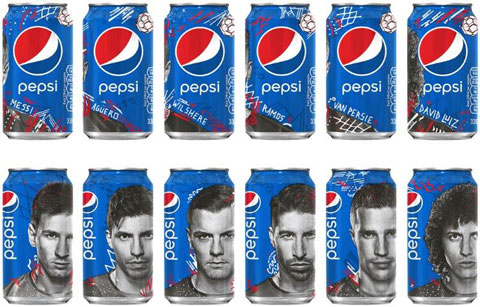
In addition to football superstar Leo Messi, Argentinian striker Sergio Agüero and exceptional young British footballer Jack Wilshere, Brazil defender David Luiz, goal scorer Robin van Persie and Spain's 115-time international Sergio Ramos are also in the Pepsi World Selection.

Not only will the players appear in Pepsi's soon-to-be-released global commercial, a selection will also be featured on limited edition packaging and promotional merchandise worldwide. Over the years, soccer has always been an important contributor to Pepsi's growth, the company writes in the press release.

1.salah_.bild1_
1.salah_.bild2_

(Teaser image: Keystone)

13 Questions for... Nadine Borter

What can’t BSW President Nadine Borter live without? And what gets on the Contexta owner’s nerves? You’ll find these and 11 other answers in the second installment of our new Q&A series.

nadine_borter_quadratisch

1. what inspired you to enter the advertising industry?

A shoot for Valser Wasser as a Contexta intern: everything gets better, the advertising stays good.

2. the best testimonial ever?

"Ik bin ein Berliner," by John F. Kennedy.

3. what do you personally think about the effect of advertising?

Only good.

4. if you had not become an advertiser - what then?

Diving instructor in French Polynesia.

5. is the opinion true for you that you can't grow old in advertising, or is that a prejudice?

Maurice Levy is 71 - so there's definitely still something in it.

6. what do you see as the biggest challenge for advertising at the moment?

It must work.

7. do you fall for advertising? When?

Always a pleasure.

8. what is impossible for you to do without?

To the bowl of candy in my office.

9. what do you think about owned media?

Old wine in new channels.

10. a buzz word that gets on your nerves?

Owned Media.

11. can you tell us a little secret?

Anyone who has worked for Appenzeller cheese for 20 years gives away no secrets.

12. was there a moment in your life when you thought: Wow. This is great. And it's from me!

Yes, on the birthday of Blanche, my daughter.

13. what would you not advertise under any circumstances?

For advertising bans.

The Show will go on

Darko Soolfrank is the adventurous entrepreneur and creative mind behind MAAG Music & Arts. The Zurich-based company provides entertainment for about 350,000 people each year. Its next production will cost over 6 million francs.

Unbenannt-22_0
Darko Soolfrank completed a banking apprenticeship at the request of his parents, who had immigrated to Switzerland. Fulfilling his first dream, he later became a ski instructor. Then he was attracted to organizing. For the Paragliding and Delta Pilots Association, he worked as an organizer of competitions, among other things. This led to further training as a marketing planner and later also as a federally certified advertising manager. It was at school that Soolfrank met Guido Schilling. Since 1995 they have been working together and since 2002 the two have been partners of MAAG Music & Arts AG, the largest show producer in Switzerland.

These days, rehearsals have begun in Winterthur for what is probably the biggest Swiss stage show of the year. "Cyclope," a six-million production, is inspired by a sculpture by Jean Tinguely. At 22 meters, this is the tallest object by the Swiss sculptor. The original is located near Paris. Tinguely, Bernhard Luginbühl, Niki de Saint Phalle and other artist friends worked on the iron sculpture made of 350 tons of steel for more than 25 years starting in 1969. A few years later, Darko Soolfrank discovered a design for "Le Cyclope".

"As a producer of shows, I get up in the morning and think, 'What could you put on stage?' And in the evening I go to bed and still think: What could be put on stage? So Jean Tinguely, with his background, has always been very close to me, even as a designer of sets, for example for a ballet at the Théâtre des Champs Elysées." At some point while studying Tinguely's work, Soolfrank came across "Le Cyclope" and said to himself, "This is a finished stage design. All you have to do is write a play around it. A musical doesn't impose itself on this kind of art, but something circus-like I can imagine." And what Darko Soolfrank can imagine, he can realize. The premiere is on February 27 and 28 in Winterthur. On two days, because the hall with 850 seats "is too small for all our guests." In summer, "Cyclope" will have another premiere in Basel on July 10. Then as an open-air spectacle. A first successful version of "Cyclope" already thrilled 27,000 visitors in Biel in 2012 on the grounds of the former Expo.

New ideas in old halls

Darko Soolfrank and his partner Guido Schilling, the producers behind "Cyclope," otherwise run the theater in Zurich's Maag area right next to the Prime Tower. Because the stage is only 12 meters high, a new hall had to be found for Tinguely's largest object, which is still 17 meters high in the scaled-down stage version. But discovering new halls has become something like Darko Soolfrank's second vocation. His first could be described as finding new show ideas and discovering new talent. Soolfrank counts "a good nose, an awareness of trends, like every advertiser has to have" as part of the necessary equipment for a show producer. This requires an understanding of marketing, especially when launching something that must resonate with the mark and thus with the audience. "We live off the visitors and get no subsidies. That requires a passion. The day does not have eight hours, but always much more, including weekends. The last New Year's Eve I could celebrate at home was about 15 years ago. I'm often at work when people are enjoying their free time," says the father of two daughters who are nevertheless well entertained.

Despite the considerable financial risk that every new production brings with it, however, Soolfrank does not see himself as a gambler. "Since Guido Schilling and I have been responsible for the Maag Hall, we have already twice come to the situation where things got dicey. Of course, this is always associated with a lot of sleepless nights." In "normal " business life, a market need is evaluated and to satisfy it, something is then produced. With a show, it's an assumption, "a hope that the idea will take off on stage and people will come. That's why it has completely unpredictable components. It's not like we have subscribers. Every production is a new product."

Either the market says "thumbs up" or thumbs down. It gets dicey when you have the "thumbs down" a few times in a row, as was the case two years ago with "Dällenbach Kari" in Bern, the musical version of "Die Schweizermacher" and "Altweiber-Frühling. This stage adaptation of the film "Die Herbstzeit losen" was indeed "a wonderful production". Soolfrank bought it in Bern, where the comedy was produced by the Stadttheater with subsidies and ran very well. But in Zurich, it just didn't want to work. After such a run of bad luck, liquidity is "used up relatively quickly, and you hope that you can find your way out of the trough with a hit.

Not only a hit, but the biggest mega hit of all time, finally became "Ewigi Liebi" for the producers in the MAAG hall. This musical ran for 5 years in Zurich and in a specially built hall in Bern. In 906 performances, an audience of 650,000 people was enthralled. The launch of this musical also came from Darko Soolfrank. He offered the project to Roman Riklin, who then wrote the book for "Ewigi Liebi" together with Dominik Flaschka.

Discover talents

Soolfrank can therefore also be seen as a promoter of talent. Talented people from the alternative scene, for example, who have the potential to make something for a broader market as well. Roman Riklin flirted with cabaret before "Ewigi Liebi," touring Switzerland with "Heinz de Specht" and with the dialect rock band "Mumpitz," among others. In the meantime he is a sought-after author also with other producers. Philipp Boë has also climbed a few steps higher on the show stairs thanks to Soolfrank. The latter has made a name for himself in Biel as a director of experimental plays. Then, after a "Soirée Creative" with "Karl's Kühne Gassenschau" and friends at a dinner, the MAAG director confided in the movement artist his idea that he wanted to make something out of Tinguely's object "Le Cyclope". In Boë's eyes, it "sparkled immediately." Still on the placemat, the concept for the spectacle, which has now grown to a budget of 6 million francs, was born. "Boë got the chance and also grabbed it." Despite his million-dollar budget, Darko Soolfrank has remained modest not only as a person. He also doesn't want to overstate his work. "We can't claim, like a playhouse, that we make intellectual theater that motivates to stimulate and question things. But we can have the effect of giving people a piece of joy. If that works out, then that already makes us happy."

Soolfrank feels at home in the theater. "That's where a lot of my strengths come together in one spot. That's why we've been doing this for 15 years now. There are many who come and go there. I like doing it: culture and entertainment as such. But organizing also suits me very well. I like to do something for the customer, for our guests. A bit of the host role combined with the cultural entertainment value. That's where a lot comes together."

In addition to the Musical Theater, the "empire" now also includes Club Härterei, the MAAG Event Hall, Frau Gerold's Garden, and Bistro K2. - Is it tempting from an entrepreneurial point of view to let one's company constantly expand? "No," says Darko Soolfrank. In the beginning, there was only theater, when the MAAG Hall opened in 2002 with the musical "Deep" by Charles Lewinsky. This played for 18 months. But occupancy was a daily struggle after the first season. As Darko Soolfrank and Guido Schilling analyzed, "If you only have one mainstay, it's almost not feasible. Similar to a soccer stadium, we need a certain amount of mantle usage so that we are a bit more broadly positioned. If a show production ever doesn't work out, we need to be able to continue to cushion ourselves." So the two jumped at the chance for the "Event Hall" right next to the theater. A wide variety of events are organized there. Currently the "Photo 14", on February 1 the ADC Gala.

Another room - the Härterei - was originally designed as a foyer for the "Event Hall". Then, when the Toni site, with its many interim club uses such as rooftop canteen and raw materials warehouse, was shut down, "we felt the need for a new club space that could absorb the Toni labels, so we said to ourselves, let's take a chance and get into the club business." That's how the "Härterei" came into being.

Finally, the concert business was added. "Today, we are one of the larger concert organizers in Switzerland. We have our own festival with 'Digital MAAG' and also organize at the Hallenstadion." The tour with Ennio Morricone or the Finnish rock band "Sunrise Avenue" are events the Maag- operators did together with their partner company Gadget. "It wasn't the lure, but actually more of a rational decision: if our core, show production doesn't work, we need to be more broadly based." And why not just cherry-pick? The internationally proven acts in the Hallenstadion? "We come from the shows we design and produce ourselves, and that's where our lifeblood is. In the meantime, we also have a good network of relationships with authors, stage designers, directors and composers. We definitely want to continue to use this strength, this USP. In other areas, we are more likely to be copied," says Soolfrank.

Currently, Darko Soolfrank and Guido Schilling present 500 events a year, reaching 350,000 visitors. That makes their organization the second-largest venue next to the Hallenstadion. Has that already led to takeover bids? "There are always interested parties. But that's not an issue for Guido Schilling and me. We want to remain independent, not really subsidized either. We want to push through our own ideas and be successful with them. We want to be able to live our spinning ideas," answers Darko Soolfrank. The contract with Swiss Prime Site as the owner guarantees transitional use of the Maag site for shows, concerts, parties and events until 2015. However, an extension is not ruled out, because all parties involved, including the Zurich City Council, appreciate the upgrade that the neighborhood will experience with this cultural enrichment. "We cost the city nothing and do something for the neighborhood." To be prepared for the future, Soolfrank and Schilling also pounced when Mr. Mayer-Sommer had a piece of land available on Geroldstrasse. "We thought, 'We've got to get our foot in there.' So we decided: let's rent 2400 square meters of land on Geroldstrasse. Then we can build a theater on it as an interim use, if necessary, if the lease with the MAAG hall is not extended." With that "foot in it," they could have played an active role if the convention center had actually come. The idea was to be able to build a definitive theater into the new complex. Because the electorate wanted otherwise and the lease with the MAAGHalle was extended, the restaurant "Frau Gerolds Garten" has now been left on the site instead of a temporary theater. A popular trendy restaurant, which the show producers now run as a further diversification in a joint venture with the gastronomy group Miteinander GmbH. With all these ventures, MAAG Music & Arts AG has 25 permanent employees. If a show is running, however, the team with all the freelancers can quickly skyrocket to 120. Darko Soolfrank acts as show developer and program manager.

Two years ago, Philipp Musshafen, an experienced hotelier, was brought in for the management. Guido Schilling works with Soolfrank more strategically and behind the scenes. He also runs one of the largest headhunting agencies in Switzerland "on the side". "Don't dream your life. Live your dream," was the claim in the musical "Space Dream," with which Schilling and Soolfrank founded their collaboration in 1995. That dream has come true for Soolfrank. "People come to us at the Hall when they're on their free time. And anything that has to do with free time and picks people up outside of their working lives is either vacations, gastronomy or culture and entertainment. In this sense, we work with the precious time of mankind. That's a dream in itself, if you're allowed to do that."

Andreas Panzeri
 

To the point: something is going on

It’s only been 15 days into 2014, but a number of things have already happened that will likely keep us busy in one way or another over the next few months.

NZZ acquires Moneyhouse to "further expand its position as a leading provider of digital business information". At the same time, there are rumors that an acquisition in Austria is imminent. It is said to involve the establishment of an online editorial department. Finally, the data analysis area is also to be expanded. The new CEO Veit Dengler seems to be serious about his digital offensive and is shaking things up. I like that. In the coming months, the veteran employees of the old aunt will have a lot to deal with.

Martin Kall, via his company Gudula Heinrich (a great name, I think!), has a financial stake in the agricultural journal Schweizer Bauer, where he has been on the board of directors since the beginning of 2013. His supervisory board mandate at the Frankfurter Allgemeine Zeitung, his activities as a member of the shareholders' committee at the Funke family group (ex WAZ media group) and as a member of the Tamedia board of directors do not seem to fill him up. Will there be any more news?

Roger Schawinski also seems to be bored. From now on (until further notice!), he broadcasts an emergency program on the frequency of the bankrupt youth station 105. You can read more about the temporary end of Radio 105 on page 38. Whether Schawi's action is completely legal doesn't seem to concern him. Why should it: once a pirate - always a pirate. Addendum: Thu 16.1: The pirate has got cold feet - he is no longer broadcasting.

In the TV data case, deceptive calm prevails on the outside. The watermarking test has been carried out. Some think the results are good, others not so much. Could this be the start of another dispute? According to reports, the private television stations are also interested in the Mediapulse data again. In any case, we are looking forward to the further episodes of the ratings and research stadium.

What will happen to Le Temps is not yet known either. Time will tell. Maybe everything will stay the same or Tamedia will buy Ringier's share or vice versa.

Everyone is looking forward to the launch of Watson. More than a self-promotion video of the crew has not been seen yet.

Native advertising is slowly making its way to Switzerland. Blickamabend.ch has shown it. Others will follow. An exciting, but not entirely harmless story. Let's take a look.

In any case, we have an exciting year ahead of us.

Pierre C. Meier, Editor-in-Chief
[email protected]
 

No secret: everyone loves Gruyère AOP

9 out of 10 Swiss people love Gruyère AOP. In a campaign, Numéro 10 shows who else might enjoy the cheese.

Numéro 10 presented more than 50 subjects in the pitch for Gruyère AOP. "The campaign should work like a saga that can be told over and over again," explains Gilles Aeby from the bilingual agency in Bern. The idea is designed to run for three years for the time being. The first wave with five subjects will run in December and January. Further seasons will follow in the spring and fall.

New productions with packshots of Gruyère AOP are shown again and again. This is accompanied by a claim that begins with the words "Also for ...". Market research shows that not only 9 out of 10 Swiss people occasionally like cheese from the Gruyère region. Almost 50 percent, or half, also describe the specialty as their preferred variety. For the other half, the following subjects have been created, which can be continued indefinitely: "Also for ..." Families, nudists, curious people, hikers or couples. The subjects can also be adapted to current situations, for example on public holidays, on Valentine's Day, during the Olympics or at the football World Cup. A TV commercial, which has lower production costs thanks to motion design, can also be updated again and again with different vignettes.

The tangy cheese, which will be marketed under international protection as Gruyère AOP from 2014, is considered the oldest traditional variety in Switzerland and was first documented in 1115. The variety is also very popular abroad and is advertised there by Numéro 10, albeit with fewer gimmicks in the motifs.

Andreas Panzeri

Unbenannt-8_18
Unbenannt-9_20
Unbenannt-10_14
Unbenannt-11_16
 

//www.youtube.com/watch?v=FHRY5v1yngU

Last but not least: Axe against the gender war

In its «Axe Peace» product line campaign, Axe is calling for peace worldwide under the slogan «Make Love. Not War.» With its latest TV commercial, the men’s grooming brand is burying the hatchet in the “gender war” for which it has been criticized in the past.

Because Axe advertising promises uninhibited women to clean and seductively Axe-scented men, the Unilever brand has repeatedly driven women's rights organizations to the barricades (Werbewoche.ch reported). In the current TV sport of the "Make Love. Not War" campaign, the men's cosmetics manufacturer takes an unusually romantic approach. 

The TV commercial shows well-known war scenes from the 20th century: a helicopter mission in Vietnam, a military parade in North Korea or Ahmadinejad with his finger on the red button. However, the war scenes are peacefully resolved by the soldiers and dictators falling into the arms of a woman - "Make Love. Not War.". This time it is not half-naked women who succumb to the infamous Axe effect, but the warring men to their feelings. (sis)

//www.youtube.com/watch?v=63b4O_2HCYM

Aroma: Interior Architecture for mad Hairstyling

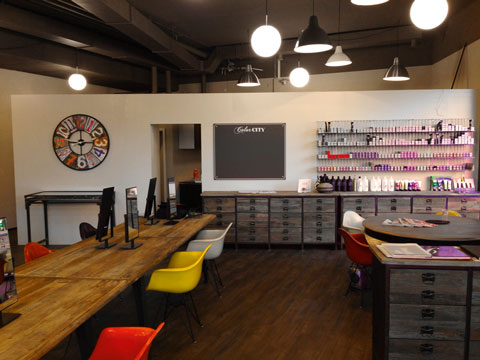
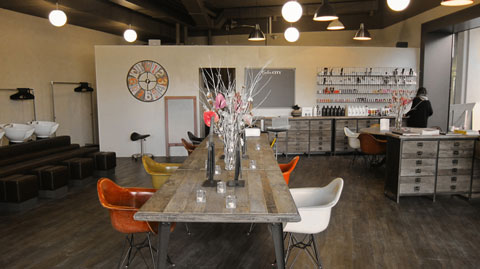
Recently, mad Hairstyling opened the third store directly at the main station in Zurich: mad Avenue. For the design, the interior architecture and the construction management Aroma was commissioned.

In the style of Madison Avenue, the meeting place for fashion-conscious city dwellers and style freaks in New York, mad Hairstyling on Europaallee offers everything to do with hair design. A store with lifestyle accessories completes the offer.

The warm wood tones, dark parquet flooring and designer furnishings create a homey, warm atmosphere in a spacious New York loft style, according to Thursday's announcement. The ladies' hairdressing area is at a long wooden table in the center of the room: a meeting and exchange area for clients and stylists. The armchairs in the men's corner are reminiscent of a 1950s barber store.

1.aroma_.1
1.aroma_.2
1.aroma_.4

A movie miracle rarely comes alone

Swiss film productions rarely reach a wide audience. When competing with international cinema, they usually have the short end of the stick. Last week, two filmmakers celebrated successes: Markus Imhoof won the Swiss Award for Culture for his film «More than Honey,» and Markus Fischer scored a ratings hit with the series «Der Bestatter.» Are we witnessing a Swiss film miracle? By Josefa Haas, Rector of EB Zurich/President of Swiss Films

A Swiss documentary film is nominated for an Oscar and a Swiss television series reaches almost half of the audience on the evening it is broadcast. The coincidence of timing puts these two productions at the center of attention at the beginning of the year, or is it more than coincidence?

In both cases, it is not about a movie production with stars. The documentary film is a genre that finds its way to viewers in unspectacular ways. Swiss film history is rich in works that focus on events and circumstances that we would otherwise miss. They are long for the television program grid, the topics and the design are unusual, and most people who go to the cinema at the weekend want to be entertained. A documentary film therefore has to overcome many hurdles and prejudices before it is seen by a large audience.

Two cultures clash among filmmakers and television executives. The former claim artistic and content-related freedom, while the latter are fundamentally committed to the audience and balance. It has always been personalities who have built a bridge here. Audiovisual culture needs cultural diversity, otherwise television and cinema will become one-size-fits-all. For its part, filmmaking can benefit from the means of production, access to living rooms and public debate. Not everything automatically has to be flat and banal. The risk of edgy productions is worthwhile for everyone involved.

Thanks to Markus Imhoof, the life and death of bees is attracting the attention of a wide range of politicians and the general public. The film begins with his grandfather's bees in Zofingen and shows how bees are dying worldwide. Anyone who has seen the film knows about the complexity of bees, their central importance for nature and food, and the threat they pose. Careful research, open discussions, spectacular shots and a gripping dramaturgy make "More than Honey" a powerful film experience. It is therefore no coincidence that it became the most successful Swiss cinema film of 2012 and the most successful Swiss documentary film and is in the running for an Oscar. TV series have long since caught up with feature films. International productions are now part of the cultural menu across all sections of the population. Their recipe for success: not shying away from the complexity of life, from the weaknesses and strengths of the characters, from human, political and economic dilemmas, from a signature style and surprises. The recipe is that there is no recipe. Standardized and copied formats do not meet these demands. There is only the resolution to be courageous, creative and intelligent.

A Swiss series measures up to these standards. "The Undertaker" ventures into Aargau, plays with the rather dry Swiss-German humor, deliberately uses clichés, gives the camera and set a great deal of freedom - wallpaper will certainly become more popular again. There is a lot of dying, often in a gruesome way. The actors manage the balancing act between tragedy and irony, suppressing tears at the right moment and leaving a cynical remark.

Next week, the industry will once again gather in Solothurn at the Film Days to show the latest productions and meet an open audience. This "Werkschau" is modest. There is no courting of stars or strutting down the red carpet. Hardly anyone who produces their films in Switzerland and finds their audience can avoid Solothurn. The mixture of experiments, debut works and author personalities is the wealth of Swiss filmmaking. Last year, the festival recorded over 60,000 admissions. So they do exist, the film wonders, on a small and large scale!
 

Successful 2013 for 3 Plus Group

2013 was the most successful year to date for the 3 Plus Group. Among other things, 3+ scored a huge hit with audiences thanks to the second season of «The Bachelor» and «Farmer Wants a Wife.» The season finale of “The Bachelor” achieved a market share of over 20 percent among 15- to 34-year-olds.

With an average market share of five percent in primetime, the 3+ and 4+ channel group achieved its best year to date among 15 to 39-year-olds, as the private channel group announced in a press release on Thursday. 3+ was also able to improve its position among 15 to 49-year-olds by one position compared to its commercial competitors, while 4+ has even improved by three positions since its launch.

Launched in August 2006, the new Swiss private TV channel 3+ has repeatedly been the market leader among 15 to 34-year-olds with its own shows "Bauer, ledig, sucht..." and "Bumann der Restaurantteser". Since the start of broadcasting, the young Swiss television station has supported Swiss film with over six million. 3+ employs around 40 people and is marketed by Goldbach Media. In the 2009 financial year, 3+ was in the black for the first time. 4+ went on air on October 9, 2012 and shows various free TV premieres.


Golden goose or fashion fad?

Although not clearly defined, "native advertising" is currently ubiquitous as a fashionable term - an attempt at an approximation together with the question of whether and how such things will ever exist in our country.

Until the summer of 2012, Google recorded no search queries for the term "native advertising," but from then on the trend curve shot upwards. In the English-speaking world, well-known titles such as Forbes, The Atlantic, and The Economist (cf. Werbewoche 21/2012, November 23, 2012, p. 31) have now jumped on this bandwagon. And when the New York Times unveiled its redesigned website on January 8, complete with Responsive Design and Native Advertising, the trend probably achieved its breakthrough, albeit with controversial commentary. In Switzerland, Ringier is betting on native advertising with the web portal for Blickamabend.ch, which went live last December. While it is clear what the latest advertising trend is called, what exactly is meant by it depends on whom you ask, and so definitions differ. Significantly, Wikipedia does not yet have an entry for it, at least in German. Instead of a definition of our own, we reproduce here some attempts at definitions that we encountered in the course of researching this article:

  • Native advertising takes the form and format of the medium in which it appears.
  • Native advertising is content that has been designed for a specific editorial message flow.
  • Consumers should not recognize native advertising as an ad, but as valuable content. It's not about selling, but about providing useful content, entertainment or infotainment around the brand.
  • Native advertising allows brands to engage with consumers according to their needs.
  • Native advertising is intended to enable consumers to experience marketing messages in the way they are accustomed to using a medium.
  • Native advertising is part of content marketing.
  • The term comes from the Latin word "nativus" (congenital).

Adding to the confusion, native advertising by no means describes something fundamentally new. Such practices exist in online media, but also in electronic media and print. Newspapers and magazines, for example, have long featured advertorials with an editorial look. While in Germany the separation of advertising and editorial content on radio and TV is anchored in law (Art. 9 RTVG) and such activities are frowned upon as surreptitious advertising, in foreign markets there are true artists among presenters when it comes to transitioning as smoothly as possible from content to advertising messages, presenting these as their own messages and then switching smoothly back to the program. And online services already have a tradition of mixing their own content with paid content: Google has ads that match search results, Facebook and LinkedIn have sponsored stories, and Twitter has promoted tweets. Last June, for example, the Internet Advertising Board (IAB) set up a working group on native advertising, which published its first document on the subject (Native Advertising Playbook) in December. This identifies six categories (In-Feed Units, Paid Search Units, Recommendation Widgets, Promoted Listings, In-Ad with Native Element Units and Custom /Can't Be Contained). It is emphasized that clear and prominently placed disclosure of paid content is of "utmost importance." Finally, the IAB authors conclude that native advertising is "distinctively and overwhelmingly" a form of brand advertising, allowing marketers to better leverage digital marketing to meet the full spectrum of their communications needs from branding to direct marketing.

Solution of two hardships

The fact that the online advertising industry praises native advertising to the skies is understandable in view of the long since meager attention paid to conventional online advertising. Whereas display advertising received 9 percent of the attention in 2000, "banner blindness" has now taken hold, and the click-through rate is now in the region of 0.1 percent. Consumers loathe intrusive banner ads and have learned to ignore them. Native ads are less annoying and deliver more.

And for publishers, too, native advertising solves an increasingly pressing problem: It is becoming increasingly difficult to finance the production of high-quality content with advertising. Editorial departments are shrinking, while the staffs of corporate communications departments are growing. If they come up with good content and pay to publish it, it would be foolish not to take advantage of it. Especially since publishers are opening up further revenue opportunities: In many cases, they set up a parallel editorial team that, together with sales, not only acquires native advertising content, but also helps brand managers create it.

In the U.S., a service provider landscape has emerged around content marketing and native advertising. There is a new wave of digital publishers such as Buzzfeed, Vice or Quartz, where native advertising is a central component of the business model. Companies like Sharethrough or Outbrain specialize in distributing branded content on suitable websites. Storify and Storyful support content curation.

But not everyone thinks it's a good idea, and there are also cautionary voices advising publishers against entering the seemingly lucrative business of native advertising. The editor-in-chief of the Wall Street Journal, Gerard Baker, speaks of a "devil's pact: Paid content unsettles the audience as to whether a media title is still trustworthy at all - so the very reputation is lost that advertisers also rely on.

Broad debate for new rules of the game

When it comes to native advertising, we too have a lot in flux. Just a year ago, an Werbewoche survey (Werbewoche 03/2013, p. 29) at Ringier stated: "We produce our own editorial content and do not take over any content in this form" - only to jump on the bandwagon a few months later with Blickamabend.ch. So in 2014, the topic of native advertising will also fully arrive here and occupy minds and spirits. As with the issue of paywalls, some will see it as the solution to the problem of declining online revenues, while others will fear that the audience will not accept it because of the problems it entails. Critics will refer to established industry rules:

Code of Conduct: The Code of Ethics for Advertising, introduced seven years ago by publishers, journalists and advertisers, stipulates "without reservation the principle of full transparency vis-à-vis the public." It states that "advertisements must not, by their design, give the impression that they are an editorial part of the medium." Lauterkeitskommission: In the "Principles of Fairness in Commercial Communication " there is a "ban on coupling commercial communication with editorial contributions," and sponsorship of editorial contributions is described as "unfair" unless this is clearly recognizable to the consumer. (Principle No. 3.12).

But native advertising is all about distinguishing itself as little as possible from editorial contributions. Whether native advertising becomes a golden goose or is soon written off as a fashionable fad depends largely on whether an industry-wide, and indeed societal, discussion can be held in the coming months to define new rules of the game with which native advertising can be successfully implemented. A look at the U.S. shows what kind of altitude is required for this: There, the Federal Trade Commission, FTC, held a one-day expert hearing at the beginning of December. Publishers and corporate communicators alike need to implement the project professionally and consistently (e.g., with their own specialized editorial teams). If, on the other hand, the issue is tackled with half-baked attempts, the earnings potential for both brands and media companies risks being damaged in the long term.

Christoph J. Walther

Der Motz von Butz: Zurich, Zureich, Zuunkreativ

The residents of Zurich have set themselves the task of transforming the Sechseläutenwiese into a tourist attraction—one of the most beautiful squares in Europe. By Theophil Butz

The briefing to our urban planners and builders must have sounded something like this. We are familiar with such specifications, wishes and illusions from advertising. During the presentation, the solution is then praised theoretically, scientifically and highly emotionally as a masterpiece. But the customer still needs space for a circus and a Böög. So the masterpiece has to be tinkered with. What is the result? We are familiar with this from advertising, something that is neither an attraction nor does it bring the desired applause and sales success.

So now I'm standing on this large but almost empty square, on heavy Swiss stone, cut into long, narrow strips and neatly laid out. The way you're supposed to cut Bündnerfleisch. (Butz don't digress!) My theory: the urban planners should show courage and create something for their city that will go around the world as a sensation. The real sensations, built by the townspeople, are all older and no such fuss has been made about them. The opera house itself, St. Peter's Church from the Middle Ages with its clock face (still the largest in Europe), the Stadelhofen train station by Calatrava, Corbusier's pavilion on the lake and, finally, the latest achievement, a high-rise building, the Prime Tower.

Many projects and ideas have been talked out of existence by the city. The double football/ice field hockey stadium, the congress center - should have been built across General Guisan-Quai to the lakeshore long ago. Have you ever looked at the exhibition center in Basel by Herzog & de Meuron? Not bad. The disaster of the Bahnhofstrasse Christmas lighting with the icicles reminds me of the renovation of the Sechseläutenwiese. That doesn't warm my heart either. The promised trees and water features won't change the situation either. Perhaps the harbor crane on the square would even be an improvement.

I would have built a contemporary counterpart on the Bellevue side opposite the opera house, then we would at least have symmetry, which is the key to all famous and worthwhile places. A tour of Paris will confirm this. Here in Zurich, two parking garage exits with a café and an exterior façade that is supposed to be trendy have been planted on the square. In my opinion, it's all gone down the drain. This oval advertising pillar for the opera house is also a joke. As we all know, plans on paper are nothing like reality.

We know all this from advertising, which thankfully is now in the famous January slump. But don't worry, I'm sure I'll find more material for the next rant about advertising. Here's a little foretaste: a nose and a mouth in front of it climb up a flight of stairs, moaning. The nose gets blocked. Incidentally, the nasal spray is called Otrivin, a medicine. Ask your doctor or pharmacist...

My pick of the week is that the Goethe Bar next to the opera house serves fresh, crunchy radishes with sea salt as an aperitif, rather than silly nuts.

butz_2

Theophil Butz, graphic designer, advertising agency owner, inspirer and, for over three years, also a mocker for Werbewoche readers. Please send any relevant information to [email protected]


A funny year 2013

By Florian Weischer, Managing Director WerbeWeischer

This is the most frequent comment that people have made to me when looking back on 2013. And there is no significant difference between professional and private issues. So it was a strange year, a year that brought us headaches as well as great joy and success. Our first year as a cinema advertising company in Switzerland has come to an end and the review is quite multifaceted.

We have learned that Switzerland has many more facets than we expected, not just the language and cultural regions (you can find out about these in advance), but also habits, likes, dislikes, idioms and their words. We experienced many careful, benevolently scrutinizing, precise and reliable, unconventional, innovative and humorous, special people. That alone makes the journey worthwhile. The distances are short (in kilometers) and the mental distance has also quickly decreased. Communication takes place in direct conversation, with time to spare and making use of one of Switzerland's strategic advantages: its excellent cuisine. However, this comes at a price. But the business for media marketers is always outside, i.e. with clients and agencies. This has already given us a very good overview of the overall gastronomic offering, especially in the metropolis of Zurich.

It was definitely worth it, not only because we experienced great places and dishes, we were also able to sell our medium very well in 2013. All the innovations we brought along and developed especially for Switzerland were received almost enthusiastically. In a few individual cases, however, we also learned that a Swiss "no" likes to hide behind very polite and authoritative words, shall we say. But as we all know, figures don't lie, and we more than exceeded our sales forecast in the first year.

We were also able to expand our cinema base, most recently even consolidating and extending our number one position in Switzerland's most important advertising region with the acquisition of the arthouse cinema chain in Zurich. Further steps will follow this year.

The previous top dog in cinema advertising doesn't find our commitment at all funny. This is understandable, but developments in the media always move forward, rarely or never backwards. Our colleagues there will experience this, and this is not only because competition is known to stimulate business, but also because the pressure from innovations is increasing. We have set ourselves very ambitious goals and the key points have long since been realized: hard box office data as the basis for billing per campaign, planning and implementation according to defined target groups, playout in cinemas at the highest technical quality level (also known as the DCI standard).

This motivates customers and agencies, but does not only make friends in competition. When the market then exerts pressure and demands these innovations from all providers, remedies and innovations are quickly promised. This is what happened in Switzerland in the fall of 2013. However, shortly after this announcement, I got carried away and made a bet that the technical renewal promised by the competitor for this February would not happen. There are only a few days to go and the chances of my prediction coming true are increasing. We will see. By the way, you can really see it in the movies - with a little practice.

Now you can guess what the winning bet will be? That's right: a good meal in Zurich - it's really easy to find. And 2014 will be a really good year. Want to place a bet?
 

get_footer();