Swiss advertising market down slightly in 2013

According to Media Focus, advertising expenditure in 2013 was slightly lower than in 2012. From January through December 2013, advertising expenditure totaled 4.81 billion francs, representing a decline of 0.6 percent.

There were no changes in the top 3 sectors with the highest advertising pressure in 2013 compared with 2012. As before, the highest advertising pressure was measured in the food sector at CHF 497.9 million. The automotive (454.7 million Swiss francs) and cosmetics + personal care (351.3 million Swiss francs) sectors ranked second and third, respectively. However, none of these three sectors reported an increase in advertising print in 2013. The food sector recorded a decline of 1.8 percent (-10.0 million Swiss francs) in 2013 compared with 2012, while the vehicles and cosmetics + toiletries sectors each suffered a drop of 2.7 percent (-12.4 million Swiss francs) and 14.5 percent (-59.6 million Swiss francs) respectively.

The real winner in 2013 was the beverages sector. The beverage market reported an increase in advertising print month after month throughout 2013. This grew by a total of 22.3 percent or 35.6 million Swiss francs in the past year compared with the previous year.

Number of advertisers constant

The number of advertising companies in the advertising print statistics remained unchanged in 2013 at around 20'000. The eleven largest advertising clients in 2013 alone represent 20 percent of the advertising print measured. The most active 462 advertisers represent 80 percent of the advertising share.

You can find the Media Focus Trend Report December 2013 under this link (PDF).
 

Radio: SRG loses market share to private broadcasters

As was the case in the first half of 2013, listeners in German-speaking Switzerland once again spent less time listening to the radio in the second half of the year. SRG stations lost market share to private radio stations, as Mediapulse and Public Data reported on Tuesday.

SRG stations achieved a market share of 64.2 percent in the second half of the year. This represents a decline of 0.7 percentage points from the first six months of last year. Private radio stations achieved a market share of 31.2 percent in German-speaking Switzerland from July to December, compared with 30.4 percent in the first half. The third group, the foreign stations, came to a market share of 4.6 percent. Even before that, SRG had lost market share to the private stations. However, because the measurement method was changed slightly at the beginning of 2013, the data can only be compared with those of previous years to a limited extent.

SRF 1 remains at the top

Overall radio usage declined in the second half of the year. On an average day, 88.5 percent of the population over the age of 15 in German-speaking Switzerland had tuned in to the radio for 122.5 minutes. In the first half of the year, a slightly larger proportion of the population (89.1 percent) had listened to the radio for around one minute longer each day. SRF 1 remains by far the most popular SRG station. Around a third of the German-speaking Swiss population listens to the station for almost 100 minutes a day, but its market share has fallen (from 32.7 percent to 31.7 percent). Among private radio stations, Zurich's Radio 24 leads the field with a market share of 3 percent.

French-speaking Swiss listen to less radio

In French-speaking Switzerland, SRG stations achieved a market share of 65.9 percent (+0.1 percent) in the second half of the year. The private stations ( 24.1 percent) face stronger competition in French-speaking Switzerland than in German-speaking Switzerland from foreign stations, which achieved a market share of 10 percent in the second half of last year. The French-speaking Swiss also listen to the radio for less time than the German-speaking Swiss, averaging 103.7 minutes per day. Residents of Italian-speaking Switzerland are in between, with 119.5 minutes a day. (SDA)

Semester figures available at Mpgroup.ch


Edelweiss sends pictograms around the world

Edelweiss is launching its new summer sales campaign this week, focusing on promoting the destinations of Las Vegas, Havana and Tampa. The campaign was developed together with Process.

In addition to traditional media such as posters and advertisements, the new campaign will also feature various online media. The campaign emphasizes Edelweiss' positioning as Switzerland's leading vacation airline, which flies non-stop to more than 45 destinations. Las Vegas, Havana and Edinburgh will be new destinations from May 2014, while Tampa has long been one of Edelweiss' most popular destinations.

""Let go and take off" is an expression of an attitude and a way of life that both customers and employees can identify with. At its core, it's about leaving everyday life behind and enjoying a relaxing time-out that begins as soon as you step on the plane," says Alain Chisari, Chief Commercial Officer at Edelweiss. Fabian Bertschinger, Creative Director of Process, adds, "The new visual and text language builds on our last campaign, restages the pictograms that are popular with the public and once again takes Edelweiss' communication a step further. "Let go and take off" serves as a creative bracket across all communicative activities."

For the past two years, Process has been providing Edelweiss with holistic support in the areas of brand strategy and communication, product design, and brand training for employees. Process is thus responsible for holistic brand development with a long-term focus.
"In addition to our claim to be among the best in the strategic development of a brand, we also focus consistently on all areas of brand staging," Fabian Bertschinger continues.

F200-Tampa
F12-Tampa
F200-Havanna
F12-Havanna
F200-LasVegas
F12-LasVegas

Radio 105: Now you can bid

The race for Radio 105 is on. The Swiss Official Gazette of Commerce published the distress sale on Tuesday with the highest offer to date from Radio 1 owner Roger Schawinski, which fellow competitors can now outbid within five days.

Although the type of proceedings has not yet been determined, the Bankruptcy Office Zurich-Oerlikon has initiated a distress sale. This means that even before the type of proceedings has been determined and before the expiry of any submission deadline, the bankruptcy office can sell bankruptcy assets "at our free discretion, either in their entirety or individually by private contract", as the invitation to tender in the Official Gazette of Commerce states. As required by law, the highest offer to date was published. In his "binding purchase offer," Roger Schawinski is offering a total of 784'534 francs to take over the infrastructure and concession of Radio 105. He wants to pay 240'000 francs for the FM concession, 10'000 francs for the broadcasting equipment and 534'534 francs for the outstanding rent until the end of the contract period on September 30, 2016. In addition, the Radio 1 owner is willing to take over at least eight employees of the current Radio 105 team - on terms that are at least 80 percent of the previous conditions. According to the invitation to tender in the Handelsamtsblatt, the gross annual salary is 48'400 francs.

Buy a pig in a poke

The purchase of the FM license, which is limited until 2019, is fraught with risk. If the Federal Department of the Environment, Transport, Energy and Communications (Uvek) refuses to transfer the license to a new owner, the payment of 240'000 Swiss francs will still be forfeited in favor of the bankruptcy estate, according to the tender notice in the Handelsamtsblatt. The competitors are effectively buying a pig in a poke. However, the Federal Office of Communications (OFCOM) has already signaled that it supports a "sustainable solution within the framework of a license transfer to an efficient applicant.

Others can bid

Whether Schawinski will definitely win the bid is still open. There are another five competitors for the purchase of the concession and the facilities of Radio 105, including the TV station Joiz and Radio Energy of the Ringier publishing house. These now have until Saturday to submit higher bids to the Zurich-Oerlikon bankruptcy office. For another interested party to be considered, the offer must be at least 15'000 francs higher. If one of the interested parties actually bids more, Schawinski has the option to submit another one-time offer without knowing the amount of the higher bid. "To the one who has made the highest offer after the publication deadline, the bankruptcy assets will be sold," the bankruptcy office writes. The previous Radio 105 operator Music First Nework had filed for bankruptcy on January 14. Roger Schawinski was the first to come to the public with a concrete rescue concept for the youth station. In the future, Radio 105's programming is to be produced in Radio 1's studio. (SDA)

Image: Keystone


Last but not least: The German thoroughness

When German VW engineers try to figure out the formula for the perfect Super Bowl commercial, it can't end well. But it will be funny.

This year's final game for the North American football championship takes place on February 2. Although the sport also attracts some interest on this side of the Atlantic, the event is mainly visible to us through the advertising. The prestige of being represented in what is probably the world's most watched advertising block of the year is so great for companies that they have good commercials produced especially for this event. In figures: On average, over 110 million viewers watch the broadcast. Most of them not only want to watch the game, but also the amusing commercials. A remarkably grateful audience for the advertising industry in times of HD recorders and replay. As a side effect not to be sneezed at, the films are distributed all over the world via YouTube after the event and clicked on, marveled at and celebrated millions of times. This even comforts the four million dollarsthat a 30-second broadcast costs.

Volkswagen can look back on a successful Super Bowl past. For example, the Darth Vader commercial "The Force" (2012) has received almost 60 million clicks to date and is one of the most popular commercials on YouTube. Last year's laugher "Get In. Get Happy" will soon break the 15 million barrier. It's no wonder that VW doesn't want to let anything burn in 2014 and - as can be seen in a teaser published on Tuesday - is drawing on the engineering skills of German carmakers.

vw-zgl

"By isolating your most successful humor ads, we have developed an algorithm to make the ultimate commercial for your big American football festival" announces the gentleman in the white coat with a German accent. The complex formula in the background reveals how puppies, Carmen Electra, twerking, unicorns, musclemen à la Old Spice and screaming monkeys have to be combined to create the perfect Super Bowl ad. It's as simple as that. Just German quality work. Even if the result definitely needs a final polish - there's still some time left. (hae)

//www.youtube.com/watch?v=Mzio0qhdxZY

Federal court: Blick mockery went too far

With its mockery of Michael von der Heide as a "faggot" after his unsuccessful appearance at the Eurovision Song Contest, Blick has violated the personality of the chansonnier. Ringier was turned down by the Federal Court.

Michael von der Heide scored only two points for Switzerland at the Eurovision Song Contest (ESC) 2010 with his song "Il pleut de l'or" and finished last. Lena Meyer-Landrut won for Germany with her song "Satellite. Blick published a photo montage on the front page at the end of May 2010.

5000 francs satisfaction

Lena Meyer-Landrut's body was precisely fitted with Michael von der Heide's head, and next to it was the text: "We want a Lena too! ...but no more von der Heide". On complaint by the chansonnier, the Zurich judiciary came to the conclusion that Blick had violated his personality with this contribution. Von der Heide was awarded compensation of 5,000 Swiss francs. The publishing house Ringier appealed to the Federal Court, but has now been dismissed. According to the court, Blick publicly exposed von der Heide to ridicule and mocked him as a homosexual and for his failure as a singer. With the montage of the head of the self-confessed gay von der Heide on the body of Lena, who is portrayed as smart and attractive, as well as the female form used in the text, he is "portrayed for the average reader as what can be understood casually and also pejoratively under the term 'faggot'.

Neither satire nor humor

Blick had thus violated von der Heide's social standing as a man and his professional reputation as a well-known chansonnier with a male voice. The portrayal was mere vituperative criticism and could not be justified as satire or humor. Blick does not want to be a satirical or joke magazine, and its readers do not expect anything humorous on the front page. The invective against von der Heide was also disproportionate to the importance of the ESC, at which other representatives of Switzerland had also recently not been particularly successful. Finally, according to the court, the amount of the awarded compensation of 5000 Swiss francs is not objectionable. In the opinion of the judges in Lausanne, their colleagues in Zurich were entitled to assume, based on general life experience, that the Blick article had caused von der Heide severe emotional pain. (SDA)

Image: Keystone

New media spokesman at Postfinance

Johannes Möri will become the new media spokesperson for Postfinance. The 33-year-old from Thun will begin his new role at the financial institution on February 3, 2014. He succeeds Alex Josty, who has moved to Berner Kantonalbank.

Johannes Möri joins PostFinance from the regional bank Valiant. There, he worked for the last five years as deputy media spokesman and was most recently responsible for investor relations and the annual report. Before joining Valiant, Johannes Möri worked for Credit Suisse in private customer consulting. He studied business administration at the Bern University of Applied Sciences, specializing in corporate communication and marketing. At Postfinance, Johannes Möri will take care of media relations together with the current media spokesman Marc Andrey and assume other tasks in corporate communications.

Last but not least: Simply the perfect picture

Online journalists are under time pressure and they often search for their image material in a matter of seconds via image databases on the Internet. We present three ways to find the right image quickly.

1. The supreme discipline is called "From the abstract to the concrete"Illustration is particularly difficult when the topics are abstract. The following three subjects from the Münstersche Zeitung stand for "the indissolubility of marriage, sexual morality and the rejection of homosexuals". How would you illustrate something like that? Exactly. The challenge was mastered brilliantly in the third picture in particular: it shows a gay man and a woman who hates gays at the same time.

1.symbolbild1

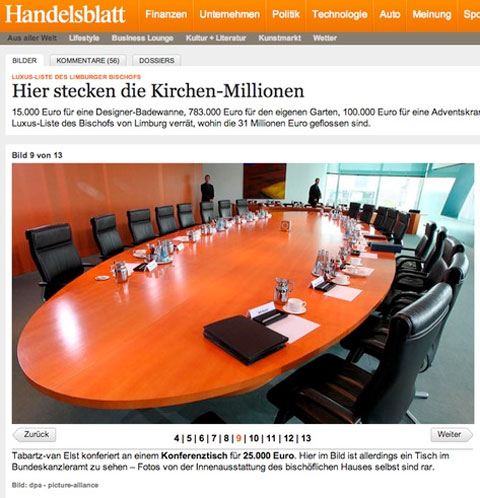
2. Another option is to use a Picture of a similar object as in the following article about the extravagance of a Catholic bishop. Among other things, he bought an overpriced conference table for 25,000 euros, but the picture "shows a table in the Federal Chancellery" because there are no pictures of the bishop's house, according to the legend. However, the visualization arouses the reader's interest, because at first glance one thinks that the church sponsors the Federal Chancellery (or something else that is done at conference tables).

1.symbolbild3_0

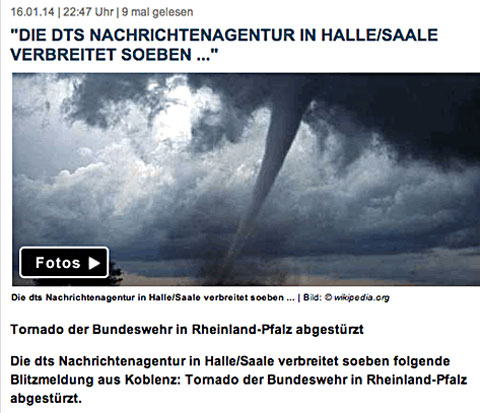
3. If you don't have any time at all, you can also publish the text unread and look for it in the image search arbitrarily to a few keywords from the lead hold. (sis)

1.symbolbild4

(Pictures: Stefan-Niggemeier.de)

UPC Cablecom hosts media literacy courses

To mark International Safer Internet Day on February 11, 2014, Pro Juventute is offering free courses to help children improve their online skills at UPC Cablecom stores in Zurich, Lucerne, Olten, and Basel.

Every year on the second Tuesday in February, Safer Internet Day is celebrated in over 100 countries worldwide. The aim on this day is to teach children and young people how to use online technologies and mobile devices responsibly.

The courses offered by UPC Cablecom and Pro Juventute are aimed at parents, teachers and interested parties. They include topics such as media use by children and young people, their own media use and attitudes towards new media, legal aspects of new media, as well as cyberbullying and other problematic phenomena, according to the company's statement on Monday.

Registrations are here received.

(Teaser image: Cablecom)

Slippery glitch with SRF subtitles

Swiss television channel SRF added lewd subtitles to Saturday's "Sport Aktuell" program. Words such as "cocksucker" and "Bumsmäuschen" were used. SRF is talking about a technical problem. The cause is being investigated.

Swiss television has made an embarrassing mistake with the subtitles for the program "Sport Aktuell", as Radio Top announced in a press release on Monday. Radio Top discovered that the subtitles for the hearing impaired for last Saturday's "Sport Aktuell" program contained sentences such as "Cocksucker! Stupid wanker!", "Now it's off to the nipples." or "Do you know the term 'Bumsmäuschen'?" were displayed.

"In fact, we had a little mishap last Saturday. The subtitles were part of a movie that was shown on SRF 2. For unknown reasons, the subtitles were also broadcast on SRF 1, where the program 'Sport Aktuell' was running," says Gion Linder, Head of Subtitling at Swisstxt, to Radio Top. The film on SRF 2 is the comedy "Jungfrau (40), männlich, sucht".

The subtitle mishap at Swiss Radio and Television SRF has apparently not led to a storm of indignation among those directly affected: As SRF said on Monday when asked by SDA, no reactions were received from the hearing-impaired.

1.srfpanne.bild_

(Screenshot: Radio Top)

Starting signal for the tenth Crossmedia Award

On May 15, 2014, the Goldbach Group will present the Crossmedia Award, worth 10,000 francs, for the tenth consecutive year. The award recognizes campaigns that demonstrate an innovative, compelling, and surprising ability to integrate cross-media content.

In addition to the Crossmedia Award, which is worth 10,000 Swiss francs, silver and bronze awards will also be presented. The additional Trendsetter Honors, special prizes for campaigns with particularly groundbreaking networking of the cross-media subsectors of mobile, video and social media, which were already created last year, are established components of the competition in 2014. As every year, all the awards presented have an influence on Werbewoche's annual creative ranking.

All cross-media campaigns implemented between April 2013 and February 2014 and designed and developed in Switzerland, Germany and Austria can be submitted by March 3, 2014 at Crossmediaaward.ch be submitted.


Swisscable under new operational management

Swisscable has new operational management. From March 1, 2014, lawyer Simon Osterwalder will lead the association of Swiss cable network companies. He replaces Claudia Bolla-Vincenz, who was at the helm of Swisscable for 15 years.

The trade association of cable network companies is reorganizing: as of March 1, 2014, Simon Osterwalder will be responsible for the management. Osterwalder succeeds Claudia Bolla-Vincenz, who is stepping down for age reasons. During her time as CEO, the cable network companies have succeeded in mastering the transformation from pure TV and radio program distributors to providers of telecommunications and entertainment services. The Association of Swiss Cable Network Companies represents the interests of 220 members with a total of around 2.7 million customers throughout Switzerland.


get_footer();