OSW advertises almost new cars

The Basel-based advertising agency OSW is promoting nearly new cars for the Grosspeter Muttenz car supermarket. Starting this fall, the posters will be displayed in Basel’s parking garages.

The Basel-based Oswald Siegfried Advertising Agency (OSW) is advertising the Grosspeter Muttenz car supermarket's "high-quality used cars", according to a press release from OSW. The F12 posters of the largest used car dealer in northwestern Switzerland will be on display in Basel parking garages starting this fall.
Responsible at Autosupermarkt Grosspeter: Jasmine Gasser (Head of Communications).
Responsible at Oswald Siegfried Werbeagentur (OSW): Michael Oswald (Art Direction), Nadine Siegfried (Consulting), René Fisch (Text).

1290582586_img080902_grosspeter1
1290582586_img080902_grosspeter2
img080902_grosspeter3

Swisscom discovers TV sports

Teleclub has built up significant sports expertise without much fanfare. Behind this is Swisscom, for whom football is an important marketing argument.

Anyone interested in football on television in Switzerland can now hardly avoid Teleclub. The pay TV broadcasts four games per round of the Axpo Super League, either live or delayed, depending on the distribution channel. While Swiss Television (SF) currently broadcasts four matches per ¬
season only shows ten matches, Teleclub has 134 games in its program. This means that fans can follow their club on TV almost without interruption - provided they can afford to pay the subscription fee.
Teleclub relies on Bluewin-TV
Cable networks are still the most common and established transmission channel for Teleclub. In addition to its feature film and series program, the pay-TV broadcaster offers three sports channels here. But Teleclub is relying heavily on the Bluewin TV distribution channel. This Internet-based technology opens up possibilities that are not available via the cable network. As so-called live events, sports broadcasts on Bluewin TV can also be paid for individually and viewed without a monthly subscription. "'Pay per view' has the advantage that you can watch the games on a trial basis, so to speak, before fully entering the world of pay TV," says Teleclub's Head of Sports Roger Feiner.
Since Swisscom launched Bluewin TV a year and a half ago, the market for sports broadcasts has been on the move. Back in 2004, it acquired a 49 percent stake in CT Cinetrade AG, which owns the majority of Teleclub. Today, Teleclub supplies all of the paid content on the Bluewin TV platform. The football and ice hockey broadcasts in particular are a sales argument to attract customers. "Sport offers exclusive content. It is crucial for customers to become interested in a channel or a new technology," says Feiner.
Two years ago, Teleclub signed a contract with the Swiss Football League for Super League matches until the end of the current season. It includes an option for continuation in the coming years. This also meant the end of Swiss football broadcasts on the free-to-air channel Sat.1. This fall, renewal negotiations for the football contracts and the broadcasts of the National Ice Hockey League A are now pending. Feiner explains that the company is concentrating on these two mass sports for the time being because they are well established throughout the country. Teleclub also has rights to all UEFA Champions League matches, the German Bundesliga and Formula 1, among others.
"Internet portal is of central importance"
Step by step, pay-TV has built up a significant sports department, which now comprises around 70 people. The editorial team is headed by Adrian Fetscherin, who was brought on board with the acquisition of his well-established sports website www.sportradio.ch. The structure of the sports department with the Sport Business Unit, Sport Productions, Sport Portal and Sport-
Mobile relies on a multimedia exploitation chain. The sports section of the Bluewin portal can be accessed via www.teleclubsport.ch, which has been expanded into a multimedia sports offering with editorial texts, images and videos. "The portal is now of central importance. Usage is increasing enormously," says Feiner. Mobile offerings will be added soon. "Thanks to the partnership with Swisscom, the convergence of media platforms can be fully realized," says the Head of Sport. Teleclub will soon be able to offer sports information from a single source anytime and anywhere.
The players are keeping a low profile when it comes to costs
The partners involved remain silent about how all these offers are financed. Teleclub does not communicate any concrete figures - not even viewing figures. These are "constantly increasing", says Feiner noncommittally. It is reasonable to assume that the income from subscription fees and sponsorship does not cover all costs. After all, there is no advertising around the sports broadcasts. The remaining costs are likely to be borne by Swisscom, in whose interest the sports content is ultimately produced.
Overall, the Swiss Football League is benefiting financially. Since Teleclub entered the business, TV revenue has risen by around 20%. However, the unknown viewing figures are problematic for the clubs: their advertising revenue also depends on the number of viewers. Thanks to frequent live broadcasts, however, they are at least more present among fans.
Although SRG SSR continues to show ten games per season, it also benefits indirectly from the sports boom on pay TV. For ice hockey, Teleclub has a production agreement with the league, which has the games produced by SRG. And in football, Teleclub has a direct agreement with SRG, which has individual matches covered by tpc, but also with foreign producers.
Adrian Scherrer

Y&R Group cures new diseases for ÖKK

The Y&R Group has continued its campaign for the health insurance company ÖKK. The campaign features additional comic illustrations depicting fictional illnesses.

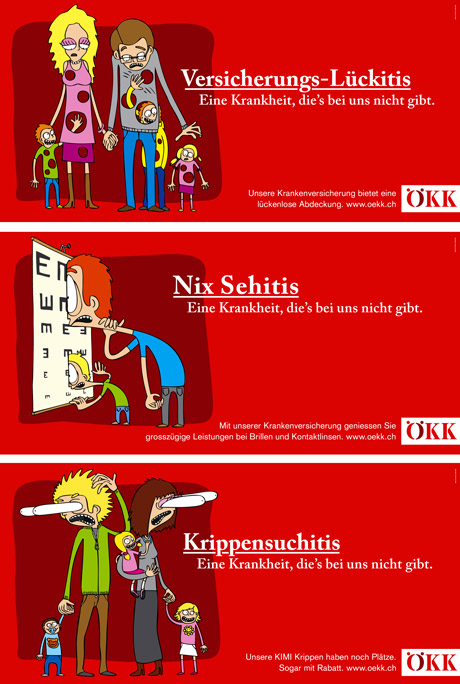
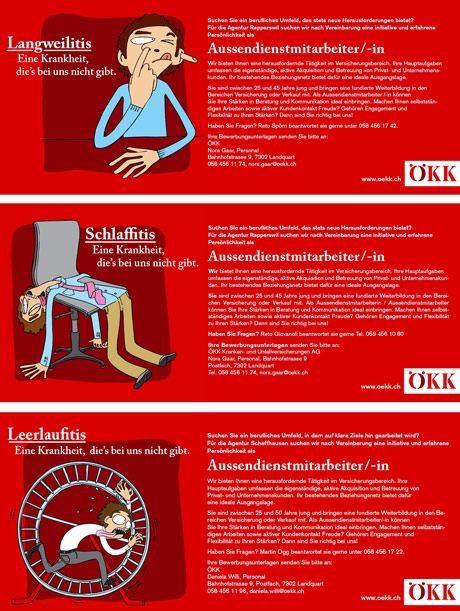
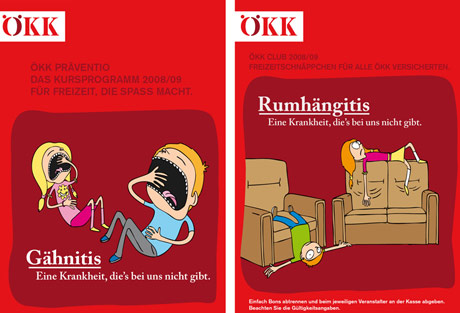
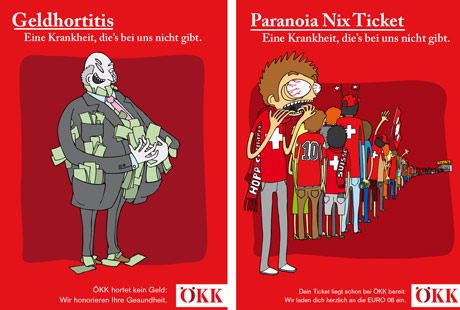
Health insurer ÖKK has commissioned the Gockhausen-based Y&R Group to continue its campaign. Comic drawings are used to depict fictitious illnesses such as insurance gapitis, crib addiction and nixitis, which are not supposed to exist at ÖKK.
"Health insurance companies often make their customers more ill than healthy," says a press release from the Y&R Group. "There is a simple remedy for this: switching to ÖKK. Here, the evils of the insurance system are mercilessly eradicated." Humor is at the heart of the campaign, the humorlessness of standard insurance advertising falls by the wayside, according to the Y&R Group. The best example is the annual report, for which the management of ÖKK had itself immortalized in campaign style.
The campaign measures are also implemented in traditional advertising, sponsoring, job advertisements and web banners, magazines and customer loyalty measures.

Responsible at ÖKK: Mario Theus (Marketing and Deputy Chairman of the Executive Board), Venanzi Vincenz (Head of Marketing Communications).
Responsible at the Y&R Group: Dominik Oberwiler (CD/AD), Martin Stulz (text), Rob Hartmann (illustration), Pablo Koerfer, Adrian Tschui (consulting), Oliver Vedolin (strategy), Caspar Coppetti (overall responsibility).

1290582585_img080902_oekk1
1290582585_img080902_oekk2
1290582585_img080902_oekk3
1290582585_img080902_oekk4
img080902_oekk5

Kreisvier designs for the Swiss Television Award

This Friday, the newly created Swiss Television Prize will be awarded for the first time by Tele and TV-Star. The Basel agency Kreisvier realized the communication measures.

Tele and TV-Star, the two television magazines from Axel Springer, are jointly awarding the newly created Swiss Television Prize for the first time. This Friday it will be presented at a gala in Zurich's Maag Event Hall. The Basel agency Kreisvier Communications was chosen to communicate the event as part of a pitch. Kreisvier made the announcement in a press release on Tuesday.
The agency created advertisements, TV trailers, invitations and the menu card and played a key role in the creation of the trophy. It was created in close collaboration with the artist René Racz, Kreisvier-AD Sven Kahler and freelance illustrator Stefan Liechti. The statue, which weighs almost four kilos, depicts a female figure whose arms flow into a stylized screen.

img080902_fernsehpreis

Search word advertising

Thomas Hanan was Google Switzerland's first employee. Today, he works at the Hürlimann Areal in Zurich as Head of Sales Switzerland. In this role, he is also responsible for maintaining relationships with agencies.

He has looked at countless stars up close in space. But Thomas Hanan had no idea at the time how to "look deep into a crystal ball" on Earth. In 1998, after completing a double degree in astronomy and marketing in Denver, the internet and digital media were already "a big topic". Google had gone online two years earlier. Even then, Hanan was fascinated by the possibilities of this search engine. But he was far from thinking that he would one day become Google's first employee in Switzerland. And he would have had to be a fortune teller to predict that this global company in Switzerland would one day be the largest development center outside the USA with over 400 employees in Zurich.
Thomas Hanan started out as a man of the first hour in a small studio in Erlenbach. Here he was to build up the future contacts for the sales department. When an engineer quickly joined as a second employee, the duo moved to Seefeld. "It was funny how two different worlds had to come together here. As a salesman, I wanted a prestigious location as an office so that I could receive customers. The engineer was only looking for manhole covers under which he could assume a strong internet connection."
When the rapidly growing team moved to Limmatquai a few months later, there were already 15 people. Here, Urs Hölzle, Google's first Vice-President, who was responsible for developing the technical and operational infrastructure at the headquarters in the USA, was still assembling Ikea furniture himself, Hanan recalls. As an Internet pioneer with Swiss roots, Hölzle was also largely responsible for Google choosing Zurich as its most important European development location. Specialists from all over the world find a great quality of life here. Google also seeks proximity to important universities.
Still great need for development in online advertisingWhen Google expanded further in 2006 to Freigutstrasse, it already had 150 employees in Switzerland. In 2007, Google Switzerland finally found its futuristic home in the Hürlimann area. As Industry Head Switzerland, Thomas Hanan is primarily concerned with "developing the agency market". Traditional media agencies and specialized online marketers are "trained" by his team on how to get the most out of a budget with Google. The impact of online advertising and its potential are well known today. "However, there is still a great need for development," says Hanan. Although we in Switzerland have one of the best broadband networks in the world and the highest Internet penetration, the proportion of online advertising is still less than 2 percent, compared to 20 in England and over 10 in Germany. "Many media people who have mainly been active in the traditional media up to now still lack the specialized know-how," Hanan notes. To enable advertisers to venture as far as possible into the jungle of the World Wide Web without losing their bearings, Google now offers a special certification. Media specialists and agencies who have attended and successfully completed the Google courses can use the title "Google Advertising Professional".
The internet not only influences opinion-forming by being the first point of contact for obtaining information. "It also influences the purchasing process," Hanan is convinced. Anyone who is about to make a new purchase, wants to compare cars, book travel or even buy a house, first looks for information online. AdWords are therefore Google's most important offering on the world's largest search portal. Clearly defined search terms such as "vacation in Greece", "vacuum cleaner" or "poster by Andy Warhol" can be used to place paid information that appears at the top of the screen when a search query is made. These text ads are highlighted in yellow on the Google screen and are therefore clearly separated from the generic area of the search results. The position of this information, which is generated according to a very complex system of statistics and quality, cannot be influenced with money. In this way, the world's largest search engine wants to remain true to its most important principle: "Google always puts the user first."
Before Thomas Hanan found his way to this company, which now has 7,000 employees worldwide, he started with an internship at Credit Suisse in Zurich. The son of an American father and a German mother studied business administration and marketing in Denver. As astronomy has always been his hobby and the highest observatory in the world is part of the university, he also completed a second degree in this subject. "It was an education for the mind," he says, describing his feelings when looking at the stars.
His entry into the web was at Multi Media Development MMD. After returning to Switzerland, Hanan helped to set up this subsidiary of PubliGroupe and then opened the Zurich office for Yahoo. Before moving to Google five years ago, Hanan took a timeout and lived under the stars for another six months. As a skipper, he ferried sailing yachts to the Caribbean. Today, he also enjoys cruising in front of his apartment in Feldmeilen.
Andreas Panzeri

SFLB wins contract for global ABB image campaign

The advertisers at Spillmann/Felser/Leo Burnett (SFLB) will realize ABB's global image campaign. The first implementations will be seen this fall.

Spillmann/Felser/Leo Burnett (SFLB) has been awarded the contract for the global image campaign by ABB. The Zurich-based advertising agency prevailed over several competitors, as announced in a press release on Tuesday.
Maria Jobin, Head of Branding at ABB, explained the decision by saying that the SFLB campaign will have a very authentic and credible effect in ABB's key markets of Europe, Asia and North America. The first implementations of the global campaign will be seen this fall.

Major shake-up at Ringier Switzerland

Ringier Switzerland has officially started work following a far-reaching internal reorganization with new structures, divisions and people and with Marc Walder as the new Managing Director. The publishing house is focusing primarily on growth in the digital market.

Ringier Switzerland officially started work on Monday following a far-reaching internal reorganization with new structures, divisions and people and with Marc Walder as the new Managing Director. Walder succeeds Daniel Pillard, who led Ringier Switzerland on an ad interim basis for a year. As the publishing house announced in a press release, the previous and new management teams have been pushing ahead with the reorganization over the past few months. The aim was to create structures for the business in a dynamic market environment.
As the Group wants to continue to grow in the digital market, three new sub-divisions have been created in the New Media division by Executive Board member Christoph Bauer: The Media Site Center (MSC), headed by Thomas Huwiler, offers Internet services. New Internet business models and platforms are being developed in the Media Lab under the direction of André Maerz, while Ringier is setting up a central marketing unit for Ringier Internet pool products in the Media Sales sub-division. Ueli Weber will take over as Head of Media Sales on November 1, 2008.
A breath of fresh air is also blowing at "Cash": from October 1, Dietrich Berg, the former head of the magazine reader market, will become the new publishing director of the Cash multimedia platform. Christoph Bauer will retain overall management of the Cash Group, while Berg will be responsible for the further development of the integrated media company.
Roland Kühne, Head of the Customer Contact Center, is taking over the management of the Magazines reader market from Dietrich Berg in addition to his previous position. The Magazines division will be managed by Urs Heller. The previous interim Managing Director of Ringier Switzerland, Daniel Pillard, will return to his traditional Ringier Romandie division as a member of the new Executive Board.
Beniamino Esposito is taking over the management of the newspaper advertising market from Martin Tamas at the Blick Group. Esposito was previously Head of Advertising Market in the Magazines division for five years. The Editorial Services, Classified Ad Models, Online Sales (blick.ch) and Crossmedia departments will now report to the Blick Group's advertising market and will also be managed by Beniamino Esposito. In return, Martin Tamas will take over the Advertising Market Magazines division and will also head the International Sales division. The Blick Group division will be managed by Thomas Passen.

Reactions to the new advertising week

Since last week, *Werbewoche* has been sporting a new look and has received a variety of reactions. Read some of them here.

The dynamics of the new layout, logo, typo and icons are great. Unfortunately, as I flipped through the new Advertising Week, it never quite became clear to me what was an ad and what was editorial. But maybe that's just the recipe for success of a good advertising magazine!
Markus Good, Chief Creative Officer, Y&R Group
Congratulations on the successful new appearance of Werbewoche. Everything now seems fresher and a little more cheeky. It's fun to read.
Roland Lustenberger, Vogt-Schild Druck AG
Unfortunately, I often find relaunches not very successful. But this one is good! Congratulations!
Yvonne Lang
You have succeeded very well with the relaunch. It is very appealing and clear. Makes more fun to read.
Özlem Bächli
Really chic - the new layout. Well done! Congratulations.
Anita Kittel
The advertising week shows format. That suits our industry well. Thank you.
Frank Bodin, Chairman & CEO Euro RSCG Group Switzerland, President bsw leading swiss agencies
Unfortunately, my impression is very ambivalent. Even more: I find the old layout better - even if it is a bit American. The whole WW now looks like a brochure. The widening of the text columns clearly reduces readability. The base font is too small. The titles with narrow bold Helvetica look too heavy, also here the readability is worse. Generally the typography: a concept for the use of the numerous type styles is not recognizable and conveys arbitrariness. The old WW was simply more clever in every respect. I don't want to badmouth everything, but a few points really need to be improved, then it will be good.
Matthias Walti
The old look of "Werbewoche" was unfortunately better than the new one. And let me ask you a question: Why does the medium that reports on the Swiss advertising and communications scene go abroad for a redesign?
Tamás Kiss, Hesskiss Advertising Agency AG
Congratulations on the new advertising week, the new newsletter and the new website. You have really hit the nail on the head.
Peter Kaufmann, Head of PR and Sponsoring, Publisuisse
As a long-time Werbewoche reader, I am pleased with the redesign of your magazine. However, for me as an almost 50-year-old, the font size of your texts is too small. You are forcing me to finally buy reading glasses.
Michel Reber, Head of Marketing Communication, Migros Lucerne Cooperative
The advertising week has discovered the picture. Werbewoche promotes advertising, promotes the eye. Congratulations on the relaunch.
Franz A. Zölch, Franz A. Zölch & Partner
Congratulations to all for the very successful relaunch!
Urs Gossweiler, Virgin Newspaper
Until now, it's been "old wine in new wineskins." For the new advertising week, it's "New wine in new skins."
Guillaume Borel, Viznerborel

Last but not least: Caucasus PR

The conflict between Georgia and Russia is not being fought solely with weapons; the theater of war has long since shifted to the media as well. Two PR agencies in Brussels are also working on shaping the narrative of the conflict—one representing Georgia and one representing Russia.

The conflict between Georgia and Russia is not only being fought with weapons; the theater of war has long since shifted to the media, where the two countries are fighting for the right to interpret what has been happening in the Caucasus since August 7. According to a report in the Süddeutsche Zeitung, for example, both countries pay a PR agency in the EU capital Brussels, which, among other things, writes press releases on the conflict in the interest of the respective country and sends them to the world press.
This apparently with some success. The crisis communicator hired by Georgia, James Hunt, who had already pulled the potatoes out of the fire for Shell in the conflict over the Brent Spar oil platform, managed with his office Aspect Consulting to sell several U.S. media on the second day of the war the story of the "victim Georgia," which had been brutally attacked by its neighbor Russia. This was despite the fact that the Georgian president had opened hostilities. To the SZ, Hunt proudly said that the Georgia war could become his masterpiece.
The Russians seem to have learned from the initial defeat on the propaganda front. Albeit too slowly, as a Russian PR consultant complains in the SZ. The lag, he says, is due to the Kremlin, which "regards PR work as propaganda made primarily for Russian audiences." Russia's man in Brussels, Dutchman Hans Kribbe, also admits that Russia does not yet have a professional communications structure. Kribbe works for Gplus Europe, a subsidiary of the New York PR empire Ketchum. Nevertheless, Kribbe seems convinced that the Russians are still doing their homework in the PR field.

André Béchir is Communicator of the Month

Good News founder André Béchir was named "Communicator of the Month" by Schweizer Werbung. He had managed to book Madonna for her only concert in Switzerland to date.

Swiss Advertising (SW) has named concert organizer and Good News founder André Béchir its Communicator of the Month. Béchir succeeded in his third attempt to bring Madonna to her first Swiss concert at the Dübendorf airfield. The event, which attracted some 72,000 visitors, was a success, as were all 3,000 events Béchir has organized to date, writes Piero Schäfer of SW in a media release on Monday.
Since the founding of Good News 36 years ago, Béchir, a trained iron concrete draftsman, has brought stars from all over the world to Switzerland for performances - thanks to perseverance and sensitive negotiating skills, Schäfer continued. The fact that the 59-year-old Béchir was able to sign Madonna for a Swiss concert is a special achievement and has already earned him the title of European Promoter of the Year for the second time.

Marc-André Pradervand new Head of Marketing at World Vision

Marc-André Pradervand is the new head of marketing at World Vision Switzerland. The 46-year-old succeeds George Kistler, who has moved on to a new challenge after seven years.

Marc-André Pradervand has taken up the post of Head of Marketing at World Vision Switzerland on August 1, 2008. Growing up trilingual and in different countries, the 46-year-old is no stranger to the international arena in which the aid organization operates, according to a statement on Monday.
The new Head of Marketing has worked in a wide variety of industries and sectors. After studying business informatics with a focus on marketing and organization, Pradervand worked on IT projects before moving into consulting and finally gaining a foothold in marketing in 2006. According to Pradervand, he was looking for a position in which he could combine his experience with his Christian convictions. In World Vision, he found an organization where he could do that. Pradervand succeeds George Kistler, who has accepted a new challenge after seven years.

Marc Isenring New Member of the Executive Board of Switzerland Tourism

Marc Isenring, a 44-year-old industrial engineer, is taking on the role of Head of Finance and Human Resources at Switzerland Tourism and will thus also join the executive board. He succeeds Rafael Enzler, who will take over as Head of Marketing.

Switzerland Tourism has appointed Marc Isenring as Head of Finance and Human Resources. The 44-year-old industrial engineer will assume his new duties on January 1, 2009, and will be a member of the Executive Board in this capacity. Isenring succeeds Rafael Enzler, who becomes the new Head of Marketing at Switzerland Tourism.
Marc Isenring will assume overall responsibility for the Finance, Human Resources and Infrastructure departments. The focus will be on budgeting and controlling worldwide, but also on the implementation and further development of Switzerland Tourism's human resources policy. With his many years of experience in various management functions at Hewlett-Packard and as Head of Finance and Human Resources in an SME company, he is ideally suited for the new task, according to a media release on Monday.
get_footer();