On Friday, ZDF will air the discussion between Gottschalk and Marcel Reich-Ranicki. There, too, the passionate Polteri does not mince words. His criticism of current television programming has since found numerous imitators.
Editorial
-
October 16, 2008
"I want to pass on the love of literature, pass it on. That is actually my main task," said literary critic Marcel Reich-Ranicki in an interlude during the live broadcast of the German Television Prize 2008. As soon as these words were heard, the 88-year-old, as we all know, set about fulfilling another task: he refused the award intended for him, the honorary prize of the founders of the German Television Prize, and spoke to the assembled TV celebrities with a raised index finger. Regardless of how you feel about it, Reich-Ranicki's performance was great entertainment. You can watch the scolding and subsequent fraternization with presenter Thomas Gottschalk over and over again on YouTube. On Friday, the discussion negotiated by Gottschalk and recorded on Wednesday will be broadcast on ZDF. And even there, the passionate Polteri does not lack for clear words: "I have no regrets, I take nothing back," he said according to the Süddeutsche Zeitung. "Television must make more of an effort." - Incidentally, many Swiss people think so too: a call from Blick.ch generated dozens of disparaging comments on television. Under the title "Which Swiss shows are garbage?", user Setenca from Zurich, for example, wrote: "Zart or Bart, Glanz und Gloria and everything where Kilchsperger has his Zinggen in it."
Matter & Gretener announce the day of the original
Counterfeits and pirated goods are on the rise worldwide, posing risks to consumers. That is why the first Stop Piracy Day will take place across Switzerland on October 25. The idea for the event came from Matter & Gretener, as did the communication campaign.
Editorial
-
October 16, 2008
Counterfeit and pirated goods are on the rise worldwide, which poses risks for consumers. This is why the first Stop Piracy Day is being held across Switzerland on October 25. The idea came from Matter & Gretener, as did the communication. Banners, POS posters, product stickers, carrier bags, information flyers, media cooperations and TV and radio commercials will be used to draw attention to the issue. In the commercials, the actor Anatole Taubman, who plays the villain Elvis in the new James Bond film, and the musician Marc Sway are committed to Stop Piracy Day. > View spot Responsible at Stop Piracy: Iris Sidler (Head of Office) with Sibylle Augsburger, Roger Chevallaz, Samuel Favre, Barbara Mögli, Ruth Mosimann, Jörg Rohrer and Elke Schäfer. Responsible at Matter & Gretener: Daniel Matter (CD), Dominik Imseng (text), Karin Beerli, Wanda Michel (AD), Marcus Gretener, Jochen Hennecke (consulting). Film production: Condor Films, Zurich. Director: Martin Fueter.
Flowcube and Zeta: Image campaign realized for Eventframe
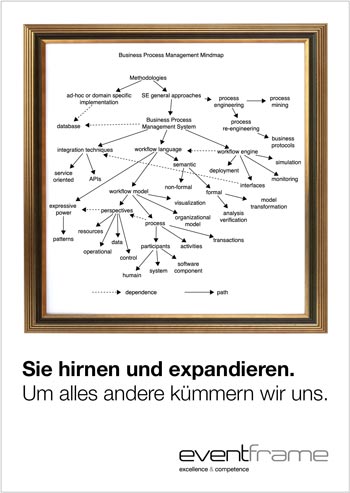
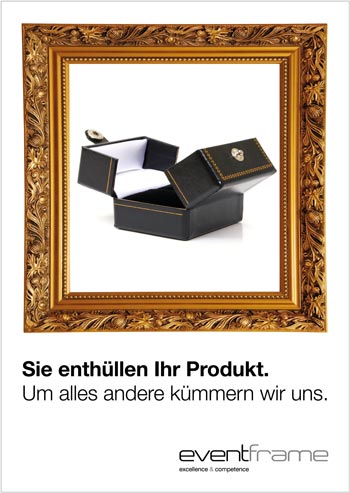
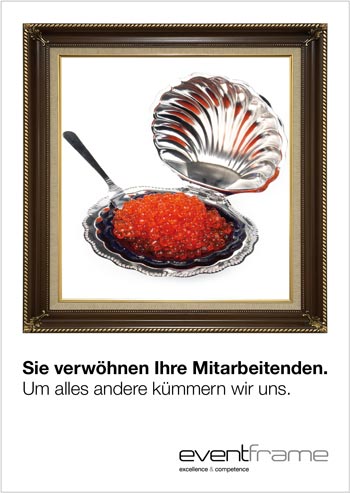
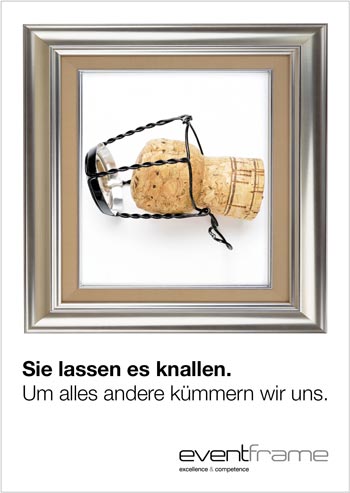
Flowcube Communications and Zeta Communication + Design have created a branding campaign for the Zurich-based event agency Eventframe. The idea that Eventframe provides the perfect setting for every event is taken literally and visualized using various picture frames.
Editorial
-
October 16, 2008
Flowcube Communications and Zeta Communication + Design have created an image campaign for the Zurich event agency Eventframe. The idea that Eventframe should give every event the right frame was taken literally and visualized using various picture frames, according to a press release. The events that need to be put in the right frame are represented by various representative objects. The campaign will be disseminated via advertisements, a website, mailings, postcards and a trade fair presence. The event agency, which has been in existence since 1990, traded as K&O Event Management until the end of July 2008 and then changed its name and image. Responsible at EventframeCharles Krabichler, Managing Director/CEO (overall responsibility), Gaby Weigold (Event Manager). Responsible at Flowcube Communications: Alfredo Schiliro (overall responsibility for concept/consulting). Responsible at Zeta Communication + Design: Ibrahim Zbat (CD/graphics), Helen Lagger, Bern (text/concept).
Rotor calls for health check for Toppharm
More and more people are suffering from what is known as «metabolic syndrome» and are therefore at high risk of a heart attack. The Rotor agency has developed a health campaign on this topic for Toppharm pharmacies, designed to encourage people to invest 15 minutes in their health.
Editorial
-
October 16, 2008
More and more people are suffering from the so-called "metabolic syndrome" - for example, they are overweight, have high blood pressure or unfavorable blood lipid levels and are therefore at a high risk of heart attack. The Rotor agency based in Zurich has developed a health campaign on this topic for Toppharm pharmacies to encourage people to invest 15 minutes in their health. The pharmacies are offering a cardiovascular check from October 16 to November 13. Customers will receive a personal risk profile and advice on possible measures. The campaign will be disseminated via posters, advertisements, flyers and the Ratgeber magazine. Responsible at Toppharm AG: Judith Lanz (Head of Marketing and Communications), Karin Walder (Head of Training and Campaigns), Simone Stucki (Marketing and Communications Officer), Andrea Oesch (Training and Campaigns Officer), Christoph Baumgartner (Editor). Printing: Birkhäuser + GBC AG. Responsible at Rotor Agentur für Kommunikation: Alexander Gessert (CD), Sascha Kieslinger (AD), Sandra Eichenberger (Desktop), Nastja Burger (Consulting), Suzanne Regez (Consulting Assistant), Martin Hauser (Production).
Lucerne agencies Planet and Sepia merge
The advertising agencies Planet and Sepia are joining forces and merging under the name Planet. One aim of the merger is to broaden the range of services.
Editorial
-
October 15, 2008
The two Lucerne advertising agencies Planet and Sepia are joining forces and merging under the name Planet. According to a press release issued on Wednesday, the merger will broaden the range of services offered. Planet's traditional integrated marketing communication services will be complemented by Sepia's concept and corporate design services. Planet's management consists of Daniela Schmid and Silvan Kaeser, who are supported by two creative directors and two consultants. The agency, which will work from Gibraltarstrasse 23 in Lucerne in future, has adopted the credo "We change the world. Your world." on the flags.
Heads of the week: animation troupe
At Elefant Studios, ten 3D enthusiasts based in Zurich are setting out to conquer the film world.
Editorial
-
October 15, 2008
The idea had been floating around in the heads of the ten owners for quite some time. The ambitious project became three-dimensionally concrete at the beginning of this year. Since then, Elefant Studios on Zurich's Lessingstrasse has quickly become a top player in the Swiss creative scene. Whether for feature films, advertising, corporate or print, Elefant Studios offers the full range of creative services in post-production, from the initial concept to the final image. 3D animation, visual effects and compositing, 2D animation as well as motion graphics and design are the specialties with which the small Zurich elephants soon want to compete with the big names on the international scene. Not a dream, but a feasible reality since ideas have become more important than technology or software more decisive than hardware in modern filmmaking. "Working on 3D requires a lot of know-how and time. The prices for the technology have dropped massively. A software license that used to cost 15,000 can now be had for 3,000 francs," explain Dany Bittel and Marco Fischer. And on the basis of this software, which anyone can get from a retailer, the ten specialists at Elefant then build their own systems "with a lot of manpower." "We invest a lot in research and development," says Miklos Kozary. "Every franc we earn is immediately reinvested," adds Sandra Milly Pötschacher. She takes care of all the organization and administration and, as Visual Effects Producer, is the "tatschmeister" in the elephant house. In it, ten guys perform as the joint owners. But there are no bull fights in the enclosure. This entrepreneurial thinking, which is pretty much lost in today's communications industry - with ten equal owners as in ancient cooperative times - becomes credibly visible during a visit to the Elefant Studios. But this start-up is a clearly managed joint-stock company, not "cinéma-copains," although of course everyone on the Elefant team is a trusted and long-standing colleague. "The scene is small. In Zurich, everyone probably knows each other. That's why we've been thinking for a while that we could join forces, buy larger equipment together, pool our know-how and thus specialize even more," is Elefant's basic idea. "With a larger store, we can also offer our services for larger projects," Dany Bittel is convinced. In concrete terms, this need arose with Billag. When the collection agency for radio and TV fees wanted to realize a series of six commercials with Tobias Fueter, the director looked for alternatives in production. Dany Bittel was attracted by the challenge. But he "couldn't handle it alone." So he looked for three colleagues - and that ultimately led to the birth of Elefänchen. Creative bunker Some of the digital savages in the loft on Lessingstrasse could almost still pass for students at the box office, but have a good number of years in the business between them. "We've all worked as freelancers before with interesting clients and many agencies. Those connections are still playing out. In the meantime, however, we can offer our old clients much more," say the united young entrepreneurs. That's why they no longer consider it a drawback that their studio with its many screens looks more like the creative bunker at a film school than an expensive address for advertisers. Clients such as Bucherer, Mini, Sandoz, the Locarno Film Festival, Swisscom and Swisslos, who have already been in and out of the studio, love the atmosphere - "and they also see what we spend our money on. To bring ideas from the first sketch into 3D form, different teams are formed depending on the project. In these pools, there are specialists for each area. Some are completely dedicated to animation. Others come from lighting, shading, modeling or compositing. The ten "bosses" have been able to gather their experience in a wide variety of well-known companies. Miklos Kozary graduated from Bern with a degree in computer science and computer graphics. After a stay in London, he joined the Swiss branch of Treibhaus Postproduction as a compositer in the film and commercials department. A stint at Mr. X. Inc. in Toronto was "tough but very educational," as he was also responsible for several feature films such as "Resident Evil" and "Shoot 'Em Up," but was able to work "until he dropped." In Switzerland, Kozary was digital compositor for "Grounding." Marco Fischer is a trained graphic designer. However, his track moved "more and more in the direction of animation" during a freelance period of over ten years in various advertising and design agencies. He later served many of his clients with his own company Tronics animated design, where he also made image and corporate films, but mostly "on a low flame", which is why he felt like joining forces with the possibility of larger projects. Dany Bittel was fascinated by the magic of 3D even as a teenager. After graduating from high school, he designed websites with a friend in Lausanne. In between, he was always tempted by the three-dimensional, also at the company Regardez in Zurich. Here he designed logos and trailers for Swiss television. After the dissolution of Regardez, he continued to offer his knowledge as a freelancer and worked during this time for "Grounding" as well as on several commercials. Fabian Gasser graduated as a visual designer from the Zurich University of the Arts in 1997, was also a partner at Tronics and a graphic designer at various multimedia agencies. Fadri Jecklin was a geomatician and 3D artist at QBUS, which he co-founded. Kunal Ghosh Dastider comes from the animation class at the Lucerne School of Design and has been working as a 3D specialist mainly abroad. Among others, he worked on "Lissi und der wilde Kaiser", "In the Name of the King: A Dugeon Siege Tale" and has recently become a certified Pixar Renderman Instructor. Patrick Graf has a degree in scientific illustration and most recently worked at Treibhaus for seven years. Vladimir Jankijevic graduated in photography from the Zurich F+F and then worked for four years at Frame-Eleven as a 3D artist in advertising and corporate. Yukio Satoh studied media art at the Fachhochschule für Gestaltung in Aarau and gained his experience with feature films at The Mill in London, among others. Stephan Schweizer was an early lecturer in compositing at SAE College in Berlin. Later, he worked abroad as a freelancer on feature films such as "The Chronicles of Narnia: Prince Caspian", "The Red Baron", "300" and also "Lissi und der wilde Kaiser" by Michael Bully Herbig. Sandra Milly Pötschacher started her media career at IP Multimedia. First she worked in the online area, later in broadcasting. This sparked an interest in further development in postproduction. When the greenhouse had to declare bankruptcy, Pötschacher became a freelance production assistant, for example on the feature film "Elisabeth Kopp," Pipilotti Rist's first feature film "Pepperminta" or Reto Caffi's graduation film "Auf der Strecke," which has since received worldwide awards. Her last station was Egli Film before she was brought to Elefant by the "boys". Andreas Panzeri
Midwife for the start-up: the Billag campaign. References More about these versatile bios and works can be found on the naturally very elephantine website www.elefantstudios.ch. There is nothing to read about the secret, but of course obvious dream that this start-up wants to become active in feature films soon.
Supposed consumer protection
More education about how the media works, rather than regulation: In these times of upheaval, when many are longing for a more regulatory state, it is high time to sing the praises of freedom. Op-ed by Stephan Russ-Mohl, director of the European Journalism Observatory at the University of Lugano.
Editorial
-
October 15, 2008
Once again, a coalition of know-it-alls and patrons is campaigning for advertising bans. They want to dictate to others whether they are allowed to see cigarette or alcohol advertising. They want to force advertisers to reserve 20 percent of an advertising space for references to the harmful side effects of certain products. Such small-minded people are not only revealing their huckster souls, they would prefer to patronize responsible fellow human beings in a way that is unworthy of a democracy. In doing so, they are depriving the very media of resources that could educate people with well-equipped editorial offices and serious journalism - not only about the dangers of drugs, but also about the risks of power fantasies with which populists, bureaucrats and citizen guardians threaten to stifle freedom in their regulatory frenzy. Anyone who finds this too flat and "neoliberal" is invited to play a thought experiment: Why don't we radically abolish all advertising? You can read about all the evil things the "secret seducers" are up to and how they manipulate us in Vance Packard's classic - although the methods have certainly become even more sophisticated since then. So it's high time we put a stop to this nonsense... If you think such experiments through to the end, you quickly realize that the supposed consumer protection would come at the price of a great loss of information and freedom - and that, as is so often the case, the regulators are unable to overlook the unplanned consequences of their "good" intentions. Most of us who were allowed to live our lives west of the Iron Curtain or who, by the grace of late birth, only know real socialism from the movies, can hardly imagine how bleak a world without advertising would be. Somehow it is also nice that this leaden gray has become unimaginable to us. Because such a social experiment already stretches our imagination, here is thought experiment no. 2. Let's go after the freedom robbers with their own means: How would it be if every European advertisement of the Brussels EU Commission had to contain a reference to the paralyzing side effects of regulatory mania and Eurosclerosis? And every election advertisement from a political party would have to be accompanied by large-print notices like this: "Beware! Don't believe any election promises" or "Those who appeal to the common good may be pursuing their own interests." Such a regulatory proposal would probably be capable of winning a majority in a referendum. Which is why we quickly turn to thought experiment no. 3: If regulation, why not the other way around? In order to guarantee a minimum of independence, reliability and integrity of a media product and to prevent editorial offices and publishers from becoming the plaything of advertisers, legislators could oblige media companies to generate at least 50 percent of their revenue from media users. That would be the certain end for free newspapers. Dozens of trees would be saved every day, and the disfigurement of train stations, streetcars and city centers by stray waste paper would be stopped - not to mention the mental pollution that we are forced to endure with "free" journalism and would be spared in future. But we probably wouldn't want to live in a community where the state forces us to pay for more media products. It's bad enough that we are fleeced month after month with the radio and television fee. So it's high time, especially now, in these days of upheaval, when many people are wishing for the return of the regulating state, to sing the praises of freedom. What we should also be wishing for, however, is the responsible use of freedom. This in turn requires a certain level of knowledge. Instead of regulation, more education about the media business and what goes on behind the scenes - and therefore also about public relations, marketing and advertising. In schools, at universities, but also in the media itself, please.
Jung von Matt/Limmat emotionalizes the medium of radio for SRG
To strengthen digital radio, SRG has commissioned the Zurich agency Jung von Matt/Limmat with a new image campaign. This now stages the transition from the analog to the digital age.
Editorial
-
October 15, 2008
The medium of radio is changing. The transition from the analog to the digital age has primarily affected the way it is transmitted. Today, Schweizer Radio DRS already broadcasts more stations via digital channels than via FM. In order to strengthen digital radio, SRG has commissioned the Zurich agency Jung von Matt/Limmat with a new image campaign. This now stages the turning point in the history of radio, which is inextricably linked to the history of man and technology, and attempts to position digital radio as a logical further development of the medium. At the heart of the campaign is an emotional film that reviews key moments of the past decades with original footage and, according to the agency, aims to show the great moments in which radio has moved, touched and accompanied us. Against this backdrop, it builds a bridge to the digital future. The campaign's motto is ultimately: "This is where the story ends. And a new one begins. Digital radio, the radio of the future." The new appearance also includes information measures at the POS. Responsible at Swiss Radio DRS: Max W. Gurtner (Head of Corporate Communications SRG) Simon Meyer (Corporate Communications SRG) Béatrice Merlach (Head of Communications + Marketing SR DRS) Ernst Werder (Product Manager Digital Radio SR DRS) Responsible at Jung von Matt/Limmat: Alexander Jaggy (Creative Direction), Samuel Christ (Text), Patrick Beeli (Art Direction), Ariel Zumstein (Graphics), Martin Fritsche, Claudia Camenisch, Felix Zürcher (Consulting) Erasmo Palomba, Ilonka Galliard, Didi Knall (Art Buying), Film Production: Panam Film, Soundmix: Kirschner Music, Postproduction: Südlich-t OHG, Munich.
Furrer Hugi&Partner is expanding its team. The public affairs and public relations agency, which operates in Bern, Zurich, and Brussels, has hired two new employees: Willi Brand and Cristina Schaffner.
Editorial
-
October 15, 2008
Furrer Hugi&Partner is strengthening its team. The public affairs and public relations agency, which operates in Bern, Zurich and Brussels, has appointed Willi Brand as a new Senior Consultant as of October 1. Brand spent the last 3 years at PR Access as PR Director. Prior to that, he was responsible for communications at Stadtplanung Bern. According to a press release issued by Furrer Hugi&Partner on Wednesday, his expertise in providing communications support for politically sensitive construction projects will be particularly in demand. Cristina Schaffner also joined the advisory team in mid-September. Schaffner attended the final courses for her Master of Arts in International Affairs and Governance at the University of St. Gallen this summer. In addition, former intern Lisa Fankhauser will be working in the area of monitoring and project assistance in future. The agency also has one departure to report: Consultant Bettina Fischer has left the office on Weinbergstrasse in Zurich and chosen the path of self-employment.
Climate change ensures peak performance
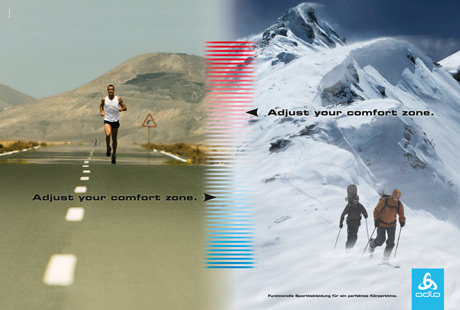
Heye Zurich has won the multi-stage pitch for an international campaign by Odlo. The ads for sports underwear show that you can stay at the right temperature while exercising, whether in summer or winter.
Editorial
-
October 15, 2008
Odlo's campaign idea so far has been: "Perceived temperature 20 degrees." The sports underwear is known for its breathable high-tech fabric, which is not only suitable for keeping you warm, but also for keeping you cool. To this end, the in-house product engineers and fashion designers at the number one sports underwear brand are constantly working on new solutions that will impress in demanding competitive sports as well as in active leisure activities all year round. So many new developments also call for new marketing activities. Despite, or perhaps because of, the enormous potential of the brand and its products, Odlo's goals were realigned in 2007. The plan was to extend the company's lead in the functional underwear segment, focus more strongly on running and outdoor, and specifically expand marketing into the summer months. The creative challenge that the agencies had to solve in the 2007 pitch for the Odlo brand campaign can be described as follows: The development of a communication idea that bridges the gap between a strong penetration of the technical product advantage and the sustainable emotionalization of the brand core. Under the creative leadership of Daniel Bieri, Heye Zurich ultimately prevailed in a multi-stage pitch. With the campaign idea "Adjust your comfort zone", Heye succeeded in "merging the rational with the emotional benefits of Odlo", as Bieri is pleased to report.
From Zurich into the wide world Heye Zurich found the creative solution in the modern display of a temperature scale on which the line "Adjust your comfort zone" appears in the cooling or warming area depending on the situation. In more local advertising German, the claim of the international campaign means: With Odlo, you can determine your own body climate. Even with great effort and adverse conditions, well-being is possible at all times. Thanks to Odlo, sport can be enjoyed without a care in the world. Together with the tagline "Functional sportswear for a perfect body climate", this understanding of the brand is also brought to the point in several visuals. The scale concept was not only convincing because Heye Zurich presented "a key idea that can be played across all disciplines and all channels", as Marco Hubeli, Head of Marketing & Communication Services at Odlo, is convinced. The new idea is also understood across cultural boundaries by every income and age group. After all, it was important that "Adjust your comfort zone" could be linked to the previous campaign in a comprehensible way. The previous communication idea of "perceived temperature 20 degrees" will be incorporated into the Odlo brand philosophy of "Passion for Sports", but will be significantly expanded to include the factors of "control" and "individuality". After all, it not only makes strategic but also business sense to build on marketing investments that have already been made. The "Adjust your comfort zone" campaign is intended to create a clear differentiation from the competition and give the Odlo brand a modern image. To this end, Odlo has also moved away from the previous black and white images. Impressive and emotional landscape photographs are the new look. The challenge for Munich-based sports photographer Andi Frank was to "capture the moment of a sporting highlight under extreme conditions as impressively as possible and make it tangible," as Martin Kraus from Heye explains. Odlo defines itself as an authentic sports brand. The aim was not to abandon this capital, but to build on the closeness to the athlete with these images - active sport, real nature experiences, an active lifestyle. Especially for markets and target groups in which Odlo still has a low level of awareness, solutions were developed to accompany the full-screen implementations, which allow the integration of a prominent product packshot. Image presentation and premium design were particularly important in the redesign of the trade and public catalogs. Following a successful pitch, these were also implemented this summer by the Heye team in Zurich. From Norway to Switzerland Odlo was founded in 1946 by Odd Roar Lofterød in Norway. In the sporting family, the production of women's underwear soon shifted to tracksuits. In 1972, 25 national teams wore Odlo competition clothing at the Olympic Games in Sapporo. In 1986, this also became fashionable sportswear. In the same year, Odlo International moved its headquarters to Zug and diversified into more and more functional fashion lines. Andreas Panzeri
Condor Films advertises on behalf of Ruag for the police target group
Condor Films has produced a product film for the technology and defense company Ruag Electronics. The resulting film about the "Panther Command" command and control system was shot under the direction of director Claudio Fäh. The aim of the product film was to produce a realistic story for the police target group.
Editorial
-
October 15, 2008
Condor Films has produced a product film for the technology and defense company Ruag Electronics. According to a press release from the Zurich-based film production company, the corporate department was able to impress with an "innovative concept". The new film about the "Panther Command" command and control system was shot under the direction of director Claudio Fäh. In the past, Fäh has already been responsible for Hollywood films such as "Hollow Man II", "Starship Troopers: Marauder" and "Gostwhisperer". The aim of the product film was to produce a realistic story for the police target group, Condor Films continues. The aim was to show the benefits of a system solution for command and control. Filming took place in a police environment in Prague and Zurich. Responsible at Condor Films: Olivier Egli (Creative Producer), Kristian Widmer (Producer).