Skype gets competition: Google integrates video telephony into its mail service

Google has added voice and video chat to its email service Gmail. From Wednesday, free calls can be made over the Internet without having to switch to another application or account.

Google has added voice and video chat to its email service Gmail. From Wednesday, free calls can be made over the Internet without having to switch to another application or account. In addition to a webcam, a plug-in for the web browser is required for use. A Google Mail account is required. The service is activated via the options button in the Gmail chat window.
The search engine operator is competing with the new chat service Skype. Unlike the Internet telephony service, no new software needs to be downloaded for Google's video chat. In addition, Skype does not offer any other communication services, such as e-mail. According to Berlecon Research analyst Philipp Bohn, Skype will have to give up its supremacy in the longer term or solve this problem.

Cannes: New PR Lions category from 2009

The international advertising festival in Cannes is introducing a new category for public relations next year with the PR Lions. The president of the first jury will be the Briton Lord Tim Bell. The winners of the first PR Lions will be honored on June 22 together with the winners of the Direct and Promo Lions.

The international advertising festival in Cannes is introducing a new category for public relations next year with the PR Lions. The president of the first PR Lions jury will be the Briton Lord Tim Bell. The PR Lions are intended to recognize creativity in "reputation management" and thus in the creation of trust between individuals, companies and their customers. Submitted projects will be judged and awarded based on strategy, creativity & originality, execution and results. The winners of the first PR Lions will be honored on June 22, 2009 together with the winners of the Direct and Promo Lions. Next year's 56th International Advertising Festival runs from June 21 to 27.
The introduction of the PR Lions does not come as a complete surprise. The opening of the new category has been on the radar of the management team in Cannes for some time, writes Festival Director Philip Thomas in a press release. However, like any new category, the introduction took time to guarantee the level of quality expected by the festival. But the time is now ripe and the festival is honored to have Lord Tim Bell as its first jury president.
Lord Tim Bell is one of the most famous figures in the British communications guild. He was involved in the founding of Saatchi & Saatchi in 1970 and built the agency into the largest agency network in the world by 1981. In 1979 and 1983 he led the British Conservative election campaign. In 1987, Margareth Thatcher personally turned to Bell when the Conservatives were in danger of suffering heavy losses in the elections. After an interlude in the British parliament at the end of the 1970s, he became deputy chairman of The Lowe Group in 1985. He is now Chairman and major shareholder of Chime Communications, which includes Bell Pottinger Communications (formerly Lowe Bell) and its sister agency VCCP.

Family Publishing: Everything from one family

Whether it’s an employee newsletter, a newsletter, a special report, or a customer magazine: Family Publishing makes it clear at a glance which company a publication comes from.

The Münchenstein-based company EBM pursues the concept of family publishing for all its external and internal print and online media. Not only for the sake of the distinctiveness and recognizability of the company's image, but also because in today's markets ever greater volumes of content are being processed and the target groups are placing ever higher demands on the orchestration of the media. Jo Krebs, Head of Public Relations at EBM, is convinced: "Family Publishing is an efficient and successful system for managing the communication of companies that have holding and group structures and operate in different markets."
Family publishing does not mean uniformity. On the contrary: just as siblings cultivate their differences, family publishing thrives on differentiation, on the media-appropriate preparation of content and forms. With family publishing, companies achieve a high level of journalistic and creative quality.
At the same time, they set themselves apart from "hand-knitted", random solutions. Family publishing supports stringent information and communication because the integrated media are based on the same design grids, data bases and processes.
Significant improvement in customer service
Family Publishing gives the various EBM companies operating in the market the opportunity to distribute certain content in a decentralized manner according to differentiated target groups. They can use the various media from Family Publishing in a targeted manner as required. This shortens decision-making processes, promotes quality and increases topicality.
Overall, efficiency can be increased and the information service for customers significantly improved. This is why family publishing will become increasingly important in the future. After all, print will remain the push medium for online content in the coming decade and will increasingly dovetail with digital media. "This makes firm and clear family ties between the individual corporate media and divisions all the more important," emphasizes Jo Krebs.
Julia Dieziger and Beat Schaller
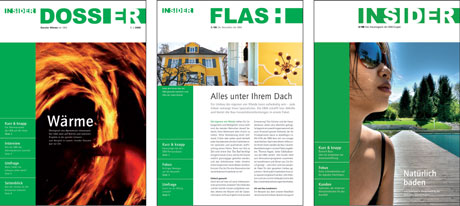
1290582332_img081112_intern_familypublishing
Internal communication: employee magazine Insider, newsletter Insider Flash and Insider Dossier.
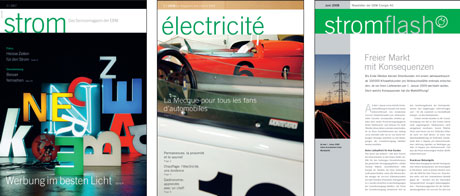
1290582332_img081112_extern_familypublishing
External communication: customer magazines Strom and Electricité and newsletter Stromflash.

Wide, wider and now from a single source

The Y&R Group explains why Publicitas is bringing its comprehensive expertise together under one roof.

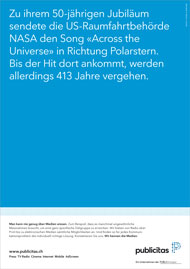
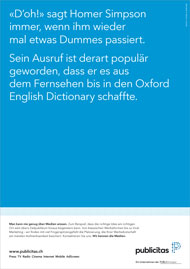
Publicitas is being reorganized. The know-how of all areas is now being bundled under one roof. The ideal time, therefore, to demonstrate its comprehensive expertise in a corresponding umbrella brand campaign. Under the claim "We know the media", Publicitas is therefore launching an international, national and regional campaign together with the Y&R Group. The aim is to impressively present and communicate "the broad knowledge that comes together at the new all-media provider". The message: in future, all the services of the Publicitas companies in the print, TV, radio, cinema, Internet and mobile sectors will be offered from a single source.
In the campaign, text ads and online advertising media tell facts and stories from the world of media - amazing, interesting, bizarre, intelligent, world record-breaking. "Each subject proves how well Publicitas knows the media, and the copy also focuses on specific offers and services from the media provider," explains CD Philipp Skrabal at Advico Young & Rubicam.
The website is designed according to the new corporate identity of the Zurich agency SNK and can be used widely. The advertisements will not only be seen in Switzerland, but worldwide. In addition to the ads in the umbrella brand campaign, adapted subjects will also appear as filler ads in various titles and formats as well as online advertising. New special ads will also be created every week. And finally, the concept is so flexible that it can easily be implemented in online advertising media, posters, mailings or broadcasting. (pan)
Responsible for this campaign at Publicitas are Michael Schaefer as Head of Marketing Services and Christian Gartmann as Director of Marketing & Communications.
1290582333_img081112_publicitas5
img081112_publicitas2
1290582333_img081112_publicitas3
img081112_publicitas4
"The 50 advertisement subjects that have already been developed are just the beginning," says Markus Gut, CCO at the Y&R Group.

Ticketcorner markets the Hallenstadion

Going forward, Ticketcorner will market events at the Hallenstadion through its distribution channels and, in return, handle approximately 50 percent of the Hallenstadion’s ticket sales. The ticket seller will also maintain a permanent ticket office at the Hallenstadion.

Ticketcorner and Zurich's Hallenstadion are entering into a strategic partnership as of January 1, 2009. Ticketcorner will support the marketing of events in the Hallenstadion and will be permanently present in the Hallenstadion with a staffed ticket sales point. This means that one of Switzerland's leading ticket sellers is working together with the largest organizer of indoor events in the German-speaking world. Ticketcorner has been a ticketing partner of important Hallenstadion customers such as Good News, Mercedes CSI, Art On Ice, Sixdays, the Super10Kampf and others for many years.
The cooperation is a response to the major upheavals in the international live entertainment market, particularly in ticketing, according to a press release issued on Wednesday. Ticketcorner is now a kind of "admission portal" for all events at the Hallenstadion: at least half of all tickets for events at the Hallenstadion are to be sold via Ticketcorner sales channels, including call centers, Ticketcorner.com and over 1,400 advance booking offices throughout Switzerland. This will significantly improve the marketing of events in the Hallenstadion, and AG Hallenstadion will also receive a share of the added value in the live entertainment market.
To underpin this strategic partnership, Ticketcorner will acquire five percent of the share capital of AG Hallenstadion. "The cooperation is based on the strategic objective of sustainably anchoring the Hallenstadion as a leading sports and live venue in Europe and marketing our events in the best possible and customer-oriented way," Hallenstadion Director Felix Frei is quoted as saying in the press release. With Ticketcorner, the Hallenstadion offers customers one of the best available marketing platforms in Switzerland with great potential and a high level of expertise in the area of customer relations.

SFLB stages a lot of boredom for Tele

Can boredom be funny - and is it still boring? Spillmann Felser Leo Burnett manages the balancing act in three TV commercials for the TV magazine Tele.

It took Axel Springer Schweiz (ASS) more than a year to prepare for the relaunch of Tele (see adjacent article), but this week the time has come: the magazine is being published with a new look, a new logo and, in some cases, an expanded content concept. Now ASS is also making a big advertising splash: A campaign created by the Zurich advertising agency Spillmann Felser Leo Burnett will be launched on November 13 and will cost ASS a total of over one million Swiss francs. In its communication for Tele, the agency focused primarily on the program section. "We focused on the direct benefits of Tele," says CD and agency co-owner Martin Spillmann. "However, we left it up to the consumer to discover the changes."
And so the campaign now demonstrates the advantage of a high-quality TV magazine like Tele: it provides orientation and an overview of the daily and weekly (over)range of available TV programs. And because there is a need for selection, Tele with its competent information and background reports is indispensable. "Tele, see what's worth seeing" is the claim developed by Spillmann Felser Leo Burnett. This also means: Tele protects against frustration and disappointment in everyday TV life.
This is exactly where the concrete implementation in the form of three different TV commercials and advertisements comes in. "We show examples of programs that you can miss because they are simply not worth watching," says Spillmann. On the one hand, there is the fictitious "Da-passiert-garantiert- gar-nichts-Show", in which nothing actually happens after the introduction: The presenter doesn't have a conversation, the four studio guests remain silent. Pure boredom. When one of the guests drinks and his gulping is clearly audible in the general silence, things even become embarrassing. "With Tele, you know what you can safely miss," is the first statement. And then follows: "Tele, see what's worthwhile."
In the second spot, you experience a paper-cutting world championship, but because the motifs are so small, nothing can be seen except women and men cutting doggedly. How exciting! Finally, a program about "The most beautiful underground car parks in Switzerland" is shown. For 90 minutes, according to the announcement, you learn all about a 6,000 square meter grey garage in Münsingen - probably with a lot of love for concrete. Even the introduction is dull. Reflexively, you reach for Tele. Or you wish for it.
It wasn't easy to convey boredom, says Spillmann. "Because there is a danger that the commercial itself could become boring." But that didn't happen, the commercials are bland in a funny way. Despite the threefold staging of boredom, Spillmann sums up: "We enjoyed the work."
Markus Knöpfli
1290582333_img081112_tele2
1290582333_img081112_tele5
1290582333_img081112_tele3
1290582333_img081112_tele1

32 million seek happiness

Bluespirit is carrying out an extensive cross-media campaign for Swisslos Intercantonal National Lottery's "Millionenlos.".

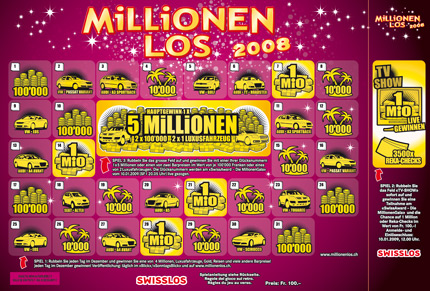
On Saturday last week, a new fever broke out in Switzerland. The million-dollar tickets went on sale at 6,000 sales outlets. Since 1999, the Swisslos Intercantonal National Lottery has been launching this ticket with particularly tempting chances of winning at the turn of the year. Prizes worth a total of 32 million francs will be distributed to the public. For example, ticket buyers can hope for a jackpot of 5 million francs. The numbers will be drawn on January 10 as part of the "Swiss Awards" TV show. This gala show will also feature the lucky ones who will be able to compete live in front of an audience to win a million francs. Further millionaires or winners of dream cars, gold and trips will be drawn daily in December. The lucky symbols will be announced first in Blick. The chances are hidden under 33 scratch-off fields on the ticket.
"It was a great task to completely redesign this traditional lottery ticket for this year," say Gerry Flückiger and Alban Haas at Bluespirit. Following an evaluation process, the agency in Schlieren was entrusted by Swisslos with the redesign of the lottery ticket and the entire realization of a comprehensive cross-media campaign for the 2008 lottery ticket. The PR contacts were handled by Swisslos Interkantonale Landeslotterie itself.
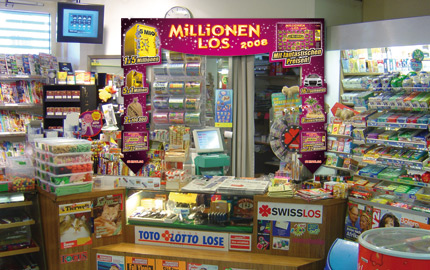
The aim of the briefing was to "further increase sales" of the limited-edition tickets by January 10, 2009. The ticket is available at kiosks, post offices, petrol stations and many restaurants in Switzerland. On behalf of Bluespirit, 4,000 of these sales outlets have been supplied with a package full of versatile POS material. The remaining 2,000 sales outlets are served directly by Swisslos Interkantonale Landeslotterie. In addition, Bluespirit is to activate online sales this year via the new micro-site Millionenlos.ch.

Making eyes sparkle
At the heart of the campaign realized by Bluespirit is the fantastic world of prizes hidden in a million-dollar lottery ticket. CD Peter Trüb and concept designer Tizian Walti rely on the magic of a dream world that lures us behind the luck of the draw. The advertising translation is shown in a large film and 15 different daily spots, where passers-by are drawn to a poster for the million-dollar lottery ticket by nostalgic fairground music. Out of sheer curiosity, they poke their heads into the poster and discover the fantastic prize carousel inside the ticket. This carousel full of valuable prizes is also the stringent key visual that features centrally in all other advertising materials. An important element is the cardinal red color of hope.
The unique music with nostalgic glockenspiel was composed by Balz Bachmann. The jingle also functions as the connecting element of the cross-media campaign in various radio commercials. The clever thing about this music is that, although it has a festive effect in the run-up to Christmas, it is not too Christmassy, as the commercial has until January 10 to encourage people to buy.
The development of the carousel stems from the collaboration with the young Zurich "hot store" Elefant Studios, which was recently featured in Werbewoche (number 37, "Minds of the week"). Elefant is responsible for the animation in the dream world. Martin Fueter from Condor was responsible for the realization of the spots in the real world.
It was a challenge for Bluespirit to top last year's commercial once again. In that earlier film, all the prizes were presented on a conveyor belt and disappeared into a huge gift package at the end. With the new idea, they didn't want a complete paradigm shift for this year. The carousel idea is actually an ideal and once again much more atmospheric replacement for the conveyor belt in order to be able to present the entire wealth of prizes at a glance.
The idea is being used in a 25-second film, which is intended to launch the sale of tickets in the first phase of the campaign and to raise general awareness of the million-dollar tickets. In the second phase, short spots will be used until the end of December. These will communicate the upcoming prizes on a daily basis. In the third phase, a closer spot will once again increase the presence and prepare the highlight: the draw for the CHF 5 million and other prizes during the Million Gala with the "Swiss Award" program.
Bluespirit is therefore relying on a highly targeted media strategy consisting of strong communication during the launch, daily adverts during the main season and support for the final week of the game. The commercials will be broadcast on SF1, SF2, Vox, Sat.1, ProSieben, 3plus, TSI and TSI2. Radio spots will be broadcast on all relevant stations. A new online presence, also realized by Bluespirit, rounds off the integrated campaign.
All individual winnings can be clicked on a micro-site and viewed in detail - dream trips or cars, for example. The daily symbols are also displayed daily from 10 a.m. on www.swisslos.ch published. This site was created in collaboration with Divio. Other online measures include animated carousels that rotate on the Blick platform, for example.
Andreas Panzeri

> View spot

1290582333_img081112_swisslos1
1290582333_img081112_swisslos2

Photopress hires new PR director

The media relations agency Photopress is expanding its PR division. Starting in early 2009, Uwe Liebminger will assume the newly created position of Head of PR and Business Development.

The media relations agency Photopress is expanding its PR division. From the beginning of 2009, Uwe Liebminger will take over the newly created position of Head of PR and Business Development. Liebminger was most recently Head of PR & Communications at the Swiss Sports Aid Foundation for a good three years.
At the moment, the media and communication scientist is training to become a federal PR consultant, which he is expected to complete in summer 2009. In addition to customer service, he will mainly take care of Photopress' communication and PR and the expansion of the customer portfolio.

Marketing and training during the crisis

W hen the economy is in a downturn, marketing and professional development usually follow suit. As a result, marketing itself falls into crisis during tough times. Along with personnel costs, marketing expenses are among the first and most targeted areas for cuts within companies. Strategies are, so to speak, put on hold.

When the economy is in a slump, marketing and training are usually too. In times of crisis, marketing itself gets caught up in the crisis. Together with personnel costs, marketing expenditure is one of the first and preferred items to be cut in companies. Strategies are virtually overridden. Even empirical studies that prove that anti-cyclical behavior in both advertising and training is the right approach in the long term are of no help. Should we be surprised? No, because we marketers have long known that people do not (only) act rationally. No matter how much emphasis is placed on fact-based decision-making methods in further education courses. When we are confronted with fear, the cerebellum gains ground and we fall back into reflexes we thought we had overcome. The general uncertainty in an economy spreads to individuals and clouds the clear view even on the carpet floors. Our heads are no longer clear and decisions are made with worry lines on our faces. But there are others who not only pursue a differentiation strategy, but also implement it in a differentiated way. Those who do not cut the marketing budget in times of crisis gain attention and can reap the rewards in the good times ahead. This also applies to companies that do not cut their training budgets in difficult times. They promote a high level of employee motivation and loyalty. What do you do?

To the point: Radio Tamtam, episode 2

For years, left-wing politicians have tried to convince us that only a strong SRG can truly fulfill the public service mandate in the audiovisual sector. This slogan was repeated ad nauseam. Anything that even remotely smacked of commercialism was considered the work of the devil.

For years, left-wing politicians have wanted to make it clear to us that only a strong SRG can really fulfill the public service mandate in the audiovisual sector. This slogan was proclaimed like a prayer mill. Everything that had the slightest appearance of commerce was the devil. Radio and television were to be controlled by the state. Fortunately, common sense and the justified fear of being seen as an eternalist media censor prevented the state from domesticating the print media as well.
Anyone who has followed the deliberations on the new Radio and Television Act (RTVA) in the National Council knows that the discussions about state controls and influence were long and sometimes very fundamentalist. This did not bode well. And that's how it turned out. The attempts to really liberalize the old RTVA failed in most cases. The radio and television broadcasters, in most cases publishers, allowed themselves to be seduced by the expected shares of the license fees. Only very few exponents warned against these golden fetters. The fee mana from Bern seemed too tempting.
What finally remained after endless debates was a law that cemented the strong position of the SRG even more. Liberalization occurred only where it did not hurt the SRG. The social democratic media minister Leuenberger, not exactly a friend of the popular electronic media, could be satisfied. The SRG was also satisfied, although it complained loudly about certain restrictions on advertising and about stronger controls by the Federal Office of Communications (OFCOM). Most politicians were also satisfied. Those on the left because of the saved public service and state control, others because they thought it would now be easier (i.e. cheaper because of the expected concession money) to operate local radio and television successfully.
The licenses for the newly defined broadcasting areas were put out to tender. There was an inkling of the chaos that was to come. The licenses were granted, the chaos was there. Established, successful radio stations had to learn that they would no longer receive a license and would therefore have to stop broadcasting as of March 2009. Established local television stations were no longer licensed. They were replaced by broadcasters favored by cantonal politicians, who will no longer trigger the anti-city Zurich reflex, or local monopolists as in Lucerne.
What follows now is the absolute political folly: the cantonal Zurich SP, of all people, wants to save Radio Energy. And at the expense of SRG programs. Good for Ringier. Embarrassing for the comrades and their credibility.
Pierre C. Meier, Editor-in-Chief
[email protected]

Solutions for the 2008 season

The next generation of annual reports is set to launch.

The next generation of annual reports is taking off: In a trendsheet, Infel presents twelve success factors for the 2008 annual report season - from media management and sustainability with a globally recognized label to e-publishing with animated graphics and moving images.
The trendsheet is available from:
Infel AG, Julia Dieziger, [email protected] .

Flops of the week

It's not just Blick that returns to the hard-hitting tabloid style with its wording ("Money here Marcel"), Frank A. Meyer can also get a bit angry when it comes to his intimate enemy Blocher.

Emancipated newspaper criticism à la Meyer
It's not just Blick that has reverted to hard-hitting tabloid formulations ("Geld her Marcel"), Frank A. Meyer can also get a bit angry when it comes to his intimate enemy Blocher. In his last column in SonntagsBlick, FAM wrote: "Weltwoche, a formerly renowned newspaper, regressed to the journalistic boudoir of its disciplinarian, the editor-in-chief to his journalistic boy toy. Even the otherwise brittle Neue Zürcher Zeitung, once the self-confident think tank of the Freisinn, indulged in embarrassing obeisances and scratching feet. One particularly devoted disciple turned the intimate dialog with his patriarch into Blocher television: the most perverse servitude that Swiss journalism has ever produced since the end of the party newspapers."
Fake Clooney annoys Nestlé
"Cheaper. Nothing else". This is the slogan used by the Martello coffee system in double-sided advertisements, which are designed exactly like the Nespresso subjects with George Clooney down to the last detail. The only difference is that Martello from the Coop range is - as the claim says - a cheaper brand. The idea for this allusion came from the KSB/SJ kitchen. Coop thinks it's funny. Nestlé an annoying plagiarism. Actually unnecessary, because the target audience is different. And the accompanying noise from Nestlé in many media outlets only serves to further promote Martello.
get_footer();