Walker: No & But won as a customer

Walker won the account for the Zurich-based publishing house Kein & Aber without a competitive pitch. The first pieces of work are expected to be unveiled in the coming days.

In future, the Zurich publishing house Kein & Aber will be relying on the ideas of the Walker advertising agency. The Zurich-based creatives won the account without a competitive presentation. The collaboration has already begun and the first results will be seen in a few days, according to the press release.
Peter Haag founded Kein & Aber in 1997 in Zurich's Kreis 4 district. The publishing house publishes the works of authors such as Truman Capote, Gerhard Polt, Harry Rowohlt, Lorenz Keiser and Woody Allen in Germany and Switzerland.
Peter Haag has made a handwritten statement about the collaboration with Walker that is now beginning:
img081112_kein

Axel Springer earns less in the first three months of 2008 than in the previous year

The German media group Axel Springer reported lower net income in the first three quarters than in the same period last year. However, revenue rose by 8.1 percent due to acquisitions.

The German media group Axel Springer, publisher of Die Welt and the tabloid Bild, among others, earned less on the bottom line in the first three quarters than in the same period of the previous year. Adjusted for the profit from the sale of the stake in the television broadcasting group ProSiebenSat.1, net income fell to 133.2 million euros compared to 179.6 million euros, as the group announced on Wednesday according to SDA. Springer-Verlag also has a presence in Switzerland. Among other things, it owns the business magazine Bilanz and the TV magazine Tele.
Adjusted earnings before interest, taxes, depreciation and amortization (EBITDA) increased to EUR 306.6 (294.4) million. Thanks to the acquisitions made in 2007, turnover climbed by 8.1 percent to 1.99 billion euros. "The coming months will pose considerable challenges for the economy as a whole and thus also for the media industry," said CEO Mathias Döpfner. Nevertheless, Springer is sticking to its forecast for the year. Adjusted EBITDA is expected to be significantly higher than the previous year's figure of around 430 million euros.

No withdrawal of Tele Oberwallis

Now that the license has been granted, Canal 9 faces major challenges.

The initiators of the Valais Wallis TV project accept the Federal Council's decision and congratulate Canal 9 on receiving the license," wrote Christian Stärkle, Chairman of the Board of Directors of Tele Oberwallis, in a communiqué on 6 November. At the same time, he made it clear that the Valais Wallis TV project is now over. In addition to Tele Oberwallis, the newspapers Walliser Bote and Le Nouvelliste, the weekly newspaper Le Confédéré and the local radio stations Rottu, Rhône FM and Chablais were also behind the Valais Wallis TV project.
Against this concentrated media power in Valais, the small French-language Canal 9 in Sierre has now won the new concession for the whole of Valais, including the Chablais region. The supporting association of Canal 9, which is now also called Kanal 9, was founded by the young Chamber of Commerce of Sierre. The aim was to promote training in audiovisual techniques. Even today, anyone from Valais can learn how to make television at Canal 9 in free evening courses.
Despite 25 years of expertise, Canal 9 faces major challenges with its new license: In mid-2009, a 20-minute German-language program window will initially be broadcast in the Upper Valais on weekdays. This will then be expanded to one hour per day in three stages. First of all, however, a studio for the Upper Valais must be set up in Brig or Visp, an eleven-strong editorial crew hired, technical distribution throughout the concession area ensured and the association's statutes adapted.
At the same time, however, Canal 9 has to reckon with competition in the Upper Valais. Christian Stärkle is not giving up. "Tele Oberwallis will continue to broadcast in its current form for the time being and will then reorient itself," he writes. The info channel, which is currently on air between 6 a.m. and 7 p.m., will remain the main component.
Markus Knöpfli

New magazine for Hawa from Basel West

Hawa AG develops and manufactures high-quality sliding door hardware systems and aims to further strengthen its position in the international market.

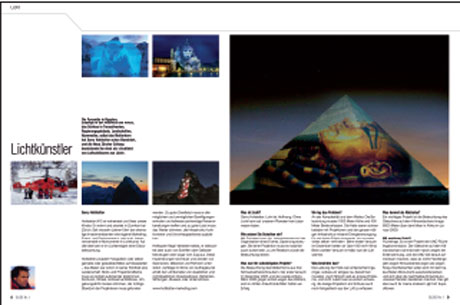
The new customer magazine Slide documents the expertise in the area of "sliding" and shows the benefits in each issue with a different central theme. The first issue delves into various aspects of lighting in an interview with lighting artist Gerry Hofstetter, portraits of employees with their favorite light and reference objects where sliding interacts with lighting design in a sophisticated way. Slide is published in German, French and Italian. The agency for corporate publishing Basel West was commissioned with the concept, editing and design.
Markus Siegenthaler
1290582332_img081112_magazin_slide
The first issue of Slide focuses on the topic of light.

Corporate publishing course now also available in Germany

On the way to a CP Master's degree - the first corporate publishing course in Germany offers this opportunity.

Following the considerable success in Switzerland, FCP and EICP, together with the Swiss Text Academy, will be offering the "Corporate Publisher" university course in Munich from March 2009. The part-time course lasts six months and consists of classroom and e-classroom teaching. It concludes with the title "CAS Corporate Publisher" - awarded by the state-recognized HWZ Zurich University of Applied Sciences.
Graduates of the "CAS Corporate Publisher" course acquire the highest level of expertise in the analysis of media markets in the context of corporate communication, in the conception and presentation of orchestrated communication solutions and in project management in publishing houses, agencies and companies. Lecturers include Prof. Dr. Dr. Helmut Schneider from Steinbeis University Berlin and Andreas Lampersbach, Head of Media Relations at MAN AG.
The "CAS Corporate Publisher" is a prerequisite for obtaining a Master's degree from the Swiss Text Academy. After a total of two to three years of part-time study, the title "MAS Master of Advanced Studies in Writing & Corporate Publishing" is awarded, which is accredited by the University of Applied Sciences HTW Chur and recognized nationally and internationally.
Registration forms and additional information are available at www.forum-corporate-publishing.de .

16 Edis have found their showcase

The Swiss commissioned film can also be seen internationally. The jury was full of praise.

This year, it was not only the films that demonstrated the internationally competitive quality of local filmmaking. The award ceremony is also becoming more professional from year to year. Last week, the Edi for the best commissioned films was awarded for the ninth time at the Schiffbau in Zurich. The show was elaborate and spiced up with funny theatrical scenes about the world of film.
The big winner of the competition is "Sound Designer" for the Hiltl restaurant from the kitchen of Ruf Lanz and OnFilm. The commercial won gold in the commercials category and also a special Edi for editing. IWC was also a double winner with "The Book of Dreams" with Silver Corporate and a Special Edi for Visual Effects. The idiosyncratic animated imagery comes from the Condor and Le Mob machinery.
The AET clip by Absolutturnus and the animation by Elefant for the Locarno Film Festival stood out as technically outstanding. Alberto Venzago captured poetic images in black and white for the last track attendant in the Gotthard tunnel. A total of 16 prizes were awarded in the Swissfilm Association competition, with a new record of 282 films entered. (pan)

Customer magazine Senso as e-paper

Helsana customers now have access to an online version of their customer magazine .

The customer magazine Senso and the redesigned employee magazine Info from Switzerland's largest health insurer have been given a new look to match the new brand identity. Inform is responsible for both the redesign and the implementation of both corporate publishing projects.
Numerous additional functions
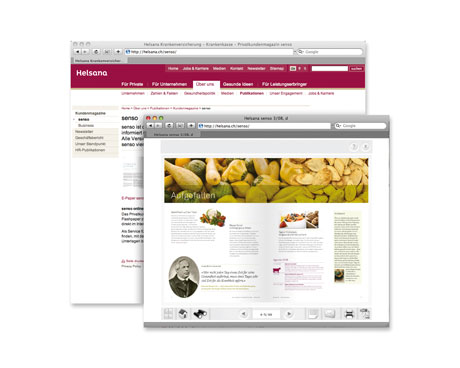
The e-paper version of Senso is new. Helsana customers can now also read the magazine online and enjoy additional functions and features. For example, they can click directly on web links, forward or print out individual pages and search for specific content using keywords. Other e-paper options include the integration of videos, online surveys and competitions or reading articles aloud.
Cédric Tribolet
1290582331_img081112_screenshot_senso
The new e-paper version of Senso offers numerous functions and features.

Recipe for enjoyable bitterness

Draftfcb says everything there is to know about Appenzeller—without giving anything away.

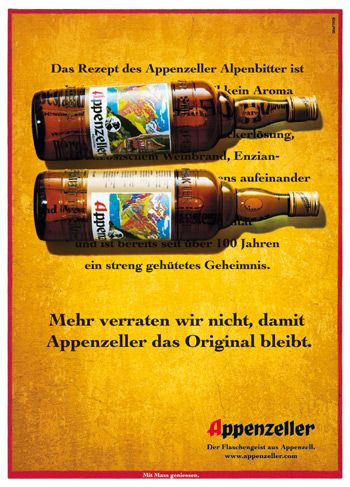
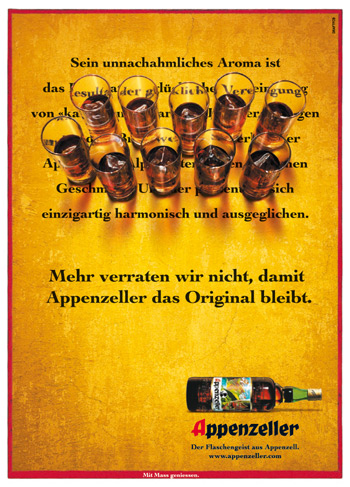
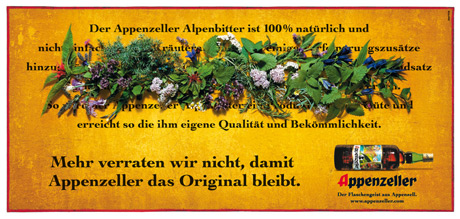
With the new appearance for Appenzeller, Draftfcb is visually building on the successful Appenzeller campaign of recent years. Appenzellers are known for their humor. The special quality of the legendary Alpine bitters should therefore also be emphasized in the usual humorous way. The consumer or connoisseur learns that there is a lot to say about its production and recipe. But what there is to say in detail is not revealed. What became a myth with Coca-Cola also works with Appenzeller: the recipe is top secret.
The agency is flirting with this "insider knowledge" from the bottle by making a detailed text on the subjects illegible with images of herbs and product elements such as bottles and jars. This trick is intended to make the campaign stand out visibly - starting immediately with advertisements and posters throughout Switzerland. "Everything said and nothing revealed," says CD Florian Birkner, delighted with the idea.
Instead, let us at least tell you the story of how the recipe for this Alpenbitter from Appenzell came about. Inspired by the many medicinal herbs of his homeland, a certain Emil Ebneter began experimenting in the spirits shop he founded in 1902. The "self-confident and dynamic young man" was soon able to present a product that could even be described as "medically recommended". The success was so great that Ebneter was allowed to move production to his parents' concert hall in 1908. Since then, a market-driven range has grown with more and more products. Today, 30 people work for Appenzeller. However, only two still know the recipe for Alpenbitter.
Andreas Panzeri
1290582331_img081112_appenzeller1
1290582331_img081112_appenzeller2
1290582331_img081112_appenzeller3
1290582331_img081112_appenzeller4

Everything is nothing without trust

In times of crisis, the truism is reborn: emotions dominate reason. But this isn’t true only in bad times. After all, emotional appeal is also the key to market success—as long as you have confidence in the feelings people have toward a brand. Op-ed by Kaspar Loeb, CEO of the Swiss advertising agency Saatchi & Saatchi Simko.

Reason leads to conclusions. Emotion leads to action. This is how Donald B. Calne, Professor of Neurology at the University of British Columbia, sums up the results of his research in a nutshell. The proof of his thesis can be seen every day in the financial industry. It is not real economic facts, but the rampant loss of confidence that has led to a gigantic loss on the stock markets, in the balance sheets of banks and for national economies worldwide.
During the crisis, a truism that was bashfully relegated to the background during the economic boom is celebrating its rebirth. It is not cool rationality that drives us forward, but our emotionality.
When clients transfer over 84 billion francs from their UBS accounts to other institutions or under their pillows in just a few months, this has nothing to do with the actual reality of seemingly reliable figures. Rather, what lies behind this is the naked fear of losing the money they have saved over the years in just a few days. The sobriety and quasi-commitment of a balance sheet can no longer achieve anything. "Emotion leads to action..."
The financial industry has a notorious aversion to communicating openly and thus to serving the trust that is absolutely necessary to keep customers and thus their investments in line. This is understandable, as discretion and restraint guarantee business and the Swiss business model. Equally notorious, however, are the regularly recurring distortions, which can often be attributed solely to a lack of souplesse in communication.
They are often light and occasionally careless words, such as those uttered by Hilmar Kopper, former CEO of Deutsche Bank, who told an astonished audience during the economic crisis that it was "peanuts" if the average Joe had to miss out on a vacation because he didn't have the change. Or when the former head of the then still Schweizerische Bankgesellschaft, Robert Studer, whispered in the discussion program "Arena" that the zealous security guard Meili, who saved files from the Third Reich era at the bank from the shredder, still had a "hidden agenda". The damage caused to the bank by these and other statements was measurable in pennies and nickels.
The phenomenon of emotions dominating reason is one of the pillars on which commercial communication is based and which therefore makes a decisive contribution to the success of a brand and the company behind it. It's fascinating how we all subtly post rationalize purely emotional preferences for a brand. I love the enthusiastic paeans to horsepower and acceleration figures for flashy coachbuilt cars chosen for their design, sleek dashboard and brand appeal. When I'm stuck in a traffic jam, I'm always amused by the idea that the Porsche next to me could actually accelerate to 100 km/h in just under 5 seconds.
What is interesting, however, is the fact that we can so accurately suppress the undisputed dominance of emotions in our decisions. While the degree of emotionality can be seen every day in the wildly oscillating stock market charts, we still try to negate this phenomenon with rational sobriety. Terms that are highly emotional are constantly used, but somehow we are not prepared to acknowledge that at the end of the day they are the guiding principle for our actions. It could well be that we ourselves mistrust our feelings because we are less in control of them than we are of our intellect.
It is probably no coincidence that, although commercial communication always plays on the keyboard of emotions, everyday reality suggests that only very simple melodies in a moderate key are in demand, which don't hurt anyone, but don't attract attention and don't move anything.
If you want loyalty beyond reason and thus increased security for the sustainable growth of your brand, you should therefore come to the sober, objective conclusion that emotionality is the key to market success. The only thing missing is trust in one's own feelings.

"Going global" for employee magazine

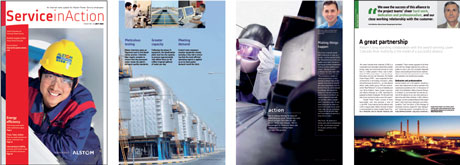
Infel completely redesigned the employee magazine *Service in Action* for the Alstom Group’s Power Service division and now produces four issues a year in three languages.

The French Alstom Group, a leading and globally active company in the fields of power plants and rail transportation, is active in the maintenance and renewal of power plants with its Power Service sector. The employee magazine Service in Action, previously managed by an agency in Paris, has been completely redesigned by Infel. The basic version is written in English, which calls for a "native English speaker" in Infel's editorial team. The coordination and approval procedures in the globally active company are a challenge.
Instead of the widespread division into people and technology stories, Infel suggested dividing the magazine into three sections. The three sections are not distinguished by their content, but by their form: The first section features classic journalism with reports, features, short news items, short interviews, etc. The second part shows generous images and concise short texts, thus creating a noticeable change of rhythm. The stylistic device of the third part is the "I" or "we" form, which emphasizes the authenticity of the employees. Silvia Brönnimann, Manager Internal Media and Events at Alstom Power Service, comments: "The new concept reflects the title of the magazine: it makes 'action' tangible and allows unusual insights into the Alstom universe."
Solution-oriented coordination
Alstom employs 76,000 people worldwide, including over 22,000 in the Power Service sector. Finding the right people in over 70 countries to obtain information and images and to approve the contributions is a challenge. "Going global" therefore means above all solution-oriented coordination of networks.
Alexander Jacobi
1290582331_img081112_mitarbeitermagazin1_alstom
The employee magazine Service in Action combines classic journalism with an attractive visual language.

Major construction site Vaud Fribourg TV

Before Vaud Fribourg TV starts airing on TV screens, its many owners still have numerous problems to solve.

It's a small revolution: the award of the concession to Vaud Fribourg TV means that the canton of Fribourg now has its own regional television station for the first time. The project is also unusual in another respect: public partners are involved in the share capital.
When Bakom's wise men unceremoniously added the French-speaking part of the canton of Fribourg to the canton of Vaud when dividing up the coverage areas, the shock was great. The prevailing opinion was that the area - with around 920,000 inhabitants in the cantons of Vaud, Fribourg and the district of Monthey in the lower Valais - was too large and too disparate. Two such different cultures, so many different players and two competing media houses could never be brought together under one concession. Now the impossible has become possible.
Five "his¬torical" local television stations in the canton of Vaud, the city of Lausanne and a further seventeen Vaud municipalities, the French-speaking Swiss media company Edipresse, the Fribourg-based Saint Paul Group with the regional newspaper La Liberté and the independent local Fribourg radio station Radio Fribourg are involved in the future television company. According to the ideas of the Vaud Fribourg TV pilot group, the private players should hold just over 62% of the shares and the public partners just over 37%.
The organizational structure is also a prime example of the Swiss ability to compromise. Although the headquarters of the station and the editorial office in Lausanne are located at Edipresse, two deputy editors-in-chief, one of whom works in Lausanne and the other in Fribourg, will ensure that "their" region is duly represented. You can feel the hand of Fribourg publisher Albert Noth: he made sure that the heavyweight Edipresse was not the only one calling the shots, but the unusual architecture of the new station does not make for television. "We have to reinvent some things from scratch," says Philippe Sordet, secretary of the pilot group. Above all, this includes making television in the previous white spot on the regional television map, the canton of Fribourg. The first step is to set up a public limited company and put together the management team, announces Sordet. One can imagine that the nomination of the director and editor-in-chief will once again become a subtle balancing of the influence and importance of the various players - Sordet does not want to divulge à tout prix who could be considered as director: "We will announce the nomination in full form soon." Before the new television station can go on air, the teams must also be put together and the collaboration with the regional newspapers concerned, La Liberté and 24 Heures, must be set up. "Sending a print editor out with a television camera" is not planned, says Sordet. However, cooperation will have to be established in the selection of topics and mutual access to material. The television editorial offices will also be based at or in close proximity to the print editorial offices.
The second major challenge is the reorganization of the advertising company Ecran Pub & Prod, which will work for the broadcaster. It is currently 90 percent owned by Edipresse, but will now be given an ownership structure that reflects the ownership structure of the new broadcaster. Regie currently handles the advertising business of the five small Vaud stations, for which the VD News Combi pool exists. For the national business, it works together with the other regional television stations, i.e. Léman bleu in Geneva, Canal Alpha in Neuchâtel and Canal 9 in Valais, in the Télé Romandie Combi TRC pool. This pool must be adapted to the realities of the larger concession areas.
However, the 900,000 potential viewers of Vaud Fribourg TV alone should make for an attractive target audience, especially in conjunction with the cross-media opportunities offered by its proximity to the regional newspapers. Another major challenge will be to find a national partner. According to Bertrand Froidevaux, Director of Ecran Pub, talks have been held with Publisuisse, Radiotele and IP Multimedia. However, it is too early to make a decision.
Helen Brügger

Radio Rouge FM, which is backed by Hugues de Montfalcon, was not granted a license. De Montfalcon had submitted a "one hundred percent private" TV project for licensing and polemicized against the "state-supported" project of the competition. But not even he seems to have believed in his chances, as he was preparing the launch of Rouge TV, a digital music and entertainment television channel for an audience aged between 15 and 25. If Bakom approves it, Rouge TV plans to launch in February. According to Philippe Sordet, Vaud Fribourg TV will launch "next summer at the latest". (hb)

Living Circus Knie

Artists and animals, the ring and backstage—*Knie Illustré*, with its fascinating themes, is being reimagined with a fresh approach.

At the beginning of the next tour, in March of next year, the Knie Illustré and the program booklet of the Swiss National Circus Knie will be published in a new concept.
The circus performances and circus life are told in a colorful mix of topics and up close. Part of the magazine is now characterized by Alberto Venzago's visual language. Primafila AG is developing the concept, magazine dramaturgy and implementation (design, editing) in close cooperation with the Circus Knie management.
Viviane Egli
get_footer();