Curt Bürgi is a veteran of Swiss advertising: the trained typesetter and printer has been working in the world of consumer seduction for more than 50 years. He started out in his profession with lead type, and pixels, zeros and ones are lining up to mark his departure. However, there is no question of "rock". At the age of 67, Bürgi still looks lively and full of ideas. "Joy at work and gratitude for the good life" - that's how simply the advertiser describes his fountain of youth. He won't say how much he gets out of regular marathons and his daily bar of chocolate.
Bürgi was born in Schönenwerd and grew up in Aargau. It was here that he completed the training he had dreamed of as a boy: typesetter. In 1962, Bürgi started his career as an editorial graphic designer at Blick. In the legendary "Pope Breakdown", in which the demise of the then Pope John XXIII was announced too early, he was involved in the precautionary production of the second 1st page, which was then printed by mistake. From Blick, Bürgi moved to the Neue Westfälische Zeitung in Bielefeld, Germany. Here he worked for just under two years as a typesetter and apprentice trainer. "It was a very good time, but rather a step backward professionally. Because the Germans were still a long way away in terms of production technology from the level that was already standard in Switzerland." After his stint in Germany, Bürgi went to Lausanne to learn French better and then worked in a large Baden printing company as a chief estimator and chief scheduler. In 1971, at the age of 30, he joined Amag, Switzerland's largest automobile importer, as production manager in advertising. His career took off.
"At that time, I was the only advertiser at Amag and the only one who knew anything about printing, production and prices," says Bürgi. "That's why I was given a free hand, and I took advantage of my freedoms." In 1975, Bürgi was appointed head of advertising at Amag Switzerland. In 1979, he founded an in-house agency within Amag, where around ten graphic designers, copywriters and media experts supported him in the development of all advertising measures.
Creative freedom of movement
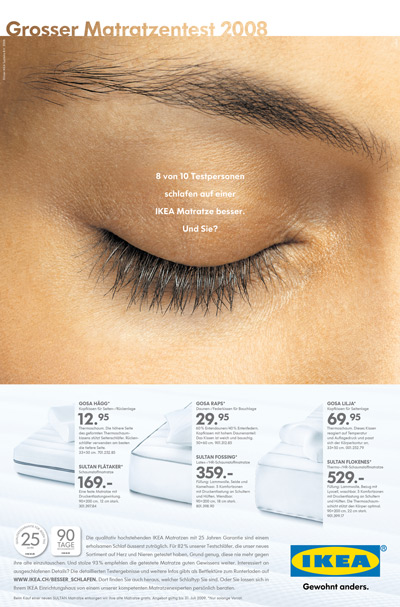
"I enforced that we ran mostly double- and full-page ads," Bürgi reports. "That alone makes a much more competent impression than tiny ads placed with high frequency." Another hobbyhorse of the advertising professional: car advertising without cars. Each of the more than 100 car models in Switzerland is covered with two to three subjects per year. Makes 200 to 300 different car subjects per year - and mostly models are shown. "Despite all the advertising, you have to sit in the car and see if you feel comfortable. You don't feel that from the ad," Bürgi says. "Advertising that conveys feelings or images gets much further. You should also not segment the target group too much, but appeal to as many consumers as possible. And that works best through the brand."
When Amag took over the marketing of Skoda and Audi in addition to VW, the in-house agency was dissolved. Bürgi used an external agency for each car brand. "I hired small, medium and large agencies, depending on the budget," he says. "In working with these agencies, I experienced a lot that I didn't like: briefings were given too little consideration, contact persons changed constantly, and the price-performance ratio was often not right. I decided: I want to have an agency of my own once more in my life. That was my ultimate goal."
Man of action
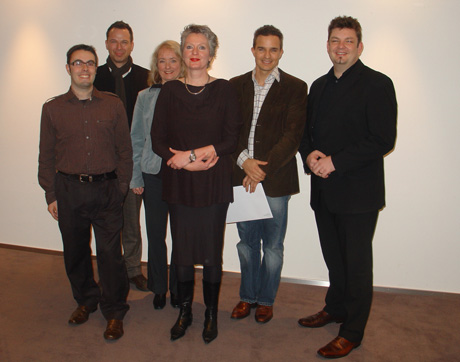
Planned, done. In 1999, Bürgi, by then director of advertising at Amag, left the company and founded the agency Bürgi & Partner with his wife and partner Andi Schaerer. "Many people called me crazy for giving up the director's position with quite a few privileges to start over," he recalls. "But I just had to do it." In the meantime, Bürgi & Partner employs 20 people - and continues to grow. For Bürgi, it was just the right time to stop and sell the agency to Andi Schaerer. As of January 1, 2009, it operates under the name "Schaerer & Partner".
Tough but fair
Curt Bürgi is known in the industry as tough but fair. With his honest assessments, he has shocked many a person - and put them on the right track. He has a good feel for people and a nose for what customers and consumers want. "That," he says, "is perhaps my greatest talent." Competitor and market analyses, as well as knowledge of prices and future techniques, are the basis of good marketing, he says. However, gut decisions always contribute to success. "Because emotions play an increasingly important role in advertising and marketing, the future belongs to image advertising," says Bürgi. He should know. In any case, he can't recall any real advertising flops from his pen.
"Car advertising has basically been about the same thing for 70 years," Bürgi says, flipping through a 1938 VW sales catalog touting the VW Beetle. That's right: It's all about cockpit, chassis and storage space for luggage, about speed, acceleration and comfort in the interior. In black and white and old letters. Otherwise, everything is exactly as it is today. Nevertheless, a lot has changed between hot metal typesetting and digital printing. Reproduction techniques have changed, and in addition to print, radio, television and digital media must be populated with banners and the like. "The last 50 years have been a sensationally wonderful time," Bürgi finds. "I was constantly allowed to learn something new, my work never got boring." However, the rapid progress also has disadvantages: Campaigns today are losing more and more of their punch, because the constant bombardment with incentives to buy is causing us to gradually lose our sensitivity to advertising messages. "Perhaps a regression would do advertising some good," Bürgi also muses. "The greater the flood of communication becomes, the less advertising can achieve."
Advertising with pleasure
His business partners and friends were surprised when Bürgi announced his retirement plans. "I received incredulity in unison: 'Bürgi, you're retiring? That can't be!'" But if you have yourself as a role model, such objections don't faze you. "From the heart, I could work another 50 years," Bürgi says cheerfully. "You can't advertise if you don't love this profession. But my head tells me not to overdo it. That's why I'm quitting now and enjoying other things." Bürgi is planning a long trip with his wife Anita, as well as commitments in the real estate, social and nature sectors. He does not yet want to be more specific about his ideas. But it is already clear that Bürgi wants to improve his handicap, because he is currently learning to play golf. And what Curt Bürgi does, he does right.
Anne-Friederike Wilhelm