Unbridled creativity for safer roads
SFLB is making creative brakes squeal for the new Volvo XC60.


Driving at excessive speeds can have serious consequences. We learn this almost daily from the media. What is less well known is that slow driving is even more dangerous, at least statistically. Various studies show that 75 percent of all collisions occur at speeds of less than 30 km/h. The most common type of accident is the rear-end collision. In 50 percent of all cases, this happens without braking. According to Suva, up to 25,000 people in Switzerland suffer whiplash injuries in such rear-end collisions every year. In the worst case, such traumas can lead to incapacity to work. In the best-case scenario, collisions in urban traffic still result in significant repair costs, most of which have to be covered by insurance.
Volvo now wants to remedy this. The Swedes are the first vehicle manufacturer in the world to offer the "City Safety" safety system as standard equipment in the new Volvo XC60. This unique safety system helps the driver to avoid rear-end collisions in slow-moving city traffic or traffic jams, or at least to reduce their impact. If the vehicle threatens to collide with another car without the driver reacting, the car brakes automatically. The laser-based "City Safety" braking system of the Volvo XC60 is active up to 30 km/h. If the driving speed or the speed difference between the vehicles is less than 15 km/h, "City Safety" can even prevent the collision completely.
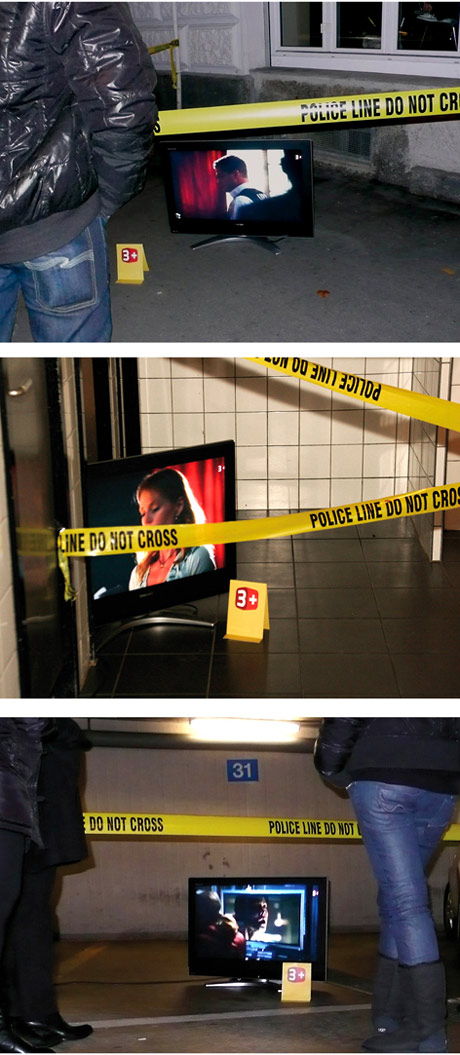
50 years ago, Volvo was the first manufacturer in the world to launch the three-point safety belt. This now ranks 8th among the "most useful inventions of mankind". In order to properly communicate a new quantum leap in car safety with "City Safety", Spillmann Felser Leo Burnett has set itself the challenge of bringing unbridled creativity to the road. "Normally, when launching new cars, the focus is on the vehicle," explains Rolf Zimmermann, the person responsible for this campaign at SFLB. Not so with the Volvo XC60. Here, the agency started with a teaser campaign that focused solely on an anonymously formulated question: "How can rear-end collisions be prevented?" Without a recognizable brand as the sender, funny print and online subjects were placed, showing original suggestions with a wink as to how rear-end collisions can be avoided. As a form of interaction, the Swiss population was invited to post their own suggestions on a website as to how car safety could be massively improved.
The result was a surprisingly original campaign launch, in which the public also played a very active and creative role. After just a few days, over a hundred suggestions were posted online. On City-safety.ch these ideas could be evaluated, which generated over 10,000 visitors in just a few days. Voting was coupled with a competition prize of CHF 10,000. The campaign was further enriched with the integration of Facebook and interviews on the website, in which people from the street presented their ideas for preventing rear-end collisions. The term "City Safety" was thus tangibly linked to the topic of "rear-end collisions". The teaser campaign could then be resolved.
The secret under the hood has now been revealed. The Volvo is presented as "the first car that can independently prevent rear-end collisions". To bring the promise to life for potential customers, the Swedish car manufacturer held a roadshow in Bern last week, with more to follow in Zurich and Basel as well as during the Geneva Motor Show. Here, "City Safety" can be tested on a specially equipped track. With a Volvo coach in the passenger seat, the automatic braking system can be experienced at first hand in a real rear-end collision. Anyone who has previously passed a blood alcohol test with 0.0 per mille alcohol in their blood is allowed to take part, for example from January 29 in the hall of Zurich main station.
Convinced car brakemen can post their personal impressions of such test drives as testimonials in a life ticker on the microsite City-safety.ch. The agency, led by the CD team of Simon Staub, Patrick Suter and Martin Spillmann, also wants to put photos and videos of these roadshows online with the greatest possible advertising impact. The campaign will be communicated with prominently placed advertisements, for example as a cover on 20 Minuten. Various online and viral marketing measures complement the campaign. For example, you can also "brake" in a video game on the website. Anyone who is impressed by the real crash drive will immediately receive an offer for another test drive from their local Volvo representative. Further special measures are planned and will ensure that the Volvo XC60 and "City Safety" remain a talking point in February.
Incidentally, Basler Versicherung also proves that the automatic brake is more than just an advertising gimmick from Volvo. Anyone who drives an XC60 will pay lower premiums in future.
Andreas Panzeri
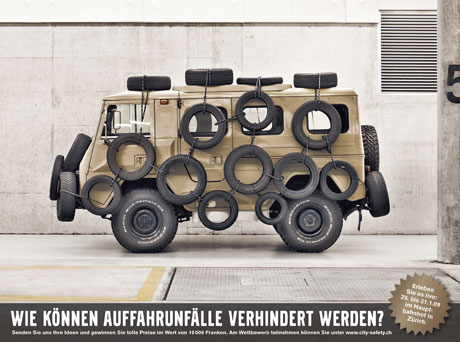
This is how advertisers imagined more safety: Teaser from the SFLB workshop.
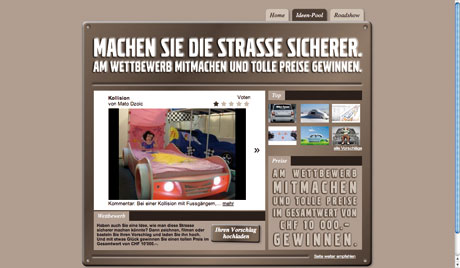
On City-safety.ch there are testimonials and a video game about rear-end collisions.
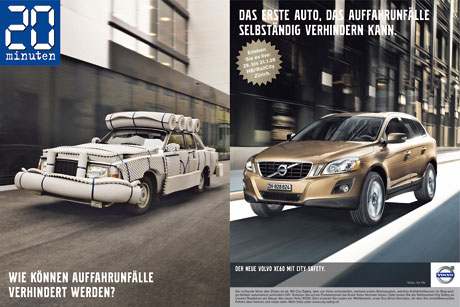
The resolution and invitation to the roadshow is made with double-placed advertisements.