Swiss Photo Award: Ewz.selection invites to Preview Day

The platform for Swiss photography Ewz.selection invites you to its Preview Day. On February 12, 2009, the 2008 exhibition of Swiss photography will be showing over 3,000 images by professional photographers from all over Switzerland at the EWZ Selnau substation in Zurich.

The platform for Swiss photography Ewz.selection invites you to its Preview Day. On February 12, 2009, the 2008 exhibition of Swiss photography will showcase over 3,000 images by professional photographers from all over Switzerland at the EWZ Selnau substation in Zurich. According to the press release, the approximately 500 works from 2008 were all submitted for the Swiss Photo Award and are available in the categories Advertising, Editorial Photography, Fine Arts and Free.
The Swiss Photo Award is aimed at photographers who are resident in Switzerland and/or have Swiss citizenship. The photo prize is endowed with the Ewz.selection award of CHF 15,000 and category prizes of CHF 5,000 each.
Preview Day: Thursday, February 12, 2009, 12.00 noon to 9.00 pm. Admission 20/10 francs. EWZ substation Selnau, Selnaustrasse 25, 8001 Zurich.
Preview Day Professionals: Wednesday, February 11, 2009, 5 p.m. to 10 p.m. Admission 75 francs. Photographers participating in the Swiss Photo Award pay 20 francs. VFG members free of charge. The Preview Day Professionals is aimed at art buyers, photo agents, picture editors, curators and other professional image makers. Unlimited contacts are included in the admission price.
Pre-registration required.

Top of the week: Worse isn't really bad yet

The crisis in advertising will not be over until tomorrow, according to Nielsen Media Research for the 2008 advertising year in Germany. Despite an increasing reduction in advertising expenditure, advertising expenditure by German companies was still slightly up in 2008.

The crisis in advertising will not be over until tomorrow, according to Nielsen Media Research for the 2008 advertising year in Germany. Despite an increasing reduction in advertising expenditure, advertising expenditure by German companies was still slightly up in 2008. At EUR 21.11 billion, gross spending even reached the highest level ever measured by Nielsen. However, companies increased their spending on advertisements and commercials by just 0.7 percent for the year as a whole (2007: EUR 20.96 billion). "The 2008 advertising year was characterized by very contrasting factors," explains Ludger Wibbelt, Managing Director of Nielsen Media Research. In 2008, advertising slipped between the economic crisis and weak domestic economy on the one hand and sporting highlights on the other. Germany, for example, followed the European Football Championships in Switzerland and the Olympic Games with rapt attention - and advertisers were grateful.

A desk for everyone and everything

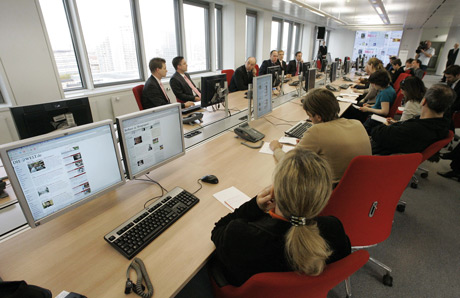
Larger media companies are consolidating their print and online editorial teams into a single newsroom, in some cases also incorporating the editorial teams from regional TV and radio stations.

The free newspaper Cash is probably the first Swiss title to have its multimedia concept implemented "from a single source": for three years, the same editorial team, housed in an open-plan office, has been keeping the Cash.ch business portal up to date, producing video and audio reports for it and publishing the daily newspaper. It also informs subscribers about the latest business news via SMS or mobile Internet. "All employees do everything," says Editor-in-Chief Rüdi Steiner. With one exception: the weekly program "Cash-TV" on SF 2 will continue to be managed by a separate editorial team. Ringier spokesperson Stefan Hackh adds that the aim is to take account of changes in media usage and to create optimal conditions for researching and publishing stories. "The editorial team decides which topic is best distributed on which channel - and in what depth."
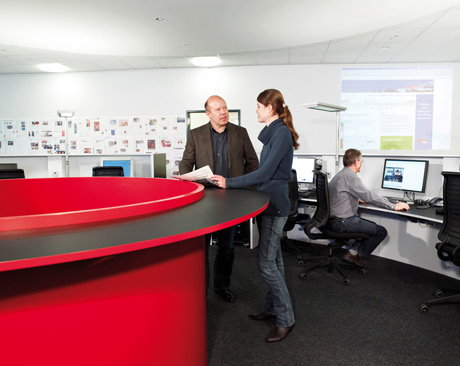
In November, the Tamedia subsidiary Espace Media followed suit: In the newly opened Berner Multimediahaus, it brought together the previously decentralized editorial offices of Berner Zeitung, Tele Bärn, Radio Capital FM and Bernerzeitung.ch on three floors. They are connected by a spiral staircase and coordinate their work at a ring-shaped desk. There is openness across all channels, but they remain independent when it comes to setting topics. The aim is to find synergies, refine ideas, strengthen research and bundle the advantages of the individual media, said Tamedia Board of Directors member Charles von Graffenried at the inauguration. The aim: "To optimally align the company's information channels to the needs of our customers in the Espace-Mittelland region."
The concept at the St. Galler Tagblatt is somewhat different: Since October 1, 2008, only the newspaper and the online portal Tagblatt.ch have been working together at the central newsdesk. LZ Medien is planning along the same lines: an open-plan office for the Neue Luzerner Zeitung, Zentralschweiz am Sonntag and Zisch.ch. Radio Pilatus and possibly Tele 1 will remain external. "We want them to remain independent of the newspaper," says Bettina Schibli, spokesperson for LZ Medien.
Non-stop cooperation
Axel Springer Switzerland chose another variant. Here, the editorial teams of the TV guides Tele, TVStar, TVvier and TV2 work together in one room and prepare the content for each of the four titles on a customized basis, including for the online portal from March. Edipresse does something similar: The print and online editorial teams work together for the daily newspapers, the three Matin editions, Bilan and Fémina, but also feed their content into a shared content pool where all titles can access it.
Basler Zeitung Medien also recently moved the print and online editorial offices of Basler Zeitung and the free newspaper Baslerstab into the same building so that they can increasingly cooperate. Radio Basel 1 in Liestal is also to be included in the medium term, insofar as this is permitted under licensing law.
Other publishers will follow suit, such as AZ Medien, which will merge its media Aargauer Zeitung, AZ-Online, Radio Argovia and Tele M1 in the new multimedia center in Aarau from autumn 2009. "In future, a journalist should be able to prepare a story for at least two media," says publisher Peter Wanner. Südostschweiz in Chur is planning something similar, as is Ticino, where Tele Ticino, Radio 3iii, the news portal Ticinonews.ch and two regional newspapers are now cooperating.
It is also certain that Ringier intends to merge the editorial teams of Blick, SonntagsBlick, Blick am Abend and Blick Online into one newsroom in January 2010. The aim is for each journalist to be able to write for at least two channels, i.e. online and print, says Stefan Hackh. However, the exact operating concept is still being worked out with the editors-in-chief. Similar ideas are being considered at Tamedia, where the Tages-Anzeiger, the free newspaper News and the online portal Newsnetz are to be better coordinated in future. No information was available from the NZZ.
Markus Knöpfli

IT in the newsroom
The Media Institute of the Publishers Association is also addressing the issue: At a conference in Zurich on February 24, technicians and editors will work together to develop requirements for IT in the newsroom. (mk)

1290582112_img090121_newsroom_springer
A role model for some Swiss publishing houses: the Axel Springer newsroom in Berlin.
1290582112_img090121_newsroom_bern
Berner Multimediahaus: Contacts from medium to medium.

Zurich film for China

Snap produced a Peugeot commercial for the Chinese market.

The global economy has its problems as well as its opportunities. In the coming days in Davos, this will once again lead to many theoretical views. Zurich film producer Michael Kindermann was able to experience a more practical consequence this summer. With his Snap Film, he produced a commercial for the new Peugeot 207 in China. "The filming was a great challenge and at the same time a unique experience. It was also very stimulating to come up with an idea together with French and Chinese customers," says Kindermann about his job. The spot was creatively supervised by the agency Euro RSCG Torque. The order came from Peugeot China. The commercial is intended exclusively for the Chinese market and has been in use since the end of 2008 with the billion-strong nation.
At the pre-production meeting in Beijing, the Zurich film team discussed the next steps with the Chinese client and Chinese and German creatives via interpreters. Then, after three days, they went to the southern Chinese island of Hainan. A fantastic landscape should have awaited the team there. However, it was mainly the filmmakers who were waiting, as a rather nasty typhoon raged for six days. Thanks to the many years of experience of internationally active director Nico Beyer, who is now new to the Snap Film portfolio, things worked out after all. In addition to the spot with Michael Mieke from Berlin at the camera, press motifs were also realized. The team had three cars at their disposal for the shoot. The equipment would have been enough for a feature film. The "very cheerful crew" came mainly from Shanghai and Beijing. After filming, the team first went to Shanghai for post-production, then to Berlin for offline editing and to Paris for final image processing.
The PSA Peugeot Citroën Group has entered into a major joint venture with China and has a joint subsidiary with Dongfeng Motor. By 2010, Peugeot intends to triple its imports in Europe and purchase car parts worth 800 million euros from China.

Andreas Panzeri

>To the spot

1290582112_img090121_peugeot1
1290582112_img090121_peugeot2
1290582112_img090121_peugeot3

The nomad

As Head of Radio & Sponsoring at IP Multimedia, Jacqueline Sasse aims to develop new business models and expand the radio and sponsorship divisions over the long term.

"It speaks well for the company that IP Multimedia still wants to tackle something new at a time when many companies are having to downsize," says a delighted Jacqueline Sasse. "Looking forward instead of driving down" is her visionary mission at the Goldbach Media company. Jacqueline Sasse took up her newly created position as Head of Radio & Sponsoring only a few days ago. She therefore does not yet want to name any goals or concrete tasks. The returnee from an international career now wants to get to know the team and the current Swiss market better. Already today, however, she can say: "I'm coming into a functioning structure and have not been approached for crisis management." She wants to bring "added value" to Goldbach's business. The radio and sponsorship areas are to be expanded in the long term. Sasse also sees potential for IP Multimedia in this line of business internationally. Likewise, holistic approaches to communication concepts are becoming increasingly important. "The marketing platform must have answers to this," promises the experienced media sales specialist.
Jacqueline Sasse can draw on concepts and ideas for tackling this challenge from a career that has so far been as varied as it has been exciting, spanning the entire world of communications.
After completing her KV in Zurich, Jacqueline Sasse moved back to San Francisco. The daughter of a Swiss and a Brazilian was born in this city, and she also spent her childhood around the Golden Gate Bridge. She completed a marketing education at Berkley University. Back in Switzerland, Sasse got her start in the media in 1989 at Bruno Oetterli's Radio Tele. As a sales assistant, she had the privilege of working with Markus Tellenbach on the initial marketing and thus the development of the new TV station Eurosport. When success soon followed, Eurosport was spun off into its own office. When Rubert Murdoch sold the pan-European channel to TF1, she was promoted to managing director for the Swiss market, Italy and Austria. After two years, Sasse was offered the job of marketing Eurosport worldwide from Paris.
In seven years, she built up the international sales structures for the sports subsidiary at TF1's headquarters. During this time, Sasse was responsible for the branches in Europe and was able to establish an agency network for Eurosport that extended far into Asia. This should enable her to serve major customers, such as the automotive industry, directly on site. In the United States, Jacqueline Sasse worked with ESPN. This wide-ranging entertainment and sports programming network was another Eurosport shareholder before selling its shares to TF1 and Canal plus.
During her time as CEO in Paris, Sasse and a team of 110 employees eventually drove up annual sales to a then record 220 million euros. Pan-European channels were brand new at the time, and Sasse had to find her own ways of selling the same product in very different cultures. The concept eventually became to build local competitions into the programming grid alongside mainstream sports in major regions. This allowed her to offer a unique USP for each country and successfully position herself in competition with the other offerings.
When she met her husband, that was the catalyst for Jacqueline Sasse to seek a little more peace and quiet in Bavaria. She allowed herself a baby break. Soon, however, the entrepreneur was tempted by a new venture: founding her own agency. Inspired by her husband's fashion world, Sasse set up YSM - Youth Sports and Music Marketing. The core competency of this agency was to accompany sports brands as they expanded into the fashion market. One specific question, for example, was: In which store is what sold? And in which scene is the sports fashion advertised?
A pioneer in this cross-border business is Willy Bogner's Sportstyle - a Munich-based company that became an important client of Jacqueline Sasse/Ispovision. "Today it is taken for granted that Puma or Nike have their fashion line. At the beginning of this trend, however, very elementary strategies had to be sought as to how these industries could also be brought together in terms of communication," says Sasse, explaining her search at the time for meaningful platforms. Ispovision became an important one, and one that continues today. The international trade fair for sportstyle in Munich was conceived for Messe München and implemented together with GQ Style as media and show partner.
Sport, lifestyle, communication and business - her diverse experience from all these worlds ultimately predestined Jacqueline Sasse for a mandate at the America's Cup in Valencia. Sasse was responsible for the hospitality program surrounding the regatta with the Alinghi. Attractive events had to be created, organized and realized for sponsors and their guests. "The temporary job was ideal for our family situation," Sasse enthuses about this excursion to the Mediterranean.
In the meantime, the sails have been furled again. And the son will soon be ready for school. So it was ideal for everyone involved that IP Multimedia was now looking for the kind of specialist knowledge in Zurich that Jacqueline Sasse can offer with all her international experience.

Andreas Panzeri

The function
With the Head of Radio & Sponsoring, IP Multimedia has created a new position to further expand the company.
The company
IP Multimedia is the leading marketing organization for private electronic offline media TV, radio, adscreen and special products. Its services include media planning, marketing and placement, booking, handling and controlling for private TV stations such as Cartoon Network, MTV, M6, ProSieben, RTL, Viva Schweiz, Vox, Regional TV, Wilmaa.com, Zattoo.ch, as well as for all Swiss private radio stations and Coop's in-store radio.

1290582111_img090121_eurosport
Jacqueline Sasse's marketing of Eurosport has generated record revenues for the station.

1290582111_img090121_bogner
Willy Bogner was an important customer of Sasse's trade show Ispovision.

To the point: The marketer is himself

What Albert Polo Stäheli, CEO of the Neue Zürcher Zeitung since September, mentioned in passing, so to speak, in an interview with the Sunday newspaper Sonntag, contains quite a bit of dynamite and will still cause some heated discussions and red heads.

What Albert Polo Stäheli, CEO of the Neue Zürcher Zeitung since September, mentioned in passing, so to speak, in an interview with the Sunday newspaper Sonntag, contains quite a bit of dynamite and will still cause some heated discussions and red heads.
Quote Stäheli: "Cost pressure is constantly increasing, so publishers should consider outsourcing the processing of advertisements to someone who can do it much more cheaply. I could well imagine the future Publicitas as a central outsourcing partner for the processing, administration and collection of the entire industry's advertising business. Marketing, on the other hand, I consider to be the core business of the publishers." Somebody's talking straight.
Polo Stäheli has never been considered a friend of Publicitas; he has always focused on marketing himself. Many in the media industry were therefore eagerly waiting to see how he would come to terms with the forced marriage between NZZ and Publicitas. A forced marriage that he himself would certainly never have entered into. Now we know.
Publicitas is in the midst of quite a crisis. It is in the middle of a gigantic restructuring process, the end of which is not yet in sight. The announced all-media strategy seems to be more difficult to implement than its inventors thought. There is great skepticism among many leasehold publishers. And now the unfavorable economic situation is also causing sales to slump. The mood in the industry has also been more Publicitas-friendly in the past.
Some publishers never miss an opportunity to piss off the former Lausanne giant. This was the case with Matthias Hagemann, publisher of the Basler-Zeitung, who said laconically in an interview: "Commercially, we were still above the previous year's figures in December. In that respect, we are probably one of the few newspapers, if not the only one, in Switzerland. After all, we market ourselves." Clearly.
If the Neue Zürcher Zeitung is now also thinking out loud and looking for new ways to cooperate ? and not only for itself, but also for the Luzerner Zeitung, the St. Galler Tagblatt and the Zurich regional newspapers - then things are starting to get tricky for the Lausanne advertising agent. Stäheli's statement is a clear vote against the comprehensive marketing claim of Publicitas, which, it should be noted, was undisputed for decades by very many publishers.
This is also a sign for some publishers who, until today, were still hesitant to join in the "go from Publicitas" call. The only question is who will be the next publisher to emancipate itself from Publicitas. Certain signs suggest that it could be Edipresse.
Pierre C. Meier, Editor-in-Chief
[email protected]

The future between book covers

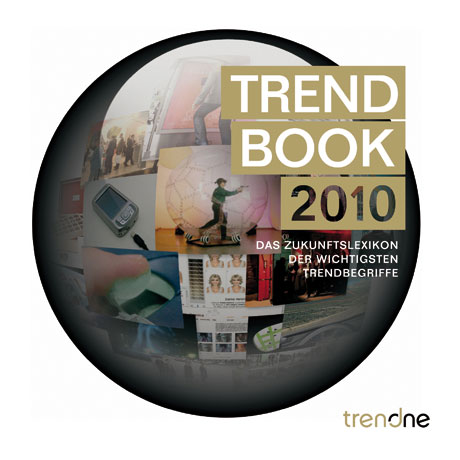
With so many trends, it's often hard to know what's really in. TrendOne knows all the better - and bundles its knowledge in the Trendbook 2010.

TrendOne is Europe's leading micro trend research institute. The Hamburg-based trend researchers' mission: to capture the spirit of the times. "Catch me if you can", you might shout at the ambitious trend scouts, who claim to discover more than 300 global innovations every month. But the lexicon of the future that has now been published is proof that the hunt for the zeitgeist is an ambitious but not hopeless endeavor.
TrendOne has analyzed product and social trends as well as marketing and media trends for its lexicon and summarized them into more than 500 macro trends. Under the macro trend "Mobility", for example, readers will find various micro developments that make up this trend, such as digital maps, GPS, mobile office and speed travel. The book thus provides new insights into the developments of tomorrow: from social trends such as the new "health style" and the trend towards ethically and ecologically responsible consumer attitudes to new forms of communication and media.
So far, so good. However, the fact that all the trends are described using English terms makes browsing through the 2010 Trend Book a tedious task. It goes without saying that GPS is simply GPS. Likewise, "mobile office" is now a common term. But couldn't digital maps simply remain digital maps and speed travel be fast travel - even if that doesn't sound so sexy? The Anglicisms that the trend researchers have come up with to describe the developments often come across as a bit of an effort. However, these linguistic mishaps do little to detract from the explanations. In brief passages, the trend researchers explain the individual trends and classify them. They also provide many practical examples and provide cross-references between the articles in the trend lexicon. The large amount of text and the few pictures also underline the fact that this is a solid reference work. The knowledge is made accessible by a detailed and clear glossary.
All in all, the Future Lexicon offers an exciting excursion into a world that in part still awaits us.
Anne-Friederike Wilhelm

1290582112_img090121_trendbook1
1290582112_img090121_trendbook2
1290582112_img090121_trendbook3

TWFE develops new logo for knowledge magazine X:enius

Commissioned by Arte, ZDF, ARD, and AVE, the Zurich-based agency TWFE has developed a logo for the new science program X:enius.

Commissioned by Arte, ZDF, ARD, and AVE, the Zurich-based agency TWFE developed a logo and all related elements—from the reporter van to the on-air design—for the new science program X:enius. In keeping with the show’s focus on science, the logo incorporates typical typographic elements such as varying letter sizes and superscripts and subscripts, according to a press release from the agency.
X:enius has been airing daily on Arte since Monday, January 19, 2009.
Contact at AVE: Walid Nakschbandi (Managing Director), Dr. Bernhard von Hülsen (Production Manager). Person in charge at Twfe: Marco Fumasoli (Creative Director/Owner), Sara Nenzi (Creative Director), Manuela Lüchinger (Consultant), Simon Piniel (Animation), Miriam Pretzlaff (Post-Production).
1290582108_img090121_twfe

Google stops ad sales for newspapers

In view of the economic crisis, Google is stopping the sale of advertisements for newspapers. The Internet company announced on Tuesday that the business had not been as successful as hoped.

In view of the economic crisis, the Internet company Google, which is spoiled by success, is stopping the sale of advertisements for newspapers. According to SDA, Google announced on Tuesday that the business had not been as successful as hoped.
Google's offer allowed advertisers to place ads in newspapers via the Internet. According to Google, the program will be discontinued at the end of February. The company is currently discontinuing several activities that are not directly part of its core business.
A Google spokesperson did not want to say how much revenue the Internet giant and the daily newspapers had expected from the program. The 807 partners included The New York Times, New York Post and The Washington Post.

Budgets of the week

In future, Rivella will rely on the ideas of the Walker advertising agency, and Heineken is returning to JWT+H+F after several years.

Walker has won Rivella
Rivella will be relying on the ideas of the Walker advertising agency in future. Once again, the Zurich-based creatives have been awarded the contract for a traditional Swiss brand without a pitch, as part of an intensive and multi-stage agency evaluation. According to Brand Asset Valuator, Rivella is one of the top 20 power brands in Switzerland.

JWT+H+F: Heineken back on board
The international beer brand is back at the Maag site. As old love never rusts, Heineken decided to return to JWT+H+F after several years. Between 1999 and 2004, the creative agency advertised for the tasty beer from Holland and developed the legendary "Sounds good" campaign, a long-running hit that attracted a great deal of attention beyond the country's borders. Now this success story is being extended by several chapters. It will be interesting to see how the cool green beer will be advertised from 2009.

Radio data 2008: Radio 1 loses listeners

Roger Schawinski's station, Radio 1, lost a significant portion of its audience in the second half of 2008. As Publica Data reports in its statistics, the market share fell from 1.2 percent to 0.8 percent. This corresponds to a decline in net reach from 107,400 to 74,700 listeners.

Roger Schawinski's station Radio 1 lost a significant amount of listeners in the second half of 2008. As Publica Data reports in its statistics, the market share fell from 1.2% to 0.8%. This corresponds to a decline in net reach from 107,400 to 74,700 listeners.
In a press release on Tuesday, the station presents the decline as harmless. After a great publicity and curiosity success in the first weeks of broadcasting last spring, Radio 1 has stabilized its listening figures. With 75,000 listeners per day, the station achieved its targets in the second half of the year. The station also points out that it currently has a reception area that is only a third as large as that of the other Zurich stations. In addition, thanks to the license, the station will soon be able to increase its listener potential fivefold. Nevertheless, the decline is striking.
By comparison, Radio 24 reached an average of 250,500 listeners per day during the same period. This corresponds to a market share of 2.4 percent. It therefore remains the most successful private radio station in Switzerland.

Wemf statistics: 6 percent less advertising revenue

The advertising market has also been affected by the economic downturn: In 2008, print publications reported revenues of approximately 1.887 billion francs. That is 6 percent less than the previous year, according to Wemf.

The advertising market has also felt the effects of the economic downturn: in 2008, print titles reported revenues of around CHF 1.887 billion. This is 6 percent less than in the previous year, as reported by Wemf according to SDA.
Property advertisements (CHF 73.7 million) showed a particularly sharp decline in percentage terms compared to the previous year (19.1%). The decrease in commercial/other advertisements (1.423 million) was 5.8 percent. At CHF 273.6 million, job advertisements also recorded a drop (-3.4 percent). At CHF 116.5 million, brochure inserts recorded a drop of 4.8%.
Broken down by print media category, only the trade press (CHF 64.6 million, up 4.8%) and the Sunday press (CHF 210.5 million, up 5.2%) recorded an increase in net advertising sales compared to the previous year. The daily press recorded a drop of 7.2% to CHF 1.033 million.
In addition, the regional weekly press also recorded sales of CHF 53.2 million (-
6.8 percent), the financial and business press with CHF 77.4 million (-5.5 percent), the general press with CHF 231 million (-14.1 percent) and the specialty press with CHF 216.8 million (-3.3 percent).
Weak December
At CHF 129.6 million, advertising revenue in December was 11.5 percent lower than in the same month last year. All sectors contributed to this decline. With a volume of CHF 11.6 million, job advertisements fell by 31.8 percent. Real estate advertisements (3.2 million) were down 12.9 percent, while commercial/other advertisements fell by 7.7 percent to 105.5 million francs. Brochure inserts were down 18.7 percent at CHF 9.2 million.
Broken down by individual print media, only the financial and business press recorded a year-on-year increase in net advertising revenue of CHF 6.0 million (+4.9%). In contrast, the Sunday press suffered the greatest percentage drop in revenue (CHF 13 million) at 31.4 percent. The general press lost 24.7 percent (15.2 million) and the daily press 6.2 percent (72.1 million francs). In addition, the regional weekly press lost 4.1% (CHF 3.8 million), the specialty press 6.8% (CHF 15.6 million) and the trade press 5.1% (CHF 3.9 million).
get_footer();