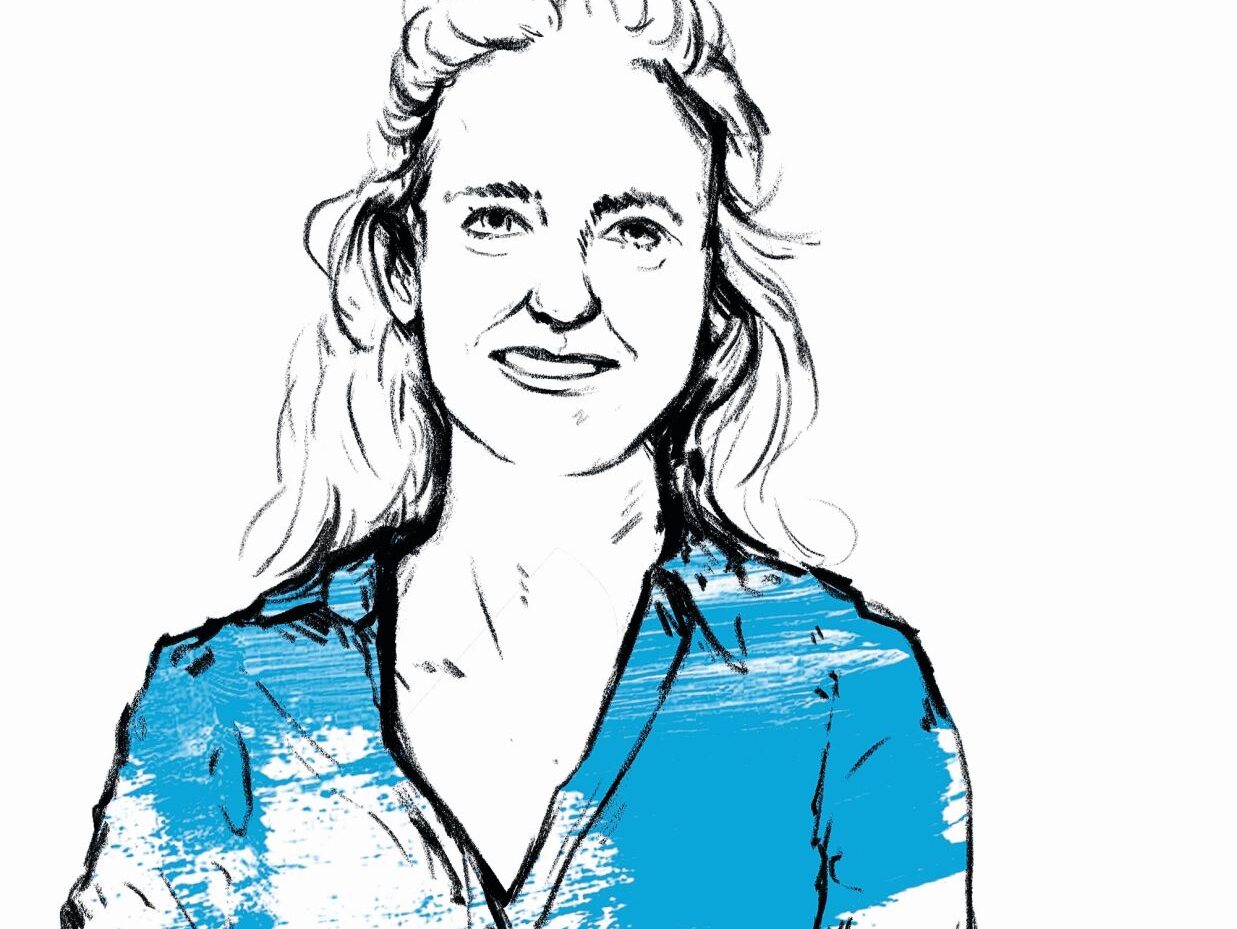
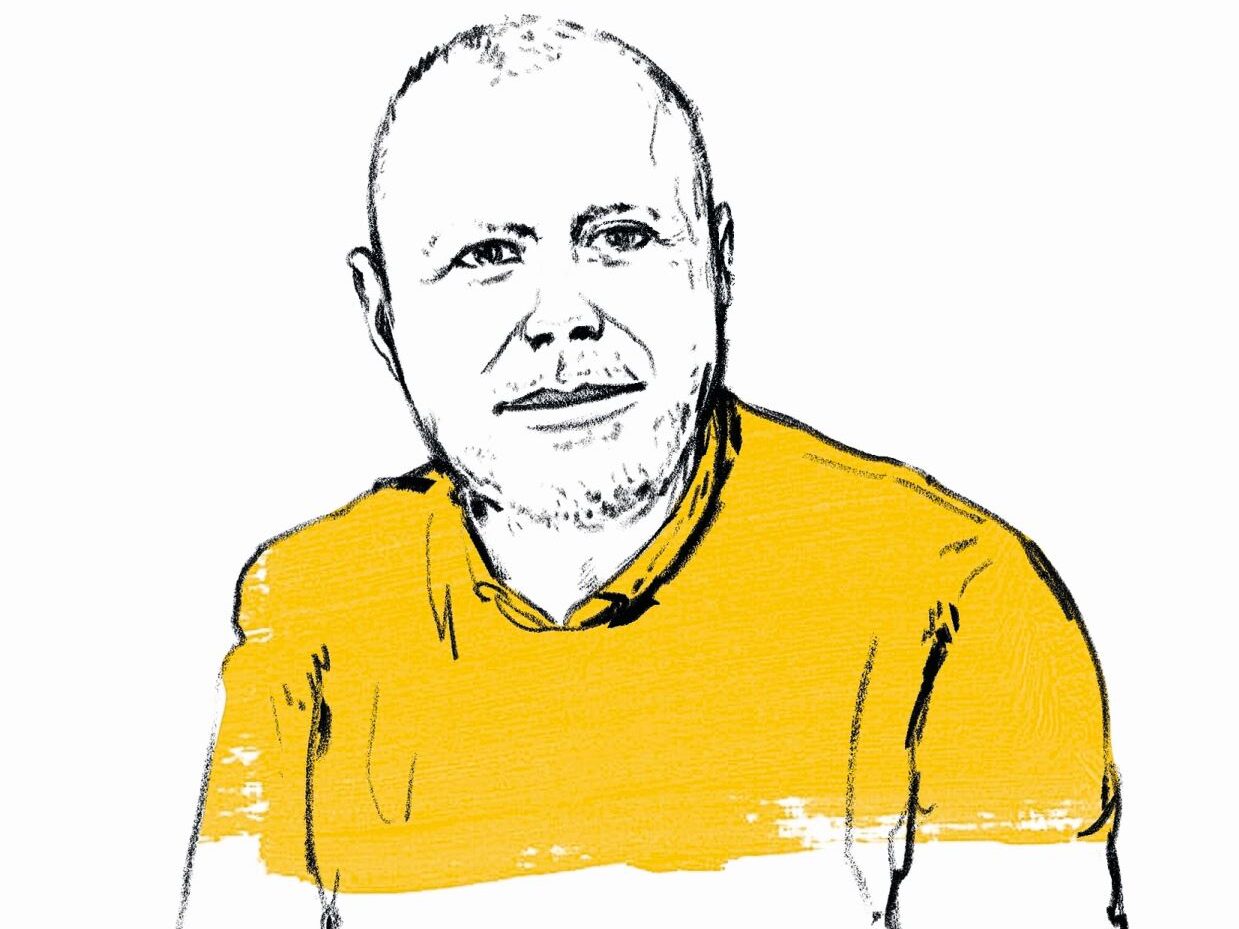
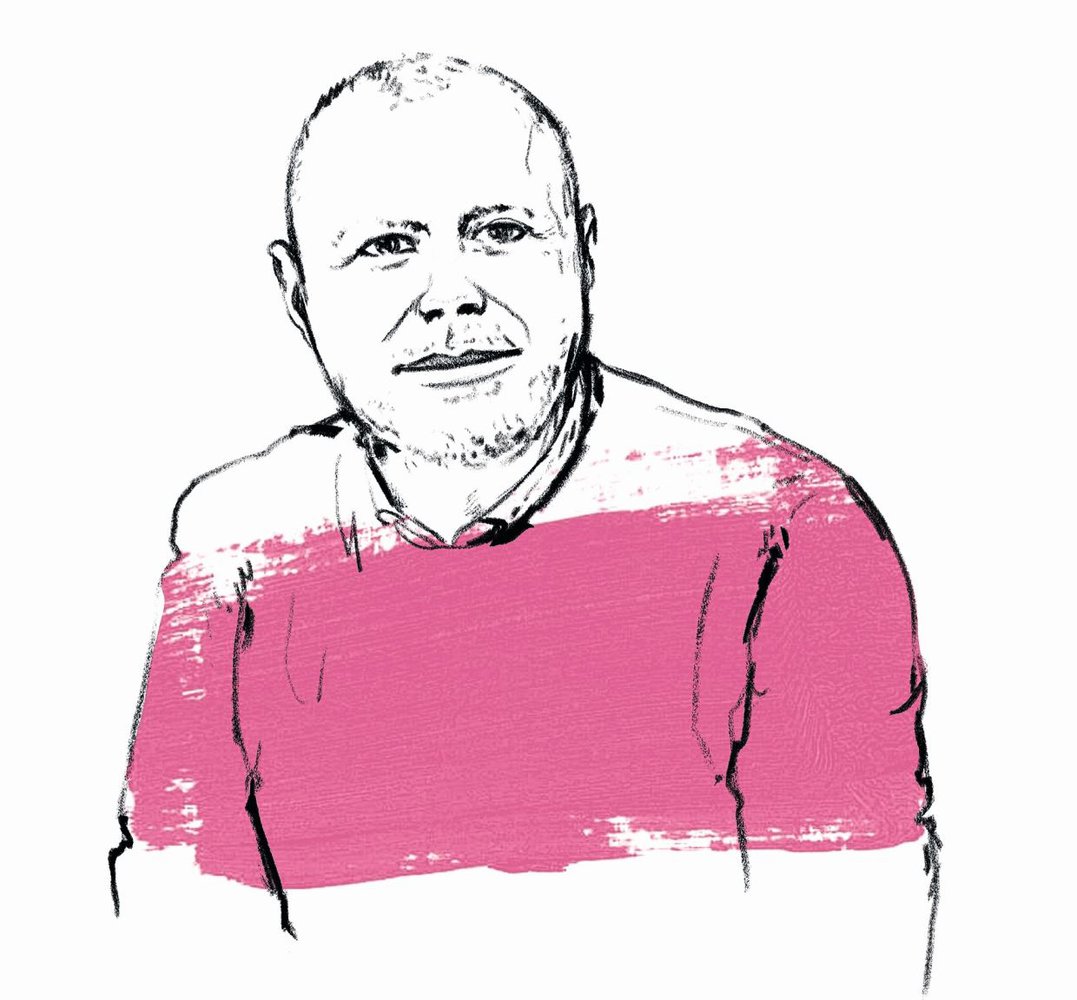
«No,» says Nicole Kopp, an industrial and organizational psychologist and co-founder of the company "GoBeyond." Her conclusion is that there is simply no single definition of the term. And there is a lot of work to be done.
Anna Kohler
-
February 14, 2024
(Photo: Luca David)
Things are going well. Very well, in fact. «Customers call us and ask for advice,» says Nicole Kopp, who founded the management consulting firm GoBeyond four years ago. Together with her team, Nicole guides individuals, teams, and organizations into the new world of work.
But what does «new world of work» actually mean? Or, as it’s so often called, «New Work»? Some say that New Work has failed spectacularly, that it makes people unhappy. What’s clear is that a transformation has taken place, especially since the COVID-19 pandemic. The world of work has experienced a surge in digitalization that enables many people to work remotely. This development is irreversible, says Nicole Kopp. But this new reality presents companies with much greater challenges. «New Work» often also means working in a more self-organized way. This brings new challenges: «New Work needs inner work.« When external structures fall away, people must build more structures within themselves—such as relationship skills, self-management, organizational management, and feedback skills. In other words, a great deal of personal responsibility. This must be learned. She gives an example: »When the boss assigns tasks to be completed, it’s easy and convenient to stand by the coffee machine with others and complain about the incompetence of upper management. But those who have to take responsibility themselves—who have to coordinate with colleagues about taking on tasks—have personal responsibility. Hierarchy-free work, in particular, demands a lot from employees. When everyone takes on leadership roles, it’s no longer so easy to gossip by the coffee machine. Of course, says Nicole Kopp, a company with flat hierarchies doesn’t operate on a grassroots democratic basis. The person best suited for a specific role on a specific project takes the lead. That’s exhausting. Some people don’t want to embrace this form of «New Work»; they prefer an eight-hour workday with little responsibility and feel overwhelmed by the demands of self-management. «That’s where we can help,» says Nicole Kopp. But managers, too, must reorganize themselves, adapt, and break down silos—not only in the workplace but also in their own minds. Changing one’s mindset is a never-ending process, because change continues at the same pace as people adapt to it. «Go Beyond» is, in fact, the name of the game. Step out of your comfort zone and into uncharted territory with an unknown outcome. That’s exactly what stresses so many people out, which is why the claim that “New Work makes people unhappy” isn’t entirely unfounded. Change is always associated with uncertainty, and that takes a toll. That’s exactly why Nicole Kopp and her team have their work cut out for them. What role does psychology actually play in this? What are the benefits of understanding people’s psychology during this process? “That’s crucial,” says Nicole Kopp. People are so complex and so vulnerable when it comes to change that a sensitive and empathetic approach is absolutely essential.
Who is Nicole Kopp?
To understand where Nicole Kopp’s individual strength—or even «superpower»—lies, let’s go back to the time before GoBeyond. Nicole Kopp grew up in a sheltered environment. She learned early on that work plays a major role in life. Her father commuted five hours every day, and her mother juggled work and family. “Sometimes, as a child, I would have liked to have had a mom who baked cakes and stayed home,” she says with a smile. Her honesty is striking, given that she herself is a working mom with a full-time job and two young children.
«If everyone takes on leadership roles, it won't be so easy to badmouth the higher-ups anymore.»
Nicole realizes early on that she is more sensitive than many of her peers; she needs places to retreat to. When things get noisy, it’s hard for her to cope. She comes home from the school camp exhausted, with a stomachache, and feeling overwhelmed. But she also senses that she can see into other people’s souls. Her high level of sensitivity and her love for people inspire her to study psychology. After an internship at a clinic, however, she realizes that she wants to work with healthy people. That’s why studying to become an industrial and organizational psychologist is exactly the right choice. Even while still a student, she begins an internship at a management consulting firm. She stays there for six years; the clients are in the high-end market—banks and insurance companies. She felt controlled by others and couldn’t exercise enough initiative, so she decided to leave. Her path led her to Wies Bratby, a Dutch attorney who, through the «WINners Program,» trains women to navigate the professional world as easily as a fish in water. During the training, she learns a lot about herself, her strengths, and her vision. She is given tools that show her that her path lies in self-employment. Together with a colleague who is a business IT specialist, she founded GoBeyond in 2020.
The company now has four employees and five additional partners in its network. Nicole is the public face of the company—not least because she has received increasing media attention in recent years. This is an advantage for the company, but it also comes with a heavy workload. As a Top Voice on LinkedIn, she is required to publish three posts a month. Since last year, she has been writing a monthly column for the NZZ am Sonntag, which takes up a lot of her time.
New Work hasn’t left Nicole unscathed either. Balancing work and family, in particular, has become a topic close to her heart. It takes a lot of self-discipline for her to live up to the high standards she sets for herself—as well as the expectations her clients have of her. «There’s a lot I don’t do,» she concludes. She doesn’t own a TV, isn’t on TikTok, and has a very small circle of friends. She used to exercise a lot, but that’s fallen by the wayside; watching a movie now and then, taking time for herself—all of that gets left behind. The price of self-employment is high. Still, she’d do it all exactly the same way again—that’s a nice way to sum it up.
How does GoBeyond work?
GoBeyond supports clients as they navigate the new world of work. The company provides consulting on agile strategy, works with teams on (hybrid) collaboration and role definition, and serves as a sparring partner for executives. Its clients come from a variety of industries, including communications and digital agencies, telecommunications, the food industry, banking, and manufacturing, to name just a few.
The Trojan horse
Consumers are definitely open to vegan dishes—but only if they come under different brand names.
Johanna Gollnhofer
-
February 14, 2024
(Illustration: Silvan Borer)
Vegan—what comes to mind when you hear this term? When I ask this question, I often hear the following associations from «meat-eaters»: «Not tasty, not healthy, no fun, sacrifice, being told what to do.» The vegan minority counters with positive attributes: «Incredibly delicious, animal welfare, climate!» However, the negative responses clearly outnumber the positive ones. The word «vegan» has negative connotations in the eyes of many people, so it’s no surprise that many people still buy animal-based foods—climate concerns aside.
So would it make sense not to label foods that are vegan as such? Would more people buy these foods then? After all, eating fewer animal products is good for our bodies, animal welfare, and the climate.
An Amazing Experiment
Researchers conducted an experiment on this topic. Participants in a control study were allowed to choose a gourmet basket as a thank-you gift. They could choose between a gourmet basket without animal products and one containing animal-based foods. For the gourmet basket without animal products, the label varied: it was labeled either «vegan,» «plant-based,» «healthy,» or «sustainable.» So, what did people choose when given the choice between a gourmet basket with animal products and one without?
It's all about the label!
When the gourmet basket without animal products was labeled «vegan,» only 20 percent of participants chose the basket without animal products (and 80 percent chose the basket with animal products). When the basket without animal products was labeled «plant-based,» 27 percent of participants chose it. When labeled «healthy,» 42 percent of participants chose the basket without animal products, and when labeled «sustainable,» as many as 43 percent of people chose it. That’s at least a twofold increase!
Negative associations
Why? «Vegan» has negative connotations for most people, the term «plant-based» isn’t really understood, and «healthy» and «sustainable» appeal, at least in part, to the values of most people.
For most people, enjoyment, variety, and sometimes even a piece of meat on their plate are important. Labels like «vegan» tend to put them off. So why not label something «vegan» with a more appealing name? Why not sneak it onto their plates like a Trojan horse? This will win over more people and drive the green transition forward.
* Prof. Dr. Johanna Gollnhofer She is an associate professor of marketing and one of the co-directors of the Institute for Marketing and Customer Insight at the University of St. Gallen (IMC-HSG). In our magazine, she writes monthly about exciting, sensational, or curious marketing studies from around the world. This month’s article is based on this study.
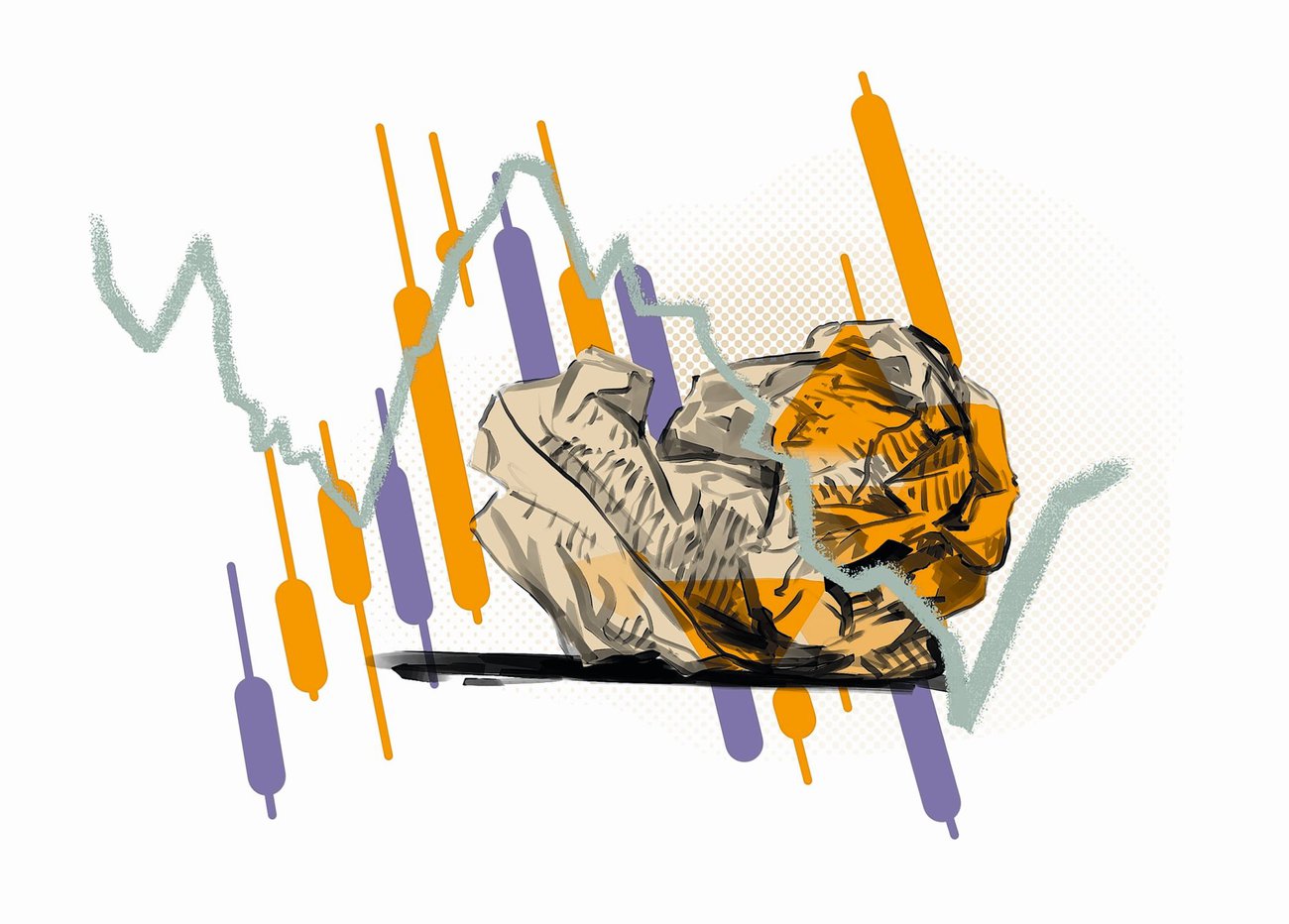
Future without cookies
Online advertising is on the verge of a turning point: the era without third-party cookies. There is a clear need for education on alternative targeting methods. How marketing professionals can prepare for this new reality.
Daniel Hünebeck
-
February 14, 2024
T he use of third-party cookies for targeted online marketing will soon be phased out. While Google Chrome will continue to support third-party cookies until mid-2024, other browsers such as Safari and Firefox have long since blocked them. With the introduction of the EU's ePrivacy Regulation, their use will now also be further restricted by law. In view of the imminent end of third-party cookies, advertisers and agencies are looking for alternative methods. Two prominent concepts are Universal ID and Topics from Google. Universal ID uses email addresses that are linked to first-party cookie data, while Topics identifies different topics in the Chrome browser and thus enables interest-based advertising.
The alternatives at a glance:
First-party data and server-side tracking: The growing relevance of first-party data as a tool for advertising campaigns is undeniable. Users who give their consent allow advertisers to use their data. Server-side tracking, where customer data is stored on a company's own servers, enables longer cookie lifetimes and greater control over data processing. This allows for more precise targeting and data-driven marketing strategies.
Topics API by Google: As part of Google's Privacy Sandbox initiative, the "Topics API" was developed to provide an alternative to traditional cookie-based tracking. This technology aims to enable interest-based targeting by analyzing the user's visit history and identifying topics that reflect their interests. These topics are then used to target advertising. In contrast to the individual user profiles created by third-party cookies, the Topics API is based on a less invasive method that uses topic categories to place relevant advertising. This offers a compromise between user privacy and effective targeting.
Universal IDs and ID systems: These approaches use uniform identifiers such as email addresses to track users across different platforms. Users register once with an ID provider and give their consent for advertising purposes. Such systems enable tracking across multiple platforms, but require a high level of user acceptance and reach. However, as users generally do not want to be tracked, it is questionable whether this is a long-term alternative method. Google in particular does not see this as a valid alternative and has therefore developed its Topics approach.
OneID is a new Swiss ID solution from OneLog that enables advertisers to target Swiss users efficiently and without overlaps via programmatic platforms. As an independent service of the OneLog login solution, OneID offers frequency capping and is also open to external publishers. Integration into the IAB Europe Transparency and Consent Framework ensures user control and transparency in data usage, laying the foundation for a future-proof digital advertising infrastructure.
Unified ID 2.0 from The Trade Desk is an initiative to create a new, collaborative identification solution that strengthens data privacy while providing effective advertising opportunities. It utilizes first-party data, with users giving direct consent for data usage, giving them more control over their information. This open and interoperable approach allows different parties in the advertising ecosystem to access a common identification method that is not controlled by a single provider. The goal of Unified ID 2.0 is to provide a transparent and consensus-based alternative to traditional cookie-based methods that is beneficial to all parties involved in the advertising process.
Contextual advertising has been around for a long time, but is now experiencing a renaissance. This is partly due to the end of third-party cookies, but also because the technology is much more advanced than it was 10 years ago. It is an approach that uses the content of a website or medium to place relevant advertising. Instead of relying on user data, this method is based on the context in which the user is currently located. For example, advertising for camping equipment or hiking boots could be displayed on a website about outdoor activities. This method respects the user's privacy as no personal data needs to be collected or analyzed. Instead, it is based on the assumption that the content the user consumes allows conclusions to be drawn about their interests and potential purchase intentions. Contextual advertising is particularly suitable for brands that operate in specific niches or industries and want to ensure that their advertising is highly relevant in a specific thematic environment.
Artificial intelligence and predictive audience models: AI-supported approaches based on probabilities enable the creation of models that function in a similar way to target groups. Strong algorithms based on extensive data pools can predict user behavior and thus enable more effective advertising campaigns. Although these methods require a large pool of data, they offer the potential for extremely precise targeting.
With the elimination of cookies and the difficulty of recognizing users, the performance of campaigns is impaired. This could lead to an increase in the cost of effective digital advertising. On the other hand, third-party data cost a premium, which is now no longer applicable. In addition, the smaller the target group, the higher the auction price had to be paid in order to actually reach it. In a cookie-less world, CPM prices should therefore tend to fall and (partially) make up for the performance losses. Whether this leads to declining performance will depend very much on the individual case.
Tips for advertising clients
Advertisers should focus on first-party data and possibly implement server-side tracking to maintain control over their data. They should also specialize in data handling and be ready to adapt to technological developments. Above all, they should keep an eye on and test the many alternative options. Advertisers should require their agencies to familiarize themselves with the latest technologies and methods for cookie-less targeting and develop strategies accordingly. It is important that agencies are able to allay fears about reach and offer effective alternatives.
Online advertising is facing a significant change. It is crucial that advertisers and agencies alike adapt and develop innovative solutions to succeed in a cookie-free world. The future belongs to those who embrace technological advancements and focus on the use and analysis of first-party data and other non-cookie-based methods.
*Daniel Hünebeck is a digital expert, works for the SWA, Digital Ad Trust Switzerland and is a lecturer at the FH Grisons.
Tips for advertising clients
1
Investment in first-party data:
Collect and use data that comes directly from your customers. This can be done through newsletter registrations, customer surveys or loyalty programs.
2
Testing new ID solutions:
Test alternative identification solutions such as Unified ID 2.0 or Topics from Google.
3
Increased use of contextual advertising:
Focus on contextual advertising based on the content of the website where the ads are displayed.
4
Technological partnerships:
Be open to new technology providers that offer innovative solutions for the cookie-less era and take a look at their solutions.
5
Constant market observation:
Stay informed about developments and trends in digital marketing so that you can react quickly to changes.
"It's important that agencies are able to allay fears about outreach and offer effective alternatives."
Norma Percy has been producing the BBC’s most important political documentaries for more than four decades and has won awards including a BAFTA and an Emmy. A conversation about power, methodology, and Bill Clinton’s lunch.
Johannes Hapig
-
February 14, 2024
(Illustration: Silvan Borer)
m&k: Norma Percy, you’ve had an impressive career. Your documentaries have won awards including a BAFTA and an Emmy. You’ve interviewed some of the most powerful people in the world. Is there one interviewee you have particularly fond memories of?
Norma Percy: I’ll never forget my first interview with Bill Clinton. Not just because he’s one of—as you say—the most powerful people in the world, but because he’s a gifted storyteller. My colleague Brian Lapping and I tried to get him in front of the camera throughout his entire presidency, and he was «in principle agreeable,» but in the end, we always ran into scheduling conflicts. But then we finally managed to get him (laughs) —specifically, in the first few weeks after he left the White House. Hillary was running for the Senate, and Bill was alone—apart from the Secret Service—at the family estate in Westchester. It was the perfect moment for a conversation. His secretary was still in Washington; other than that, there was no staff around, so there was no way to send him our questions in advance. But he looked them over for ten minutes while we set up our equipment—that was enough for him. We were working on a film about the Northern Ireland conflict: It had been Clinton who, in 1994, had arranged for a U.S. visa to be issued to Gerry Adams—at the time the leading figure in the IRA and, in the eyes of the British government, of course, a terrible terrorist—so that Adams could participate in peace negotiations there. I asked him if he remembered the exact moment when he gave the «green light» for Adams’s visa. He replied: «I’d been to lunch with Helmut Kohl beforehand. He loved to eat, and so did I. We had a fantastic time. Afterward, the Adams case was on my desk.» I couldn’t help but think—forgive me—«Digestive problems with Gerry Adams.» (laughs).
«Bill Clinton wanted me as an advisor. Was he serious? We'll never know.»
Clinton, however, apparently has an excellent memory.
Oh, yes. He remembered every detail—the British were against the visa. The U.S. State Department was against it. The Department of Justice was against it. But he thought, «We have to give peace a chance.» We talked for quite a while, and then it was time for our team to return to London. We almost missed our flight because Bill was determined to give us a tour of his new office, where various photos were already hanging on the walls. Each one came with—of course—a typical «Clinton story,» and you can imagine how hard it is to just walk out of there. (laughs).
After that, you spoke with the former U.S. president several more times, right?
Yes, most recently it was more of a spur-of-the-moment thing when we were making a documentary about Cuba. I don’t think I’ve ever mentioned this publicly before, but I was actually just the «executive producer»—responsible for overarching themes—and wasn’t directly involved in the research. I was far too busy with a Europe-related topic to also be deeply engaged with Latin America at the same time. However, my colleague, who was supposed to interview Bill Clinton in New York City, was going through a difficult pregnancy at the time and asked me—practically at the last minute—to fill in for her. So I put the European files aside and headed off to the U.S. (laughs)! The meeting in New York was very, very different from the one in Westchester years earlier.
In what way?
By now, the machinery surrounding the former president was running like clockwork. And he was obviously prepared, because he greeted me with a firm hug. «Norma,» he said, «it’s been so long. I’m so glad to see you.» Deep down, I suspected that his office had briefed him on when we’d met in previous years. But the way he hugged me… You just want to believe Clinton, you know? Once we were done with the actual questions, we sat together for a while longer—and ended up talking about the situation in the Middle East. I could sense that Clinton was convinced that, as president, he had come very close to brokering a lasting peace agreement for the region. And he was considering continuing his involvement there as a mediator. «If I do that, Norma,» he said, «then you’ll have to come along and advise me.» Was he serious, or was he just trying to flatter me? We’ll never know. But it was certainly charming.
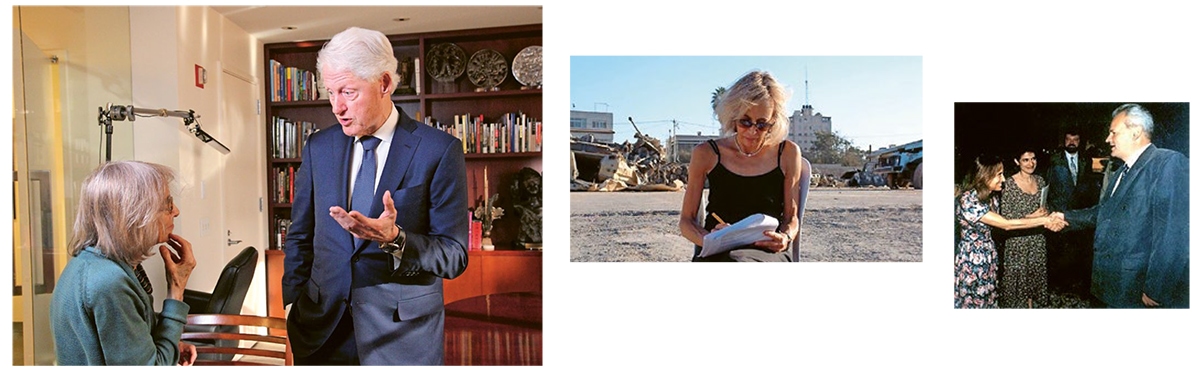
At work: Norma Percy with U.S. President Bill Clinton (left), near Yasser Arafat’s home, and with Yugoslav and Serbian leader Slobodan Milošević. (Photos: courtesy of the source.)
You got along well with Bill Clinton, but you didn't give him any special treatment. There are audio recordings of your interviews in which he refuses to answer certain questions …
He didn't refuse; he just wanted to clarify. In our series «The 50-Year War,» we reported on his plan to make peace with Syria. I asked him about his latest attempt in this regard—during a meeting with President Assad in Geneva. Clinton said he couldn’t possibly talk about it without first discussing the negotiations in Shepherdstown. And he was right—because his overzealous advisors were gesturing at me from the background to wrap things up, I had cut out a question about the earlier Shepherdstown negotiations. But Clinton persisted. So I asked. As the conversation continued, it became clear to me: At the earlier meeting, Syria had been ready to make peace, but Israeli Prime Minister Barak had «got cold feet.» You really had to know that to understand Assad’s behavior in Geneva. At that moment, Clinton was a better historian than I was.
The anecdotes about Bill Clinton clearly illustrate how you work—the BBC describes your method as the «Norma Percy style.» You don’t ask your interviewees for their opinions or judgments—as many of your colleagues do—but rather you want to “hear what happened.”.
Perhaps many of my colleagues and I are pursuing different goals? Or the same goals, but through different paths? My colleague Brian Lapping and I want to show the world what it would be like to be «in the room,» so to speak, when the really, really big decisions are made. These are often secret meetings that we only learn about after the fact—or where the people involved aren’t allowed to speak about them until years later… There usually aren’t any photographers around, and there aren’t any voice recorders on the table. So we go back afterward to those who were there and have them recount in detail what they remember. Now you’re going to say, «Norma, politicians lie!»
I am a little more optimistic about this, but I can imagine that all the people you interview present a version of history that is favorable to them. That would be only human, but it would skew your reporting.
In my experience, politicians are generally convinced of what they do. If you treat them with fairness and openness, they are usually willing to provide a relatively objective account of the events in which they were involved. You just have to ask the right questions—that’s something I had to learn myself. (laughs). When we were covering the end of the Soviet Union as journalists in the early 1990s, I said to a top official of the former Politburo: «Tell me what happened at the meeting, just as you told your wife when you came home that evening.» The man was shocked! He didn’t want the whole world to be able to watch on TV what he and his wife had discussed with each other. (laughs). I drew my own conclusions from this and came up with a different way of phrasing it. But at its core, this is exactly the kind of insight I'm looking for.
And if, by any chance, the accounts of individual parties involved don't add up …
… then we trust the viewers to make up their own minds. Take, for example, our current series on Putin’s war in Ukraine—a new episode aired a few days ago. In this episode, we speak with, among others, Liz Truss, who was the British foreign secretary at the time, and the Russian ambassador to London, Andrei Kelin. On the day of the Russian invasion, Truss summoned the ambassador and—to put it bluntly—gave him a piece of her mind. Both confirm this in our program. They only have conflicting memories regarding the end of their meeting.
That's right, I noticed that.
Kelin told us that Liz Truss had simply walked out of the room and that he found that rather rude. Truss, on the other hand, said she had thrown Andrei Kelin out. That is something we, too, are unable to clarify definitively using our method. But I’m convinced that if both of them have seen the documentary, they each feel they were portrayed accurately and fairly. The rest is up to the audience.
«Never underestimate the intelligence of your audience.»
Helping people form their own opinions rather than influencing their opinion-forming process.
That's right. When I was younger, I worked for the production company Granada TV, and its head, Sir Denis Forman, used to say, «Never underestimate the intelligence of your viewers, but always assume they might be lacking important information.» Most people actually have a pretty good sense of whether someone is lying or telling the truth in an interview.
In the program you just mentioned, you also report on the UN Security Council meeting that took place on the day of the invasion of Ukraine. I was impressed by how many key figures you were able to interview afterward. How do you gain access to these individuals?
First, we explain in detail—for example, via letter or email—what we do and what we intend to report on. Then we usually propose two meetings spaced out over time: the first one is not recorded, but during it we discuss the questions we plan to ask later. With the information from this meeting, the relevant individuals can then review their notes and official documents once more, reflect on the matter, and so on. As a result, by the second meeting, they are well-informed, provide our viewers with valuable insights, and feel at ease—which is not to be underestimated. We actually plan in terms of research, filming, and production phases, but because we want to accommodate the protagonists of our documentaries as much as possible, these phases often overlap. Please don’t forget: The people we approach hold all the cards. If they decline an interview, there’s nothing we can do. So we have to be flexible. But by the way: I’m glad you brought up the scene from the UN Security Council.
Why?
I consider the coverage of the UN Security Council meeting on the day of the invasion of Ukraine to be some of the best work we’ve done in the past 40 years. It really makes you feel like you’re right there. And so much is happening all at once! You witness the ruthlessness of Putin, who is attacking Ukraine while the UN Security Council is in session. The Ukrainian ambassador, whose country is under attack, is in the room, and the Russian ambassador, whose country is starting the war, is presiding over the meeting as chair. Look at how nervously and surprised he is as he fiddles with his phone… I don’t think he was privy to Putin’s plans.
And then the Ukrainian ambassador asks his Russian counterpart if he’d like to see a few videos from Kyiv. He says he can play them on his iPhone. The missile strikes, the panic …
Barbara Woodward, the British ambassador to the UN, told me that they had «heard all the phones buzzing at once.» That makes sense, of course—during a meeting like that, cell phones are set to silent mode—but the vibration alert kicks in, and push notifications keep coming in. For everyone sitting in that room, more or less at the same moment. Just imagining it sends a chill down your spine, don’t you think?
Since we're on the subject of Russia: Was it harder to get access to Gorbachev and the members of the Politburo—or to Putin and his entourage?
Toward the end of the Soviet Union, the timing was better than it is today. Timing is crucial. Yes, we had some initial difficulties with the Politburo, but Gorbachev’s «glasnost»—his policy of openness—had already progressed so far by the time we were dealing with the crumbling USSR that the rules of the past seemed to have been suspended. And then, quite quickly, all the barriers came crashing down. The Politburo members had no idea how to conduct interviews with independent journalists and thought—and please take my word for this—that they had to tell the BBC the truth. We produced a five-part documentary, and the first episodes aired on television while we were conducting research for the next ones. Of course, this influenced our interviewees, and—can you imagine?—the former head of the KGB became a real fan. When I spoke with him, he recounted his memories in a rather dramatic way: «It was a mild, wonderful summer night…,» and then asked me, «Is that it, Norma? Are those the details you need?» (laughs)
In previous years, you spoke directly with Vladimir Putin about a number of topics, but in your current broadcasts on the war in Ukraine, he is only mentioned indirectly. You can no longer reach him, can you?
No. A few months ago, I had a phone conversation with Dmitry Peskov, Putin’s press secretary. It may sound paradoxical, but Peskov was very polite and calm; there was no sign of hostility in his remarks or tone of voice. However, he made it clear that I would not be able to speak with the Russian president in the foreseeable future—perhaps never again? I have to accept that. In situations like this, we fall back on archival footage; we show speeches by Putin or Sergei Lavrov, who also no longer wants to appear on camera. We have, however, interviewed the Russian ambassador in London, the Belarusian representative to the United Nations, and the Russian ambassador to the UN. We can assume that their statements are carefully coordinated with the Kremlin. And it also depends on what «spin» you give a TV program. Yes, I place enormous importance on speaking with as many of the people as possible who were «there» when something happened. But if we’re making a documentary about Russia and the West, in which the fundamental question is how Western politicians have dealt with Putin—and are trying to deal with him today—then it’s perhaps more important to talk to the former. Here’s an example: David Cameron initially tried to «pull Putin’s fangs,» opting for a conciliatory approach… and only stopped doing so when the Russian president defended the poison gas attacks carried out by his Syrian ally Assad. That was Cameron’s «red line.» Do I need to interview Vladimir Putin for a documentary with this content? No. But I do need to get the «Cameron camp» in front of the camera.
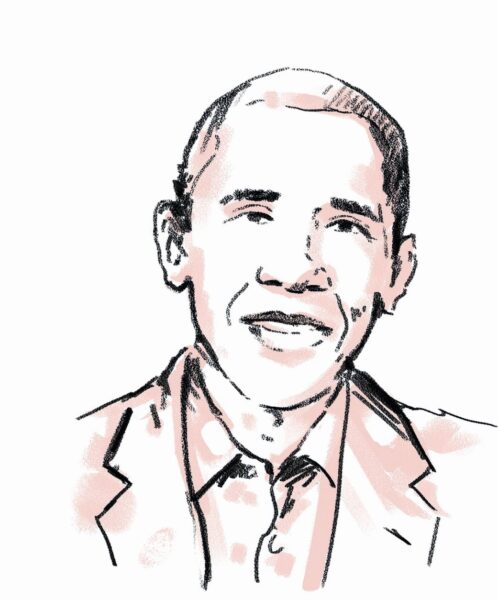
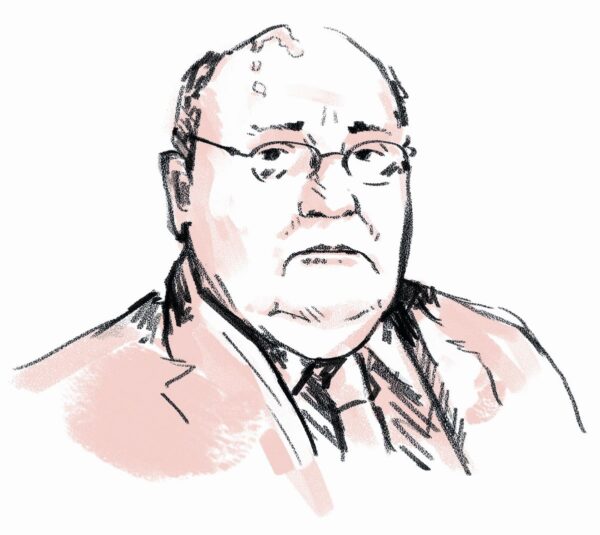
Letters Upon Letters: To persuade the world’s most powerful people to grant interviews, Norma Percy sends them detailed project proposals …… and in doing so, it has not only influenced U.S. President Barack Obama …… but also managed to get former Soviet President Mikhail Gorbachev in front of the camera.
In your reporting on Russia and Ukraine, you are breaking one of your most important rules: never to cover wars or political developments that have not yet come to an end.
Yes and no. Our series on Putin and the West—with a special focus on Ukraine—began with Yanukovych’s rapprochement with the West, to which Putin responded by annexing Crimea. Then we looked at Russia’s Middle East policy. And after we’d spent about six months researching a possible third part of the series, the invasion happened. So we’d gathered plenty of material to shed light on the steps leading up to the war in Ukraine, even though we ourselves couldn’t have known that the war would break out. The BBC asked us to use this material… and we agreed. What was broadcast a few days ago—the first days of the invasion—is already history, but you’re right: it’s history that is still unfolding, and we don’t know how it will end.
You haven't mentioned one of Putin's most ardent admirers yet—namely, Donald Trump. He is probably the only statesman missing from your «collection.».
That's true. But does that make me sad? (laughs)? I have so much evidence that what he says in private conversations is exactly the same as what he spouts in speeches and on television. I don’t think a conversation with him would add any value, either for me or for the audience. I’d rather ask heads of state and members of his administration how they perceived Trump. And then I’ll make a film based on their statements.
Is there actually a documentary you would have liked to produce but never did? Or one you’d really like to make someday?
October 7, 2023, provided us with a sad occasion for a new episode of our Middle East coverage. In our programs, we’ve covered developments up through 2005—when, according to the Sharon Plan, Israel’s presence in certain areas was supposed to be reduced or ended entirely. That was nearly two decades ago, and as you know, a lot has happened since then. In any case, there was no peace. Many of the seeds for the current conflicts were sown back then, and that’s what I want to trace—so that people can better understand why we find ourselves in the situation we’re in today. As always, that’s the driving force behind everything I do.
Norma Percy is a British documentary producer who, through her company BrookLapping, works almost exclusively for the BBC. Her elaborate series, often curated over several years, are characterized by her distinctive “Norma Percy style” and have already been honored with one Emmy, two BAFTAs, five Peabody Awards, and other prizes. Many of her documentaries are Available for free on the BBC Video Player, Users in the DACH region simply need to install a VPN client.
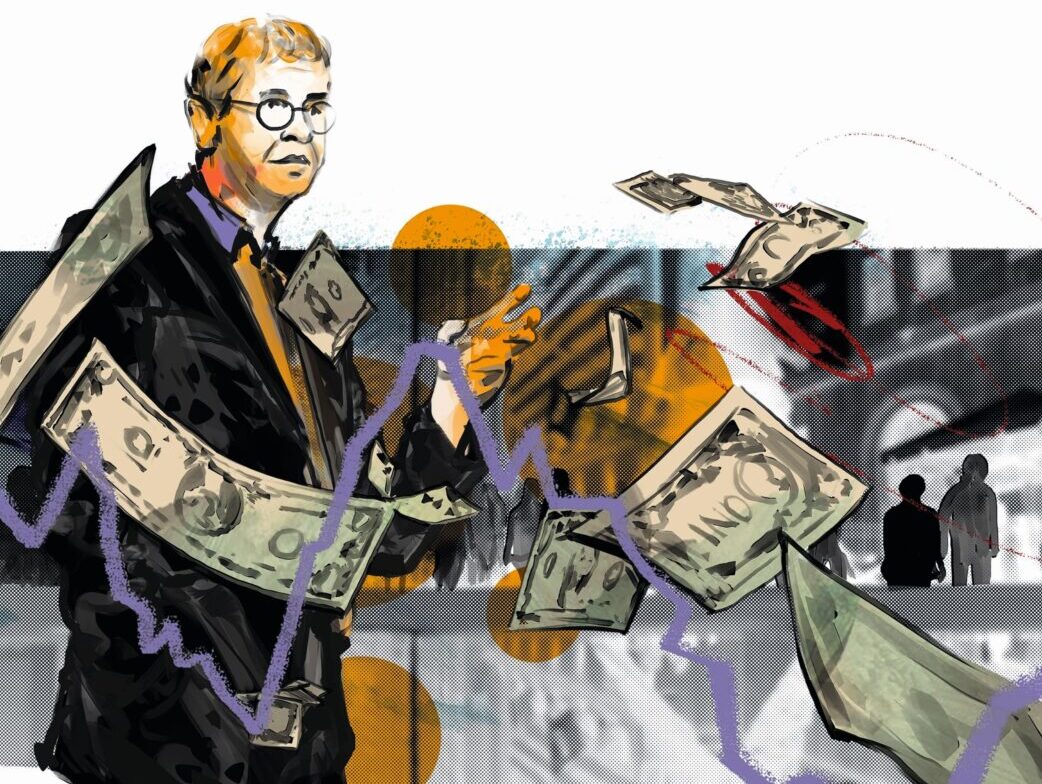
A. Michael Spence: Fragments of the new world
Nobel Prize-winning economist Prof. A. Michael Spence is causing a stir with a new book: Together with former British Prime Minister Gordon Brown and star economist Mohamed A. El-Erian, he calls for acknowledging the fragmentation of the world order—and building something new from its parts.
Johannes Hapig
-
February 13, 2024
(Image: zVg. / Editing: Silvan Borer)
m&k Werbewoche.ch: A. Michael Spence, the story behind your new book "Permacrisis: A Plan to Fix a Fractured World" could begin like a popular joke: "Three people walk into a bar ..." - and these three people are a Nobel Prize winner, a British Prime Minister and a world-class economist.
Prof. A. Michael Spence: Well, if you want to use a bar as a metaphor, it would have to be a digital bar (laughs). Gordon Brown, Mohamed A. El-Erian and I had the conversations that eventually became the book virtually - during the Covid pandemic. Mohamed played a central role: we've known each other for more than 15 years, I've learned a lot from him, and he in turn has known Gordon forever. During the pandemic, the two of them were often on the phone or zooming in on each other and exchanging ideas, first about the British economy, then about the global economy. Mohamed was interested in my perspectives on certain topics, so he invited me to join the conversations. This turned into a discourse lasting twelve or 13 months ...
... which you then decided to record in book form?
Yes, although Mohamed asked a pertinent question immediately after this decision: "Did anyone actually take notes?" (laughs) Of course, nobody had done that. So we divided up the terrain and formulated guidelines: What new growth models and forecasts are there? What implications do political changes have for the global economy? What challenges, but also opportunities, do we face? What mistakes are we currently making? Is there a way to strengthen positive trends and mitigate negative trends? Of course, we didn't want it to sound to readers as if three authors with very different "sounds" had written individual essays that were then compiled into a book. So we brought Reid Lidow on board - an incredibly talented author who Gordon knows from previous projects. He turned our "expert speak" into elegant and, above all, comprehensible formulations, and then it only took eight months for the publisher to start distributing the work.
"We live in a world in which global shocks are overlapping."
This is remarkable, especially because the book is dedicated to an interweaving of enormously complex problems - which is why you refer to a "permacrisis", a permanent crisis, on the title page. Why did you choose this term?
Because we live in a world in which not only are local crises occurring more and more frequently, but there is also a superimposition of global shocks. Take the economy alone: the Asian financial crisis was followed by the bursting of the "dot-com bubble", "9/11", then the global financial crisis, then the sovereign debt crisis in Europe - and finally the Covid pandemic, which not only cost many people their lives, but also cost many companies their economic foundation. Or look at climate change: There are so many natural disasters occurring in such quick succession that we no longer need to make plans for the next 30 or 40 years, we need to act now! And then there's the war in Ukraine ... When our book is published in paperback, we will probably have to include a new war in the Middle East in our analyses. So the first dimension of a perma-crisis is a shift in the event structure from "A is followed by B is followed by C" to "A and B and C happen simultaneously, everywhere, and interfere with each other".
And the second dimension?
That would be a fundamental, structural change - which is often overlooked as a component of perma-crises. However, it is not only the overlapping shocks that constitute a perma-crisis, but also changes in the global economy and the institutions that have shaped and regulated it to date. The transformation of supply chains, the trade in energy, the accumulation of economic power in territories that were previously labeled - and treated - as emerging markets ... all of these are arguably irreversible developments, partly evoked by the external events mentioned, partly motivated by history or political strategy. The fundamental question of our book lies in the combination of both dimensions: How do we find our way in a world that is only just emerging? And how do we - as politicians, bankers or business leaders - make the best of it? You know, we can either look depressed at the erosion of the order we know or try to see the good in what is coming. The decision is up to us.
In your book, you do the latter - it therefore has a thoroughly optimistic undertone.
The growth of new markets is not a negative thing per se, just like the scientific and technological innovations that can emerge from crises. Just think of the hyperboost that the pandemic has given to the development of a new class of vaccines - we could benefit enormously from this in the future. However, we first have to make the mental shift towards a "crisis as a resource", because it is not exactly in the human nature (laughs).
Because you are talking about new markets in emerging countries: Has the time when "the West" sets the pace and the rules come to an end? And if that were the case, was globalization never really inclusive?
Good question. Globalization was inclusive as long as we benefited more from it than others. As long as our "suppliers" didn't show too much desire, we didn't mind that there was a transfer of know-how and technology, that they got a slice of the cake and that this reduced inequality on the planet. But did we want true, perfect equality? No. We wanted the lion's share of the profits for ourselves and we wanted to rule. This is not a moral judgment, but simply an observation I have made as an economist. On the one hand, this makes our suppliers more and more self-confident because we are becoming more and more dependent on them, and on the other hand it has serious domestic political consequences if we relocate production jobs to low-cost foreign countries. Countries become bolder, more aggressive when they are no longer dependent on us as "customers", but the situation is reversed; and people become frustrated when they lose their jobs. "Why aren't we invited to the party you're having at our expense?" - this is the question that nations and individuals alike are asking themselves, and in this question - whether it sounds like populism or not - lies explosive power.
"Globalization was inclusive as long as we benefited more from it than others."
You and your co-authors speak of the emergence of a "multipolar world" in which the blocs and alliances of the past are becoming obsolete. Can this term still be used at all in academic discourse - or have autocrats like Vladimir Putin and Xi Jinping not long since turned it into a political battle cry?
We can simply remove the term from our vocabulary - problem solved (laughs)! But joking aside: when we say multipolar, we mean a permanently moving variance of political and economic centers of interest that cooperate with each other in area X, but can have absolutely contrary views in area Y. People like Putin and Xi are more likely to mean new, but definitely consolidated centers of power - China and its supposed sphere of influence as a pole, Russia and its supposed sphere of influence as a pole, etc. But this is not a development, not an adequate representation of our world - in this idea, a few blocs simply become many blocs that are either allied with each other or see themselves as opponents. We, on the other hand, think that the BRICS states may be interested in cooperating closely with the USA on climate change, but are bothered by the dominance of the US dollar. Global politics will thus become ... well, at least it won't become any clearer (laughs). But in future, we will have to continually balance out where we can find common ground instead of speaking in absolutes.
However, this has not only economic but also security policy aspects.
Absolutely. We no longer trust each other. Numerous heads of state and government are working hard to ensure that the situation does not get out of control, but the influence that the West had after the end of the Cold War has also declined drastically in security policy issues. And - even if there may be other voices - I believe that this influence has actually been good for the planet. The powers that were trying to control the destiny of the world were largely benevolent. The G7 - for a while, with a much more moderate Russia, the G8 -, the UN Security Council, the IMF or the World Bank ... wanted to protect the global community from harm. However, they could only function as long as there was a minimum level of international consensus. This gave them power and a mandate. Today, it would no longer work for a European country to outvote China on currency issues; today, the UN can hardly pass any resolutions because someone is always blocking something. The major institutions have become paper tigers.
Can we reform the institutions - or is it more realistic, as you said earlier, that we only negotiate on specific issues when it is convenient for several players?
In the short to medium term, the term alliance will be synonymous with "equal interest at the same moment". I know that's not nice - and Gordon would argue that pragmatism is no excuse for not working hard to re-establish multilateral institutions. I agree with him, but it will take time. And until then, we have to keep in mind that nobody wants to run their national economy into the ground, so trade could open the door to broader cooperation when the time is right. But maybe we'll do better this time with trade and make it truly inclusive, otherwise someone is guaranteed to end up feeling left behind again ... and we'll have new problems.
Trade between Russia and Europe has not been able to prevent the war in Ukraine.
That's right. But in principle, I would say that if you have close economic ties with other countries, you should at least think twice about doing anything that could jeopardize these ties. They are ... better than nothing.
One of the guiding ideas of Fukuyama's "End of History" at the beginning of the 1990s was that capitalism as an export model inherently includes democracy as a model for success ... and that all countries will adapt the latter. Now we realize: Capitalism and democracy can do without each other.
We hoped that countries that develop their economies would also reform their government systems as they become more prosperous - that they would "do business like us" and thus "become like us". It turned out differently.
Why?
Because we initially neglected the diversity - the spectrum - of capitalist models in the hope that "everything would finally be fine" after the Cold War. There is no "one" capitalism that you can impose on any country. The only certainty is that extremes do not work anywhere - radical liberalism, which allows the economy to operate without regulation, is just as doomed to failure as a planned economy. This is because the latter lacks incentives for individual commitment: you can rely on Adam Smith's writings or delve into the disastrous political experiments of recent Chinese history. Do you know how the Chinese economy experienced its first "boom"? By motivating farmers to produce more than their quotas and promising them that they would be allowed to sell the overproduction on the free market. So much for a planned economy. Anyway, back to my point from the beginning: we have long assumed that there is a kind of "median capitalism" where all nations will gradually come together. We have also believed that there is a "median democracy". Both are wrong. Apart from the extreme models we have mentioned - which are doomed to failure a priori - the controls and spectrums are constantly being shifted everywhere, the boundaries are being explored, the parameters are being re-evaluated. We have to come to terms with this.
"We are unable to predict whether the AI surge will lead to an S-curve or continue."
In your new book, you also deal with the consequences of artificial intelligence for the world of work. I have to ask you the crucial question: Will AI boost our productivity - or make a lot of jobs obsolete?
I don't think we'll be able to make a final judgment for a few years yet. There are still too many variables in the equation. I have just published a paper with James Manyika from McKinsey in Foreign Affairs where we look at this very question: James understands a lot more about the technology than I do, but we agree on the potential consequences of ever wider adoption. Initially, we will see a huge surge in productivity throughout the economy, but we are not able to predict whether this surge will end in an S-curve - i.e. come to a standstill at a certain plateau - or whether it will continue.
Do you have a guess?
Now: Generative AI differs from older speech recognition or image recognition algorithms in its broad applicability and accessibility. You don't need any training to interact with Chat GPT, write simple prompts and use the AI as an assistant. I think that will be the primary function for a while at least: Assistance. Not full automation that makes human input obsolete. The computer writes the first version of software, the engineer improves it. The computer writes a draft of a patient report, the doctor adds important details. And so on.
So it's not about replacing the software engineer or the doctor. It's about relieving them of tedious work so that they have more time to use their specialist knowledge in a more targeted way.
That is correct. That is the optimistic prognosis that I advocate - and that we also advocate in the book. I am of course familiar with Erik Brynjolfsson's "Turing trap" and, applied to AI, the distorted perception of automation that CEOs or HR leaders must not fall for. First, we build a machine that, when we ask it questions, gives us the feeling that we are not talking to a machine. It therefore seems obvious to us to compare the output of AI with that of humans; there must be some kind of benchmark. But if we conclude from this: "AI is faster and better - let's get rid of humans", then we are endangering companies much more than we are doing them any good.
Why?
Because the increased productivity that AI can ensure will not generate a "surplus" of output, but will fill the gaps that could not be filled otherwise. The USA and many European countries are suffering from a blatant shortage of skilled workers and an ageing workforce - so this is an excellent time to use AI to compensate for the workforce that will be lost.
In various interviews over the past few months, you have said that your new book does not offer a panacea for the ongoing crisis of the present. It could be seen as a conversation starter or a wake-up call, but it does not contain a perfect solution. Do you sometimes ask yourself what could happen if global leaders don't heed this wake-up call?
Let me start by saying this: I have always been someone who has admired the courage of business leaders and politicians. As a scientist, I have it good: I only "have" to research, write and give lectures. But heads of government and CEOs have to operate in a system of manifold interdependencies and take dozens of factors into account in every decision. It's a veritable art - you need not only expertise, but also character and talent to do it well. Now to your question: if those who make the decisions don't adapt their actions to the facts - if they resist the new disorder of the world instead of exploring innovative opportunities in it - it could become unpleasant. I don't like to talk about catastrophes or a complete standstill of the economy, that doesn't suit me. But we would be using so little of the potential that lies hidden even in this permanent crisis that it would be a terrible waste! With all the negative news these days, we must not simply sit back and wait like rabbits in front of a snake to see if we will be eaten. We must realize that challenging circumstances can catalyze positive solutions and act accordingly with courage. We should not keep our fingers crossed that the world will become more pleasant and easier by itself. We should keep our fingers crossed that we can make it more pleasant and better.
Andrew Michael Spence is an American economist. In 2001, together with George A. Akerlof and Joseph E. Stiglitz, he was awarded the Alfred Nobel Memorial Prize in Economic Sciences for their work on the relationship between information and markets, in particular adverse selection. Spence was a professor at Harvard University (Graduate School of Business), before that he was at Stanford University.
In her book "Permacrisis: A Plan to Fix a Fractured World" Nobel Laureate in Economics A. Michael Spence, former British Prime Minister Gordon Brown and star economist Mohamed A. El-Erian paint a pragmatic picture of the present - without falling into pessimism. A refreshing plea for resilience and a spirit of innovation.
Let's give freedom of thought
Agencies can only thrive if their employees are allowed to think and act without restrictions. A plea.
Alexander Haldemann
-
February 11, 2024
(Illustration: Silvan Borer)
In this column, I usually address a broad audience—people who, like me, are at home in the communications industry, but also those involved in other sectors of the economy. This time, however, I’d like to write within «somewhat narrower boundaries» and appeal specifically to my colleagues in the world of agencies (whether their services are strategic, creative, digital, or otherwise). For we are experiencing a «watershed moment» in a hyper-competitive market and must (finally!) dare to think differently. In the situation we find ourselves in, one thing must become clear to us: To deliver what the market—and we ourselves—expect of us, we must establish interdisciplinarity. And to establish true interdisciplinarity, we must move beyond the very idea of interdisciplinarity. Does that sound like a contradiction in terms? Then please allow me to elaborate.
Interdisciplinarity—but for real!
The idea of interdisciplinarity is based on the assumption that agencies—as well as various other companies—must have disciplines, profiles, and areas of expertise that, while they can be enabled and encouraged to collaborate, must not be called into question simply because they exist. Strategists are strategists, creatives are creatives, and data experts are data experts. We can apply design thinking and organize workshops where a temporary «mixing» takes place, but in the end, most people are happy to return to their familiar territory. Why is that, actually? I believe it’s because the people who work in agencies have different talents that are more pronounced than others—talents they themselves emphasized when they applied for their positions and when they presented their portfolios. Talents that go hand in hand with individual preferences—talents that develop into expertise or even «thought leadership.» But when we—especially as leaders—encourage or discourage our colleagues from «resting» on their expertise and established roles (the strategist lays the foundation, the copywriter develops the headline, the designer creates the look and feel, and so on), this ultimately leads to the kind of tunnel-vision thinking that we can only try to counter with pseudo-interdisciplinarity.
Agencies as Forums for Ideas
Wouldn’t it be better to view agencies as «forums for ideas»? As places where the «freedom of thought» that Schiller called for in *Don Carlos* prevails? Where, while there are experts in every field, there are also processes that allow for a constant—not just temporary—flow of ideas between all departments; where every good idea is taken seriously? Yes, I know: putting that into practice is an enormous challenge. But the year is still relatively young… so perhaps this could be another good resolution?
* Dr. Alexander Haldemann is CEO of Publicis Groupe Switzerland.
Billie Jean King: "My favorite word is freedom"
Billie Jean King has changed women's tennis more than any other player before or since, but her fight for equality extends far beyond the sport. In an exclusive interview with m&k Werbewoche.ch, «BJK» talks about the lessons of the past and her plans for the future.
Johannes Hapig
-
January 24, 2024
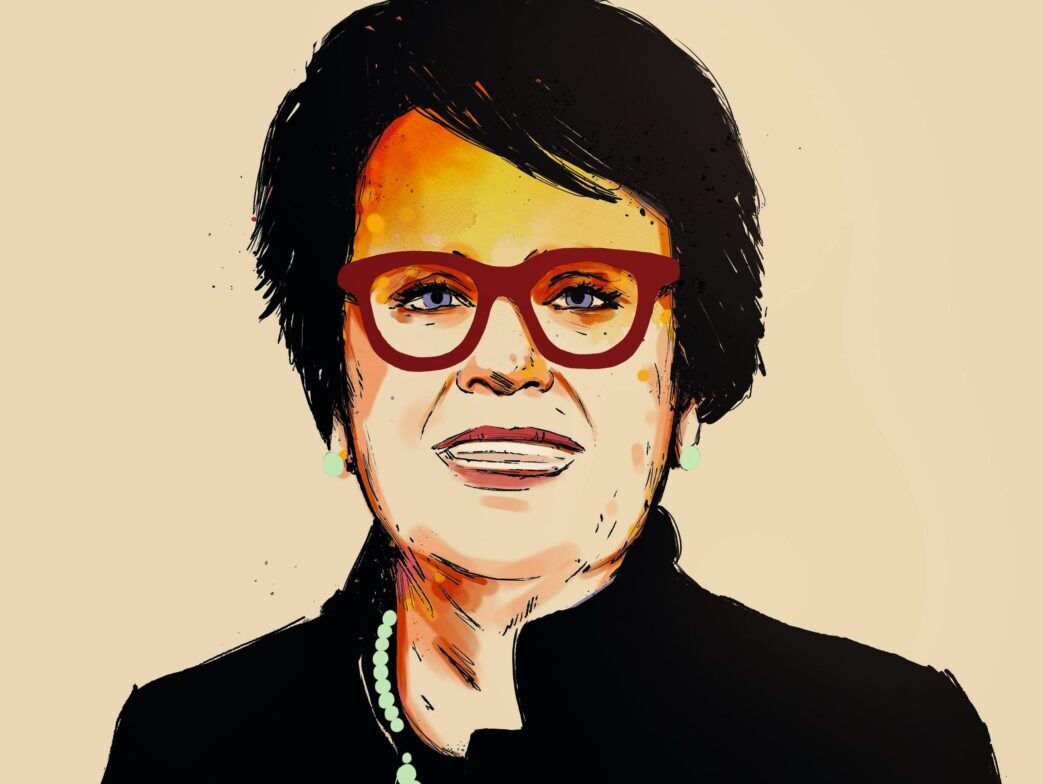
(Illustrations: Silvan Borer)
The catacombs of the Estadio de la Cartuja in Seville resemble a concrete labyrinth. It’s cool in here—much cooler than outside, where the temperature is still around 20 degrees Celsius even on this November Monday—and people are working flat out everywhere: The Billie Jean King Cup final is coming up; signs and posters are being put up, and hospitality staff are familiarizing themselves with the venue. In the middle of the stadium stand huge tents that even those with media accreditation aren’t allowed to enter. «That’s where,» a colleague explains to me, «the matches will be played starting tomorrow. We’re not allowed in there yet.»
That doesn't bother me much, because I didn't travel to southern Spain primarily for the high-level tennis matches, but rather for the woman after whom the Billie Jean King Cup is named: One of the most popular figures in sports history and arguably the most important advocate for gender equality in tennis—known to everyone here simply as «BJK»—has agreed to an exclusive interview with m&k. When she appears in the conference room I found after a long search (and which is guarded by a tight-lipped, Scottish giant), the room immediately fills with energy. «She’s got plenty of that,» her personal publicist, Tip Nunn, will remark a little later—and accordingly, BJK immediately takes the lead in the conversation.
m&k: Billie Jean King, thank you very much for meeting with me here in Seville. I …
Billie Jean King: Before we begin—have you had a chance to talk to the Swiss team yet? Belinda (Bencic, Ed.) just announced that she’s expecting a baby. She couldn’t tell us the gender yet, but as long as the baby is healthy, it really doesn’t matter (laughs) – Wonderful news, don't you think? I remember seeing her on the court for the first time many years ago, and even back then I thought she'd become a fantastic player. Absolutely fantastic.
Yes, the Swiss media have reported extensively on the pregnancy. It’s interesting that you mention Belinda Bencic—because I was planning to start this conversation by asking about a young player anyway: When Coco Gauff, who won the women’s final at the U.S. Open this year, was presented with the trophy and the accompanying check, she said, «Thank you, Billie, for fighting for this.» You were standing right next to her—and I wondered what you were feeling at that moment.
I really appreciate that Coco understands how hard the fight for equal prize money in women’s tennis has been. After all, this year we celebrated the 50th anniversary of equal prize money at the U.S. Open, so I suppose I was hard to miss if you were watching the tournament… Whether that’s a good thing or a bad thing is up to you to decide… (laughs) – In any case, posters with my likeness were hanging everywhere, and they had to be reprinted several times because they kept selling out. 1973 marked an important step toward gender equality in women’s tennis. And although it took several more decades before all four «Grand Slams» had officially committed to financial equality—with Wimbledon in 2007 being the last to do so—1973 was a milestone.
Her role in advancing pay equity for women in professional sports cannot be overstated. It not only dates back further than 1973 but also extends beyond tennis: In 1970, you led a group of nine female players, the «Original Nine,» which a few years later evolved into the Women’s Tennis Association. In Washington, D.C., you delivered a passionate plea in defense of «Title IX,» which was signed into law by President Richard Nixon: This legislation prohibits discrimination based on sex in all federally funded school programs, including sports. This made athletic scholarships for girls possible, for example. Five decades have passed since then, during which you have not only continued your original commitment but—on top of that—have become a global LGBTQI+ icon. Where do you find the strength for all of this?
Would you like me to tell you my favorite word? It’s «freedom.» That word has driven and motivated me ever since I was a young girl. Freedom and equality go hand in hand, because only in an equitable and just society is every person free to develop in whatever way he or she wishes. To answer your question even better… would you mind if we took a brief detour into my childhood?
No, I'd be happy to.
My father was a firefighter, and my mother was a homemaker. They were incredibly supportive of my brother and me in our athletic pursuits—perhaps partly because my father was quite ambitious himself. For example, he would repeatedly try to make 100 consecutive shots into the basketball hoop in our backyard, and if he missed even once, he’d start all over again. So my brother and I were able to try out various sports, and at age eleven, I finally settled on tennis. I had to save up to buy my first racket, but after I got it and tried it out, I ran home and told my mother, «This is it; this is what I’m going to do. I’m going to be the best tennis player in the world.» Her reply was, «All right, but you’ve got homework to do first.» (laughs)
«At the Los Angeles Tennis Club, I intuitively sensed: Something here is definitely not right.»
I assume you started training right after you finished your homework?
Yes. (laughs) We were living in Southern California back then, and the Los Angeles Tennis Club was sort of the … the Mecca for people who wanted to make it in the sport. So I signed up. I remember well how one day I was practicing there—I was twelve years old by then—and looked around: Everyone was wearing white outfits; everyone looked exactly the same. And I thought, «Where are… all the others?» Of course, back then I didn’t have the intellectual framework to realize that tennis could be a platform for inclusion, but I sensed that something had to change. Something here is completely wrong. And I intuitively realized: I didn’t just want to become an outstanding player; I wanted to change the game itself. It was a true epiphany. Although, looking back: I was a white girl; I was healthy; I was relatively privileged. Back then, I couldn’t even begin to imagine how my sisters and brothers of color—or people with disabilities—must have felt in 1955. But something began to «burn» inside me… a fire that hasn’t gone out to this day.
One could say that you became «(…) a rolling stone, (…) if the cause was right …»
You're quoting «Philadelphia Freedom»! How many times did you listen to the song before you knew it by heart? (laughs)
I used it to get in the right frame of mind for the interview, so I played it on repeat during the flight to Seville.
This is a truly special song for me. I don’t want to digress too much, but Elton John is a close, very dear friend of Ilana’s (Kloss, Billie Jean King’s wife—Ed.) and mine. He composed the melody for me after I began coaching the Philadelphia Freedoms in 1974, a mixed-gender tennis team with both male and female players. That was revolutionary back then. Bernie Taupin wrote the lyrics, and I still get goosebumps when I hear the song.
I can imagine that. But as you say, it’s tempting to digress. So let’s get back to your fight for equality. After that moment at the Los Angeles Tennis Club that you just described—how exactly did you begin paving the way for equality in professional sports?
I’d like to share a few thoughts on this that—hopefully—your readers can also apply in their own careers. If you want to make a big difference, you first have to realize that you can’t do it alone. Ultimately, it all comes down to strong, sustainable partnerships. Before my relationship with Ilana, I was—as you probably know—married to a man named Larry King. When Larry and I discussed how we could advance equality in women’s tennis, we quickly agreed that it would come down to partnerships, sponsorships, and the media. We needed money, and we needed attention—not from those who viewed equality as a charitable cause, but from those who also recognized it as a profitable business model. Larry and I did just that, and time has since proven us right. By the way, when we talk about strong relationships—it was no different with the «Original Nine» you mentioned earlier: Without the strong bond we all shared, and without the other players choosing me as their leader—even as they risked their own careers—I could hardly have accomplished anything. What we put together would never have worked as a «one-woman show.» But because we did it together, it was a lot of fun; we were able to provide great entertainment, and that, in turn, had an impact on promoters and sponsorship. Do you see what I’m getting at? Success is… a network of mutually beneficial, interwoven relationships.
By the way, I like that you say your teammates on the «Original Nine» «chose» you as their leader …
Yes, that’s exactly right. I firmly believe in the following credo: «Leaders don’t choose followers—followers choose leaders!» Many people see it differently; they tend to believe that someone suddenly appears and declares: «I’ll show you the way!» But that’s wrong—at least if you’re aiming for sustainable leadership structures. A single person who gets a group to follow him or her? I prefer the idea that a group essentially chooses someone from within its own ranks to lead the way.
You just mentioned the role of the media and the economics of attention. Did you have a natural flair for theatrics—for example, during the «Battle of the Sexes» against Bobby Riggs? Incidentally, that historic match also took place exactly 50 years ago …
… and since then, not a single day has gone by without someone asking me about this game. Unless, of course, I barricade myself at home and turn off my phone. (laughs) That’s how powerful the impact of the «Battle of the Sexes» still is. When I received the Presidential Medal of Freedom, President Obama told me that he watched the match between Riggs and me on TV when he was twelve years old. And that—when he became the father of two girls—he kept thinking about it; in fact, that the match even influenced how he raised his daughters. Isn’t that incredible? In 1973, 90 million people worldwide were glued to their TV sets—what a number! And they got to see a woman succeed in the very arena that Bobby Riggs had previously called a «men’s arena.» Yes, there were a few dramatic moments, a few eccentric outfits. And that’s absolutely fine, because I believe that professional athletes are always entertainers as well. But what was most important was… the fact that there was such extensive coverage of the event. And that’s the connection to the present. Do you know how much coverage the evening news programs devoted to women’s sports on average until just a few years ago?
«If you want to make a big difference, it all comes down to strong, sustainable partnerships.»
Very little, I suppose?
About five percent. Five percent! Today we’re at fifteen percent, but of course that’s nowhere near enough. We need more people to invest in women’s sports—Ilana and I, for example, have just teamed up with Los Angeles Dodgers co-owner Mark Walter and his wife Kimbra to launch a new professional women’s hockey league. It will launch in North America in January 2024. On another note, we recently became minority shareholders in the Dodgers because they champion inclusion and do good. Meanwhile, there are more and more businesspeople and high-net-worth individuals who see that they can help launch something new in women’s sports—and that it’s worth getting involved. The more investors join, the more teams there will be. The more teams there are, the more exciting the competitions become, which in turn attracts spectators and brings in sponsorships… and so on and so forth. In the end, everyone involved benefits.
We talked about change through partnerships—and through skillfully directed attention. Is there anything else one can do if they want to make an impact?
Absolutely. I’m regularly invited to give commencement speeches at universities—and I really enjoy doing that. At some point, I decided that I wanted to base all these speeches on a few… fundamental ideals. Ideals that everyone can apply as they see fit, every single day, for the rest of their lives. Ideals that foster inner contentment and external success, that make you wake up with a smile in the morning.
«We knew that to achieve equality, we needed money and media attention.»
Now I'm curious.
First, I need to come back to the topic of relationships. This is because, in my talks to students, I use the term “relationships” in a much broader sense than we both have in the past. I tell my audience that they must first and foremost build a good relationship with themselves and then—if possible—with their families, their friends, their God… whatever is important to them. Second, I try to remind the students that the end of their time at the university doesn’t mean the end of learning… quite the opposite! I encourage them to maintain the curiosity typical of young people throughout their lives. I’m already old (laughs), but I’m still constantly learning something new! For example, I’m very curious when it comes to technology. Even if I need the eight-year-old grandchildren of friends to explain the features of my iPhone to me, I still want to understand them. Finally: In my speeches at universities, I always emphasize how essential a solution-oriented attitude is. Even better… don’t just copy solutions that others have already tried, but have the courage to innovate! If college graduates, your readers, or even you yourself take these three ideals to heart, nothing is impossible. That’s how I’ve achieved everything I’m able to enjoy today—and hopefully will continue to enjoy in the future.
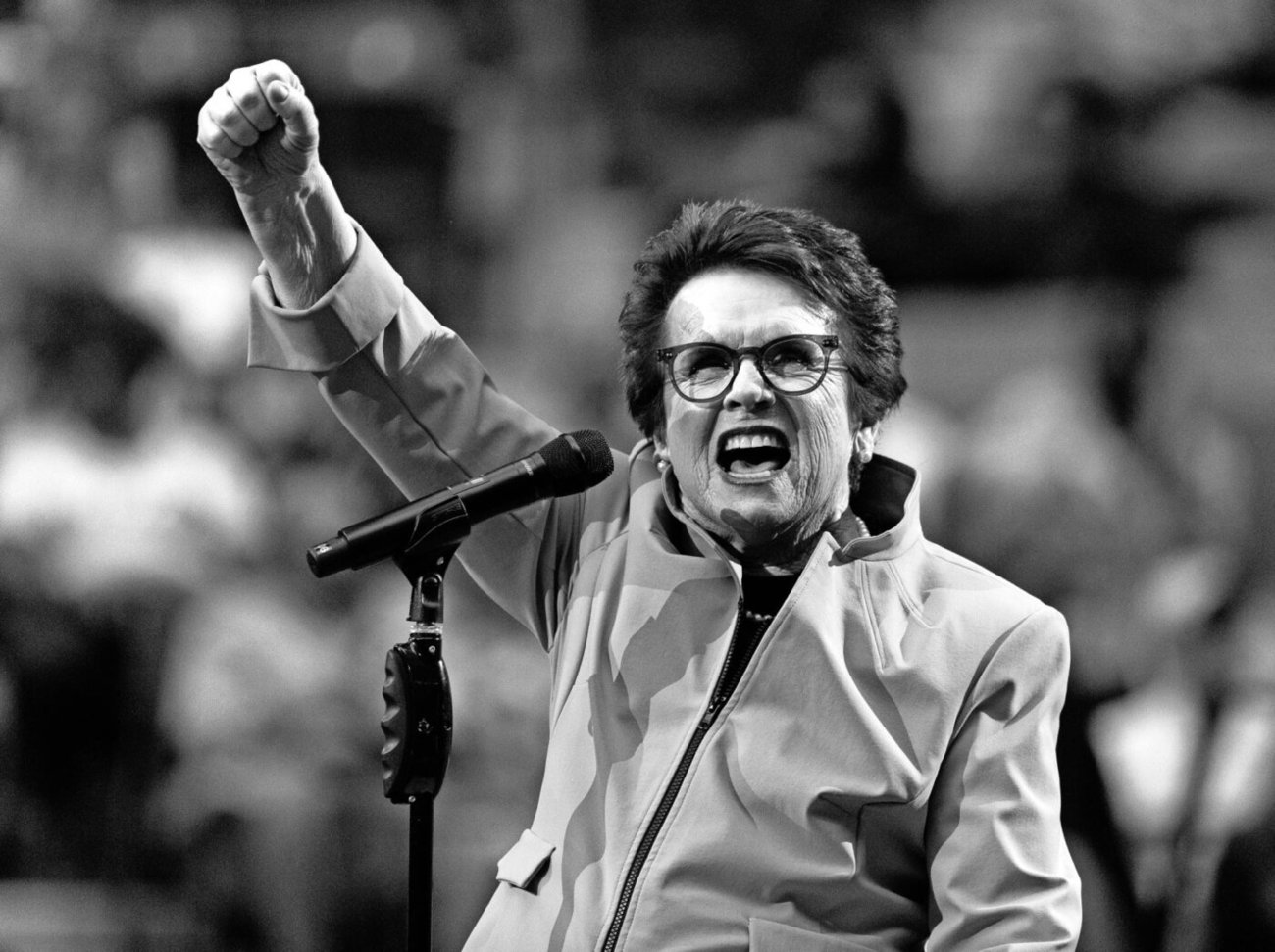
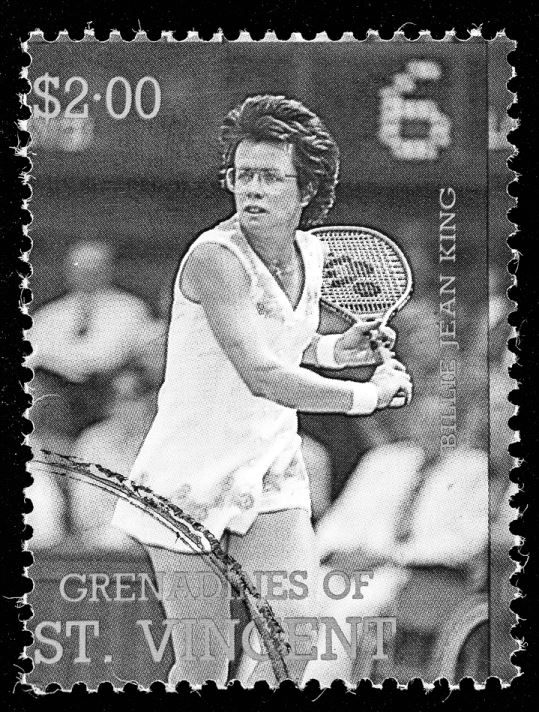
The Present and the Past: Billie Jean King at the U.S. Open in New York City……and on a stamp issued in her honor, circa 1988. (Images: Shutterstock.com)
That’s a good transition to the «Outlook» section, with which I’d like to conclude our conversation. In 2014, you and your wife founded the «Billie Jean King Leadership Initiative» with the goal of promoting equality in the workplace. I’ll quote from the preamble: «While progress has been made, the statistics still reveal the harsh truth that we are far from achieving equality in the workplace.» So you’re officially moving beyond the realm of sports. Why is that?
You’ve already touched on the crux of the answer I’m about to give you: because we haven’t reached our goal yet. Sports are a microcosm that encapsulates all aspects of society, so we must view what we observe there as symptomatic of broader contexts. As I mentioned, Ilana and I have been entrepreneurs for decades and are constantly dealing with international companies. What we see time and again is that there are people who simply aren’t given a chance! Amazing women who report to a male CEO—women who make you think, “Actually, she’s the one who should be leading this organization.” But they don’t get a fair chance. And that’s exactly what we need to change. What’s the situation actually like in Switzerland? I was quite shocked when I learned that women in your country haven’t had the right to vote until 1971.
Gender equality in the business world—and in some parts of society—has improved, but I would agree with you: We haven't reached our goal yet.
Do you know what I’d like to experience while I’m still on this planet? This is going to be a bit of a broad brushstroke, but: I’d like to see how many things «come together.» I’d like to see the ATP and the WTA merge. I’ve been waiting for this for decades, and while there are more and more partnerships, I’d love to see us officially united. I also watch the Women’s World Cup and think, «Does this have to be separate from what the guys are doing?» Et cetera, et cetera. And then I think beyond sports, together with Ilana: We want stereotypes in society to be openly discussed and deconstructed. There will only be true equality when we stop saying, «Girls always have to be perfect, and boys always have to be brave.» These false ideas that we plant in our children’s minds need to be done away with. It’s all so, so ridiculous. We don’t live in a binary world! There’s no more room for silly clichés. No one can be perfect all the time, and no one can be brave all the time, no matter what gender they—or it—is. Let’s just be who we are, and let that be enough! I’ve told you about President Obama and how he told me that the «Battle of the Sexes» influenced the way he raised his daughters. So many other men have approached me over the years and said: «I’ve changed this or that perspective because a woman set an example.» At the same time, there are countless women—athletes and non-athletes alike—who tell me about the influence their fathers had on them… How the men in their lives encouraged them and supported their dreams; just as my father did for me! For me, equality means: Everyone gives their all to help everyone else; people reach out to one another. Because in the end, that’s what unites us: We are all human beings.
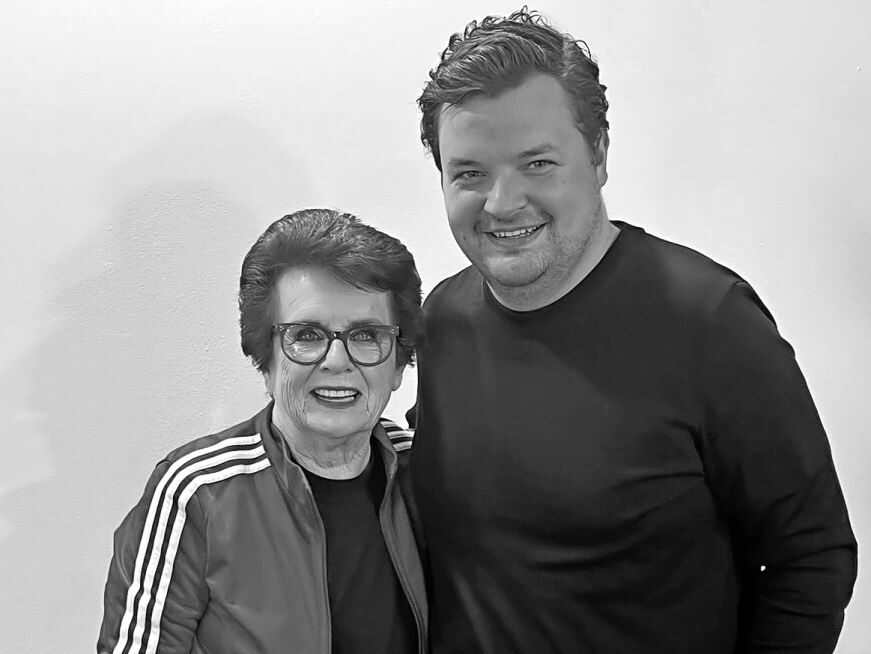
Meeting in Seville: Tennis icon Billie Jean King and m&k co-editor-in-chief Johannes Hapig. (Photo: m&k Werbewoche.ch editorial team)
Book Recommendation: «All In: An Autobiography»
Billie Jean King’s eventful life cannot be told in a single interview, let alone in a magazine—but the richly illustrated autobiography *All In*, published in 2021, does an excellent job of it. The New York Times commented: «A powerful rallying cry, in a life full of them.»
Leading Together: Billie Jean King and Ilana Kloss
Billie Jean King and Ilana Kloss have been a couple for more than 40 years and are a «match made in heaven» (not «made on the tennis court»—because the two have never played as a team, even though that would be a wonderful story). Ilana Kloss, herself a champion in the sport and a successful association executive, now handles everything that happens «behind the scenes»—especially when it comes to the couple’s various business ventures: She is CEO of Billie Jean King Enterprises and co-founder of the «Billie Jean King Leadership Initiative,» a nonprofit organization dedicated to equality in the workplace. «My father was a salesman and always worked on commission,» Kloss recalls in a conversation we had on the sidelines of the tournament in Seville, «and I think I learned a lot from him about the rules of business.» Just as his wife emphasized in our interview, Kloss believes it’s crucial to support minorities—by ensuring they «not only have a seat at the table, but also a voice when the people at the table speak.» That’s why she’s particularly proud of her co-ownership of the Los Angeles Dodgers, the women’s soccer club Angel City FC, and the founding of a new women’s hockey league in North America: «We tell girls to be confident if they want to become tennis players, soccer players, or hockey players. But we need the right infrastructure to make that possible.» Kloss has made it her mission to create that infrastructure; a mission that will be driven by the expansion of existing initiatives: «We have the Leadership Initiative, we have the company, we have the Billie Jean King Cup,» explains Kloss, «but we want—we need—more for women, worldwide.» She therefore plans to expand her company’s portfolio with conferences, entertainment, and further investments, while also strengthening its consulting services in the area of equality. Because, as Ilana Kloss is convinced: «Things have improved a lot, of course. But we still have a long way to go.» And then she says, just as her wife Billie Jean King did the day before: «So far, we’ve had a wonderful life, a wonderful career. But we’re far from done.»
Billie Jean King, also known as «BJK,» is a former American tennis player, entrepreneur, and activist for gender equality and LGBTQI+ rights. During her athletic career, King won 39 Grand Slam titles: 12 in singles, 16 in women’s doubles, and 11 in mixed doubles. King, who is regarded by many as one of the greatest tennis players of all time, has received numerous honors and titles—including the Presidential Medal of Freedom, membership in the French Legion of Honor, and recognition as one of the 100 «most important American women,» as named by Life magazine.
This article first appeared in the 11-12/2023 print issue of m&k
When less is more
Fewer material possessions, fewer unnecessary decisions, less clutter—and in return, more of a chance to be yourself, more contentment, more success—who wouldn’t want that? On minimalism as a trend and its economic implications.
Dr. Julia Wentzlaff-Eggebert
-
January 14, 2024
(Image: Unsplash.com / Yoann Siloine)
It’s no wonder that the megatrend of lifestyle minimalism is enjoying great success and has long since taken the advertising world by storm. But upon closer inspection, the phenomenon raises questions: How can something be less, yet become more? Isn’t the principle of «less» being twisted here into a new form of materialism? And who actually benefits from this «more» achieved through «less»?
A Contradictory Principle
Lifestyle minimalism sees itself as a counter-movement to the culture of waste in our time. On the one hand, it criticizes the careless use of resources and goods; on the other hand, it offers a strategy for coping with the overwhelming abundance of the market and the constant availability of all material desires. The longing for simplicity is therefore primarily a phenomenon of affluent culture and is understandable for segments of the population who live in abundance. Renouncing consumption expresses a deep desire to reconnect, in a saturated, superficial, and overwhelming world, with archaic and immaterial needs that lie beyond consumable goods.
As a response to the problem of excess, the driving force behind this change in mindset lies not least in the repeated manifestations of the devastating consequences of excessive consumption and economic activity that have become apparent over the past decade: first and foremost the 2008 financial crisis, a symptom of debt-financed overaccumulation, and the UN Climate Change Conference COP21, an internationally recognized testament to the climate-damaging consequences of our economic practices. As a result of these crises, there has been a growing societal desire for alternative, less growth-oriented economic systems. These «degrowth» systems prioritize social well-being, economic justice, and ecological regeneration over continuous growth and the accumulation of capital. However, since the growth mindset remains firmly entrenched in social norms, statistical standards, and international economic policy, these efforts lead to a conflict. – This conflict manifests itself in the paradoxical principle of lifestyle minimalism: On the one hand, wasteful consumption and growth-oriented thinking are undermined. On the other hand, there is a promise to derive benefit from this renunciation. Thus, the principle of minimalism is not «less is less,» but «less is more»: a paradoxical intertwining, in other words—minimizing for the sake of maximizing.
«The desire to do without is, above all, a phenomenon of affluent culture and is understandable among segments of the population who live in abundance.»
Specifically, this connection is illustrated, for example, in Marie Kondo’s bestseller *The Life-Changing Magic of Tidying Up*: Here, readers are encouraged to ask themselves, while decluttering their homes (or other areas of their lives), whether a particular item or activity brings them joy or not. According to Kondo, order depends on personal values—that is, on how a person wants to live. According to Kondo, what matters for finding «more» in «less» is not the use of an object, but rather the individual’s sense of well-being and self-expression. – Thus, lifestyle minimalism has two sides: alongside its laudable motives, it also carries the risk that the criticized behaviors are not truly abandoned, but merely transferred to individual practices of self-expression.
Luxury in the Age of Individualism
Minimalism as a lifestyle emphasizes asceticism. At the same time, it’s a trend that, on Instagram, tends to look like high-end designer pieces and one-of-a-kind items. That’s because many companies have now attempted to integrate this lifestyle into their corporate identity: Minimalist Cooking, Capsule Wardrobe, Minimalist Digital Design, Minimalist Interior Design, etc.—all product lines designed to showcase a minimalist way of life, while promising a reduction in consumption—albeit through consumption itself. Even in lifestyle guides such as those by Dominique Loreau or Fumio Sasaki, this contradiction becomes apparent: Loreau, for example, urges readers to throw away old scarves and blankets in order to replace them with higher-quality cashmere versions. However, the question of how the discarded products could be repurposed is not part of the minimalist movement. Or in Sasaki’s *Goodbye, Things*, the book not only lists items one could part with but also those particularly suited to simple living: first and foremost, Apple products with their minimalist design and ease of use. As honorable as the intentions behind them may be, these forms of lifestyle minimalism are themselves subject to the very commercial principles they seek to counteract. Perhaps overall consumption decreases as a result, but people opt for more expensive and higher-quality versions instead.
«Lifestyle minimalism sees itself as a counter-movement to the culture of waste in our time.»
This trend is evident in the simultaneous boom in the luxury market—where luxury (entirely in line with minimalist principles) no longer tends to mean prestige and material possessions, but rather purpose, experience, time for oneself, and the opportunity to enjoy life to the fullest. This is a development that finds particularly fertile ground in a world where individualism is considered part of a free society. For in this worldview, actions are not primarily carried out out of ethical duty, but because they contribute to personal growth and well-being. Seen in this light, a minimalist lifestyle—such as the one advocated by Marie Kondo—is luxury, plain and simple: here, what always matters is «how it is for me.» Self-expression and self-care take precedence over considerations of necessity, sustainability, or functionality.
Would you like a little more?
Just as lifestyle minimalism has two sides and is defined by an inherent contradiction, new trends are already making it look outdated: After minimalism influenced millennials and older generations in particular, Generation Z is now bringing back the hype for knickknacks. In contrast to the oatmeal-colored, tidy living rooms of millennials, the new «Cluttercore» aesthetic elevates the hoarding of knickknacks to an art form: Under the corresponding hashtag, you’ll find countless images on Instagram and TikTok of rooms overflowing with carefully curated photographs, concert tickets, colorful scraps of paper, small stuffed animals and figurines, stickers, plants, and decorative lights… Yet although this nightmare initially looks like an anti-movement to every minimalist, it brings to light the still implicitly present, affirmative attitude toward individualistic and luxury-oriented consumer behavior: Generation Z takes individual desire and the definition of one’s own personality through material possessions to the extreme. Whether this is already the tip of the iceberg or still has room to grow will likely be decided by the next Generation Alpha.
This article first appeared in the m&k print edition 11-12/2023.
In the green labyrinth
A sustainability workshop concept developed by the Wirz agency in collaboration with the HSG helps companies navigate the maze of «green communication.» Below are five key points to keep in mind when it comes to sustainability communication.
Marleen Diener *
-
January 6, 2024
(Image: Unsplash.com / Peter Burdon)
1. The 17 SDGs and Why They Matter for Brands and Communication
The Sustainable Development Goals (SDGs) form the core of the UN Member States’ 2030 Agenda for global sustainable development. They are also useful in the areas of brand development and communication, providing an overview of the thematic areas in which a brand or company can take action. Even if, for example, a company’s complex supply chain touches on various SDGs, it is advisable to focus its brand and communication strategy on 1 or 2 of the 17 SDGs. Ideally, this should be an area that already has several points of connection to the brand’s DNA. This allows the corresponding sustainability positioning to be established over the long term and anchored with the relevant target audience.
2. Sustainability as a Key Driver of Employer Branding
As Gen Z comes of age, it is becoming the most important target group of our time. This elusive demographic expects companies and brands to take action on sustainability. A connection between these two topics is evident in employer branding: The demands on employers regarding sustainability are rising, as shown by the study by StepStone & Handelsblatt Research Institute: Three out of four respondents consider it important that sustainability is a top priority for their (potential) employer. At the same time, the shortage of skilled workers—exacerbated by the COVID-19 crisis and the war in Ukraine—has further intensified the «war for talent.» A sustainability strategy developed from the perspective of the company or brand is therefore becoming increasingly central not only from the consumer’s point of view but also for recruiting and employer branding, in order to attract (young) talent.
3. Are there «sustainable» products?
In marketing products and services, terms such as «sustainable,» «climate-neutral,» or even «climate-positive» are used. However, every newly manufactured product leaves an ecological footprint and thus impacts the environment—with the right efforts, they are therefore, at best, «more sustainable» or «climate-neutralized.» In sustainability communication, messages are becoming increasingly precise. Armedangels—a clothing brand known for its sustainable fashion—responds, for example, with radical honesty. Its campaign «Sustainable products don’t exist» raises awareness to encourage people to rethink their own consumption habits and prioritizes its purpose over potential sales.
4. The Responsibility of the Marketing and Communications Industry
Sustainability is an issue that many marketing and communications professionals are grappling with. In the context of our advertising integrity, we must not forget that we bear a dual responsibility. On the one hand, we have a responsibility to protect our clients from greenwashing scandals by addressing the root causes and providing expert advice. At the same time, we have a responsibility to consumers to protect them from deception and misinformation. Sustainability communication has the potential to provide guidance in the «sustainability jungle,» empower people to make more sustainable decisions, and thereby make a real impact on our environment.
5. Green Attitude-Behavior Gap
We’ve all been there: Our personal attitudes toward climate and environmental protection often don’t translate 100% into our actual purchasing behavior. Scientists have identified a variety of reasons for this so-called “Green Attitude-Behavior Gap”—ranging from limited availability and price differences to a lack of confidence in the effectiveness of sustainable products. Letting this discourage us isn’t helpful. Instead of pointing fingers at consumers and shifting the blame onto them, sustainable purchasing decisions should be made as accessible as possible. The more the positive impact that each individual can make is communicated in a motivating way, the more personal commitment becomes an integral part of one’s own reality.
Conclusion on Sustainability Communication
1: The 17 SDGs
Focus on one or two Sustainable Development Goals from the UN’s 2030 Agenda for Sustainable Development for UN member states.
2: The War for Talent
Positioning in the area of sustainability is becoming increasingly important, including for recruiting and employer branding, in order to attract (young) talent.
3: Sustainable products don't exist
Every newly manufactured product leaves an ecological footprint and has an impact on the environment—so, at best, these efforts make them «more sustainable» or «climate-neutral.».
4: Responsibility
Sustainability communication has the potential to provide guidance in the «sustainability jungle,»,
5: Green Attitude-Behavior Gap
Instead of pointing the finger at consumers and shifting the blame onto them, sustainable purchasing decisions should be made as accessible as possible.
* Marleen Diener is Head of Strategy Consulting and Director of the Wirz Group's Center of Excellence for Sustainability.
At Sustainability Workshop Through collaboration with HSG, the Wirz agency has developed strategies for how companies can position themselves credibly and communicate their activities effectively. m&k will feature additional snippets in upcoming issues.
This article first appeared in the m&k print edition 11-12/2023.
How does an idea come about?
Reflections on a question that is almost as old as humanity itself (and yet never goes out of style).
Alexander Haldemann
-
December 21, 2023
(Illustration: Silvan Borer)
As we approach the end of 2023, this column will also take on a somewhat… contemplative tone?! No, not quite, but it will be «thoughtful and reflective»: While my articles usually emphasize the strategic importance of communication in various contexts, this time I’d like to—together with you, dear readers—reflect on a meta-topic. It’s difficult to pinpoint the topic exactly, as it shifts between the realms of innovation, inspiration, creativity, and collaboration. I haven’t found a single term that effectively captures this context «in a word.».
So I’ll just tell you how I came to reflect on the context in question: A few weeks ago, I attended a dinner with Sir John Hegarty—a small, private gathering that had come together in Zurich before Hegarty was scheduled to deliver a keynote speech at a major marketing event the following day. Thanks to the composition of the guest list, the conversation inevitably turned to the question of how ideas are born—and not just how they arise, but how they become great ideas.
Rick Rubin: «The Creative Act»
Sir John spoke about a book that had made a deep impression on him (and that some of you might want to take with you over the holidays): *The Creative Act* by the renowned American music producer Rick Rubin. The book is an attempt to capture something that is essentially indescribable in ink and on paper; to make the aforementioned context of innovation, inspiration, creativity, and collaboration as «tangible» as possible for outsiders. On the one hand, Rick Rubin resists—and this is what Hegarty particularly liked—being classified as a «genius» to whom good ideas «just fall into his lap»; but he also refuses to establish a fixed methodology that is presented as a universal recipe for creativity. Rather, he offers suggestions, provides gentle inspiration, and advocates for maximum (!) openness—openness to one’s surroundings, to the people, colors, sounds, and smells around you. The music producer (who, for example, helped launch Johnny Cash’s second career) calls for an open-minded embrace of the diverse influences the world has to offer.
Ideas by the Water—or Through Connections
Now, I’m not a creative myself at our agency, so I hope my team will forgive me for this digression, but I think Rubin’s ideas—backed by the great Sir John Hegarty—are absolutely spot on. I like to have important conversations while taking a walk by the lake, because the exercise and the view of the water help me think more clearly and articulate my thoughts. I have a digital «card index.» And I surround myself with people I find intellectually stimulating: over a spontaneous espresso in the office, even without a meeting on the agenda—or in my personal life, where it doesn’t matter at all what the other person does for a living. That’s how I come up with ideas, and sometimes—hopefully—there are big ideas among them. Maybe you’d like to try that in the new year, too. Or at least flip through Rick Rubin’s book once. It’s worth it.
Dr. Alexander Haldemann is the CEO of Publicis Groupe Switzerland.
Why the economy must serve
Dr. Stephan Feldhaus, an expert in ethics and communication, argues that the economy should not be misunderstood as a separate entity. Rather, he says, it is a vehicle that must serve people’s well-being. Executives, in particular, have a responsibility in this regard.
Dr. Stephan Felddhaus *
-
December 19, 2023
(Illustration: Silvan Borer)
As a branch of business ethics, corporate ethics addresses the issue of corporate responsibility toward individuals, society, and the environment. It always involves individual, social, and environmental responsibility simultaneously. In this context, Peter Ulrich coined the term «economy in the service of life» in his writings on business ethics. Human economic activity is not an end in itself and does not follow any inherent laws; rather, it always serves to fulfill goals that individuals or groups set for themselves or for others.
This aligns with how we generally define the economy. In its original sense, the term “economy” refers to all human and material expenditures and revenues that serve to ensure human subsistence—for example, through hunting, agriculture, or trade and commerce. In the modern sense, the economy refers to the totality of all institutions and actions that serve to systematically meet demand—that is, to satisfy the needs of every individual. Economic institutions include businesses as well as private and public households. Economic activities include all human actions that systematically and efficiently allocate scarce resources with the goal of satisfying needs as effectively as possible. The necessity of economic activity arises from the scarcity of goods on the one hand and the limitlessness of human needs on the other.
«So wouldn't it be perfectly legitimate to say, »An economy that doesn't serve a purpose serves no purpose at all!'?"
Thus, in both its most fundamental and its modern sense, all economic activity ultimately has a «servant» character. People use economic processes to achieve the goals they have set for themselves. Wouldn’t it therefore be entirely legitimate to say, «An economy that does not serve is of no use!»?
Yet today, when we speak of «the» economy in everyday language, hardly anyone thinks of the economy’s role as a servant. «Tax reform harms the economy,» «The economy needs a flexible labor market,» or «AI—when used correctly—strengthens the economy»: It’s easy to get the impression today that «the» economy exists as an independent entity with its own expectations and needs; and even more so, that people are there for the economy and not the other way around. We talk about «the» economy as if people were meant to fulfill the economy’s needs—to «serve» it.
The «Magic Triangle»
In debates about sustainability, we even speak of a «magic triangle» and—alongside «society» and «the environment»—treat «the economy» as a separate objective. Purely economic goals and requirements stand on an entirely equal footing with social and ecological goals and requirements. In doing so, we suggest that there are laws of nature independent of human action—laws that are inherent in the system itself—which must be balanced against the needs of society and the conditions of the environment.
«It's easy to get the impression today that »the' economy exists as an independent entity with its own expectations."
But if we construct «the» economy as an independent entity that pursues its own inherent goals, we increasingly lose sight of the fact that the economy—with all its economic processes and laws—is merely a means by which we seek to achieve the goals we have set for ourselves. And we as human beings—whether as consumers or producers, as private citizens, or as political or business leaders—must define these individual, societal, or business goals ourselves; «the» economy does not dictate them to us.
Targets are human
Whether and by how much, for example, a company’s revenue should increase—and whether the profit to be achieved should rise by an even greater percentage—are goals that are defined and set by those who hold leadership positions within a company. There may be plausible reasons for these goals, and there may be people who question these reasons and consider other goals to be more appropriate. As a rule, goal-setting follows an internal process of discussion and deliberation within the company. There is no «economy» that, as an external, overarching authority, demands or dictates such a goal.
«When individual interests gain the upper hand, we privatize the profits and socialize the losses.»
This is not about a fundamental critique of growth. But it is about understanding that any overemphasis on seemingly immutable economic laws causes us to lose sight of what really matters: people—specifically, the people who set the individual goals and the people who are affected by those goals. The goals—including growth targets—that we seek to achieve through economic processes must be set in such a way that they serve people.
I consider it a major problem that we are increasingly leaving the definition and setting of economic goals—both in the business context and in the broader economic context—to a very small number of individuals. But if we, as individuals and as a society, continue to distance ourselves from this task, we should not be surprised when economic activity comes to be dominated by individual and narrow interests. Then, suddenly, the economy is no longer there to satisfy the needs of individuals and societal requirements, but rather people are there to satisfy the supposed needs of the economy. But when individual interests gain the upper hand, we individualize the profits and socialize the losses.
From the perspective of business ethics, the only relevant consideration is that all norms, laws, and rules—as well as all human-created systems, organizations, and institutions—ultimately serve a single primary purpose: to enable human life (both as individuals and in their social and environmental contexts) to flourish.
Responsibility of the leadership
Especially in this context of business ethics, responsibility has undoubtedly become a key sociopolitical category in our current self-understanding. The call for greater responsibility—as well as complaints about its absence—can be found in nearly every commentary on the state of modern civilization. What specific responsibilities, then, do those who assume leadership roles in economic activities and institutions bear within a «life-affirming» understanding of the economy?
«In a business context, leaders have fourfold responsibility.»
In my view, leaders have a fourfold responsibility in an economic context: First and foremost, leaders bear an overarching ethical and integrative responsibility for the success of the whole. Furthermore, from an ethical perspective, they bear an implementational, complementary, and innovative responsibility. What does this mean specifically?
Integrative Responsibility …
The integrative responsibility of leaders refers to the incorporation of ethical considerations into business activities from the very beginning. This means that ethical principles and values are integrated into all aspects of business operations, including strategy formulation, decision-making, a corporate culture that promotes ethical behavior, relationships with stakeholders, and responsible business practices.
It is essential to develop a clear vision and mission for medium- and long-term success, to establish a binding ethical framework by defining guidelines and standards, and to build trust and transparency with all stakeholder groups. Our actions should be guided by the fundamental conviction that normativity is not the «flip side» of economic rationality, but rather its foundation, and that there is no fundamental contradiction between economics and ethics.
«Ethical behavior also pays off economically in the medium and long term.»
The first step toward the integrative incorporation of ethical considerations into business conduct is the personal conviction of leaders. They strongly influence the fundamental character of a company and shape its behavior. By virtue of their authority—whether derived solely from their hierarchical position or also from their personality—leaders shape the entire organization with their attitudes and values. What is the «style» of leadership? How much time does the leader devote to which tasks? What do they express admiration or contempt for? Through nonverbal communication, a leader can signal whether they truly stand behind the ideas, goals, and tasks. The leader’s personal example «shapes the culture,» and there are instances where a «cultural revolution» has been made possible simply by replacing leaders.
Of course, assuming integrative responsibility requires a whole range of skills and competencies: In addition to excellent technical expertise and judgment, leaders must possess a high degree of emotional intelligence and social competence. This includes the ability to engage in personal development and self-reflection, to demonstrate ethical sensitivity, and to distinguish between what is merely efficient and what is truly relevant. The ability to engage in dialogue and resolve conflicts, along with the highest level of communication skills, round out the profile.
… operational responsibility …
Leaders also have an ethical and practical responsibility to comply with the applicable regulatory framework; that is, they must ensure that their individual actions conform to the rules established by that framework. This, therefore, concerns fundamental compliance with regulations. Illegal business dealings, bribery, corruption, tax evasion, unfair competition, price-fixing, wage dumping, social and individual discrimination, and environmental violations not only violate existing regulatory frameworks but also constitute ethical misconduct.
… complementary responsibility …
Beyond complying with and implementing the applicable framework regulations in accordance with the rules, leaders must assume a supplementary ethical responsibility; that is, they must proactively and independently apply ethical standards on their own initiative—in line with the framework regulations— but which cannot be sufficiently defined and regulated in a generally binding manner by those regulations alone. This involves the continuous improvement of existing regulatory frameworks and/or company- or industry-specific additions. This can be achieved through codified industry agreements as ethically grounded collective commitments by companies, as well as through individual ethical commitments by companies in the form of established corporate ethical principles, codes of conduct, or company guidelines. In this context, executives should, particularly in the event of a conflict, engage in public discussion with their stakeholder groups.
… and innovative responsibility
Furthermore, leaders must fulfill an ethical and innovative responsibility; that is, beyond merely complying with, improving, and supplementing the relevant frameworks, regulations, and agreements, they can allow their business activities and decisions to be guided by ethical principles that have not—or not yet—been applied equally to all economic actors, —for example, through regulatory frameworks or industry commitments—whether in product policy, human resources policy, or even in specific and by no means always unsuccessful calls for regulatory corrections.
This can refer to a whole range of individual measures: environmentally friendly production processes or the reduction of waste and emissions, for example, or products and services that are more environmentally sustainable, that promote social equity, or that lead to more equitable access to health and education services; after all, these are not developed by environmental or social agencies, but rather by businesses and companies acting on their own initiative. Internal organizational structures—ranging from flexible work hours and locations to providing opportunities for professional development and training for employees, and even the establishment of on-site daycare centers—are also independent responsibilities and achievements of individual companies and their management.
Leaders bear a high level of ethical responsibility in the context of an «economy that serves life.» But the effort is worth it: Ethical behavior also pays off economically in the medium and long term. Only in the short term can a person who shirks responsibility in the so-called prisoner’s dilemma—and fails to adhere to the agreed-upon rules that apply to everyone—maximize their own benefit. In the medium and long term, benefits can only be optimized through ethically responsible action.
* Dr. Stephan Feldhaus is a nationally and internationally renowned communications expert and ethicist. Until 2019, he served as Head of Group Communications and a member of the extended Group Executive Committee at F. Hoffmann-La Roche; since then, he has led Feldhaus&Partner, the consulting firm he founded in Basel. In addition, he serves—among other roles—as Chairman of the Board of Directors of Viollier and as Chairman of the Board of Trustees of the Basel Museum of Antiquities and the Sammlung Ludwig. A doctor of theology, he is also active as a deacon in the Christ Catholic Church of Switzerland.
Sir Mary: The next chapter
After seven years of operating independently, Sir Mary is entering into a partnership with the agency network Myty. What motivated the founders to do this?
Johannes Hapig
-
December 14, 2023
Working together with the Myty Group in future: the Sir Mary management team with Daniel Zuberbühler, Tino Elsener, Vanessa Habisreutinger, Nicolas Hostettler, Nadine Pachoud, Florian Beck, Maurizio Rugghia and Fabian Habisreutinger (from left to right). (Pictures: zVg. / Sir Mary)
At the end of September, the Zurich agency Sir Mary announced a partnership with the rapidly growing Myty Group (Werbewoche.ch reported). As a young agency network, Myty has been shaking up the industry since 2020 - not only in Switzerland, but throughout Europe - and already combines the strengths of 13 companies with more than 700 employees. In an interview with m&k advertisingweek.ch Sir Mary co-founders Maurizio Rugghia and Daniel Zuberbühler explain why a partnership with Myty is the next logical step in the development of their company - and what it means for the team, the clients and the agency's management.
Daniel Zuberbühler: Many thanks for the compliment! Sir Mary is well positioned to meet the needs of advertisers. Winning the ranking has officially confirmed this, which naturally makes us proud. Nevertheless, in our industry it is important to always stay on the ball and think ahead.
Maurizio Rugghia: Sir Mary was founded with the ambition to change the agency market as a modern agency and first address for digital-first communication. For us, it's about shaping the game, not just playing in it. Because we want to continue to meet this high standard, we are ushering in the next phase for Sir Mary, together with Myty. So it's not about what we "need", but about how we can continue to develop our potential and meet the growing and changing demands of our customers in the future. We see the partnership with Myty as a step that opens new doors for us in terms of technological resources, specialization and expertise in different disciplines. We are still the same crew, but now we have access to an impressive range of resources and skills that go far beyond what we could have achieved on our own.
"This step is an extension of our possibilities, not the end of our journey."
Myty is - despite its impressive scale - less well-known and considerably more compact than, say ... Dentsu, WPP or the "usual suspects". Did you join in spite of this or precisely because of this?
Zuberbühler: Our condition for a partnership was clear: we wanted to leave our identity, our culture and our location untouched. Myty allows us to do just that and gives us entrepreneurial and cultural freedom.
Rugghia: We deliberately chose Myty precisely because it is different from the usual suspects. Myty offers a unique combination of agility, innovation and a close-knit community culture that aligns perfectly with our vision at Sir Mary.
What fascinates you about Myty?
Zuberbühler: Myty won us over with her motto "Just getting started", which fits perfectly with our own spirit. What inspires us is her fresh, uncomplicated approach.
Rugghia: We want to help, participate and have our say. Directly with the founding team, with whom we got on really well straight away. We don't want to sit in the nest, that has never been our ambition and will never be.
Are you not worried about giving up your independence with this step?
Rugghia: What we gain with Myty is far more than what we could have achieved as an individual agency. We firmly believe that our strengths will be further enhanced in the network. It's not about giving up control, but about expanding our capabilities and increasing our competitiveness. We are more motivated than ever to use the additional resources and collective experience of the network to create something new that shapes the market and inspires our clients.
What opportunities does this step open up for you?
Rugghia: From an entrepreneurial perspective, this step gives us a unique opportunity to play an active role in shaping a European network. We now have the platform to present our vision on a broader stage and play an active role.
Zuberbühler: For our customers, this means above all that we can now offer them an even broader range of expertise and services. The additional partnerships within the Myty network enable us to respond to their individual requirements in an even more targeted manner. And last but not least, our employees will benefit from this step. They gain access to a larger pool of knowledge and experience and have the opportunity for professional exchange and further development, which is crucial in our industry. This in turn opens up new career paths for them that might not have been possible before.
Does your decision also say something about your view of the development of the communications industry over the next five, ten, fifteen years - and if so, what?
Zuberbühler: Our decision in favor of Myty definitely reflects our assessment of where the communications industry is heading. We are convinced that a digital-first mindset is a must - not a can. Today, not in the future. It is the foundation on which communication strategies are built.
Rugghia: The industry is evolving at a rapid pace and we are seeing increasing specialization and fragmentation within the communication disciplines. Strong and networked partnerships are becoming essential to serve the diverse disciplines and connect channels seamlessly.
"We can tap into the concentrated specialist knowledge of 700 new colleagues at any time."
Will anything change for your employees now?
Rugghia: Nothing will change for the employees - we will continue to be operationally and culturally independent. They now have the opportunity to make use of the network's expertise, help shape the up-and-coming Myty brand and work on cross-agency projects. Workstations are also available at other Myty locations: for easier remote working in Berlin, Hamburg, Zagreb and other major cities.
And for the customers?
Zuberbühler: What is new - and very attractive for our customers - is that we can tap into the concentrated specialist knowledge of our more than 700 colleagues under the Myty umbrella at any time. From specialist disciplines in web and app development, e-commerce, artificial intelligence, corporate branding and corporate content to customized agency offerings, employer branding and digital solutions. For our customers, this means more opportunities to realize challenging projects and keep their finger on the pulse of digital transformation.
"We are not managers, but entrepreneurs and doers who are deeply rooted in the industry."
Hand on heart: Is this the first step towards an "exit" for the founders - or can we expect them to remain involved in the agency's day-to-day business?
Rugghia: Honestly, this step means an expansion of our possibilities, not the end of our journey. Sir Mary's management remains unchanged and fully committed to the day-to-day business. The existing and well-coordinated team is crucial for success and strategy!
Zuberbühler: Furthermore, we are not managerial types, but entrepreneurs and doers who are deeply rooted in the communications industry. We not only enjoy our work, but also feel a deep sense of satisfaction in helping to shape the continued success of our group.
Sir Mary's current projects: A major image campaign for the insurance company CSS...... and a collaboration between Samsung and the cult series "Tschugger".
Sir Mary is a creative and media agency founded in 2016 by Maurizio Rugghia, Daniel Zuberbühler and Florian Beck. Right from the start, the agency focused on a digital-first approach and won numerous prestigious accounts - and awards: For example, Sir Mary was named Swiss Digital Agency of the Year 2018 and DACH Newcomer Agency of the Year 2019; Sir Mary also took first place in the annual ranking of Swiss Advertising Agencies 2023.
This article first appeared in the m&k print edition 11-12/2023.