Marketing and media research glossary: specialist knowledge from A to Z

You may have learned these terms at some point, but they’re quickly forgotten or become outdated. How is your marketing and media research vocabulary?

(Illustration: Dall-E and Wordart.com)

On Tuesday, Wemf AG für Werbemedienforschung will publish the current readership figures and online reach of press titles in the form of the MACH Basic reach study and the MACH Total Audience intermedia study. These semi-annual studies on media usage in Switzerland provide crucial information for the media and advertising market. It is therefore high time to brush up on the marketing and media research glossary and re-familiarize yourself with the most important basic terms.

Affinity

Indicator that expresses the suitability of a medium to reach a ➝ target group. Ratio of reach in the target group to total reach multiplied by 100 (indexed). Affinities above 100 indicate an above-average suitability of a title for the target group in question; below 100 indicates a below-average suitability. Affinity index = reach in % in the target group × 100 / total reach in %. The higher the index, the better the media performance of a title in the relevant target group.

BRS

Broadest Readership refers to the number of people who have held a print title in their hands to read or leaf through it in the last six months.

BUS

Broadest Usership shows how many people have visited a movie theater at least rarely or used the Internet, a website, TV or radio at least rarely.

CATI

Computer Assisted Telephone Interview is a telephone interview in which the interviewee is guided through the interview with computer support.

CAWI

Computer Assisted Web Interview. This means that the interviews take place directly on a computer screen. The interviewee fills out an interactive online questionnaire.

cRR

Calculated Recent Readership indicates the readership of an average issue. It is calculated on the basis of the usage frequencies recorded in the ➝ MACH Basic survey and the time of last use of a print title. The reach cRR can be used to calculate media plans.

Double reader

Indicates the overlap between the readership of two or more titles. Due to the double readership (➝ external overlap), the net reach is reduced compared to the gross reach.

Average contact

The gross reach of a media plan is generally greater than its net reach. The average contact / opportunity to see (OTS) indicates the relationship between the gross and net reach of a media plan. The formula is: OTS = gross reach (contact total) of a media plan / net reach of a media plan. The OTS shows the number of average contacts per person reached.

External overlap

Indicates the overlap between the readerships of two or more titles. The external overlap reduces the net reach compared to the gross reach and leads to a higher ➝ average contact.

Frequency question

Question relating to the proportion of issues of a title that are normally read or leafed through.

Complete edition GES

Newspapers with front pages or partial editions that appear on the reader market under different title designations.

GRP

Gross rating point is a performance indicator of a media plan. It shows the advertising impact of the plan. The GRP corresponds to the net reach in percentage points, multiplied by the average contact of the campaign, and can be specified for different target groups. The formula is: GRP = net reach in % × ➝ average contact.

Heavy user

Normally read every or almost every issue of a title. ➝ Medium user and ➝ Light user.

Impact

Effect and success of communication measures, overall impression (e.g. of an advertisement).

Internal overlap

If several editions of the same title are used, parts of the readership are reached several times. ➝ External overlap.

Contact distribution

Indicates how many people in a defined target group come into contact with all advertising media selected in the distribution plan and how often. In contrast to the OTS value, which shows the average number of contacts per target person reached, the contact distribution shows how the contact probabilities are distributed across all persons reached in the advertising target group.

Cross table

Tabular representation of two or more variables with their values. ➝ NEXT>LEVEL.

Light User

Usually read less than half of the issues of a title. ➝ Medium users and ➝ Heavy users.

Reading time per issue

This value indicates how long an issue is read on average before it is finally put away.

Reading quantity per issue

This value indicates how much of the content of an issue (= all pages) is read on average. For example, the specification "Reading quantity = 0.8" means that on average 80% of all pages in an issue of a title are read by its readership. The reading quantity is a net value.

LpE

Readers per copy is calculated by dividing the total readership of an issue of a title by the circulation of this title that reaches the reader market. The formula is: LpE = reach or readers of the title / circulation of the title (copies). The English term RpC (Readers per Copy) is also used as LpE.

MACH Basic

The national readership study in Switzerland. Provides the Swiss advertising market with the official reach of Swiss newspapers and magazines (individual titles, ➝ total editions and title combinations). Representative sample of approx. 30,000 people per publication. ➝ The population of the sample consists of all residents of Switzerland and the Principality of Liechtenstein aged ≥ 14 who live in private households. Publication: twice a year (April and October).

Medium User

Usually read about half of the issues of a title. ➝ Heavy users and ➝ Light users.

NEXT>LEVEL

The WEMF's own data analysis tool for accessing WEMF studies, statistics and databases as well as other third-party studies.

Non-Replica

Digital edition of a title that differs from the printed edition in terms of editorial content, advertisements, layout or format. ➝ Replica.

OTS

The gross reach of a media plan is generally greater than its net reach. The average contact - opportunity to see (OTS) - indicates the relationship between the gross and net reach of a media plan. The formula is: OTS = gross reach (contact total) of a media plan / net reach of a media plan. The OTS shows the number of average contacts per person reached.

Pick-ups per issue

This value indicates the average number of times an issue of a particular title is picked up for reading / leafing through by its readership before it is finally put away. As print titles are relatively long-lived, the same issue of a title X normally has several acts of use, in contrast to programs or advertising spots in the "fleeting" electronic media Y. This contact-qualifying information can only be calculated for titles that have a sufficiently large ➝ BRS.

Projection

Extrapolation of the sample to the population. The total readership is extrapolated from the relevant sample range to the population. This is normally rounded to 1000 readers.

Quantitative market and media research

Data collection using standardized research methods to ensure that the results are statistically ➝ representative.

Replica

Digital editions in the form of replicas are the immaterially transmitted main editions of a title that correspond to the printed version in all details of content, layout (including placement of advertisements) and publication method. Digital editions in the form of replicas can be enriched with films, photo galleries, music or additional text elements. The terms "replica" and "e-paper" are understood as synonyms.

Representativeness

Each element of the population has the same chance of being selected (assumption from probability theory). In the case of random sampling, a ➝ confidence interval can be specified on the basis of the number of samples. If the sample size is large enough, the selected subset represents a smaller but true representation of the population.

RUS

Regular usership is a common denominator in relation to the use of different media types, which is necessary for a large-scale comparison of intermedia. Reach values are not suitable for this, as they are collected and defined differently for each media category. The MACH Strategy therefore uses "RUS - Regular Usership" as the basis for all calculations for the intermedia comparison. This is defined analogously for each medium, regardless of whether it is an electronic or a print medium: In each case, it refers to the group of people who regularly use a medium.

Significance

Statistical certainty. ➝ Confidence interval.

CPM

The thousand-contact price is a key figure for assessing the relationship between the advertising costs (e.g. of a media plan) and the size of the gross readership reached with the media plan (= total contacts). The formula is: CPM = advertising media costs / gross reach in thousands of contacts.

Area of trust

A random sample cannot provide exact information about the ➝ population under investigation; the results obtained from a sample are only valid for the population within a certain confidence interval. The (calculable) confidence interval depends on two variables: the sample size and the response distribution. The following applies: the larger the sample, the smaller the confidence interval. And: the greater the difference between the affirmative and negative answers, the smaller the confidence interval.

WLK

Widest readership. ➝ BRS (Broadest Readership).

Target group

Target group of people who are to be specifically addressed with a communicative measure. The target group is usually defined according to socio-demographic characteristics, consumer / purchasing behavior and psychographic criteria.


About acronyms

The media and advertising industry is teeming with cryptic acronyms. Unfortunately, many of them are not self-explanatory. And the ones you learned during your specialist training are often already outdated - or have simply been forgotten. The Glossary of the Wemf offers a little help in this regard.

The brand makes it

Especially in uncertain times, brands serve as anchors—as points of identification and focus for consumers. But creating and maintaining them is a complex process: Four key insights from the experts at MetaDesign.

The power of strong brands cannot be overstated: They carry companies through crises, serve as the centerpiece of both internal and external communication, and ensure brand recognition and trust. Precisely because they are so «charged» with meaning, their creation and maintenance are considered a «science in their own right»—a science that the MetaDesign agency seeks to perfect. In the following, five experts from the Berlin and Zurich offices share their unique perspectives on «brand genesis.».

The Timeless Power of a Name

By André Stauffer, Creative Director, MetaDesign Zurich

«Viva il Colore!» Fiat is celebrating color and has reinvented itself yet again—without me even noticing. While the brand has undergone its umpteenth «brand refresh» and has followed many trends, one thing has always remained the same: the name. While the brand’s adaptability ends with its name, that much-talked-about «mental movie» begins: The brand name triggers a unique brand film to play inside our minds, in which we link what we’ve seen and heard with our own images and experiences. Nowhere is there more of the brand’s DNA and a stronger sense of identification with the brand than in its name. Naming is the supreme discipline of brand development. I dare say that nowhere else in the creative process is more of the brand itself created. Hats off to my teammates, who tackle this task with such confidence, using both intellect and creativity. Where value creation is so significant, particularly strict criteria apply: meaning, tone, and storytelling in the naming process are one thing. However, if a chosen name is already taken, all that effort may have been in vain. Where the creatives’ work ends, that of the trademark attorneys begins. They are indispensable partners and advisors in the process. They help identify obstacles and conflicts early on. And they know how to leverage the room for interpretive maneuver within trademark law—both in terms of argumentation and creativity—to find constructive solutions. For successful name development, it is crucial to bring these experts on board early on. As with the creative process, it pays to approach this task with courage in order to ultimately achieve a compelling and satisfying result. For the name to truly become a cornerstone of the brand, it must be imbued with meaning and emotion and carefully nurtured. This is where design, among other things, comes into play. Great names are wonderful sources of inspiration in this regard. With that in mind: “Viva il Colore!”

Co-creation at its best!

By Alexandra Fukazawa, Designer, MetaDesign Zurich

«WOW!» The first time I «prompted» instead of designing was quite an experience—and it made me realize: AI is fast, AI is good, and it’s getting faster and better all the time. At least from a technical standpoint. Is that scary? Maybe a little. And yet: In the brand creation process, an unprecedented freedom is suddenly opening up. Today, we still use AI as a data source, a sparring partner, and an accelerator. In the near future, however, we see AI more as an equal partner, as a co-creator. Interacting with a machine on this level is still unfamiliar and new to us. And we’re realizing that where creatives eventually hit their limits… AI keeps going. What does that mean for our role in this dialogue? Boundlessness without direction leads nowhere. The art will lie in curating creative excess in a meaningful way without clipping its wings—for example, by specifically tailoring existing AI to a brand identity and feeding it the right data so that it doesn’t copy itself or—even worse—the competition. That’s where the potential lies: moving away from the Brand Experience Hub—toward the brand’s own real-time AI. This will allow us to think about brands in an even more agile and creative way than is possible today. Along the way, we continue to encounter many questions surrounding ethical and legal issues. And as with any development process, we’re closely monitoring technology’s progress, stepping in to fill the gaps that (for now) still exist in emotional intelligence, intuition, contextual understanding, and human interaction. These are crucial elements in a brand-building process because they represent key components of a (brand) personality. Because they make brands tangible and palpable. Because they set brands apart. So we still need both: artificial and human intelligence. And together, we’ll be able to elevate brands to a whole new level.

Toward a Human-Centered Brand

By Snigdha Pandey, Brand Strategy Director, MetaDesign Berlin

In the jungle of buzzwords that is today’s brand discourse, the two biggest trends stand in sharp contrast to one another: «AI» and «human.» Brands are competing to harness the potential of technologies like GenAI, yet at the same time insist on being—or striving to be—deeply human. How can we continue to develop brands that must constantly stay at the cutting edge of performance and efficiency while simultaneously striving to be as human and approachable as possible? The answer may lie with a key group that is often overlooked in brand development and activation: employees. Effectively involving the workforce in the process has already proven successful for many brands, such as Airbnb and Spotify. It is no longer enough to simply feature a few employees on social media. Instead, they should actively participate in the brand’s transformation—not just be an audience. Creating a culture of diversity, decentralization, and self-determination is crucial to achieving this level of participation. In this transformation process, the employer brand must also evolve accordingly. Consumers are becoming increasingly sensitive to how companies treat customers, employees, society, and the planet. So if companies ignore their employer brand, their overall brand can also suffer. Nevertheless, very few companies so far view their employer brand as more than just a recruitment tool. Developing a comprehensive employer brand requires systematic thinking and the ability to adapt quickly. Strengthening internal brand perception is just as important as increasing external appeal. Since none of this can be achieved overnight, brands must embark on a long-term path toward both external and internal brand maturity.

360° Brand

By Kim Fischer, Head of MetaSpaces Germany, MetaDesign Berlin, and Basil von Meiss, P.O. Spatial Experience, MetaDesign Zurich

What does it take for people to choose a brand? Nothing is better suited for this than three-dimensional space. The seamless integration of the metaverse, digital twins, and spatial branding not only opens up innovative opportunities for companies but also creates a holistic strategy for building emotional brand loyalty. While the metaverse opens up new avenues for marketing and product presentations, digital twins play a key role in precise product development and efficient maintenance. Three-dimensional spatial design through spatial branding intensifies this experience by turning buyers into active participants. Companies that adopt this approach not only transform their products into emotional experiences but also create an immersive environment where people can experience the brand with all their senses. This holistic approach to brand management transcends the traditional distance between audience and brand, turning people into engaged brand ambassadors.

In the context of ESG, these technologies not only strengthen emotional engagement but also contribute to improving resource efficiency and reducing emissions. The precise monitoring of environmental impacts through digital twins supports the fulfillment of ESG commitments and positively influences stakeholder perception. However, the comprehensive use of the metaverse, digital twins, and spatial branding requires not only strategic investments but also adjustments in terms of workforce readiness, data protection, and security measures. This integration enables companies to respond flexibly to market demands and successfully position themselves in an increasingly digital business environment.


Steven Pearlstein: Greed was cool

There was a time when the iconic film antihero Gordon Gekko actually represented the Western economic elite. But those days are over, says Pulitzer Prize winner Prof. Steven Pearlstein: Capitalism needs competition, but competition needs moral rules. A conversation.

Pulitzerpreisträger Pearlstein: «Kapitalismus? Ja, aber bitte moralisch.»
Pulitzer Prize winner Pearlstein: «Capitalism? Yes, but please, let it be ethical.»

m&k: Steven Pearlstein, let’s start with your critique of American capitalism, particularly the mantra «Greed is good»: Is there a specific point in time when Western societies began to glorify greed?

Prof. Steven Pearlstein: The phrase «Greed is good» became part of popular culture in the 1980s thanks to the movie *Wall Street*. The film captures the era of the neoliberal revolution quite accurately. You may be too young to remember, but the neoliberal revolution was a direct response to the fact that U.S. capitalism was falling behind compared to other countries that pursued a competitive, shareholder-centric approach. People were afraid of falling behind, so they began using incentives that primarily benefited select individuals. Executive compensation was tied to the stock price; bonuses were tied to shareholder value. The more profit—no matter how it was generated!—that was generated, the better off the shareholders were, and the better off the CEOs were. Greed became the lever used to boost performance. In my book *Moral Capitalism*, I take a highly critical look at this strategy: I argue against the claim that the pursuit of maximum self-interest is crucial to the success of a capitalist system. And I oppose the widespread misinterpretation of the teachings of Adam Smith and Charles Darwin: Both are accused of having viewed greed as the «driving force» or «natural trait» of our species, yet this is far too simplistic an interpretation. The work of these two brilliant scholars is being misused when it is reinterpreted to make them vassals of aggressive capitalism.


«People were afraid of falling behind, so they began offering incentives that primarily benefited select individuals.»

The «glorification of greed»—not that I want to sound like a conspiracy theorist—was at least partly orchestrated, right?

Well, the idea that conservative academics and industrialists like the Koch brothers dominated public discourse and «forced» the country into neoliberalism doesn’t do justice to the actual situation. As I just hinted at, the U.S. faced enormous challenges in the 1980s regarding its competitiveness. It was losing its lead in manufacturing and was transforming into a technology- and service-based economy. The measures I have described were seen as necessary to remain competitive on the international stage. Even though there were critical voices back then—the question of whether the focus on «greed-driven incentives» and the associated interventions in the economic fabric were too harsh was certainly debated. However, people born in the 1990s or early 2000s often assume that the rise of neoliberalism involved some kind of conservative backroom deal-making. I’m not saying that there aren’t people who have become obscenely rich thanks to turbo-capitalism. I’m just saying that the decision to unleash it was made for more complex reasons.


Was it necessary—in order to make neoliberalism socially acceptable—to adapt the narrative of the «American Dream»? From—let’s say—«Anyone can achieve a dignified life» to «Some will earn more money than they can spend, if they play by the rules»?

The American ethos is now focused primarily on individualism, rather than on a balance between personal and collective interests. This is a difference from Europe. Individualism and materialism have become part of the DNA of the «American Dream.» It happens almost automatically when you tell people for thirty or forty years that you have to deregulate businesses and «let the bull run free» … and that people have to elbow their way to the top (laughs). In the past, the «American Dream» … wasn’t exactly egalitarian either, but it framed the emergence of prosperity differently. Roughly speaking, the idea was: If we participate in the nation’s collective growth, then we’ll get a new house, a new car, be able to go on vacation, and send our children to college. So the element of national growth came before the component of individual social mobility. Since the 1980s, it’s been the other way around. And because so few people actually manage to rise to the top in a neoliberal system, measured social mobility—«American Dream» or not—is lower here than it is in Europe. Even though we intervene in the economy far less through regulation than you do. It sounds paradoxical at first, but it makes perfect sense once you think about it.

«I argue against the claim that the pursuit of maximum self-interest is crucial to the success of a capitalist system.»


I’m an outsider, and perhaps I’m romanticizing your country, Prof. Pearlstein. But—I get the impression that the «American Dream»—regardless of how one chooses to interpret it—is fading.

I understand what you’re saying. But you need to delve deeper into the issue than «just» looking at neoliberalism and its consequences. We’re facing an acute housing shortage across the country, which is causing young people to keep putting off the decision to buy a home. The cost of college is rising—and while the number of students is also increasing, those who don’t have financial support from home end up taking on heavy debt. The reality of life for the Founding Fathers—who, a few centuries ago, simply staked out a piece of land and settled there—has been romanticized into a myth… «Everyone gets their own little piece of land»… and for some time now, reality has finally caught up with this myth.


People also seem frustrated that while the minimum wage is rising, their purchasing power appears to be declining. I spoke with Nobel laureate Prof. Sir Angus Deaton about the example of a man living in a trailer park—on paper, he earns much more than his father did, but his father owned a house and a car, and the family took extended trips.

In theory, inflation-adjusted income should provide the same purchasing power that people had one or two generations ago. However, in certain areas, inflation cannot be adjusted for because it is so extreme that regulatory intervention would be an economic disaster—the government simply could not afford it. Housing and education have become disproportionately expensive, which is why Sir Angus cited the example of a precarious living situation in a trailer park. That said, I always have a bit of a hard time with these examples.


Why?

The people sitting in their RVs, feeling dissatisfied, often have one or two flat-screen TVs; there’s a truck in the yard—and they even own a jet ski. These are all things that previous generations would have considered absolute luxuries—things that were deemed unaffordable. People tend to ignore the gains and blow the supposed losses out of proportion. The result is frustration.


And yet the frustration «feels real»—and is thus a potential trigger for social unrest.

Oh, absolutely. Our mutual friend Dick Thaler coined the terms «loss aversion» and «status quo bias,» which show that perceived injustice cannot be eliminated by statistics. You can’t use facts like the ones we’re discussing here to change people’s beliefs. At least not in most cases.


In *Moral Capitalism*, you say that injustice and capitalism are not inextricably linked; that it is a mistake to assume that social upheaval is a «necessary byproduct» of capitalist systems. What, then, would «ideal capitalism» look like?

Capitalism certainly requires a certain degree of inequality to create incentives for productivity—but not to an extent that undermines social cohesion. Historical attempts at complete conformity, such as in communist states or in Israeli kibbutzim, show that too much equality can actually be demotivating when it comes to fostering talent and encouraging innovation. I am convinced that capitalism thrives when everyone has access to the same opportunities—not when we «guarantee» the same outcome for everyone. Now you might object that this isn’t far removed from the neoliberal positions listed earlier. But that is not how I want my statements to be understood. The U.S. has reached a point where inequality is undermining the sense of community and cooperation—and thus, inequality is harming the economy. In my view, «ideal capitalism» is «moral capitalism»: it must never forget the norms that jeopardize its ability to function.


Could you elaborate on that?

I believe that the image of the person who «fights their way to the top» does us more harm than good. Neoliberals like to say, «Mr. X or Ms. Y deserves it—they climbed the ladder all the way to the top on their own!» – But what if that ladder had far fewer rungs than Mr. Z’s? And what if Mr. Z—and the millions who start out under unfair conditions—pass on to their children the realization that the top of their ladder is practically unreachable? You don’t need to answer these questions, because that has already happened. And so, in modern capitalism, we have raised a «lost generation.».

«I believe that the image of someone who »fights their way to the top' does us more harm than good."


If you read Smith and Darwin—whom you mentioned earlier—closely, you’ll see that they repeatedly emphasize the delicate balance between self-interest and the common good.

That’s right. And then, really, you can’t misinterpret them either. Moral capitalism balances self-interest with the collective interest; that’s the only way it can be sustained. Here we return once again to greed: We can get lost in case studies and argue about which CEO «deserves» which salary. Let’s limit ourselves to a fairly general thought experiment: Can people accept that their boss’s boss earns five times as much as they do? Yes, generally speaking. But: Can you accept that a CEO lays off 5,000 people—and then pays himself a million-dollar bonus a week later? No, because that breaks the unwritten contract not to let greed prevail. And that has devastating consequences… such behavior erodes the morale of the remaining workforce. They can never trust company leadership again. And in the end, the company falls victim to all of this.


«Moral Capitalism» needs both: enough inequality to create incentives for performance; and enough fairness so that no one loses faith in the system.

Absolutely. Both morality and the belief in the possibility of upward mobility enable capitalist societies to thrive. Imagine two extreme scenarios: one in which very few are extremely wealthy, while the rest are slaves with no chance of upward mobility. And another in which everyone—regardless of their effort—enjoys the same level of prosperity. If we set aside the possibility of a revolt in the first case, we quickly realize: Neither the slaves nor those who are all on the same level will feel even the slightest motivation to do more than they absolutely have to.


If countries have lost the balance you're referring to—what can policymakers do to restore that balance?

Politics plays a crucial role in striking this balance, but exactly what it does must vary depending on culture and historical norms. While the U.S. may have leaned too far and for too long toward radical neoliberal inequality, Europe has at times likely leaned too far toward social safety nets and egalitarianism, which in turn has hampered economic dynamism. Each country must find its own balance, which is influenced by cultural preferences regarding work and leisure as well as tolerance for inequality. I can’t give you any blanket advice—you’ll find a few tips in my book, but I’d be going too far if I tried to address Europeans in particular. I know too little about your economy to presume to do so.


Well, workers’ rights in Switzerland aren’t all that different from those in the U.S. In Germany and Austria, on the other hand, workers often have an advantage over employers—but they’re at a disadvantage when it comes to taxes.

Those are some interesting examples—and you could certainly discuss them further with a macroeconomist. I lack the big-picture perspective for that. I can only repeat—or offer as a conclusion—that in response to global competition and technological change, countries are continually adapting their economic policies while learning from each other’s experiences. In this dynamic process, which is influenced by cultural and historical contexts, various policy levers must be balanced to achieve the desired results. There are no one-size-fits-all solutions.


Let’s shift our focus back from the global perspective to the U.S. for a moment: Do you think the problems of capitalism that your country is experiencing are directly contributing to political division?

Yes, but the decline of neoliberal capitalism is not the only reason why the country is drifting further and further apart. Issues such as demographic change and, in some cases, uncontrolled immigration are also causing people concern. However, the correlation between rising inequality and political dysfunction shows that there is a certain symbiosis between the two, leading to a mutual exacerbation of the problems. If our population does not act in unity, it threatens our ability to remain a leading global economic power. That, in turn, affects people’s quality of life—and they blame politics for it. It’s a vicious cycle! Eventually, the only «way out» left will be an internal shock—a crisis of such magnitude that we’ll be forced to change course. But I certainly wouldn’t wish for that (laughs)!

Börsenkurse: Profitieren nur wenige vom Kapitalismus, droht ein systematischer Schock.
Stock Market Prices: If Only a Few Benefit from Capitalism, a Systemic Shock Looms.


Capitalism—just like democracy—has certain self-regulating mechanisms. But they are no absolute guarantee of stability; they can be undermined.

Yes, under capitalism there’s supposed to be self-regulation—but the neoliberals have long since twisted this fact to suit their own purposes: «The market regulates itself, so we never need to intervene»—and they let things run their course until the market overheats and everything ends in a crash. It’s as if, in a democracy, they refused to take action against enemies of the constitution in the name of the constitution itself—until those very enemies undermine the constitution. And then it’s too late. What I’m trying to say is: Overregulation isn’t wise, but neither is underregulation.


As a Pulitzer Prize winner and former chief editorial writer for *The Washington Post*, you know the political and economic situation in the U.S. better than most. In this super election year of 2024, are you feeling more optimistic or more pessimistic?

I’m not optimistic. Our political system is fighting for its survival, and although our economy is currently doing quite well compared to other countries, it is not reaching its full potential—for the reasons we’ve already mentioned. The U.S. is caught in a downward spiral of partisan thinking and eroding trust, which is holding back the economy. Perhaps politics, too, needs a wake-up call to bring us back to a focus on the essential issues.


The stability of the United States is always in our best interest as well—we Europeans look across the Atlantic; we … need the United States.

You know, this idea of dependence, of «We need you» … is that still relevant today? Of course, the fact that we support the European continent in various ways has historical roots. But a unified stance—a concept of the «United States of Europe»—would be good for all of you. You have what it takes, you have the resources… it’s just the political will that’s missing.


Yes, the «United States of Europe» is likely to be a challenge. To put it mildly.

You still need to reduce your dependence on the U.S. And I say that as an American. Sometimes I just can’t wrap my head around what your presidents argue about at these conferences—goodness, those are such trivial matters! You’ve also managed to adopt English as a unifying language, even though the French are probably still a bit put out by that (laughs). But that’s certainly taking things too far. I disqualified myself as an expert on European affairs a moment ago, so I’ll now speak solely from the perspective of an interested observer.


«As Europeans, you need to reduce your dependence on the U.S. And I say this—as an American.»

I find your observations really fascinating.

Look, it’s likely that every nation has its own culturally rooted peculiarities that are difficult for others to understand. I can’t understand how you’ve been subsidizing your small farmers for years, even though they haven’t played a significant role in the food supply for a long time. All they really manage to do is rattle their tractors over to Berlin to demonstrate for cheaper gas. It’s absolute madness. At the same time, we Americans are—rightly—met with incomprehension when we once again try to dismantle the minimal mandatory health care that exists thanks to President Obama. How can people argue, vote, and act so contrary to their own vital interests? Just as you in Europe romanticize your agriculture, we romanticize an idea of «freedom,» even if it does us more harm than good. Many of my fellow citizens hate the welfare state—they believe that everyone is the architect of their own fortune—and that food stamps should be taken away not only from the unemployed but also from their children. They say they’re all freeloaders. It’s madness.


Note: In a few years, these will be children whose “ladder”—to borrow the metaphor used earlier—has many more rungs than that of their peers from more affluent backgrounds.

Exactly. That’s right. The focus should be on supporting children living in poverty to ensure they don’t start life at a significant disadvantage. Investing in these children would not only be fair, but would also boost productivity and GDP in the long run. Likewise, moving away from protecting inefficient sectors, such as small-scale agriculture in Europe, would lead to benefits for society as a whole and for the economy. Who knows—maybe something will change; maybe these are just cries in the wilderness.


Prof. Steven Pearlstein is an American university professor and journalist. Until 2021, he wrote twice a week for the renowned *Washington Post* on topics related to economics, business, and politics; In 2008, he received a Pulitzer Prize for «his insightful columns, which examine the nation’s complex economic problems with masterful clarity.» In the fall of 2011, he was appointed Robinson Professor of Political and International Affairs at George Mason University—a position he assumed alongside his writing career and continues to hold today.


Book tip: Moral Capitalism

In the book on which this interview is based, U.S. Pulitzer Prize winner Prof. Steven Pearlstein shows that capitalism does not have to be inherently unfair—but that the U.S. (and many other Western countries) do have a «greed problem» that throws things out of balance. Political upheavals included.

Gerald Schrömbs: The founder of meaning

As a PR professional, Gerald Schömbs is committed to making a difference in people’s lives and invests his time, money, and network only when it makes sense. That adds up to quite a lot. He’s even been awarded the Federal Cross of Merit.

(Photo: Benno Kraehahn)

Gerald Schömbs invites me to his home; we sit at the kitchen table. His partner, Axumawit Berhe, is working in the next room, and their son, Fritz, is at daycare. «We have an hour; then I’ll pick up Fritz,» says Gerald. His son and his relationship are his favorite challenges. Structure, daily routine, repetitive tasks—not exactly his forte. For a long time, Gerald cherished his independence, structuring his days exactly as he wanted. His smile reveals that he wouldn’t have it any other way today; everything makes sense.

But let's start from the beginning

Originally from Bad Harzburg, Gerald moved to Berlin at the age of 20 to learn the craft of public relations at an agency. He already had a few years of experience in local journalism under his belt and realized he was interested in people, culture, and building relationships. At the tender age of 17, he interviewed superstar Nena, attended a James Bond film shoot, and wrote about it in his local newspaper. Gerald was drawn to Berlin—it’s a city teeming with life, and the country’s most creative agencies have set up shop there. Gerald learned how networks support one another, how connections branch out, and how relationships grow and flourish; during his training, he was given a toolkit from which he could draw on resources.

Our Own Agency

He is a loyal soul; the people he values—whose values he shares—accompany him on his journey. They can count on Gerald, just as he counts on them. At 24, Gerald feels ready to take the leap into self-employment. He founded a PR agency and confidently named it after his last name. Together with a colleague, he named the new venture Schröder and Schömbs. His partner left the company after a few years, but her name remained. That was exactly 34 years ago. The agency has over 40 employees and continues to grow rapidly. He stepped back 13 years ago but remains active as an advisor, attends the monthly shareholders’ meeting, and makes his network available as needed. During the handover process, he sought professional help and learned how the business could run without him. Today, he passes this knowledge on to others who want to follow in his footsteps.

Friends for Life

He became painfully aware of how precious life is—and yet how fragile—when his girlfriend at the time took her own life in 2001. It turned his life upside down, and everything was put to the test. A friend and former coworker of Schröder and Schömbs helps him through their conversations. She herself had lost her brother in the same way. The two of them founded the organization «Friends for Life.» «The organization was my way of coping with grief,» Gerald sums it up. Diana, the coworker, now leads the organization; he himself stepped back in 2010 but—how could it be otherwise—is there when needed, making his vast network available to expand the organization’s reach, posts on social media, and thus repeatedly puts the organization in the spotlight—but not himself. That’s not his thing. He prefers to quietly pull the strings behind the scenes until the network is strong enough to hold. But it’s not just him; many German celebrities are also lending a hand: Clueso, Klaas Heufer-Umlauf, and many others. Gerald and Diana have received the Federal Cross of Merit on behalf of the organization. The website states: “In Germany, more people die by suicide each year than from traffic accidents, drugs, and AIDS combined. Suicide is the second-leading cause of death among adolescents and young adults. To raise awareness of this, well-known TV hosts, actors, musicians, and artists are helping us. They, too, know that it can happen to anyone. But there are warning signs to watch for, and ways to get help.”

«I don't work for money»

An incredible principle that Gerald Schömbs has adopted for himself. «Money comes to me,» is his motto. Since starting a family, he does question this from time to time, but so far it’s still working out well, he says with a laugh. His partner, Axumawit, is the CFO of «nebenan.de» and keeps an eye on the finances. In the end, everything always works out.

«The »Friends for Life' association was awarded the Federal Cross of Merit."

Gerald invests in startups as a business angel. He usually already knows the founders and shares their values. He does what a PR professional with a focus on sustainability does: he networks, invests, builds long-term structures, and weaves a support system that holds them up and catches them if they fall. For example, he invested in the mission-driven startup «Bcause,» which was founded in 2021 with the vision of making long-term financial commitment easier and accessible to everyone. He also supported Studio Bummens and TLGG—at the time, Germany’s first social media agency—with his expertise, his network, and his love for interesting people and things.

«Gerald Schömbs knows how to achieve maximum reach with a manageable amount of effort.»

In addition to his relationships with people, Gerald cares deeply about issues like sustainability, climate change, and education. He isn’t interested in owning things; sharing, renting, giving away, and reusing are more his style. Not getting too attached to things, letting go. Staying flexible. Showing character, protecting the environment. He doesn’t need a car; Gerald has apps from every mobility provider, and there are countless of them in Berlin. What he does treat himself to, however, is travel time. He dives with sharks and goes snowboarding in the most remote mountains. Gerald documents all of this through photography and makes the images available for free on various platforms. «One of my shark photos has 24 million views and has already been downloaded over 28,000 times,» he says. He knows that his fascination with travel doesn’t align 100 percent with his love for sustainability, but he shares his knowledge and respect for nature in a wide variety of ways, ensuring that his hobbies have the greatest possible impact—including on the outside world.

His current passion project

Somehow, exciting projects seem to find their way to Gerald—or perhaps he just has an eye for what’s good. Good for everyone—that’s what matters—good for the climate, good for people, and good for education. His new passion project is called the «Machenstiftung.» And the story begins with Gerald’s aunt, Gisela Simon. She wants her fortune—which was largely built up by her father, Hans Simon, to provide for his family—to now be used to do long-term good for others. Gisela worked as a psychotherapist for children and adolescents as well as a family therapist, so issues surrounding families, single parents, and children—especially those related to poverty—are close to her heart. She turns to her nephew Gerald. He takes the time to research the best possible way to invest the money for the long term and with maximum sustainability. A limited liability company (GmbH) is established as a socially responsible enterprise. This structure ensures that all profits remain within the company. Gisela, Gerald, and Axumawit Berhe lead the foundation, which specializes in issues such as children, family, education, democracy, online hate, and marine life.

So illustriert die Machenstiftung ihre Wirkungsabsicht.
This is how the Machen Foundation illustrates its mission.

The Creator of Meaning

Gerald Schömbs knows how to achieve maximum reach with a manageable amount of effort. This gives him and his various passion projects visibility across all social media channels; he has built a loyal community that shares his values and helps drive the projects forward. It all makes sense.

Gisela Simon gründete die Machenstiftung mit ihrem Neffen Gerald Schömbs. Bild: Benno Kraehahn
Gisela Simon founded the Machen Foundation with her nephew, Gerald Schömbs. (Photo: Benno Kraehahn)

No one can do everything, but everyone can do something. This is the guiding principle of the Machen Foundation, which Gisela Simon founded with her nephew Gerald Schömbs. Education, climate protection, and social justice are the areas in which the foundation is active. After all, these issues pose challenges to health, to social cohesion, to democracy, and to peace within society and between nations. Major issues. Every single one of them is more relevant, important, and urgent than ever. Too big of issues? «We know,» the Machenstiftung website states, «that there are committed people with creative projects, good ideas, and approaches that bring about change—immediately, tangibly, and effectively. That is exactly who we want to support: people who take action. The Machenstiftung exists for them.»

Inspiration knows no boundaries

When isolationism dominates the world, agencies must take action to counter it: Our ideas can only flourish «without borders.».

Illustration: Silvan Borer.
(Illustration: Silvan Borer)

The year 2024 is often referred to in the media as a "fateful year" - because some of the most powerful countries in the world are holding national or at least regional elections that threaten to have a major impact on our future. In the German states of Saxony and Thuringia, the far-right AfD is threatening to win the state elections, in Russia an autocrat is consolidating his grip on every area of society - and in the USA, nothing less than the world order as we know it is up for grabs in November. On the other side of the Atlantic, it will be decided whether isolationism will become socially acceptable again; whether "the big for themselves, the small for the big" will emerge as a (geo)political trend. I don't need to explain to you, dear readers, why this would be highly dangerous. But perhaps I can add one point to the list of dangers of which you are already aware? Isolationism not only makes the world unsafe. It also guarantees that innovation and the exchange of ideas will come to a standstill. And that makes it the biggest fly in the ointment of the global (creative) economy.

Isolation leads to crisis

In my last column, I quoted - in a different context - the shatteringly passionate plea of the Marquis of Posa to King Philip II of Spain, formulated in Schiller's "Don Carlos": "Give freedom of thought!" The fact that I am using this sentence once again is intended to demonstrate this: It not only fits perfectly into our present day, but also to what we agencies "do". "Freedom of thought", i.e. the unrestricted and barrier-free flow of inspiration and concepts - the friendly exchange with colleagues on the other side of the planet - and the inquisitive view across language and national borders enable us to meet our clients' problems with fresh, unconventional solutions. "Super apps", which have long been part of everyday life in China or South Korea, spur us on to further develop mobile communication platforms. The investments being made in artificial intelligence in Silicon Valley are both a call and a warning for us to add our own resources. And global campaigns with which mega brands launch new products show us time and again that clever communication can be translated into effective corporate growth. All of this is lost if our sources of inspiration suddenly dry up - or if we refuse to accept external influences.

Now it's up to us!

When isolationism becomes a political trend, agencies must take countermeasures, because our ideas can only flourish "without borders". We, who are used to amplifying the voice of others, must now find our own voice. We have the know-how, we have the experts, we have a vital interest in the continued existence of an open world. We must not allow those who want to abolish the latter to do so.


* Our columnist Alexander Haldemann is CEO of Publicis Groupe Switzerland.

In the eternal in-between

The debate over business and morality is almost as old as economics itself: Anyone who wants to make a profit must sometimes accept minor—or major—collateral damage. But as profits rise, so does power; and with power comes responsibility—and the question of morality resurfaces. A reflection.

Bild: unsplash.com / Dynamic Wang.
(Image: unsplash.com / Dynamic Wang)

«The economy» is often referred to as an autonomous entity that apparently follows its own rules and laws in order to function. At the same time, given the growing influence of some companies and their CEOs, it seems increasingly important to reflect on their moral guidelines: To what extent can economic decisions be separated from moral obligations? Or, conversely, should companies even be required to use their influence to promote moral good?

When Worlds Collide

The Austrian satirist Karl Kraus is said to have told a student who wanted to study business ethics: «You’ll have to make up your mind: business or ethics.» For at first glance, the two seem to follow fundamentally different principles: free competition on the one hand, practical reason on the other. The ethical principle even appears to contradict free competition in some respects, so that economic activity is put on the defensive when judged by moral standards. For example, when Rittersport did not withdraw from the Russian market after the start of the war in Ukraine—unlike many other Western corporations (including Apple, Coca-Cola, IKEA, LEGO, McDonald’s, Starbucks, and Volkswagen)—the family-owned company faced criticism that was certainly creative but no less scathing, such as: «Square. Practical. Blood,» «Tastes like war crimes,» or «Ritter Mord.» The storm of outrage led the company to decide to donate the profits from its Russian operations to humanitarian causes.

«Economic activity can be put on the defensive when it is judged by moral standards.»

The example of Rittersport is not an isolated case: Although economics and ethics seem to follow their own principles, companies are coming under increasing pressure to integrate ethical considerations into their corporate management and to commit to doing good through «corporate social responsibility projects» (CSR projects). As commendable as these efforts to combine economics with ethics may be, they present management with major challenges.

Profit Maximization as a Social Responsibility

The difficulty of reconciling economics and morality becomes particularly evident when companies forgo economic advantages in favor of a morally motivated decision. A company then risks being outcompeted and jeopardizes its very existence. – From a moral standpoint, this would not be a significant issue in and of itself if it did not simultaneously lead to the neglect of other social obligations: for example, providing the population with affordable goods and services, advancing science through innovative engineering, paying taxes, or creating jobs … In the case of Rittersport, for example, withdrawing from the Russian market would have deprived numerous cocoa farmers of their harvests. When evaluating the morality of business decisions, it is therefore important to recognize that the principle of profit maximization does not serve only the company’s own interests but must also be viewed within the context of a social value chain.

So if it were to become the general rule to forego economic benefits in favor of moral principles, the entire system—along with its capacity to drive civilization—could be thrown into turmoil. For this reason—and from a moral standpoint as well—it is a delicate matter to relieve companies of their pursuit of profit and commit them to other goals. On the other hand, it would be hasty to conclude that moral decisions in corporate management are justified only if they simultaneously promise an economic advantage.

Moral Pursuits as an Economic Advantage

In marketing in particular, it’s often argued that ethical behavior pays off economically in the long run because it builds trust, increases customer loyalty, and motivates employees. So is it a «win-win strategy» after all? Well, it’s certainly a win for the company. However, this kind of calculation in turn fuels moral doubts that are all too familiar under the term «greenwashing»: If a company profits from ethical actions, it raises suspicions that it’s using ethical motives as a marketing ploy. Strictly speaking, these are not moral actions at all: for moral actions can serve no other purpose than the common good. A morally correct action that is carried out (also) for the sake of profit is—despite its correctness—by definition not a genuine moral action.

«For goodness is not good intentions, charity, or the pursuit of one’s own advantage, but solely this: to act in such a way that the dignity of all human beings is respected.»

So are there really two worlds—an economic one and a moral one? On the one hand, does humanity, as homo economicus, operate under the law of profit maximization in the struggle for survival in highly competitive markets (with all their social advantages and disadvantages), and on the other hand, does it, as homo moralis, submit to practical reason?

On the Basis of Moral Obligations

To get straight to the point: The two-worlds theory is morally untenable. For, fundamentally, the situation regarding morality among the ruling elite is not much different from that of the rest of humanity: Human beings are subject to moral law not because of a specific role they hold—such as head of state or CEO—but because they are free as human beings. Their freedom means they can set their own purposes for their actions: For example, I can intend, through my actions, to protect the environment or to treat other people fairly. In this way, every action can have all kinds of purposes, and it is this ability of human beings to set their own purposes for their actions that constitutes their freedom.

The capacity for freedom determines human dignity. A dignified person does not pursue goals set by others, but rather those that he or she reasonably sets for himself or herself. This does not, of course, mean that we can do whatever we please. For a purpose can only be reasonable if it does not infringe upon the freedom of other individuals (otherwise it would contradict its own principle). An action taken out of freedom must therefore uphold the freedom—and thus the dignity—of others. Or, in the words of Immanuel Kant: «Act in such a way that you treat humanity, whether in your own person or in the person of any other, always at the same time as an end, and never merely as a means.» For the good is not good intentions, charity, or the pursuit of one’s own advantage, but solely this: to act in such a way that the dignity of all human beings is respected.

Does more influence also mean more moral responsibility?

From the perspective of moral philosophy, there is therefore neither a reason to exempt economic actors from moral obligations nor to assign them special moral responsibility. Moral responsibility knows no degrees, and it is not a self-contained realm that can be separated from other disciplines. Nor can the noble cause of generating equity capital—as it were, «on behalf of society»—serve as an excuse for the sometimes insidious excesses of the imperative to maximize profit. Rather, moral responsibility is grounded solely in human dignity. It is simply the duty of every manager, every businessperson, and every human being.

Autonomy and Appearance

The conflicts described—which can arise between moral and economic imperatives in business decision-making—stem from the initial assumption of two autonomous systems: the realm of economics on one hand, and that of morality on the other. Yet although the economic system may function even without morality, separating the two spheres is untenable from a moral standpoint: Not only is morality necessary as a guiding principle for the market-driven imperative, which tends toward excess, but moral duty is also universally applicable and cannot be excluded from certain areas of life.

Furthermore, even «the economy»—which is often spoken of as an autonomous entity—is not really that autonomous: it has always been socially and morally motivated. Viewed in isolation, it is a self-referential system of relative market values. It has neither meaning nor purpose in and of itself. – Rather, «the economy» gains these only within a broader social context: as a provider of services, for example, or through the creation of jobs, and so on. Even the imperative to maximize profits—which appears to be the ultimate goal of companies—is, when viewed as a whole, merely a means to fulfill these social purposes. However, its value cannot be measured in market terms because it is rooted in human beings themselves and is non-negotiable. Thus, it is a matter of human freedom to preserve it—that is, to respect human dignity—and this is the duty of every person, without exception.


Book Recommendations: Reading on Economics and Ethics

1: The Economics of Inequality

Bestselling author Thomas Piketty shows that inequality is often equivalent to injustice. When that happens, society and policymakers must intervene—and Piketty provides the tools to do so.

2: The Crisis of Democratic Capitalism

Capitalism and democracy are no longer compatible, says Financial Times chief columnist Martin Wolf. This harms those who have the public’s best interests at heart—and benefits populists. What can be done to counter this trend?

3: Economy for the Common Good

How does an economy function when companies and individuals cooperate rather than compete? Christian Felber’s bestseller on the subject—which has become required reading—attempts to find a practical answer.

4: Economics and Morality—A Conflict?

The editors are collecting contributions that shed light on various challenges at the intersection of economics and ethics in order to generate new ideas. A pragmatic work full of valuable insights.

Fawn Weaver: Madame Whiskey

Jack Daniel learned the art of bourbon distillation from a man who had once been a slave. History nearly forgot this fact, but then along came Fawn Weaver: The entrepreneur breathed new life into the memory of Nathan «Nearest» Green—and in doing so, created the best whiskey brand in the U.S.

Bild: zVg. Uncle Nearest Premium Whiskey / Bearbeitung: Silvan Borer.
(Image: Courtesy of Uncle Nearest Premium Whiskey / Edited by Silvan Borer)

m&k: Fawn Weaver, your whiskey brand «Uncle Nearest» is one of the fastest-growing spirits brands in the world, has been producing the most award-winning bourbon in the U.S. for the past five years … and is based on a story that had almost been forgotten. Would you tell us that story?

Fawn Weaver: You’ve caught me at just the right moment, because I’m about to publish a book on the brand—titled *Love and Whiskey*. I think the title fits perfectly, because the book is about love, honor, and respect between a white man and an African American in the American South in the early 19th century. The white man is known all over the world; his name was Jack Daniel, and you’ll see his name in every bar and every supermarket today. The African American’s name was Nathan «Nearest» Green—but during his lifetime, everyone in his hometown of Lynchburg, Tennessee, simply called him «Uncle Nearest.» And now here’s the crucial detail: it was Nearest who introduced the young Jack Daniel to the art of whiskey distillation! He thus played a significant role in the enduring success of the global brand «Jack Daniel’s.» The two met because Jack took a job at a pastor’s distillery, which was run by Nearest—as a former slave, he performed a physically grueling, dirty, and exhausting job there. And he did it with masterful expertise. Jack Daniel noticed this immediately, apprenticed under him, and the two became friends. Incidentally, Nearest Green is the only African American whiskey distiller of his era whose work is historically documented.


That means there were presumably others like him—but there isn't enough evidence to prove it?

Yes, unfortunately. It is highly likely that the history of whiskey production in the United States was also shaped by slaves—but so far, there is too little hard evidence to support this. Just circumstantial evidence. If you go to Mount Vernon, for example, and visit the distillery of the first U.S. president, George Washington, you’ll find historical illustrations there showing workers covered in soot from head to toe. Do you remember the fireplace scene in «Mary Poppins»?» (laughs)? That’s how you should picture the illustrations. As I said, the job was incredibly hard and thankless. No one can tell me that wealthy white men went to the distillery in the morning, took off their ruffled collars, and then stood by the stills all day long. I’m certain that countless distilleries were run by slaves. Nearest is simply the only one whose name we know—and that’s only because of some very unusual circumstances.


You're one of those «circumstances,» Fawn … but not the only one?

Exactly, and now it gets really interesting: Nearest Green was never «hidden»; his legacy was not obscured in retrospect. His name lived on, at least well into the late 1970s. We know that he was Jack Daniel’s mentor and teacher; we know that his son George worked with Jack. And we also know that Jack Daniel was always more interested in the business side of things—that is, the trade in spirits—but not so much in the art of producing and refining them. There’s an anecdote about this that I simply have to share with you: Apparently, Jack was already selling whiskey from a wheelbarrow to soldiers fighting in the American Civil War when he was just 15 years old. That was punishable by death, because the army leadership was determined to prevent the soldiers from getting drunk—which is entirely understandable (laughs). But Jack Daniel covered his whiskey jugs with hay, followed the exhausted fighters, and made a tidy profit. He wasn’t afraid of getting caught. «Who would shoot a child?» he reportedly said when asked if he wasn’t afraid of the punishment for bootlegging. He was truly a crafty one. But he never forgot who had actually taught him the trade—and all of Jack’s descendants treated Nearest, his son George, and George’s children with respect and as an essential part of the company’s and family’s history.


You just mentioned that this changed in the late 1970s. What happened back then?

In 1978, there was a change in leadership at the company. The last descendant of Jack Daniel who had been actively involved in the company’s affairs—first as a director, then as chairman of the board—passed away. And suddenly, there was no one left who wanted to preserve the memory of Nearest Green’s family and their enormous contributions. They were no longer mentioned during tours of the distillery; the brand was focused solely on its—admittedly very charismatic—founder.


Until a journalist from the *New York Times* began investigating—and you read the results of that investigation.

Exactly. The article that essentially brought Nearest Green back to life was written by Clay Risen; he’s now a close friend of mine. Clay told me that even while he was doing his research, he sensed there was «more» to the story; but he had only very limited resources for his investigation. He hoped that someone would use the story as an opportunity to dig deeper.


… and then it was time for her big moment!

Well, I wouldn't put it quite so dramatically (laughs). I had no particular interest in working as a historian—nor did I have even the faintest idea how the whiskey business worked. I happened to read the Times article about Nearest Green in a hotel in Singapore; my husband was there on business, and I was accompanying him. Clay may forgive me, but at the time, I was almost more fascinated by the illustration than by the text itself: a photo of Jack Daniel, surrounded by the leadership of his distillery—lots of white people, of course, but right next to him was an African American: George Green, Nearest’s son. The newspaper had only printed a cropped version of the photo at the time, but after I returned from Singapore, I set out to find the full image… and in it, you can see that Jack and George together form the center of the shot. What’s more: George very subtly—but, in my opinion, intentionally—covers Jack’s amputated leg, which Jack is said to have been deeply ashamed of. To me, this seemed to point to a deep bond that transcends generations and skin color.


And this was in the deepest South of the United States—a part of the country marked by segregation and racism at the time the photo was taken.

That’s right. And suddenly I realized: I had no choice but to delve deeper into Clay Risen’s preliminary research. What I had discovered was already hitting too close to home. I contacted experts, archives, and the descendants of Nearest Green and Jack Daniel scattered across the Southern states. All of this resulted in the book mentioned in the introduction, *Love and Whiskey*, but also in a company that is experiencing encouraging growth.

Flüssige Erinnerungskultur: «Uncle Nearest Premium Whiskey» gibt es bereits in mehr als 60'000 Geschäften zu kaufen; täglich werden es mehr.
A Culture of Memories in a Bottle: «Uncle Nearest Premium Whiskey» is already available in more than 60,000 stores, and that number is growing every day.


If the research for the book came first—why did you establish the distillery several years before the book was published?

Have you seen the movie *Hidden Figures*? It was released in 2017 and is about three African American women who worked at NASA in the 1960s. Most people who have seen the movie—and whom I ask about it today—can vaguely recall the plot, but not the names of the main characters. It doesn’t matter that the movie was a success or that critics praised it—people are inundated with stories and entertainment, and «Hidden Figures» shows that even if a blockbuster is dedicated to you, a year later the public has already forgotten you again.


That's what you wanted to avoid.

Yes, I wanted to create a living, vibrant, lasting tribute to Nearest Green. At first, a distillery seemed like a more fitting way to do that than a book or a movie. «Love and Whiskey» might become a bestseller and then fade from the public eye. But the whiskey bottles bearing Nearest’s name—a tribute to his art—are already available in more than 60,000 stores. That number is growing every day. We still have a lot of potential in the U.S., and in Europe, we haven’t really even started marketing yet. The distillery is a century-long project that will ensure the name Nearest Green is never forgotten. And something tells me that Jack Daniel would also be pleased with this development.


From the whiskey shelf to the cultural memory …

Exactly. I’ve found my life’s work in building this brand. Imagine a «Mount Rushmore of whiskey» featuring Johnnie Walker, Jim Beam, Jack Daniel’s… I want Nearest Green to take its rightful place alongside them. Storytelling alone won’t cut it, because if we sell a great story but a mediocre product, people might try it once—but never again. Nearest was a master of his craft. Our standards must never be lower than the ones he set for whiskey himself. Otherwise, we would be doing him a disservice.


A fitting detail: Your distillery—and this is something I find particularly charming—is run by a descendant of Nearest Green. She was actually working in a different industry, but she found her calling here with you.

You mean Victoria Eady Butler—a wonderful person to whom we owe an incredible debt of gratitude. I met her when we were trying to trace the Green family’s history. Victoria worked in the legal system, so—like me—she actually had nothing to do with whiskey. But I remember how we did a tasting together… and how she analyzed every whiskey perfectly. Without any prior knowledge whatsoever. She just has it in her blood. That’s why I’m so happy she decided to help build our distillery. Every single bottle we sell bears her unique touch.

Jack Daniel – mit weissem Hut und charakteristischem Bart – neben George Green, einem der Söhne seines Mentors Nearest.Bild: Archivmaterial.
Jack Daniel—wearing a white hat and his distinctive beard—next to George Green, one of the sons of his mentor Nearest. Photo: Archive material.

Your hiring decisions, your business approach, your ideas… You tend to be a bit unconventional, don't you?

Sure, I've always been a rebel (laughs). That’s just the way I’ve been ever since I can remember. If you want to do something well, you have to do it differently from everyone else … and that goes for whiskey production—or spirits in general. In the United States, about 90 percent of our industry’s total revenue is generated by six conglomerates—seven if you count «Tito’s,» but they only have one product, so the term «conglomerate» might be a bit of a stretch. In any case: All of these conglomerates were founded by white men, are owned by white men, or have a majority of white men on their boards of directors. Diversity isn’t really an issue there yet; the patriarchy is incredibly influential. But that doesn’t deter me. Instead, I tell myself: “If, in the history of our country, no woman of color has ever succeeded in this industry—then it can’t be the fault of women of color. It must be the fault of the system.” So I’m changing the system.


I'm thinking right now about a conversation I had with Bozoma Saint John, the former CMO of Netflix. In our interview, she told me about meetings where she was the only woman and the only African American—and she said, «We mustn’t let ourselves be intimidated!»

Absolutely right. I don’t let patriarchy or a lack of diversity keep me up at night. When I walk into a meeting where I’m surrounded by only men—only white men—I don’t really care. That said: Maybe they shouldn’t hand me a microphone, because I’m guaranteed to make a comment about it. (laughs). I generally find it exciting and important, as a person of color, to have the chance to advocate for greater representation. And I do that … gently or with the force of a wrecking ball. It all depends on the situation (laughs).


You recently announced on Instagram that you're getting into the real estate business on a larger scale and have purchased a bank building. What's the story behind that?

The answer can be summed up in one word: equality.


That's a concise way of putting it. Could I still ask you to elaborate on that, though?

For a long time, African Americans were prohibited by law from purchasing land in various U.S. states. Women were not allowed to have bank accounts without their husbands’ consent, let alone take out mortgages. And African American women … they were doubly disadvantaged. I am convinced that while we cannot correct this historical injustice overnight, we must strive to leave something behind for the next generation… a better starting point, if you will. And that comes through education, financial security, and home ownership.

Die Brennerei, in der «Uncle Nearest Premium Whiskey» entsteht: ein beliebtes Ausflugsziel.
The distillery where «Uncle Nearest Premium Whiskey» is made: a popular tourist destination.


So you're buying real estate not only as an investment, but also as a political statement?

Yes. We have to ask ourselves: How is it possible that the divide between people of color and white people in America is widening again so many years after the abolition of slavery and despite all the achievements of the civil rights movement? Something in the system is inherently flawed. When the Carnegies, the Mellons, the Rockefellers, and the Du Ponts—all these «American dynasties»—began building their fortunes, it was always tied to the purchase of land. I know some people who are hesitant about this: They think the government could expropriate them at any time. But there are now strict regulatory limits in place to prevent that. That’s why I say: If we want to build our own dynasties—diverse dynasties that represent society as a whole—we must learn to use our resources wisely.


Powerful messages can change the course of history—you can see that in your example, but you can also see it in what you’ve done with the story of Nearest Green. It all comes full circle, doesn’t it?

I just mentioned that a good story is useless without a good product. But the reverse is also true: No product or brand can succeed without a great story—without a purpose—without a genuine, authentic message. Take a look at Tesla: Some people claim that Elon Musk alone is responsible for the brand’s success, but isn’t the great inventor Nikola Tesla perhaps the company’s true «North Star»? Isn’t the brand «charged» with his spirit of innovation, his willingness to explore—and transcend—boundaries, in the truest sense of the word? I believe that when the North Star shines, people naturally align their course with it. Our whiskey brand is no exception. We didn’t found a distillery and then go looking for a story to impose on it; rather, the article about Nearest Green in the *New York Times* moved me so deeply that I simply had to learn more. And as I—with the help of wonderful experts, colleagues, and friends—learned more, I wanted to know even more, and at the same time, I wanted to bring the story to life through a product. Please believe me: you’ll understand just how deeply we’ve dug once «Love and Whiskey» is released. Now we’re done digging.


Or what?

We’re building upward. And with each passing day, we’re carving ever-clearer contours of Nearest Green—the slave who introduced Jack Daniel to the art of distillation—into the Mount Rushmore of whiskey.


Fawn Weaver is an American entrepreneur and author. In 2017, Weaver played a leading role in founding the «Uncle Nearest Premium Whiskey» brand, which honors the legacy of Nathan «Nearest» Green—a former slave and later mentor to Jack Daniel. The whiskey produced by Weaver and her team has been named the world’s best bourbon five years in a row since 2019; she is also considered the most successful woman—and the most successful African American woman—at the helm of a global spirits brand.

Stability despite change

Traditional brands often appeal to their target audiences through long-cherished values. But they can’t rest on their laurels, because the market is constantly changing. Maestrani, Babor, and Kattus show how to adapt to it—without losing sight of their core values.

Bild: Unsplash.com/ Brad Starkey
(Image: Unsplash.com/Brad Starkey)

Strong brands are more important today than ever before: In uncertain times, they offer consumers trust, security, and guidance—and people are often willing to spend a little more even during crises. After all, they know what to expect and have known and loved the product for generations. Traditional brands, in particular, stand for consistent quality and often forge lifelong relationships with consumers.

But as is often the case in relationships, standing still can spell the end. If you want to stay together, you have to work on yourself—whether you’re a person or a brand. «Especially for heritage brands, the biggest challenge is shaking off the dust that’s settled, keeping up with the times visually, utilizing new communication channels, and striking the right tone for those channels,» explains Tabea Höllger of Brand Trust (see interview). And it’s best to do this gradually, because change isn’t for everyone—and, as we all know, people are creatures of habit. For brands, this means: «Brand management is an ongoing process,» says Andreas Felder, CEO and Managing Partner of the Swiss branding agency Rembrand. «I recommend taking this process one small step at a time. It’s better to keep things up to date consistently rather than waiting and then having to take the big leap at some point.» At Rembrand, they use their own tool for this: the «BrandNavigator,» which, based on deep insights into consumers, the market, and the brand, shows how and where a company can navigate its brand into the future. «The key to maintaining customer loyalty is staying true to your own DNA. Customers want to be taken along for the ride, because they evolve throughout their lives. It’s exactly the same with brands,» says Felder. Three long-established brands from three countries that have succeeded in doing just that demonstrate how this works in practice.

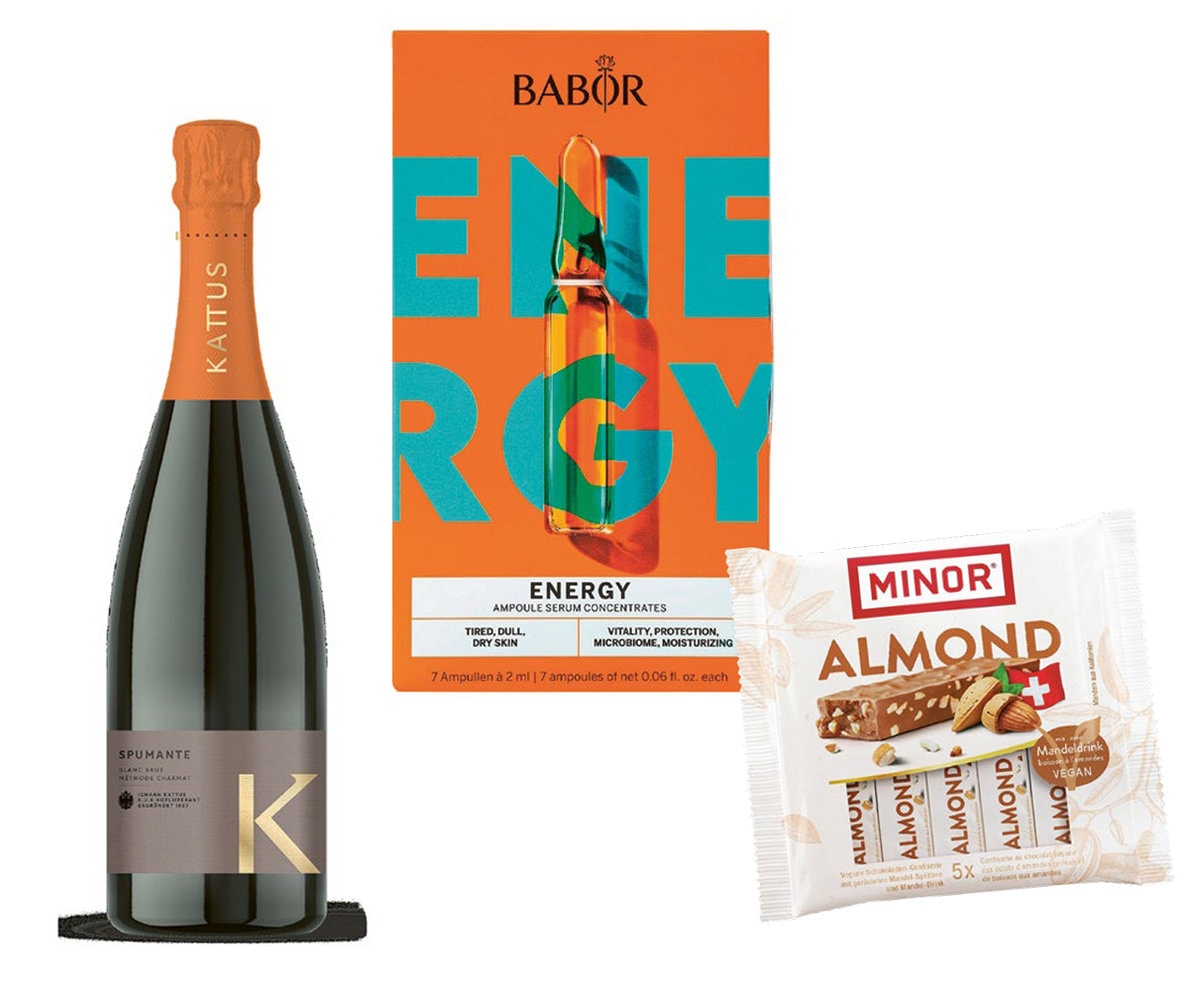
Kattus, Babor, Minor: Modernizing brands without compromising their essence.

Maestrani: Don't miss the pulse of the times!

The iconic Swiss brand Minor has been around since 1936 and has thus enjoyed nearly 90 years of success on the market—and just recently, Minor has firmly established itself in the Swiss chocolate scene. The challenge: «Many people still remember the iconic, square Minor bar from their grandparents» time. It’s an emotional connection that’s priceless—but it also carries the risk of missing the pulse of the times,« says Chief Marketing Officer Valentin Haag. With support from Rembrand, Minor has therefore been working on its positioning and, »as a first step, has sharpened its brand positioning from a mainstream chocolate bar to a premium indulgence brand,« says brand expert Felder. This means modernizing the packaging design, introducing new varieties (vegan), new recipes—and setting new standards when it comes to sustainability. Because, as Haag explains, »for cult brands to remain relevant, they must enrich their established value system with additional values.”

«The key to retaining customer loyalty is to stay true to your own DNA.»

Maestrani closely observes what chocolate fans expect from the iconic brand at the «Chocolarium,» the company’s in-house interactive experience center in Flawil: There, visitors get a glimpse into the production process—and brand managers have the opportunity to ask them about their opinions and preferences. This allows innovations to be tested early on and trends to be identified. «This helps us bring contemporary product innovations and revamps to life,» says Valentin Haag. As one of six pillars of its brand purpose, the company has defined the theme of «joy in progress»—meaning not settling for the status quo. For Haag, this is “the foundation for healthy adaptability within the organization.”.

Babor: Traditional Values, More Relevant Than Ever

The German skincare brand was founded in 1956. A long history and a challenge: «Babor has grown very rapidly organically in recent years. That pace made it difficult to maintain control over the brand, and at some point, everything stopped fitting together—the portfolio, the distribution channels, and even the brand’s visual identity. Now we want to give the brand a stronger international focus. To make that happen, we needed a sharper, globally applicable premium positioning,» says Tim Waller, Co-CEO of the Babor Beauty Group and President of Babor and Premium Brands. A new design, a new logo, a seal of quality, and a new positioning are intended to help achieve this. Despite all the changes, the new concept draws heavily on the brand’s heritage, which, according to Waller, is more relevant today than ever. «With the relaunch, we wanted to place greater emphasis on our roots in professional skincare and our expertise. This is clearly evident in the logo and the accompanying seal: the rose symbol has been removed from the logo and now adorns the seal. This seal will become an integral part of every product and can also be used at the point of sale. It pays homage to the golden mirror, which was already our trademark back in the 1960s.» Sustainability is also taking center stage—even though the topic is not new to Babor: The brand was founded as «biomedical natural cosmetics» and has now defined a new standard under which the entire skincare line is to be free of silicones, parabens, microplastics, and the like by 2025. And it’s resonating: According to internal tests, the new branding could generate more than 62 percent higher conversion rates.

«Traditional brands stand for consistent quality and often build lifelong relationships with consumers.»

Kattus: At 200, as fresh as a startup

On the 200th anniversary of its founder’s birth, the iconic Austrian brand faced a challenge: Over the years, knowledge of the production process for high-quality sparkling wines had faded into the background among its target audiences. But that is precisely what defines the Kattus brand—and should therefore be highlighted more prominently once again. The solution was a new concept as the central theme, to which all of the company’s activities are aligned: «UpGrape.» Following a year-long strategic process with brand expert Lutz Kucher, this motto gave rise to a new positioning, a revamped product portfolio, new core values, and a new, unified, and modern design—including bottles whose colors complement the product’s character. As a tribute to the company’s long tradition, the labels (which, by the way, are now sustainable and made from grape pomace) feature a reference to the founding year, 1857, and the company’s designation as an imperial and royal purveyor. «But we didn’t just stick a new label on the bottle—we carried out a fundamental relaunch that extends across all areas of the company and is deeply integrated into the product itself,» explains Managing Director Maximilian Nimmervoll. And this process, according to Managing Director Johannes Kattus, has also led to exciting developments within the company. «The entire company is more agile, more curious, and more dynamic. In some areas, we operate like a startup and take more risks. That’s fun and motivating—especially because, at the same time, we embody the entrepreneurial virtues of a family business steeped in tradition. Internally, we combine the best of both worlds and project that image to the outside world as well.»


REQUESTED

«Tradition is often confused with being old-fashioned.»

Tabea Höllger, brand expert and partner at the management consulting firm Brand Trust. (Photo: Courtesy of the publisher.)

m&k: Relaunching long-established brands is no easy task. What are the biggest challenges?

Tabea Höllger A major misconception: tradition is often confused with being outdated. Or to put it another way: creative professionals, in particular, tend to equate a relaunch with being new and different. Tradition, historical achievements, quality promises that may seem old-fashioned, and—unfortunately—visual recognition cues all too often fall victim to this «refresh.».


And what are the biggest opportunities?

A relaunch grounded in brand strategy conveys the brand’s values through its brand style—clearly, specifically, and recognizably. This is a valuable opportunity. Many examples from our experience show that relaunches are particularly successful when the brand style is rigorously derived from the brand strategy rather than developed purely on a creative basis. With clear guidelines derived from the strategy, there’s no need for «I like it» or «I don’t like it» debates over taste.


How can a brand maintain its core identity despite a relaunch while still establishing new values?

Simply incorporating new values into a logo, corporate identity, and tagline is just superficial management. Values are shaped by the performance of a company—and they are shaped consistently. Yes, new values can emerge, but for them to be incorporated into a relaunch, they must be credibly justified at the performance level.


Who is a relaunch suitable for—and who is it not suitable for?

For any brand that operates successfully, there will be times when similar relaunches are necessary—for example, to be well-positioned for newly emerging media and formats. When making radical changes, the company must be clear about the strategic reasons driving this step. And this “why” must be communicated. A relaunch based on a change in CMO, personal taste, or idealized visions is not a valid reason!

The "place to be" in Austria

This May, Vienna’s «4GAMECHANGERS» festival kicks off a new edition—with m&k serving as the official media partner for the first time. But that’s not the only reason you shouldn’t miss this event.

Beeindruckender Veranstaltungsort: die Marx-Halle in Wien.Bilder: zVg. «4GAMECHANGERS»-Festival.
Impressive venue: the Marx-Halle in Vienna. (Pictures: zVg. "4GAMECHANGERS" festival)

Every year since 2016 (with the exception of interruptions due to the Covid-19 pandemic), Vienna has become the "place to be" for the DACH economy, for people from business, politics and the media in early summer. This is when the "4GAMECHANGERS" festival takes place in the Austrian capital, an event organized by the leading national private broadcaster ProSiebenSat.1 PULS 4 and ORF. The organizers are explicitly not only interested in discussing TV or media topics, but also in informing, inspiring and entertaining the visitors with a wide range of offers. m&k is the official media partner of the festival for the first time as part of its market entry in Austria - and provides you with a preview of the highlights.

For pioneers

The first day of the festival - the so-called "4PIONEERS DAY" - is traditionally dedicated to those who are interested in the colorful and agile start-up landscape in the DACH region and beyond. The program addresses founders, entrepreneurs, business angels and investors alike - top-class speakers, well-known CEOs and up-and-coming game changers share their expertise on the big stage and talk about topics such as entrepreneurship, finance, innovation and tech. Meanwhile, "behind the scenes", contacts are made or deepened, synergies are explored and alliances are forged.

Stargast 2023: Anwältin und Aktivistin Amal Clooney.
Star guest 2023: Lawyer and activist Amal Clooney.

For future enthusiasts

On the second day of the festival, the focus is on the future: the "4FUTURE DAY" is all about the most important topics of tomorrow and the "next generation": redesigning education, equal opportunities, the future of the healthcare system and sustainability topics such as climate, jobs, education, health and social issues. This is not only exciting for pupils and students, who are explicitly welcome at the festival, but also for experienced HR managers or leaders who are looking for new talent - or simply want to know what makes "Gen Z" tick.

For global meta-themes

The "grand finale" is always the "4GAMECHANGERS DAY". The focus here is on global meta-topics. The future of Europe and hot topics such as "The Power of Cooperation", equal opportunities, freedom of the press and quality journalism and the divergence of our society will be discussed. Exciting talks on world affairs, human rights, media and culture await the visitors - and usually the C-level density in the audience is particularly high on this day, which in turn opens up interesting networking opportunities. Some of the speakers are still being finalized, but regular updates can be found online (see info box on page 104). In previous years, "4GAMECHANGERS DAY" has featured appearances by Amal and George Clooney, Ukraine President Zelenskyi made an appeal to a free Europe and former and current political celebrities came together.

«Place to be»: Mehr als 5000 Besucher:innen täglich werden erwartet.
"Place to be": More than 5000 visitors a day are expected.

The "4GAMECHANGERS" festival 2024 will take place from May 14 to 16, 2024 in the Marx-Halle in Vienna. Over three days, guests can expect a mixture of inspiring keynotes, exciting panel discussions and exclusive networking opportunities. Information on the program and tickets are available here - and m&k-Werbewoche.ch readers receive a 25 percent discount with the code FESTIVAL7PFWM&K.

Interviews with dictators: Masters in conversation

Dorothy Thompson with Adolf Hitler, Sandro Brotz with Bashar al-Assad, Armin Wolf and Tucker Carlson with Vladimir Putin: For a wide variety of reasons, talk show hosts and journalists agree to interview dictators. A genre with a future.

(Image: Shutterstock.com)

It was what the media industry calls a “scoop”: On February 6, 2024, Russian President Vladimir Putin gave an interview to a Western media outlet for the first time since the start of the war in Ukraine. Global attention was guaranteed. What an opportunity to sit across from the man in the Kremlin and ask him questions. Except: The interviewer was Tucker Carlson, an American talk show host and notorious conspiracy theorist.

Carlson loves the attention, but not necessarily the truth. He had worked for Fox News until 2023. His show, «Tucker Carlson Tonight,» was the most-watched political program in the U.S. No wonder: Carlson’s comments became increasingly sensational. He reported on visits from extraterrestrials, spread conspiracy theories about the COVID-19 pandemic and immigration, and defended the storming of the Capitol and Russia’s invasion of Ukraine. Above all, he was a staunch supporter of Donald Trump. That went reasonably well until Tucker claimed that Dominion voting machines had caused Trump to lose the election. Dominion sued Fox News, and the two parties settled on $787 million in damages. That was too much even for Fox News: The network fired Tucker Carlson. Since then, Tucker has been entertaining his audience with videos on X. He calls his show «Tucker Carlson Network.» In the first episode, he claimed that the U.S. military had recovered the wreckage of an extraterrestrial spaceship—complete with a dead alien crew.

Even the Kremlin disagrees

So Vladimir Putin invited this Tucker Carlson for an interview. Before the interview, Carlson claimed that he was the only one who had tried to secure an interview with Russia’s leader. Even the Kremlin refuted this lie: Dmitry Peskov, the Russian government’s spokesperson, stated that the Russian president receives many interview requests, but that the Kremlin sees little benefit in communicating with Western media. In other words: The Kremlin saw a benefit in the interview with Tucker Carlson—and Tucker willingly allowed himself to be used.

«The Kremlin saw a benefit in the interview with Tucker Carlson—and Tucker willingly let himself be used.»

It becomes clear right after the first question what this benefit looks like: Putin’s answer to Tucker’s question is a bit more detailed than usual. For a full 45 minutes, the president explains to his American visitor what’s going on in Ukraine. He begins in the year 862 and then delivers to Tucker roughly the same speech he gave after the attack on Ukraine. And Tucker? He doesn’t have much to say. The two men sit across from each other on spindly wooden chairs, with a small white Baroque table between them. Putin leans back, one arm resting on the armrest, his legs spread apart. He is, quite clearly, the master of the house.

The interview is a textbook example. Not of journalism—it has little to do with that. It couldn’t be, after all; Tucker Carlson isn’t a journalist, but a talk show host. That means: He masters the talk; he commands the format; the content doesn’t matter. No: The interview is a textbook example of the «dictator interview» genre—conversations with powerful men that are anything but conversations.

The «Dictator Interview» as a Genre

Why do autocratic rulers give interviews? Here, an interview with a politician is an opportunity to grill that person. In the best-case scenario, it leads to a lively exchange between the interviewer and the interviewee. If the journalist does a good job, they can corner the politician. If the politician does a good job, they can get their message across to the public through the media. An autocrat needs neither one nor the other. So why do they still meet with journalists?

«»Dictator Interviews’: Conversations with powerful men that are anything but conversations.”

There is certainly a risk that the dictator will be seen through by the journalist—or by the female journalist. The best example of this is Dorothy Thompson’s encounter with Adolf Hitler. Before the war, the American journalist was perhaps the most important political columnist in the U.S. She was the first woman to serve as a correspondent for major American newspapers in Vienna and Berlin. She was married to Sinclair Lewis and was friends with Carl Zuckmayer. When the Zuckmayer family emigrated to the U.S. in 1939, she vouched for them with an affidavit, and the Zuckmayers initially stayed at her apartment at 88 Central Park West. In his autobiography *Als wär’s ein Stück von mir* (*As If It Were a Part of Me*), Carl Zuckmayer describes how Thompson struggled with the German language in 1923: «At first, she had particular difficulty with the distinction between »Du« and »Sie”—which doesn’t exist in English—and she always mixed them up; and when she visited Reich Chancellor Stresemann for an interview, she caused quite a bit of amusement by addressing him as “Du” and his dog as “Sie.””

Dorothy Thompson: «I Saw Hitler!»

After many unsuccessful attempts, Dorothy Thompson finally had the opportunity to speak with Adolf Hitler in 1931: Toward the end of the year, she met with Hitler at the Hotel Kaiserhof in Berlin for an interview. In 1932, a few months before the Nazis came to power, she published the book *I Saw Hitler!*. When she returned to Germany in 1934, she was expelled as a result. In 2023, her book was published in its entirety in German for the first time (Dorothy Thompson: *I Met Hitler! On the Psychology of Fascism*. DVB Verlag: Vienna 2023). «When I entered Adolf Hitler’s room, I was firmly convinced that I was about to meet the future dictator of Germany,» Thompson writes. But she found herself face to face with a small man with a ridiculous mustache and continues: «Not even fifty seconds later, I was pretty sure that wasn’t the case. That’s roughly how long it took to grasp the astonishing insignificance of this man who had the world on the edge of its seat.» And then she realizes that her impression doesn’t matter: «I saw him as a little man. But perhaps that—and precisely that—is the secret of his enormous success.» Dorothy Thompson realizes that this man’s success may stem precisely from the fact that people like her find him ridiculous and vulgar. Thompson understands that Adolf Hitler’s power of persuasion lies not in his political program, but in the emotions he stirs in his followers. Her encounter with Hitler enabled her to decipher him. Only her contemporaries failed to notice this.

Emotions Before Reason

It’s all about emotions, not reason. Perhaps that’s the secret of all autocrats. Another problem with interviews is that they don’t really let themselves be cornered. Sandro Brotz learned this the hard way when he had the opportunity to interview Syrian President Bashar al-Assad in October 2016. It took countless phone calls, emails, and conversations in the run-up to the interview. After half a year, he finally received confirmation—a full nine days before the actual meeting with Assad in Damascus. Unlike Tucker Carlson, Sandro Brotz is a journalist—and a critical one at that. How does a journalist like that interview a dictator without giving him a platform? Sandro Brotz later explained to his own network that the editorial team had been aware of this risk. «That’s why we aired the interview as part of a broader segment and had Assad’s statements assessed by Middle East experts. In addition, I conducted many background interviews with high-ranking representatives of humanitarian organizations beforehand. The consensus was clear: Assad must be confronted with the harm he is causing.» Brotz tried—with mixed success. Assad refused to be drawn out of his shell and remained firmly in control throughout the interview. Nevertheless, Sandro Brotz believes: «It is a journalistic duty to ask the questions the whole world is asking. An interview is always a historical record as well. What’s the alternative? To remain silent in the face of war crimes? Then we would have failed at our job.»

Der Schweizer Journalist Sandro Brotz bei Syrien-Diktator Baschar al-Assad, Dorothy Thompsons Werk «I Saw Hitler!». Bilder: SRF / zVg.
Swiss journalist Sandro Brotz with Syrian dictator Bashar al-Assad. (Photo: SRF)

Real journalists have less influence

The problem is: If you want to dine with the devil, you’d better have a damn long spoon. Journalists are usually at a disadvantage when facing dictators. Even the best ones. Take Armin Wolf, for example. The host of the ORF news program «Zeit im Bild 2» is considered one of the most feared interviewers in the Western Hemisphere—or at least in its German-speaking part. When he invites politicians to appear on his «ZiB 2,» he makes even seasoned stars tremble. In June 2018, Armin Wolf had the opportunity to interview Vladimir Putin. The interview took place in the Kremlin; the decor and furniture looked practically identical to those in the interview with Tucker Carlson: white wooden chairs, a small white Baroque side table with a glass of water, and a carpet. The fact that Armin Wolf interrupted the Russian leader eleven times made headlines in Russia. The fact that it yielded nothing eleven times made headlines in the West. Armin Wolf later told «Politico»: «It was definitely the toughest interview I’ve ever conducted.» Putin is an «extremely shrewd conversationalist.» He knows how to make life difficult for the interviewer. «He speaks at length and goes into detail. As soon as you interrupt him, he focuses on the interruption.» That’s rare among politicians, says Armin Wolf: «Either they let themselves be interrupted or they ignore you and keep talking. But Putin responds to every interruption.» The result: «After the third or fourth time, the interviewer comes across as rude or not particularly interested in his answers.» Moreover, Putin is a «world champion at »whataboutism.«» He very quickly diverts attention away from a topic. «If you ask him about corruption in Russia, he starts talking about corruption in Ukraine.» It’s very difficult to draw Putin out of his shell. “He doesn’t say a single word he doesn’t intend to say. He’s extremely controlled.”

The result: Putin says whatever he wants. In the West, the interviews—when conducted by journalists—can be contextualized, commented on, and analyzed. The problem is that the video footage is also available in Russia. This is how Tucker Carlson earned the dubious honor of receiving a lot of airtime on Russian state television. After all, what Putin told him into the microphone fit right into the program, and Tucker laughed so heartily while doing so.

He’s in a good position to laugh. Because the vast majority of interviews with dictators aren’t about critical questions or groundbreaking answers, but about attention. About ratings and headlines for the media—and about flattering sound bites and message control for the rulers. The more simple-minded their interview partner is, the more likely they are to achieve this goal. I am therefore certain that we will see many more encounters between talk show hosts à la Tucker Carlson and autocratic rulers. In these dictator interviews, their interests align perfectly: attention without substance. Masterful.

Creative Hive: How the honeycomb grows

Creative Hive is Germany’s platform for creative networking, inspiration, ideas, projects, and business. Managing Director and co-owner André Paetzel spoke with us about the power of community—and the plans for 2024.

Bild: unsplash.com / Denys Nevozhai.
(Image: unsplash.com / Denys Nevozhai)

m&k: At a time when traditional associations in many industries are struggling with declining membership, your Creative Hive concept is growing and thriving. What makes you special?

André Paetzel: Well, first of all, we are not an association or a political advocacy group. We are a community—a group united by the belief that creativity is a key driver of positive change in the economy and society. Through our in-person events, we connect and engage the community—here we explore current and major topics such as entrepreneurship (startups, investors, and family businesses), sustainability, art & culture, health, talent, as well as marketing and leadership issues. Perhaps the secret is that we’re an open system for anyone who wants to make a difference and has ideas. There’s no competitive mindset here. And when community members support one another with ideas or expertise, the principle of «pay it forward» applies. Ultimately, we grow through ideas, not through membership fees.


You’ve been the CEO of Creative Hive since the beginning of the year; before that, you and Publicis Chief Growth Officer Christoph Pietsch had been running the project more as a labor of love. Why the shift toward «professionalization» now?

First and foremost, we follow our instincts and believe in the community’s potential. What was built out of passion and fun—with simple means but a great deal of love—is now taking on a more structured form. We also sense a need in the market to support brands, institutions, and individuals in developing, curating, and revitalizing—in other words, activating—their very own ecosystems. The brand is thus evolving from a community of 3,500 members into a community builder. This feels like a logical next step for us.


What are your «basic rules» for modern, sustainable community building?

First and foremost, a clear shared vision, a statement of purpose, and a framework of values are of the utmost importance. They serve as a kind of collective navigation system—and, at the same time, as guiding principles for our shared activities. In addition, inclusion and diversity are of the utmost importance to us, not least to ensure that all members feel welcome and heard. Community-building is the ultimate way to build trust capital—a long-term investment strategy that, if done right, yields high returns. Transparent communication and simple sets of rules organize our cultural interactions: «We help each other,» «Payback always comes,» or «Creativity is a team sport.».

«Come by—you're always welcome. Maybe we'll build the »Davos of the Creative' together soon."

What do you personally value most when it comes to networking?

For example, showing genuine interest and attention to the person I’m talking to. It’s important to me to build authentic relationships based on trust and honesty. I firmly believe that genuine connections are more valuable in the long run than superficial interactions. Furthermore, I greatly value mutual support within networks. To me, this means that I don’t just strive to benefit from others, but also actively work to help and support others wherever I can. The community is the foundation for our interactions, and for us, that means growing together. As Viktor Frankl said: «It never, ever depends on what we can expect from life, but rather solely on what life expects from us.»


What highlights does Creative Hive have planned for this year?

Creative Hive is a highlight all year round because the community is built on relationships. And those relationships don’t just become more valuable and tangible during events or programs. But of course, we also offer inspiring programs such as the Leadership Circle, collaborations with the «Top 40 Under 40» in the capital, insights from the arts and cultural sectors, and events focused on clusters like entrepreneurship, sustainability, and marketing-focused offerings like «CMOs United – Leaders in Growth & Transformation» or the Agency Leaders Dinner with 100 agency representatives. In addition, this year will feature a major study examining creativity and its impact on both people and organizations—“Welcome to the C-Suite, Creativity.”.


Finally: If anyone reading this is interested in your project, what’s the best way to get in touch with you?

Of course, we love meeting people in person. If you’re still skeptical, feel free to contact us on LinkedIn, by email, or by phone. Stop by—you’re always welcome. Maybe we’ll build the «Davos of the Creative World» together soon.


André Paetzel is a native of the Ruhr region. He first entered the media world at Grey Worldwide. This was followed by stints at Deutsche Markenarbeit (now part of Handelsblatt), Publicis, Grey Adventures, and Kienbaum. For more than 15 years, he has been deeply involved with brands in the context of digitalization. André Paetzel has lectured at universities such as the AMD in Düsseldorf and the University of St. Gallen. Together with his partner Christoph Pietsch, he runs Creative Hive, creating inspiration and impact for people and organizations.

André Paetzel, Managing Director of Creative Hive. (Photo: Courtesy of the publisher.)

Can I still hope?

The world we’ve seen unfold in recent years has turned many of us into pessimists. This raises the question—both at work and in our personal lives—of whether hope is even relevant anymore.

Illustration: Getty Images
(Illustration: Getty Images)

Anyone who reads the news regularly is informed about pandemics, climate change, species loss, the potential impact of artificial intelligence, fake news, inflation and war. No wonder more than half of Europeans have a rather dark view of the future. Where has the good hope gone? Has the belief in a better future become naive in view of our reality, or is there something like a well-dosed, justified hope despite everything?

Credibility of pessimism

Although one might think that pessimism about the future is a rather recent trend as a result of the many unsettling news items, its appeal is by no means a new phenomenon. As early as the 1840s, John Stuart Mill wrote: "I have observed that it is not the man who hopes while others despair, but the man who despairs while others hope, who is admired by many as a wise man." So a person who warns others of a terrible misfortune tends to appear more credible than an optimist - regardless of how realistic the claim is. For example, if someone thinks that a certain share price will rise immensely in the next five years, they are more likely to be considered risk-blind and naïve. However, if someone warns me that the price of a share I own is going to fall, they immediately have my undivided attention.

"Pandemics, climate change, inflation and war: no wonder many people have a dark view of the future."

It would appear that our current reality gives us plenty of reason to be pessimistic. However, the popularity of pessimism is also due to the fundamentally higher credibility of pessimistic forecasts. This is particularly true where there is a great aversion to loss, i.e. where concerns about a disadvantage provide fertile ground for pessimistic ideas to flourish. Take the stock market, for example.

Looking into the crystal ball

When it comes to financial and economic matters, pessimists are often given a big stage. However, the stock market in particular shows that a pessimistic attitude does not always indicate greater realism. It is more like a self-fulfilling prophecy, especially as the fall or rise of the DAX or SMI is heavily dependent on the predictions of the human players. If they are pessimistic, prices will fall. If they are hopeful, shares rise. So looking at the stock market prices is almost like looking into a crystal ball - except that it does not simply predict the future, but indicates how we assess it.

The fact that the DAX, for example, has risen from 1,000 points to around 15,000 since the end of 1987 confirms that, despite all the circumstances, optimists are in the majority - on the other hand, this is also a result of economic growth. But there is certainly reason for hope! And instead of prematurely seeing the next stock market slump as the fulfillment of doom-mongering stock market prophecies, we should remember the words of the old optimist Mark Twain from time to time: "Stock slumps are like Christmas. They come back every year." The biggest daily gains are often achieved even during the deepest crisis, such as during the 2008 financial crisis or at the start of the Ukraine war in 2022.

The age of no future

Following the conceptual model of the philosopher G. W. F. Hegel, Francis Fukuyama spoke of the "end of history" in the early 1990s: Following the Cold War, democracy proved to be the world's most important political system and many states had established a promising, capitalist economic system. People were united by a shared belief in a future of freedom and prosperity. - Numerous surveys show that this enthusiasm has faded today: since the early 2000s, the model of democracy has not spread further around the world. As many studies reveal, social inequalities have grown, the gap between rich and poor has widened and the once bright vision of a free, prosperous life has turned out to be a bubble for some population groups. In contrast to countries such as China and Saudi Arabia, which regularly show optimism rates of 75 to 80 percent in surveys, only 22 percent of young Europeans believe in a better future. The difference is that where the governments of China or Saudi Arabia have turned positive visions into a political program - think of Xi Jingping's promise to make China "one of the greatest countries in the world" by 2049 - a void seems to have grown in many European countries. In view of this, the pessimism of disillusioned Europeans can be understood as an attempt to avoid being even more disappointed by the future in their disorientation in the world and history.

Hope and freedom

In fact, historical and economic developments are not the only reason for the growing pessimism: in the Edelman Trust Barometer study cited, pessimism in democracies is also explained by citizens' impression that they cannot really participate in political decisions. Accordingly, the idea of a negative future is not only related to the lack of a positive goal or the disasters that occur, but also to the belief in how much influence we can have on the future. Pessimism feeds on the idea of a future that will befall us fatefully and is beyond our scope of action.

"Pessimism can be an attempt not to be disappointed by what may come."

For this reason, pessimistic forecasts tend to narrow our scope for action. If we hear too much bad news at once, we fall into a kind of rigidity: there's no point anyway. - Optimism, on the other hand, can provide motivation for action, as it contains a moment of freedom, a "You can do it!" This belief in our own ability gives us a reason to make an effort and change the inadequate status quo. While a pessimistic attitude has a paralyzing effect, optimistic thinking empowers us to take action. - However, this enthusiasm comes with the risk of falling flat on our faces when good things are expected where danger actually lurks. The crucial question is therefore whether naïve hope can be differentiated from legitimate hope. Is there legitimate hope? Or in the words of Immanuel Kant: What can I hope for?

What can I hope for?

According to Kant, the question of the legitimacy of hope is one of the three core questions of human reason. It is fundamentally different from the question of who or what gives hope. - According to Kant, all hope is aimed at happiness. - The central question is rather whether I am allowed to hope for this. In other words, can I (justifiably) hope to become happy through my actions?

"If we want to turn the tide for the better, we must not just hope: We must hope."

In contrast to pessimism and naïve or false hope, the legitimacy of hope depends on whether it is realistic to achieve what is hoped for. This means that legitimization is linked to the limits of the scope for action. For Kant, this is not limited by political decisions or applicable law (in which case we would be talking about legality), but by the laws that are a priori necessary in the strict sense, i.e. based on human reason. In the practical sense, this includes moral laws. If there is to be a motive to act in accordance with moral laws instead of making ourselves comfortable in pessimistic rigidity, we must be able to assume that morally correct action also makes us happy. For only this hope gives us a reason to make an effort, even if reality seems bleak. Hoping for a good future is therefore justified or even necessary if it motivates a morally justified endeavor.

Seen in this light, good hope is more than a soul whistling in the dark forest: by enabling us to change the status quo, we know through it that many of the problems mentioned, which - like the fall in share prices - initially appear to be beyond our control, are products of human action and can therefore be changed by it. So if we don't want to let go of the possibility of turning the tide for the better, we must not just hope: We should hope.


Book tips: Hope, illuminated from several perspectives

"The consolation of beauty"

Author Gabriele von Arnim writes grandiosely and movingly about how we can find comfort (the twin of hope, so to speak) in the beauty that constantly surrounds us. We just have to decide to look.

"Hope"

Journalist Nermin Ismail gets to the bottom of one of the most basic human emotions, meets people who have almost lost hope, talks to them about their hardest times and what has helped them. A powerful, "real" work.

"Radical hope"

Jonathan Lear approaches hope from a philosophical direction - similar to the author of this text. His question: Does a world like ours allow us to hope in the face of cultural destruction?

"Do I still have hope or do I have to get some?"

An exceptionally clever, witty book about hope in difficult times - in Till Raether's typical, easily digestible (yet profound) style.

get_footer();