The team players

As Chief Executive and Chief Growth Officer for the DACH region, Frank-Peter Lortz and Christoph Pietsch lead Publicis Groupe’s development alongside the Country Leadership Team. In conversation, however, it quickly becomes clear that these two top executives don’t let their positions go to their heads. An unpretentious conversation about the economy, agency models, and «creative flights of fancy.».

Christoph Pietsch (left) and Frank-Peter Lortz from Publicis Groupe. (Pictures: Amin Khelghat)

m&k: Frank-Peter Lortz, Christoph Pietsch: Shortly before our interview, the global CEO of Publicis Groupe, Arthur Sadoun, published his review of the year 2023. He praises how well your company has dealt with economic challenges and mentions various areas in which Publicis can claim international market leadership. With such a "conclusion", are you relaxed about the future?

Frank-Peter Lortz: You ask us this question in January, so it is of course difficult to make a serious forecast by the end of the year. But I agree with Arthur when it comes to looking back on 2023: it was an excellent year for Publicis, both globally and here in DACH. We were financially successful, the share price went and continues to go - to put it casually - through the roof. We also continued to develop in terms of content and showed that our "Power of One" model makes us resilient and successful. So much so that it is now being copied by some of our competitors. That's a nice compliment, isn't it? (laughs) So, yes, I am optimistic about what is to come. But it is also possible that the economic conditions will continue to deteriorate, at least in Germany and Austria, and we need to keep that in mind.


It's no secret that marketing, communication and advertising measures are often the first to be cut when the economy darkens. How do you motivate the companies that use your services not to give in to this temptation? Because whatever you do, it seems to work quite well.

Christoph Pietsch: I need to expand a little on that. Let's take a look at the journey we have taken as a company over the past few years: What our colleagues have achieved in terms of transformation - whether in terms of our portfolio, structures, initiatives, the entire approach, so to speak - is impressive. It's incredibly motivating and radiates in all directions. For us, this has become a kind of credo, which in a nutshell is simply "to do good things with good people". There is a great deal of passion in all of this ... and that is simply incredibly attractive, almost like a kind of superpower. There are certainly always business factors that our clients have to take into account when working with agencies, but if they find a well-positioned, inspiring, cleverly structured sparring partner in us, then that helps to maintain connections even in challenging times. And even deepen them. Challenging times require ideas and concepts.

Lortz: I was very positive in my review of 2023, but you have to be honest - the wind was blowing in the face of the entire industry last year, and of course we noticed that. A tailwind would have been more pleasant. On the other hand, it was a litmus test, so to speak, for our business model ... and I'd say we passed it.

"The wind was blowing in the face of the entire industry last year, and of course we noticed that too."


You mentioned earlier that the "Power of One" makes Publicis resilient. Apart from the fact that this is a good claim, how does this "power" really become a differentiating factor in the market?

We are affiliated with many agency brands - including some that have historically enjoyed enormous popularity - but internally we are de facto one agency. We have a joint, cross-brand management board and have totally exciting, very different people who - when it comes down to it - all pull together. If someone has problems, they get help. And that's what sets us apart as a group.

Pietsch: (laughs) In previous roles, I've always told this story in exactly the same way as Frank-Peter just did, but the difference is that we really activated the collective potential of the "Power of One". In the end, the group is an agency. After three years in the group, for example, I'm still delighted by the fact that the entire board meets several times a week via video call and has intensive discussions: what are the current overarching issues, who is working on what potential, where do we need support? And even if there is a challenge or "dip", for example because a pitch or client is lost - which happens in our line of work - the agency in question can count on support. As a team, we think about how we can support each other. A team with a joint profit and loss account.

Lortz: "The Power of One" also makes us more agile and flexible. We can react much faster because there are no artificial barriers between agencies and employees and everything can be adapted immediately to changing market conditions or customer requirements. Clients often grow when the contacts realize: "We not only have a problem in area X, but now also in area Y - but Publicis can solve both problems."


As a top manager, how do you create a culture for around 3,000 employees at all hierarchical levels in the DACH region? That seems to me to be a complex, ongoing task - and important to ensure that good people don't leave.

At the moment, we are in the fortunate position that top talent is coming to us rather than leaving us - be it top creatives, digital experts or media professionals: people want to work for Publicis, that's a fact, and that in itself is proof that the Group is successfully optimizing its potential in the DACH region. When we receive dossiers from applicants who would really have no problem finding a job anywhere else ... it shows that we are already doing a lot of things right. An agency basically consists of two components: Employees and customers. If one of the two areas isn't right, the entire construct immediately begins to falter. Furthermore, as I said before, the "Power of One" must be more than just an empty phrase. For example, I firmly believe that a sense of togetherness can only develop if we not only allow interdisciplinary and inter-agency work within the Group, but if we actively promote it. We have internal training and development programs in which colleagues are deliberately motivated to think "outside the box". We organize events to strengthen the internal culture. We enable all colleagues to work abroad for several weeks a year - we support them with residence permits and insurance and help them find accommodation. This goes far beyond the DACH region. If you actually have your office here in Düsseldorf, but want to get to know Paris, New York or São Paulo better as a location and city, we make that possible. This also promotes cross-group cohesion enormously.

Pietsch: Perhaps at this point we can bring together two things that we have already discussed: Namely, the question of how we build successful relationships as an agency and how we develop an attractive employer brand. We want to be the best agency in the market for our customers and employees. And I think the formula for this is quite simple: ultimately, success always attracts success. Clients want to work with agencies that take on a leadership position, see themselves as a platform and are not somewhere "below the rest" in terms of performance. And the best employees want the best employers. We need to hear and understand this and take the needs of both interest groups seriously if we want to continue to grow.


As Chief Growth Officer, you would therefore also be at the interface between culture and communication. Am I reading too much into your role here - or would you agree?

Pietsch: So, promoting culture and communication is the task of all of us - the task of a large number of very capable, highly valued people who work here in the company. But, yes: I don't see my job as a pure sales or acquisition function. For sustainable growth, we have to look at the structures and tools as well as cultural issues. We have to think about the areas in which we excel, where this excellence comes from and how it can be transferred to other areas. Even in areas that perhaps need to catch up. There are then different strategies in marketing and sales, including which offers to put in the shop window depending on the situation. Creative communications is always popular because client turnover rates are higher there, digital business transformation because demand is higher than ever before, and media because it is often international in nature. Who helps whom to grow? Who stabilizes whom when things get difficult? Which service has which function in the value chain and in cross-selling? These are questions that we can answer from our model. In the end, the overall concept has to be convincing. Customers have to experience that it works and helps the business - and if our colleagues also attest that our form of interdisciplinarity is something special, then we've done a good job.

"Who stabilizes whom when things get difficult? Who is located where in the value chain?"


With the "Working with Cancer" initiative - which Arthur Sadoun launched as a result of his own cancer diagnosis - Publicis has motivated hundreds of global companies to voluntarily increase the protection of their employees in the event of illness. Isn't that actually the greatest success of recent years for you?

Pietsch: "Working with Cancer" is an extremely impressive program that has sent out a very important signal from the very first moment based on the clinical picture of the global CEO - and how he deals with it. And when you can set up a global NGO with more than 1,300 member companies virtually from scratch ... with SAP, Beiersdorf, Bank of America, Pfizer et cetera ... then you realize that the organization is not "just" advertising. It leaves a footprint and initiates real change.

Lortz: Something like "Working with Cancer" is fortunately being noticed and is a great success. Global advertising networks are often criticized for their size. But without this size, there wouldn't be the leverage needed to get something like this off the ground and create space for it, for example at the World Economic Forum in Davos.

Über den Dächern von Düsseldorf: Christoph Pietsch (links) und Frank-Peter Lortz beim Fotoshooting im 25hours-Hotel Das Tour.
Above the rooftops of Düsseldorf: Pietsch and Lortz at the photo shoot in the 25hours Hotel Das Tour.


Do you feel attacked when smaller "hot stores" accuse you - for example - of institutional inertia?

Most of the time, that doesn't bother me at all - but there are exceptions, as I just mentioned. I generally have great respect for smaller and medium-sized agencies; there are good reasons for them to exist. And there are also good reasons that they win great accounts and do a good job on these accounts. Our industry thrives on diversity - and I love diversity.

Pietsch: I would like to disagree.

Lortz: (laughs) Okay.

Pietsch: No, that wasn't adequately formulated, I'm not contradicting you, but adding to it. I wish I could answer as calmly as Frank-Peter. But we get annoyed every time we lose. We really do. (laughs) Of course, we are always fair sportsmen and women and can acknowledge when other offers were simply better - but we also want to impress in every competition and be the best. Compared to other agency brands, we simply have a different approach in terms of our model, portfolio, internationality and self-image; certain parameters are difficult or impossible to compare. And yet it's annoying when you lose a pitch against competitors - who you generally hold in high regard as people. We are simply ambitious. In the end, that's also part of the eternal story: the seemingly century-old story of the differences between owner-managed and capital market-oriented network agencies. Sometimes you're Goliath, sometimes David. Sometimes Roman, sometimes Gaul. This togetherness is often associated with challenger characteristics. From "unconventional", "unseen" to "totally courageous". What is often forgotten in the discussion: Offers must be designed around needs. The needs of customers, organizations, brands and talents ... So there is enough work for everyone.


But wouldn't you like to be a "Gaul" again?

Radicalism cannot be consistently maintained forever, neither with people nor with agency brands. Do you really want - no - can you really be credible and always be an "enfant terrible"? At some point, you have to grow up. "Nothing to lose" and healthy aggressiveness are acceptable stylistic devices in a certain phase of the agency brand - positioning and building awareness, so to speak. And if you deliver great work, you will grow. The portfolio also grows over time. Once the company has established itself and developed into a medium-sized organization through impressive performance, this also comes with greater responsibility. For employees and customers. All of this often means that you gradually lose the top position you held in the early days. Incidentally, this does not mean that you can no longer have an excellent creative product at your core.

Lortz: Expansion costs money. If I want to meet the increasing demand from existing and potential customers, I have to hire new people, rent larger offices and invest. I then automatically leave the area in which I was radical and different and become a little more like the norm. And - as already mentioned - "young and wild" people follow suit, doing for a few years what you did in the beginning ... Our industry is in constant flux, there's an incredible dynamism in it that spurs us networks on to develop dynamically as well. Maybe that's how everyone stays fresh together; maybe the big and the small benefit from each other.

"The market has room for a wide variety of players, who should all be given their time and their chance."


Chief Executive Officer and Chief Growth Officer: How do you actually work together on a day-to-day basis?

Pietsch: Well, first of all, it's Frank-Peter's fault that I'm here. (laughs) In the room where we are sitting today, Frank-Peter made us the offer to come to Publicis. In many conversations with Frank-Peter, the management board and the teams, it became clear that we could learn a lot here and perhaps even make a difference. From the very first day, I have (turns to Lortz) I appreciated your unpretentious, open and down-to-earth manner, it was a good fit on a personal level. And: you give space to spinning. (laughs)


You have to explain that ...

We have very different characters on the entire management board and in the agency leadership teams, as we have already mentioned. For some - and I would count myself among them - things are sometimes much easier in their heads than they really are in the end. Nevertheless, wild ideas and concepts are heard, seen and equally valued - by everyone in the agency group, by the way. If things get too wild, someone comes forward and says "it's probably not that simple", giving the thinking a new, important twist. Frank-Peter is also happy to take on this navigation.

Lortz: What I would like to emphasize again at the end of this interview is that it is nice that you invited us both for an interview, but we are not solely responsible for everything we have said. We play as a team, the management colleagues as well as each and every colleague in other positions. That's exactly how it has to be - it's one of my most important tasks to strengthen the team. I don't believe in hierarchies just for the sake of it; I don't need them to "lead" either. I don't need status symbols. I just want to be part of the team. If we want to continue the transformation that has made us so successful, we need feedback and dialog - we need people who aren't afraid to "go crazy" or think really, really big (points to Pietsch) - and this is only possible if we create an environment in which this is possible. You know the saying - "The head is round so that thinking can change direction?" That's what we want to be: a place where heads stay round. (laughs)

"That's what we want to be: a place where heads stay round."

Chief Growth Officer Christoph Pietsch (hier links) schätzt die «bodenständige Art» von CEO Frank-Peter Lortz; dieser wiederum lobt Pietschs Mut, «richtig, richtig gross zu denken».
Chief Growth Officer Christoph Pietsch (left) appreciates the "down-to-earth manner" of CEO Frank-Peter Lortz, who in turn praises Pietsch's courage to "think really, really big".

Artificial intelligence: creative added value or hype?

No topic has stirred up the marketing and communications industry quite like artificial intelligence (AI), especially generative AI. But is AI just hype, or can the technology actually offer creative value?

Die Frau, die Sie auf diesem Bild sehen, existiert nicht – der Autor hat sie mithilfe von Midjourney «visuell zum Leben erweckt». Der Prompt lautete wie folgt: «a portrait of a female indian chief, closeup, dslr, high detail --v 6.0».Illustration: Stefan von Gagern
The woman you see in this image does not exist—the author «brought her to life visually» using Midjourney. The prompt was as follows: «a portrait of a female Indian chief, close-up, DSLR, high detail –v 6.0.» (Image: AI-generated with Midjourney/Stefan von Gagern)

There wasn’t a single marketing conference in 2023 that didn’t have at least one AI-related topic on the agenda. There was virtually no keynote speech that didn’t mention AI or an AI-related product—whether at Meta, Microsoft, Amazon, or Google. A single tool—ChatGPT—has shifted the topic from a niche subject for experts and data scientists to the center of marketers’ attention.

Almost every marketer who has ever tried ChatGPT for themselves has experienced that magical moment: the moment they saw with their own eyes, for the first time, how the text generator can churn out usable marketing copy in seconds. Many suddenly became interested in it—and, more specifically, in what AI could do for their own companies. AI features for marketing had been around for five to eight years prior—for things like data analysis and campaign personalization—but to many, it sounded like science fiction before ChatGPT. AI features were mostly visible and usable only to marketers at large companies through enterprise software like Salesforce Marketing Cloud or Adobe Experience Cloud. ChatGPT, on the other hand, is free for everyone—and even the significantly more powerful Plus version, at $20 per month, is affordable for just about anyone.

A Dream Team of Man and Machine?

At the same time, no topic is as polarizing as AI. AI enthusiasts dream of replacing their content teams with ChatGPT and automatically populating SEO blogs. In contrast, AI skeptics warn that only human copywriters can create content that customers actually want to read.

«Companies need to jump on the bandwagon now if they don't want to fall behind.»

Is AI really useful in marketing? And is AI so good that the technology can replace marketers and content creators? Creative software specialist Adobe has been answering this question repeatedly for about ten years—long before ChatGPT—such as when the first AI features appeared in Photoshop. «AI enhances creativity, but it doesn’t replace it,» was the credo of Adobe CEO Shantanu Narayen in nearly every keynote.

In fact, AI can make people better, more creative, and more productive—if used correctly. ChatGPT can help generate ideas for products, topics, and marketing campaigns. AI can help copywriters overcome writer’s block. Creatives of all kinds can use it to develop ideas faster and more effectively; it’s essentially a sparring partner that acts as a «creativity booster» to help them get their next project off the ground.

Der Autor hat auch dieses Bild in wenigen Sekunden generiert – und zwar via Midjourney und mit folgendem Prompt: «a portrait of an indian chief, closeup, dslr, high detail --v 6.0»Illustration: Stefan von Gagern
This image was also generated by the author in just a few seconds—using Midjourney with the following prompt: «a portrait of an Indian chief, close-up, DSLR, high detail –v 6.0.» (Image: AI-generated with Midjourney/Stefan von Gagern)

A Risk: AI-Generated Content Without Fact-Checking

The past year has not only demonstrated the potential of AI innovations but also revealed their weaknesses. For example, while text generators like ChatGPT can produce ideas for marketing content—such as social media posts—in seconds, they also tend to “hallucinate”—that is, to invent or distort facts. Therefore, it would be risky to leave your blog entirely in the hands of AI without having a human perform a fact-check.

Thus, the right mindset lies somewhere between these two extremes: AI is a tool that can speed up many tasks, enhance creativity, and take on specific tasks. Experts are still needed to operate AI tools and monitor their output. It’s no coincidence that Microsoft has named its AI assistant for Office 365 «Copilot.».

A Real Benefit for Marketing and Creativity?

At the same time, it would be wrong to dismiss AI as useless in marketing because of these weaknesses. According to forecasts by Adobe, the demand for digital content is expected to increase tenfold over the next two years—while expectations and the pace of change are set to rise even further. Forbes predicts that companies using AI will see a 38 percent increase in productivity when generating ideas and a 29 percent increase when writing website copy. Those who forgo AI assistance here run the risk of falling behind the competition or simply being unable to adequately maintain their channels.

Knowing how to use AI properly is a skill that will be increasingly in demand in the coming years. Given these figures, it’s surprising how slow the adoption of AI has been—according to Bitkom, only 15 percent of companies in Germany were already using AI as early as 2023; and the figures are likely to be quite similar in the rest of the DACH region. Getting started, however, sounds easier than it is. AI tools like ChatGPT, for example, look simple at first glance. Anyone can ask the chatbot to write a social media post on a topic like «AI in content marketing.» Prompting—the instructions telling the AI what to do—is done not in a special code but in natural language, as if you were having a conversation with a person.

But then the AI generates generic text—which probably no one wants to read. Some declare the AI experiment a failure after such a tentative attempt. In fact, when it comes to ChatGPT and many other AI tools, the rule is: «Quality in, quality out.» That’s why the ability to write good prompts—known as prompt engineering—is essential for reaping the benefits described, such as increased productivity and greater creativity.

In the example mentioned, a little context would have gone a long way toward improving the output—that is, providing information about the desired social media platform, target audience, and tone. To help people learn how to craft prompts, OpenAI recently published a collection of examples showing what can be achieved with ChatGPT—and added an official «Prompt Engineering Guide» to help users get better results. Some tips from the guide include keeping prompts as detailed as possible, tailoring them to specific personas, enriching them with examples, and noting the desired length of the output.

Another great learning resource is the free Chrome extension «Superpower-ChatGPT.» It not only offers additional tools for the interface but also provides a collection of prompts from the community that can be filtered by categories such as «Copywriting» or «SEO.».

The Future of Multimodality

AI has made huge strides in development over the past year and, in particular, has demonstrated that the technology can generate not only text but also convincing images. In just a year and a half, the image generator Midjourney has evolved from a tool that was once ridiculed into a serious competitor to real photo shoots. Version 6, released in December, amazed experts: Images generated with Midjourney have completely shed the «AI look» that was previously so typical. Human portraits, for example, look as if they were taken with a professional SLR camera and, with their finest details and sophisticated lighting, are barely distinguishable from real photographs. You can put this claim—and your own judgment—to the test with the illustrations accompanying this article. Previous weaknesses, such as the generation of text and logos within AI images, have also been improved, and the production process now runs more smoothly than before. According to «Everypixel Magazine,» in 2023, more images were generated using AI than were photographed in the previous 150 years—more than 15 billion per day using the «text-to-image» feature.

«To many people, the widespread use of AI before the introduction of ChatGPT sounded like science fiction.»

Right now, there’s still a lot of chaos in the world of AI tools. There are tools for many small, specific tasks, and hundreds of new AI tools are released every month. But since spring 2023, ChatGPT has been showing us what the future might look like: multimodal. AI tools will be able to understand various input and output formats. Today, ChatGPT can use the built-in image generator Dall-E 3 to generate images based on the context of previous prompts and understands images as input. This makes it possible to upload infographics and have the AI explain them.

Overcome Challenges, Stay Ahead

Even though the use of artificial intelligence in marketing still presents challenges, it offers real benefits in terms of productivity and creativity. Especially when people with AI expertise and the machine work closely together, immediate added value is realized. As a result, the demand for AI training and skilled employees will increase dramatically in the coming year—and all companies need to jump on the bandwagon now if they don’t want to fall behind.


Stefan von Gagern He is now joining the ranks of m&k’s top-tier freelancers. He is an AI trainer and coach, copywriter, and LinkedIn ghostwriter from Hamburg with twenty years of experience as a tech journalist.

Job sharing: sharing the fire

Full-time contracts and overtime are a thing of the past—driven by a shortage of skilled workers and the lifestyle choices of young talent, a shift in thinking is currently taking place. Even executives are increasingly working reduced hours.

Bild: unsplash.com / Allec Gomes
(Image: Unsplash.com / Allec Gomes)

When the U.S. communications agency BCW was looking for a leader for its German office, it decided not to hire one CEO—but two. Susan Hölling, who started at the company as a trainee, and Björn-Christian Hasse, who brings global expertise to the table, have been an equal leadership duo since the summer of 2020. «Because we divide up the work, we can not only lead our teams but also help implement many initiatives,» says Hasse, pointing out one of the many advantages he sees in his modern co-leadership role. Two more: Together, they can share the burden of responsibility and, when vacation time comes, even hand it over completely.

«Back in the day, we used to compete with our coworkers to see who could work the most overtime.»

This new way of working together is set to catch on—at least within the agency itself. «We have many moms and dads among our employees whom we want to enable to work flexibly for us, and that’s why we’re also fostering an open work culture in leadership positions,» explains Hasse, who is also responsible for the Swiss market at BCW. «While I like to start my day early in the morning, Susan goes to the market with her daughter one afternoon a week,» he says, describing the options. The father of two young twin sons works full-time, just like his co-CEO—but without the overtime that’s typical for this position. Furthermore, under the company’s in-house «New Work» model, it wouldn’t be a problem if he ever wanted to scale back his hours. Hasse describes his agency’s mission statement as an “agency for adults.” Lively work without burnout.

Anything is possible: working full-time or part-time, in tandem, and from home. In the morning, in the evening, and even at night. «No matter when or where—the main thing is that the work gets done,» the co-CEO states as the condition. This great freedom naturally comes with additional organizational challenges: The teams must coordinate closely to avoid bottlenecks. They should also make sure to meet in person regularly to exchange ideas more thoroughly. «Working exclusively at night, for example, is therefore out of the question,» Hasse says with a smile.

Mothers as Successful Leaders

A lot has changed since he began his PR career a good 20 years ago: Back then, he and his colleagues were still competing to see who could work the most overtime. On weekends and even on vacation, people were at least in «standby mode.» And managers returning from parental leave were trusted with small projects at best. «A waste of talent,» Hasse criticizes. «Today we know that it’s precisely parents—especially mothers—who lead successfully and with empathy.» And if a baby happens to be sitting on your lap during a video meeting at home, that’s also «totally normal» these days.

«The key point is that fewer hours do not necessarily mean less commitment. On the contrary.»

Gabriele Kaminski has also been observing the major changes in the world of work. A lot has happened in recent years for the managing director of GK Personalberatung in Frankfurt. «COVID was certainly a catalyst for remote work. The ongoing labor shortage in many industries, however, calls for sophisticated part-time models,» says Kaminski, who primarily seeks out executives for global corporations in the DACH region. It therefore comes as no surprise to her that the IT industry, with its tight staffing levels, is more eager than others to meet the demand for flexible work arrangements. In Switzerland, according to the headhunter, the finance and pharmaceutical sectors also stand out, as they attract employees with comprehensive childcare options, Kaminski explains. «With such initiatives, companies are particularly appealing to the younger Generation Z, for whom family time is more important than salary.»

Fear of losing one's significance

Deloitte’s analysis, «2023 Gen Z and Millennial Survey,» confirms this theory. For both age groups—defined in the global study as those born between 1983 and 1994 and between 1995 and 2004—work-life balance is a key factor in choosing a new employer. In fact, 81 percent of Gen Z respondents and 76 percent of Millennials say they want flexible and reduced working hours—while still having fair career opportunities. Some fear they will be overlooked for promotions or assigned less interesting work.

«Today we know that it is parents—especially mothers—who lead successfully and with empathy.»

A debate has recently flared up in Switzerland over whether part-time work threatens overall prosperity. According to figures from the Federal Statistical Office (FSO), among couples with school-age children, mothers work an average of 55 percent of a full-time workload, while fathers work 91 percent. Overall, 38 percent of the workforce in Switzerland currently works reduced hours, representing an increase of about seven percent over the past ten years. Like Switzerland, Austria and Germany are also traditional part-time countries: both labor markets have seen a steady rise in the number of workers with reduced hours, each at 29 percent.

This is increasingly affecting the executive suite as well: According to a study by the pro-employer Institute of German Economy, about 13 percent of all executives work less than full-time. There is a clear gender difference here: Among female executives, 25 percent work part-time, compared to just 5.5 percent of male executives. The desire for shorter workdays is often driven by the need to care for family members, but also by the desire to pursue personal development in other areas.

No less than 70 to 80 percent

But even as the trend toward part-time work grows, companies still have reservations. «Most HR managers still prefer candidates who want to work full-time,» Kaminski reports. This is especially true for managers: «If a leadership position is to be filled with a reduced workload, then please not less than 70 to 80 percent,» says the HR expert. A company like BCW, which sets working hours according to its employees« preferences, still seems to be something of an exception. »Part-time leadership is still a rather rare phenomenon,« confirms Annina Hering, Senior Economist for Germany, Austria, and Switzerland (DACH) at the international job board Indeed. According to her data, 16 percent of job postings on Indeed are now advertised as flexible, allowing for part-time or full-time work. Nevertheless, Hering also concludes: »If given the choice, most companies prefer a full-time employee. Otherwise, they’d have to find two part-time employees, which many HR departments are reluctant to do.« However, the Indeed economist leaves no doubt that part-time models will gain traction in order to make the most of every workforce resource. It’s also crucial to recognize that fewer hours don’t necessarily mean less commitment. On the contrary: »Many part-time employees get the job done faster than those who spend the entire day at their desks,” says Hering.

«Job sharing gives women, in particular, the opportunity to advance their careers while working fewer hours.»

From this perspective, two part-time workers can accomplish more than one. That is also the basic idea behind job sharing. Irenka Krone-Germann, author of the book *Part-Time Employment in Switzerland: Relevance, Impact, and Challenges*, has been advocating for new flexible work models such as job sharing and top sharing for more than ten years as co-founder of the Part Time Optimization (PTO) association in the canton of Fribourg. According to Krone-Germann, when companies hire two part-time employees for a single position, the benefits are enormous. «Customers and employees always have two points of contact and therefore always get a second opinion,» says the expert. For her, one thing is certain: «A duo has been proven to be more successful.» In addition, job sharing traditionally gives women in particular the opportunity to advance their careers while working fewer hours and to remain in the workforce while raising a family. As a prime example, Krone-Germann points to the University Hospital of Vaud, where women work part-time as clinic directors thanks to top-sharing. According to figures from the Federal Statistical Office (BfS), this model is currently practiced by 9.6 percent of part-time workers and 3.6 percent of all employees.

Job sharing requires trust

Just like working part-time, a job tandem—in which both people work 60 percent—also presents challenges. «For two people to successfully share a position, it takes a lot of openness, trust, and transparency,» explains Indeed job market expert Hering. Individual teams would also need to organize themselves more effectively, and detailed agreements should be made—such as ensuring that no meetings are scheduled after 2:00 or 3:00 p.m. «We’re not there yet,» Hering believes. According to her, the reason why so few HR departments have addressed job sharing or tandem management so far is that workforce planning is still too rarely viewed as a corporate strategy.

At O2 Telefónica Deutschland, they seem to be a step ahead. For Chief Human Resources Officer Nicole Gerhardt, the focus isn’t on working hours or location. Much like at the communications agency BCW, for her it’s all about results, productivity, and the needs of individuals. The executive still wants to try out a few more things: «For many managers, our flexible and digital way of working is also an alternative to traditional part-time models.»

How original can advertising be?

«Something new that’s already worked three times»: Many CEOs—and, consequently, their CMOs—would likely describe their «dream ad» with this oxymoron. And lo and behold: technology makes measurable mediocrity possible. But where’s the creativity?

Bild: unsplash.com / Lucas Sankey.
(Image: Unsplash.com / Lucas Sankey)

Attention, dear readers: here comes a tagline—or rather, a double entendre. It actually captures the essence of a fictional shampoo brand quite well—one that’s not only affordable and good for your hair, but also eco-friendly: «Great hair shouldn’t cost the world.» This slogan would likely succeed in convincing new customers to buy this sustainable shampoo. But more than that? Probably not. And that’s no surprise: After all, the tagline didn’t come from a creative professional who put a lot of thought into crafting a good advertising slogan, but from ChatGPT.

«Do campaigns that are written and talked about have a greater impact on a company's success than others?»

Presumably, very few people would talk about this campaign and its fictional slogan, let alone write about it. And that also reduces the chances of really attracting attention—let alone achieving an «earned effect,» that is, generating earned media and advertising that is created organically and is therefore more credible and authentic. A study by the Weber Shandwick Collective (TWSC) in collaboration with the Institute of Practitioners in Advertising (IPA) demonstrates the magnitude of this effect. The question the researchers asked for their study was: Do campaigns that are talked and written about (over a longer period of time) have a greater impact on a company’s success than others?

That's how strong the «earned effect» is»

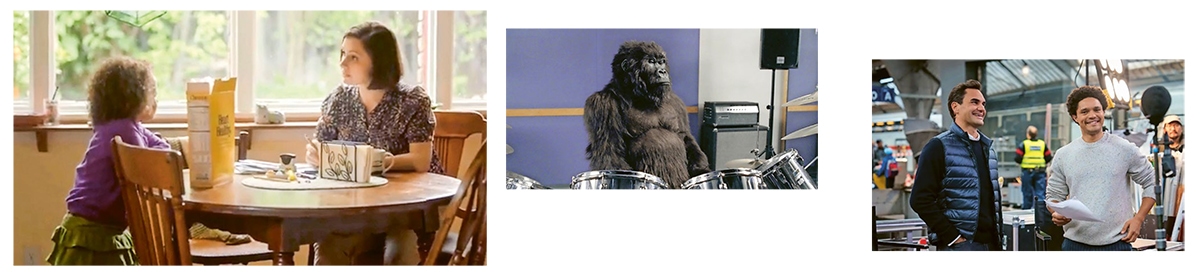
In addition to marketing guru Peter Field (IPA), the team also included Nigel Rahimpour (Head of Strategy at Nonfiction Research; at the time the study was conducted, he was Head of Strategy at Weber Shandwick Germany). The researcher and former top advertising executive knows how to generate earned media through well-crafted advertising: In 2013, he developed the «Unconditional Love» campaign for the breakfast cereal brand Cheerios, which featured a multicultural, diverse family at the breakfast table—and went on to become one of the most talked-about campaigns in the U.S. From the New York Times to the Daily Mail and Ads of the World—media outlets around the world covered the (at the time still) quite unusual campaign; even Oprah Winfrey spoke about it. Brand awareness skyrocketed, and the «earned effect» was enormous. Field and Rahimpour demonstrated in their study that this pays off for brands in multiple ways. According to their findings, campaigns that generate media coverage and conversation over an extended period of time outperform others across all KPIs. In numbers: They are 53 percent more likely to generate very large growth effects, for example in revenue, market share, or new customers. The probability of achieving very large gains is 2.6 times higher. Fifty-seven percent achieved disproportionately high sales increases, and 40 percent achieved very large market share gains as well as a 42 percent improvement in ROI—in some cases even with a smaller budget.

«Ad agencies are often under pressure to (…), with the result that all advertising looks the same.»

But: For a campaign to be written about and talked about, it must create something that has never existed before—something no one expected. It must surprise and inspire people, evoke emotions, and be more than just «right,» as Nigel Rahimpour says—it must be «interesting.» The problem, according to the expert: «Agencies today are often under pressure to produce campaign ideas in ever less time. The result: They’re relying more and more on technologies like AI—with the effect that all advertising looks the same. Advertising becomes average. Most campaigns are correct, to be sure. But none of them are interesting.» Artificial intelligence, for example, says the advertiser, can think rationally, but it cannot think irrationally. And that is precisely what makes for good advertising.

What Set Cadbury Apart

One of Rahimpour’s favorite examples: Cadbury’s famous gorilla commercial, which the chocolate manufacturer used to promote one of its brands in 2007. The ad features a close-up of a gorilla who is clearly enjoying Phil Collins« hit »In The Air Tonight« while playing the drums along to it. »If the gorilla had taken a bite out of a piece of chocolate at the end, that would have been logical and correct, but it would also have been a bad move. It would have ruined the commercial,” explains Rahimpour. As it was, however, sales rose by nearly ten percent across the company’s entire portfolio.

«Inspiration can be found anywhere. Even in your own gut—or on ChatGPT.»

The campaign is 17 years old—what has changed since then? «Advertising used to be bolder. People relied more on their gut. Instead, many today are relying more and more on technology. As a result, the focus on big ideas is being lost,» says Rahimpour. The question is: How important are such big ideas today—in an age when campaigns can be precisely targeted using data and automation to reach their audience exactly when they need the product in question? Extremely important! Because that’s the only way to build a brand: «After all, performance marketing only speaks to people who already know the brand,» says Nigel Rahimpour.

Hand in Hand with AI & Co.

The key is to take advantage of these technologies and see where they can be applied in a targeted way—hand in hand with human creativity. Then, even big ideas are still possible. Advertising legend Michael Conrad is also convinced of this. He has been involved in the industry since the late 1960s, serving, among other roles, as global chief creative officer at Leo Burnett—and today he says: «With all the new technologies and possibilities, the key is to see what benefits they bring us.» «Blockbuster ideas» may make up the smallest share of advertising today—but they still exist. The advertising icon points, for example, to the multi-award-winning campaign by Switzerland Tourism featuring Roger Federer’s attempt to shoot a commercial for Switzerland with a Hollywood great like Robert De Niro. «Above all, campaigns like that take courage,» says Conrad. «The creators who dare to do this deserve a round of applause.»

Nevertheless, according to the advertising expert, about 85 percent of the advertising we encounter every day is uninteresting and clichéd. It only has an impact when large budgets are used. «The biggest challenge for brands is answering the questions: Who do I want to be? How do I differentiate myself? That requires investment. And the most cost-effective investment is creativity.» He adds that technologies like AI cannot replace people, but can support them. «Chat GPT can improve advertising and make it more substantive. But it can’t make it more creative.»

A cornflakes commercial that’s sparked widespread discussion in the U.S.; a gorilla drumming along to Phil Collins‘ megahit «In The Air Tonight»; the Switzerland Tourism campaign featuring Roger Federer and Trevor Noah: all examples of excellent advertising creativity. (Images: Cadbury / Cheerios / Switzerland Tourism)

What happens to our creativity?

Do these technologies also make us less creative? Jutta Portner, founder and CEO of the consulting firm «C-to-be. The Coaching Company,» which advises large corporations on topics such as creativity techniques, says: «The impact of modern technologies is enormous. Is our creative freedom being stifled as a result? Even though algorithms lack intuitive experience, they can surprise us with unexpected combinations and ideas. The challenge lies in viewing these technologies as creative partners that open up new possibilities for us, rather than as a threat to our creative integrity. Ultimately, it’s up to us to strike the right balance and ensure that big data and AI are valuable tools that further fuel creativity. If we use them in combination with our emotional memory of experiences, they will enable us to reach new creative heights.»

What if creativity isn't flowing?

During his career, Michael Conrad measured what truly sets a campaign apart using a special evaluation criterion that classified ten communication qualities into different categories. Among other things, he emphasized that for campaigns to truly stand out, they must set a new standard in their category as well as a new standard in communication. This is also a prerequisite for Nigel Rahimpour. «Good advertising,» he says, «aims from the very beginning to get people talking and writing about it. It creates added value—whether with or without the support of technology.»

And what if creativity isn’t flowing? There are tricks to unleash it—Jutta Portner has summarized them: «In business, the creative process is always a problem-solving process,» says the creativity expert. What helps? «Let the problem rest for a while; step away from it. Deliberately allow yourself to get bored—that way, your brain will seek out new stimuli. Change your perspective; look at the problem from a child’s point of view, for example. Another tip: Surround yourself with inspiration. Creativity can be contagious. Surround yourself with people, places, and things that spark your creativity. Visit art exhibitions, immerse yourself in inspiring literature, or listen to music that appeals to your senses. Inspiration can be found anywhere.» Even within yourself—or on ChatGPT.


This article first appeared in the print edition of m&k, No. 1-2/2024.

Gender compensation: men cost extra

Through its Gender Compensation initiative, ADC Switzerland aims to bring more women into creative leadership positions. How this will be achieved, when the desired outcome will be reached, what hurdles need to be overcome, and what the Oscars have to do with it. ADC board members Stefanie Huber and Inken Rohweder von Trotha explain.

Bild: Unsplash.com / Virginia Marinova / ADC
(Image: Unsplash.com / Virginia Marinova)

A good idea doesn't care who it comes from. The consumers of advertising based on good ideas don't really care either. But ... ADC Switzerland improves creative communication by judging it and recognizing above-average, outstanding and groundbreaking work, publishing the awards and making them a public issue. However, as an association of the leading creatives in the communications industry, ADC Switzerland currently has less than 20 percent female members. This is a shame, and the aim is to change this. Gentle pressure is being applied to move towards a 50:50 reality. This is to be achieved with the globally exclusive Gender Compensation initiative. Stefanie Huber and Inken Rohweder von Trotha explain the good idea behind it.

"The number of women in the club corresponds to the underrepresentation of female creatives in management positions. This is a problem that has improved slightly in recent years, but requires additional focus. It goes without saying that we do not want to accept women at random, but rather those who meet our criteria. This was the basis for the Gender Compensation initiative and the associated ADFforward program," recalls Stefanie. "We wanted to develop something that didn't exist yet. It made sense to us to compensate for the lack of women in teams," adds Inken. Gender compensation is also simple and easy to understand. It is comparable to CO2 compensation when flying, where a certain amount can be added - voluntarily - to the ticket price for every mile flown.

How it works

Every agency that submits a work for the ADC Awards lists the people involved in the work in the submission form - as always. What is new is that the Gender Compensation tool sorts the people involved according to male/female and any gender imbalance at creative management level is displayed on the screen as a percentage. The situation becomes clear. But even if all the alarm bells are ringing because there is not a woman in sight in the team, the agency can still do something. You can compensate for the imbalance and thus at least contribute to the general balance. Gender compensation is voluntary. Those who opt for it have three options with different amounts of compensation.

"In order to keep female high potentials and diverse talents in the industry, we need networking, exchange, role models, tools and coaching for smoother interaction."

"We want to create awareness with this initiative. CCOs and CEOs in agencies often have the impression that their teams are diverse. But if you ask them, there is a lack of women at CD level and above in creation," explains Stefanie. "That's why it would be valuable if they took gender compensation as an opportunity to recognize the inequality and change something in the future."

Money to move forward

The funds raised are also relevant to the topic - after the Awareness item. They flow into ADCforward. This tailor-made leadership program is aimed at female high potentials, who are supported through various measures (e.g. further training for the next career step). On the other hand, it is aimed at all managers in the advertising and communications industry who can play their part in promoting gender equality. "Managers who are responsible for the teams are increasingly confronted with demands from female employees as a result of social change. We often hear from men: 'That's enough! But that's not the case. It still takes a lot and especially a lot of understanding for each other," explains Inken. In the best-case scenario, ADCforward provides both groups with practical tools to stimulate measurable development.

Inken Rohweder von Trotha (links) und Stefanie Huber, beide im ADC-Vorstand.Bilder: Virginia Marinova
Inken Rohweder von Trotha (left) and Stefanie Huber, both on the ADC board. (Image: Virginia Marinova)

"In order to keep female high potentials and diverse talents in the industry, we need networking, exchange, role models, tools and coaching for smoother interaction. We can't afford for talented people to change direction because they are prevented from reaching top positions due to prejudices and often unconscious social barriers," Stefanie explains. She already received promising feedback after the premiere of the program last year. "Many participants thanked us for doing something so exemplary." For her, such personal experiences are a sign that the 50:50 reality is not a utopia. It's happening slowly. But it is happening. "Suitable partners could speed up the process. "Sponsors who want to pull together with us," says Inken, already thinking about the next step.

From gold cube to golden boy

In psychology, compensation refers to a strategy with which someone (consciously or unconsciously) attempts to compensate for an imbalance. With its initiative, ADC Switzerland wants to eliminate an imbalance that exists in other professions. Gender compensation could therefore be wonderfully applied to any creative competition, such as architecture prizes, music awards or the Academy Awards. "We would find collaborations exciting. Perhaps the Oscars 2025 would be less biased with gender compensation," says Inken with a smile.

ADC Switzerland - without putting on the barbierosa glasses - is facing equal times, which include excellent creative directors, art directors, copywriters, designers and directors. Maybe not tomorrow, but the die is cast.

GWA: A political start to the year

At its very first New Year's reception, the GWA refrained from making industry predictions but called on its members to take political responsibility all the more clearly.

Diskussion über Agentur-Nachwuchs: GWA-Regionalvorstand Jan-Philipp Jahn (McCann Germany), Aissu Pentzien (Butter.) und Isabelle Rogat (Thjnk)Bilder: zVg. GWA.
Discussion about new agency talent: GWA regional board member Jan-Philipp Jahn (McCann Germany), Aissu Pentzien (Butter.) and Isabelle Rogat (Thjnk). (Pictures: zVg. GWA)

Premiere for the leading German agency association GWA! The traditional summer party in Berlin was supplemented by a New Year's reception for the first time at the end of January - not in the federal capital, however, but in one of the country's "advertising capitals": 250 industry representatives, heads from the media and companies gathered in Hamburg (despite the rail strike and some stormy gusts) to look ahead to the coming months, review 2023 - and network over lunch.


Top location with top players

The relevant statistics show that Hamburg was an excellent choice of venue: Today, the Hanseatic city is one of the top locations for the agency and creative industries in Germany. This development only began in the 1980s with the establishment of several well-known agencies such as Scholz & Friends, Springer & Jacoby and Jung von Matt. Today, eight of the "Top 10 owner-managed agencies" in Germany have their headquarters in Hamburg. Almost 1000 agencies based in Hamburg employed 13,440 people in 2022 and generated around 2.3 billion euros in 2021. In addition to the agencies, numerous media companies, film productions and tech companies are also part of the creative industry, generating a total turnover of around 12.2 billion euros.

"We have to take countermeasures here! We agencies also need to become more active!"

Politics "sees" the advertising industry

The fact that this has also reached the upper echelons of politics was underlined by Hamburg's Senator for Culture and Media, Dr. Carsten Brosda, in a free, rhetorically powerful speech: For quotes such as, "This is where creative, progressive and attention-grabbing campaigns are created. The creative industries are the engine of innovation and progress. In its creativity lies the potential to spark new ideas, break through boundaries and shape the future", Brosda earned applause. However, his call for clients and agencies to stand up for the protection of democratic society across the board was even better received. "The media and politics cannot do this alone," said the senator with conviction, "and that's why we need all of you; everyone here today and the colleagues you work with." Some of the applause turned into cheers and bravos, probably also against the backdrop of the impressive protests against right-wing extremism that had taken place in Hamburg shortly beforehand.

Hamburgs Kultur- und Mediensenator Dr. Carsten Brosda
Hamburg's Senator for Culture and Media Dr. Carsten Brosda.

Larissa Pohl: "Massive countermeasures"

GWA President Larissa Pohl also struck the right note by only marginally addressing predictions and industry oracles (" [...] there is reason for a certain optimism [...]: after all, relevant studies are forecasting a growing advertising market for Germany, albeit a weak one."). They are much more moved by "the irritating, even worrying news and events we have had to deal with this year alone", explained Pohl. Populist opinion-making, targeted disinformation and a dramatic decline in interest in news - coupled with dwindling media literacy - are being exploited by the relevant players to manipulate people in a targeted manner. The GWA President made it clear: "We need to take massive countermeasures here! We agencies also need to become more active." The association therefore supports the #UseTheNews initiative, which is about to be launched throughout the DACH region and is intended to show the younger target group in particular how important seriously researched and fact-based news is for forming opinions.

Verbandspräsidentin Larissa Pohl
Association President Larissa Pohl.

Finale: The young talent discussion

To stay with the younger target group: Because the agency world is also struggling with "talent sourcing", a lively discussion on "Agencies as career springboards" rounded off the program. GWA regional board member Jan-Philipp Jahn (McCann Germany), Aissu Pentzien (Butter.) and Isabelle Rogat (Thjnk) discussed how "young talent" can be inspired for the industry and promoted within it.

"We'll do it again"

In the end, there was a consensus: there must be another event like this in 2025 - perhaps even in Hamburg? Scholz & Friends CEO and "landlord" of the event location FM Schmidt offered his premises "with pleasure".


The German Association of Communications Agencies (GWA) was founded in 1952 as the German Association of Advertising Agencies and has had its current name since 2002. The GWA speaks for the agency sector to business, politics and the public. The approximately 150 members are among the leading communications agencies in Germany.

Myty Group: Rethinking networks

David Rost and his Myty Group AG are shaking up the communications industry: Since 2020, the entrepreneur has «acquired» 14 European agencies, and there’s no end in sight. What sets Rost apart from the competition?

(Pictures: Chris Reist)

And suddenly David Rost climbs out of the window. The founder of Myty Group AG, one of the fastest growing agency groups in Europe, doesn't really like the co-working background for the planned photo shoot; you get the feeling it's all a bit too clichéd for him, too staged. Foosball tables, mood boards, colorful seating: you've often seen this in founder portraits. So without further ado, it's off through the window, into the ice-cold inner courtyard - which is explicitly not open to co-working users - and has a rather raw industrial character. The journalist and photographer can barely keep up, the people in the surrounding offices watch the spectacle with interest. Then David Rost positions himself in the middle of the action, a smile on his lips. "So," he says, "now we can get started."

Someone who does it differently

The anecdote fits the sketch that this article will draw of the entrepreneur: Rost does not particularly care about conventions, but transcends them; but he does so without arrogance or megalomania, but with charm and enormous speed. He acts and thinks so quickly that it is sometimes difficult to keep up, but it is also a pleasure to watch him.

14 companies at 23 locations now belong to the international Myty cosmos, each with autonomous management, but centrally networked and supported from the headquarters in Berlin. That's around 800 employees, many of whom are considered top talents in their respective fields. In Switzerland, for example, the acquisition of Sir Mary in Zurich made headlines; in Croatia, the local agency of the year 404 is part of the portfolio; integr8, a full-service digital agency with which David Rost once started his career as an entrepreneur, operates in the German capital. 14 companies since October 2020 - how has Rost and his management team managed this "inorganic growth", as he calls it? And why does he think the "Myty principle" is a good idea - no: a better idea than the one behind other networks and holding companies?

"I really had no idea"

To answer these questions, you have to go back to the beginning of Founder's career. Initially, he wanted to follow his father, a seasoned journalist and former editor-in-chief of newspapers such as the "Märkische Allgemeine", into the media, but then saw the first signs of a dying newspaper on the horizon. So Rost did an internship at a Munich agency (original quote: "I really had no idea what was going on there, but I was sufficiently street-smart to become a valued team member"), stayed there for two years - and, after another stopover, founded the aforementioned integr8 agency. He enjoyed design, had a lot of interest in digitalization and if you could combine that with marketing and creation ... wouldn't that be an excellent "full service offering" for a broad group of customers?

"I really had no idea what was going on. But I was sufficiently street-smart."

"I still believe that we did a good job with integr8 right from the start," recalls David Rost, "but I also realized that the specialists in the company actually needed their own environment." The "creatives, the techies, the designers ... feel more comfortable when they can work in a habitat with their peers", the entrepreneur felt. At the same time, he was looking for a lever to grow quickly - but the classic network principle ("buy and integrate") was out of the question, based on the aforementioned insight. David Rost wanted to create a construct in which experts could simply be experts - at an individual, team or agency level.

A joint venture with a media group failed due to the fact that "not everything that looks good on the drawing board works in reality". When the group began to retrain advertising salespeople in agency sales (a project that insiders would describe as "daring" at best ... and that would still be a euphemism!), the entrepreneur had long been working on an exit strategy.

Private equity co-op as a solution

At a private equity fund in Pfäffikon on Lake Zurich, David Rost finally found someone who shared his vision: to create a network of agencies in which everyone retains their history, their skills and their profile, while still creating synergies when it counts. After countless brainstorming sessions, the idea was born not just to acquire agencies, but to give the owners a stake in Myty in exchange for their company. This strategy not only prevents owners from being "paid off", half-heartedly fulfilling a two- or three-year follow-up contract as an employee and then retiring to a finca in Ibiza. It makes the success of every Myty member the success of all Myty members.

"The creatives, the techies, the designers ... feel more comfortable when they can work in a habitat with their peers."

Attentive readers may object that other networks also like to talk about collective success. But, to give the truth its due: Employees there are only motivated to commit to "the big picture" if the internal culture is right and management knows how to create a sense of community. Of course, this is not impossible, but it is less tangible and involves much more lengthy processes. With Myty, there is an economic factor in addition to the cultural aspect: the better an agency performs, the better everyone performs. The companies involved in the group form synergies purely out of self-interest - and community is not created through forced esprit de corps, but through the exact opposite.

No pressure to vote

David Rost attaches great importance to not dictating business decisions to Myty members and not "talking them into the day-to-day business", as he nonchalantly explains. This also means that the agencies in the network are free to choose their own partnerships: They can go into a pitch with Myty colleagues, but also with external providers if they consider them more suitable. "I believe this differentiates us enormously from our market competitors - and increases the autonomy and satisfaction of the companies that belong to us."

"I can't tell you today which agency will be joining us in six months' time."

The effect? Network agencies are looking for partners who are also part of Myty out of a sense of freedom, but not because it is imposed on them. This now works so smoothly that David Rost is surprised by a cell phone notification in the middle of a conversation with m&k: Two Myty companies have jointly won a pitch. He has to smile: "I didn't even know that they were applying for this mandate together. Great!"

Monsieur "laissez faire"?

However, to avoid a possible misconception here: the entrepreneur (and his private equity partners) are not acting as described because they don't care what happens in the company. What may sound like "laissez faire" is calculated down to the last detail, makes economic sense and pays off. "This may sound a bit harsh, but I have no tolerance for irrational decisions," says David Rost, "and we don't do anything because it feels nice on impulse ... or because it's always been done that way." This also means that although the autonomy of the Myty agencies is sacrosanct, thoughts about new business areas and opportunities must not be blocked. The founder reveals: "If, for example, we can use the currently fragmented resources of individual agencies to create a more powerful offering in the media sector, then we need to think about it." This could also work remotely under a new, uniform branding for a media unit, as a hybrid competence center with staff in Munich, Zagreb, Zurich and Berlin. The advantage: people would remain in their agencies, in their familiar environment. And additional office costs could also be saved, especially as David Rost notes: "In Berlin, we only recently got rid of the majority of our office space out of conviction." The employees who really want a fixed desk are given one - the rest can work on projects from anywhere or dial into conference calls.

Myty-Founder David Rost: «Autonomie und Synergien sind kein Widerspruch.»
Myty founder David Rost: "Autonomy and synergies are not a contradiction."

Quo vadis, Myty?

Flexible, hybrid competence centers as the next logical step. And then? "The great thing is that I can't tell you today which agency will join us in six months' time," says the entrepreneur. David Rost travels Europe incessantly - sometimes alone, sometimes together with a top-class advisory board that has recently started work - meeting agency founders and owners, analyzing national advertising markets and the cultural "fit" in relation to the overall construct. "London, even after Brexit, Scandinavia, the Baltics, Southern Europe ... we're not ruling anything out," says Rost before he takes his leave. And leaves the writer with a feeling: There are still many windows through which the entrepreneur will climb, still many conventions that he will break.


David Rost is the founder and CEO of the Myty Group, a European agency group headquartered in Berlin. Founded in October 2020, the group now comprises 14 companies with around 800 employees, including in Germany, Croatia and Switzerland. Before founding Myty, Rost ran Integr8, an agency he founded seven years ago that focused on combining digitalization, strategy, marketing and design. It still exists - and is now part of the Myty Group.

Really "green" advertising?!

Outdoor advertising is positioning itself as one of the most environmentally friendly media of all: With innovative solutions and increasingly smart advertising formats, the medium could even improve the carbon footprint of a media plan. Is there any truth to this claim?

(Iconic image: Unsplash.com)

Before the monsoon sets in, a very special melody resounds in some parts of India: people long for coolness, the fields for water. To invite the rain and influence nature, people sing the melodic "Raag Megh Malhar" - an emotional, mystical chant that brings the atmosphere, joy and beauty of the rainy season to life. Artists perform the "Raag" at rain festivals, concerts and ceremonies - and since the end of last year, the rain has even been singing the song itself: This is made possible by a giant poster measuring more than 200 square meters from the tea brand Taj Mahal Tea, which hangs in Vijayawada in eastern India.

"Outdoor advertising is one of the model students when it comes to CO2 emissions."

It is the largest billboard in the world that can interact with the environment - and even earned a place in the famous Guinness Book of Records last September. The highlight: the billboard, which was developed together with the agency Ogilvy India, plays the traditional song with every shower using special strings and a clever arrangement of weights that fill with rainwater. This is not only guaranteed to attract attention, but also impressively demonstrates that outdoor advertising and the environment can obviously complement each other perfectly.

Fresh air oasis in the city

Whether it's analog posters that clean the air and absorb pollutants, digital outdoor advertising with a self-sufficient power supply from alternative energies, giant planted posters and facades, poster tarpaulins made from recycled ocean plastic or bus shelters that attract bees: Whether analog or digital, the industry is extremely creative when it comes to the climate. With Goldbach Germany as its marketing partner, the start-up Green City Solutions offers moss filters for advertising spaces that filter the smallest particles such as fine dust, viruses, bacteria, but also odors and gases from the air and enrich it with oxygen. The evaporative power of the mosses cools the air by a few degrees Celsius. This turns the digital advertising media into small oases of fresh air in the middle of the city.

"Every second less that has to be produced, uploaded and broadcast saves energy - and budget."

Mediaplus and Climatepartner recently calculated the CO2 emissions of individual media types, according to which outdoor advertising is considered one of the more environmentally friendly channels compared to others. In figures: According to this calculation, out-of-home (DOOH) produces 5 to a maximum of 80 grams (large surface area) of CO2 emissions per 1000 contacts, compared to around 280 grams for online moving images and around 9000 grams for newspapers (Nordic format), for example. For Markus Ehrle it is clear: "Out-of-home advertising is one of the model students when it comes to CO2 emissions." By this, the President of the Swiss Outdoor Advertising Association (AWS) means not only the medium itself, but also its differentiating and informative character: "Advertising campaigns also enable more ecological products to find their markets. For example, out-of-home advertising investments by brands in the field of electromobility increased significantly in 2023."

OOH in the media mix

A study by the German Outdoor Advertising Association (FAW) and the consultancy Bynd has investigated how environmental sustainability affects the media mix - and whether budget shifts in favor of outdoor advertising have an impact on the ecological footprint. The result: for given budgets, there was a simultaneous improvement in the carbon footprint as well as the impact on various KPIs when OOH was added to the media mix. According to the study, even a slight increase in OOH can ensure a lower-emission media mix without significantly reducing the impact on the KPIs. For the industry, it is therefore clear that every euro that is shifted from other media to OOH is also a euro for the environment.

One-to-many medium

And word is getting around: "The topic has only now really caught on with advertising clients - also thanks to the initiatives of the Swiss Advertising Clients Association (SWA), which is committed to sustainability in marketing and communication," says Markus Ehrle. After all, the medium has good arguments in terms of its carbon footprint: as a one-to-many medium, outdoor advertising reaches thousands of people with one poster or digital spot - and not just one, as is the case with other channels. Providers are also making an effort to make their business model as sustainable as possible. APG|SGA, for example, has been using 100% green electricity since 2012, covers purchased electricity for buildings, electrical advertising media and vehicles with renewable energy and has photovoltaic systems on some of its premises. The company aims to achieve net zero emissions by 2035. Sustainability is also a major issue for Ströer; the outdoor advertising group's strategy even landed it in the final of the German Sustainability Award, Germany's largest award for companies that act sustainably.

"The pressure on advertisers to be as 'green' as possible in terms of their marketing measures is increasing."

A lot is happening in the field of digital out-of-home advertising - DOOH - in particular: screens are becoming more powerful and require less power, are more durable, are renewed more frequently and are switched off more often at certain times. And: "Thanks to programmatic, DOOH has not only become even more efficient, but is also much more environmentally friendly in this area than the other channels that can be booked and controlled automatically," explains Nadia Abou El Ela, Managing Director of the Institute for Digital Out of Home Media (IDOOH), an interest group for digital out-of-home advertising. "Whereas with one-to-one media, a new booking and playout process has to be initiated for each individual contact and the spot has to be loaded onto each individual device, a single spot broadcast on a DOOH screen generates numerous contacts." There is also another way in which CO2 can be saved relatively easily with moving image media: by shortening the length of the ad. "Every second less that has to be produced, uploaded and broadcast saves energy - and budget. With the ideal spot length of ten seconds, DOOH is already doing well here," explains Abou El Ela.

Record year for DOOH

These advantages are well received: According to the latest Nielsen advertising trend for 2023 (in Germany), DOOH can look back on a record year and was able to increase sales by a quarter compared to the previous year. The average market share of digital advertising media within out-of-home advertising has also risen to 41%. Is this rise due to the medium's pleasing ecological balance? Not necessarily, says Nadia Abou El Ela: "In fact, the positive eco-balance of DOOH compared to other media channels does not yet seem to have penetrated the market everywhere. We see a need for clarification, especially among some traditional media agencies and advertising clients. This assessment is also confirmed by the poster media agencies: although demand for digital out-of-home has risen significantly in recent years, this growth cannot be clearly attributed to the eco-balance of the medium. Rather, other important factors such as costs, reach, targeting options and general market conditions are likely to have had at least as great an influence on bookings to date. However, we are convinced that we are only at the beginning of environmentally conscious media planning and that the topic will rapidly gain relevance."

Climate-neutral advertising increasingly important

This is confirmed by the "Green Media 2.0" study by Annalect. According to the study, climate-neutral advertising is becoming very important for 40 percent of the marketing managers surveyed. For Abou El Ela, the to-do for the new year is therefore clear: "We need to capitalize on this momentum and present DOOH even more clearly as an environmentally friendly alternative." IDOOH is therefore planning a new "Green DOOH" working group for 2024, which will develop economically viable solutions on how each individual industry participant can become climate neutral or at least offset their CO2 emissions. In addition, solutions are to be found on how the entire industry can reduce its footprint.

And soon this will no longer be a nice-to-have, but for more and more companies sustainability reporting will become a real obligation. The pressure on advertisers to be as "green" as possible in terms of their marketing measures is increasing, says Nadja Abou El Ela, "and they will pass this on to the advertising and communications industry, which will then no longer be able to avoid DOOH as one of the most environmentally friendly media.

Come on, let's play: Reader:inside connection with mini-games

Many media outlets are desperately searching for new strategies to retain readers. The New York Times is trying its hand at mini-games—and is even getting Hollywood stars «hooked» on «Wordle,» «Spelling Bee,» and others.

For about a year now, Ben Affleck has been receiving daily WhatsApp messages from his fellow actors Matt Damon, Jason Bateman, and Bradley Cooper. However, these messages aren’t about joint projects—nor are they about the Hollywood stars« chances at the major award shows. No—the messages revolve exclusively around »Wordle,” the daily mini-word puzzle from the New York Times. Affleck told the industry publication The Hollywood Reporter In a 2023 interview, he revealed that he was «finally» allowed to join the aforementioned illustrious Messenger group, where potential solutions for the game are discussed—and that the addictive nature of this word puzzle shouldn’t be underestimated: «I thought I was good. Now I realize how much better the others are—and I want to get better myself,» he revealed with a laugh.

Crossword Puzzle 2.0

The anecdote shows that «Wordle,» «Spelling Bee,» and the like have replaced the crossword puzzle of the New York Times have replaced it as an intellectually stimulating pastime, especially among a younger audience. But that’s not all: They have also become a veritable part of pop culture, generate additional revenue for the publisher—and have a positive impact on the «New York Times» brand. How did they achieve this?

«The Times crossword puzzle became a cult favorite—and remained so for decades.»

One person who can answer this question is Zoe Bell. On the one hand, as «Executive Producer of Games,» she is responsible for the development of new games; on the other hand, she is also in constant communication with her colleagues regarding existing applications. And Bell acts—not least out of personal interest—as a sort of chronicler of «puzzle culture» at the Times. In the interview, she recalls the significance of the full-page «crosswords» in the 1940s, which offered a welcome distraction amid news reports about World War II—and «small moments of triumph when you realized you were steadily getting better.» The crossword puzzle became a cult favorite and maintained its reputation for decades as one of the most challenging of its kind—a reputation that matched the high standards expected by the readers of the New York Times placed on the medium.

The Digital Boost

Of course, it wasn’t until decades later that an entire «puzzle ecosystem» emerged, thanks to puzzle editor Will Shortz (who celebrated his 30th anniversary with the publication in 2023) and his ambitious plan to assemble a full editorial team around him. At first, he was assigned a few interns to assist him, and later he was also given the budget for full-time positions. The New York Times By 2009 at the latest, it had become urgent when their crossword puzzle was first offered in a digital version and its already high popularity spilled over into the virtual realm. In 2014, «Spelling Bee» was launched—which, incidentally, is also the name given in the United States to spelling bees for elementary school students—and in January 2022, the publisher purchased the rights to software engineer Josh Wardle’s creation «Wordle,» which had become a viral megahit during the pandemic (and retains that status to this day, see introduction).

«All user groups are now blending together; a great »mélange' has begun."

«Wordle had an extremely positive effect on our department and on our standing within the publishing house,» recalls Zoe Bell. «At the same time, we knew: We can’t mess this up!» After all, the game brought a large number of new users into the NYT Games ecosystem, and the goal was not to scare them away—but to get them excited about other apps beyond «Wordle.» Including ones they might eventually have to pay for.

«Top Funnel Game»

«Wordle» subsequently became the «top funnel game.» It serves as an introduction, a taste of what's to come. Anyone who wants access to features beyond the free basic functions—including the recipes or lifestyle tips from the New York Times Those who want access—or who’d prefer a whole «bundle» that includes news content—can purchase subscriptions at various price tiers. Criticism arose only immediately after the «Wordle» acquisition, when the core group of fans worried that their favorite pastime had been «sold out.» But the dust has settled, as Zoe Bell assures us: «The funnel works!»

«»Wordle’ had an extremely positive impact on our department. At the same time, we knew we couldn’t mess this up.”

The strategy is working

Meanwhile, all user groups are blending together, and a vast mix has begun: Through the games, people are finding their way to the news content of the New York Times (or at least keep them in mind as their first «touchpoint» when they want to learn more about a topic); the magazine’s readership, in turn, has access to various forms of high-quality supplementary entertainment that keeps them engaged even on days when they don’t feel like reading political commentary or lengthy background reports. And Zoe Bell and her colleagues already have several new ideas in the «pipeline»: Through a grassroots democratic process, any of them can submit proposals, which are then tested at various stages and—if all goes well—released to a beta audience for testing. «That’s always exciting,» says the producer, «and of course especially thrilling when you came up with the idea for a game yourself.» Though Bell admits: There are also certain drawbacks when your own name is attached to a «New York Times-Game.» «I developed ‚Connections,‘ but I don’t choose the daily word groups for it,» she says, «and yet, whenever my family and friends can’t figure out the answers, they always complain directly to me.»


Zoe Bell works as an «Executive Producer of Games» at The New York Times. Previously, she held leadership positions at game developers including Big Huge Games, Kongregate, and Dena.

"Our motto: quality instead of quantity"

The boutique agency Ruf Lanz has won the 2023 Creative Ranking. And not by a narrow margin, but with a whopping 399 points. m&k Werbewoche.ch spoke with the delighted—and very composed—CEO Markus Ruf about crises, powder kegs, and quality over quantity.

Markus Ruf, founding partner and co-owner of Ruf Lanz. (Image: zVg.)

Anna Kohler: Markus Ruf, congratulations to first place in the creative ranking. How has Ruf Lanz managed to create such outstanding advertising for more than 20 years and with a small team?

Markus Ruf: It always starts with the realization that nobody has been waiting for our clients' messages. It takes an idea that packages the message in such a surprising way that the audience wants to see it and appreciates it. We put our heart and soul into such ideas. As far as the size of the agency is concerned, we at Ruf Lanz have always adhered to the motto of quality over quantity. We never wanted to do everything, and certainly not at any price. This attitude has kept us as a creative boutique in the top group of the most creative agencies since we were founded in 2001. In 2019, Werbewoche wrote: "This long-term consistency is unique in the history of the rankings." The fact that we now have eight heads are in first place in the creative ranking, ahead of Wirz and Farner, which are around 20 to 30 times largeris of course the crowning glory. And a huge compliment to our customers and our dedicated team.


How did you feel about the year 2023? In relation to the industry, but also in relation to the world in general?

"The world is a powder factory where smoking is not forbidden," Friedrich Dürrenmatt once said. Unfortunately, there was a lot of smoking on our planet in 2023. Due to the large number of simultaneous crises, the state of emergency has almost become permanent. It is significant that the German Language Society has chosen the word "crisis mode" as its word of the year for 2023. In contrast, the fact that our agency has been doing very well, with wonderful work for both long-standing loyal and new clients, is a somewhat frivolous contrast against this backdrop. For 2024, we can definitely only wish the world more creative instead of bellicose madness!

"We never wanted to do everything, and certainly not at any price. This attitude has kept us as a creative boutique in the top group of the most creative agencies since we were founded in 2001."


Ruf Lanz is withdrawing from the award hype from 2024. Why?

Since the first cube at the ADC in 1989, we have received countless awards from all the major festivals. Previously for other good agencies, since 2001 for Ruf Lanz. Welti-Furrer had to weigh them for security reasons when the agency moved three years ago and they weighed 1.5 tons. So our hunger for awards is satisfied. That's why we are grateful to say goodbye to the ADC and many other awards. We will continue to make a name for the good reputation of Swiss advertising and its clients on the international stage, for example with selected works in "Lürzers Archive Best Advertising Worldwide".


But now you are really saying goodbye with a bang ...

The fact that we are saying goodbye to first place after all these years is of course the perfect departure. However, our decision was made independently of this: We already decided this in December 2023.


You have been an ADC member for over 30 years and have been a volunteer on the board and presidium for many years. Do you still remember your first judging?

Yes, I think it was 1992. "Ideas are like sperm. Many are produced, but only very few have a fertilizing effect. And it's precisely these few that we're looking for." That's what Johnny Jost, smoking his pipe as usual, said by way of introduction. As a youngster, I was allowed to work with greats like Reini Weber, Jean Etienne Aebi, Hansjörg Zürcher, Claude Martin and Ruedi Wyler. Unfortunately, there were only two female advertisers in the club at the time: Irène Hiltpold and Ursula Hiestand. Since then, of course, hardly a single ADC stone has been left unturned. But Johnny's phrase has lost none of its validity, as has that of the then ADC President Martin Suter: "The ADC improves advertising by judging it." With this in mind, we wish the ADC many more fruitful juries.

Why the economy must serve

Dr. Stephan Feldhaus, an expert in ethics and communication, argues that the economy should not be misunderstood as a separate entity. Rather, he says, it is a vehicle that must serve people’s well-being. Executives, in particular, have a responsibility in this regard.

As part of business ethics, corporate ethics deals with the question of the responsibility of companies for individuals, societies and the environment. It is always about individual, social and ecological responsibility at the same time. In this context, Peter Ulrich coined the term "life-serving economy" in his economic ethics concepts. Human economic activity is not an end in itself and does not follow any inherent laws, but always serves to fulfill goals that individuals or groups set for themselves or others.

The way we generally define the economy fits in with this. In the original sense, the term economy describes all human and material expenses and income that serve to secure the livelihood of people - for example through hunting, agriculture or trade and commerce. In the modern sense, economy or economics is the totality of all institutions and actions that serve to meet demand in a planned manner, i.e. to satisfy the needs of all individual people. Economic institutions include companies as well as private and public households. Economic activities include all human activities that make planned and efficient use of scarce resources with the aim of satisfying needs in the best possible way. The need for economic activity arises from the scarcity of goods on the one hand and the unlimited nature of human needs on the other.

In both the original and modern sense, all economic activity ultimately has a "serving" character. People use economic processes to achieve self-imposed goals. So wouldn't it be completely legitimate to say: "An economy that does not serve, serves nothing!"?

However, no one today thinks of a serving function of the economy when we talk about "the" economy in common parlance. "The tax reform is damaging the economy", "The economy needs a flexible labor market" or "AI - used correctly - strengthens the economy": today, it is easy to get the impression that "the" economy exists as an independent entity with its own expectations and needs; and even more, that people are there for the economy and not the other way around. We talk about "the" economy as if people have to fulfill the needs of the economy, to "serve" it.

The "magic triangle"

In the debates on sustainability, we even speak of a "magic triangle" and - alongside "society" and "the environment" - set "the economy" as an independent target. We place purely economic goals and requirements on a completely equal footing with social and ecological goals and requirements. In this way, we suggest that there are inherent laws that are independent of human beings, which need to be balanced with the requirements of society and the conditions of the environment.

However, if we construe "the" economy as an independent entity that follows its own inherent goals, we increasingly lose sight of the fact that the economy, with all its economic processes and laws, is merely a means by which we seek to achieve the goals we have set ourselves. And these individual, social or entrepreneurial goals must be defined by ourselves as consumers or producers, as private individuals or as political or entrepreneurial leaders; "the" economy does not set the goals for us.

Targets are human

Whether and to what extent, for example, a company's turnover should increase and the profit to be achieved should increase even more in percentage terms are targets that are defined and set by the people with management responsibility in a company. There may be plausible reasons for these targets and there may be people who doubt these reasons and consider other targets to be more appropriate. As a rule, the setting of targets follows a process of discussion and consideration within the company. There is no "economy" that demands or determines such a goal as an external superior authority.

This is not about a fundamental criticism of growth. But the point is to understand that any independent application of seemingly ironclad economic laws loses sight of the very people who are actually at stake: the people who set the individual goals and the people who are affected by these goals. The goals, including growth goals, that we want to achieve through economic processes must be set in such a way that they serve people.

I believe it is a major problem that we are increasingly leaving the definition and setting of economic goals in both a business and macroeconomic context to a very small number of individuals. However, if we as individuals and as a society continue to abandon this task, we should not be surprised if economic activity is also dominated by individual and special interests. Then suddenly the economy is no longer there to satisfy the needs of individuals and social requirements, but people are there to satisfy the supposed needs of the economy. But when individual interests gain the upper hand, we individualize the gains and socialize the losses.

From an economic ethics perspective, it can only be a matter of ensuring that all norms, laws and rules as well as all man-made systems, organizations and institutions ultimately have one main purpose, namely to make people's lives (as individuals and in their social and environmental relationships) a success.

Responsibility of the leadership

In this context of economic ethics, responsibility has undoubtedly become a key socio-political category of our current self-image. The demand for more responsibility, as well as the complaint about the lack of it, can be found in almost every statement on the state of development of modern civilization. So in a "life-serving" understanding of the economy, what special responsibility is assigned to the people who take on a leadership role in economic activities and institutions?

In my view, managers have a fourfold responsibility in a business context: firstly, managers have an overarching ethical and integrative responsibility for the success of the whole. In addition, from an ethical point of view, they have an implementing, complementary and innovative responsibility. What does this mean in detail?

Integrative responsibility ...

The integrative responsibility of leaders means incorporating ethical considerations into business activities from the outset. This means that ethical principles and values are integrated into all aspects of business operations, including strategy setting, decision-making, corporate culture that promotes ethical behavior, stakeholder relations and responsible business practices.

It is important to develop a clear vision and mission for medium and long-term success, to create a binding ethical framework by defining guidelines and standards and to build trust and transparency with all stakeholder groups. Action should be guided by the basic conviction that normativity is not the "flip side" of economic rationality, but its foundation, and that there is no fundamental contradiction between economics and ethics.

The personal convictions of managers are the starting point for integrating ethical considerations into business activities. They strongly influence the basic character of a company and shape its behavior. By virtue of their authority, whether it stems solely from their hierarchical position or also from their personality, managers shape the entire organization with their attitudes and values. What is the "style" of leadership? How much time does the manager devote to which tasks? What do they say with admiration or contempt? Through non-verbal communication, a manager can signal whether he or she really stands behind the ideas, goals and tasks. The leader's personal example is "culture-defining" and there is experience that a "cultural revolution" is possible simply through the exchange of leaders.

Of course, assuming integrative responsibility requires a whole bundle of skills and competencies: In addition to excellent technical expertise and assessment skills, managers must have a high degree of emotional intelligence and social skills. This means the ability for personal development and self-reflection, ethical sensitivity and the ability to distinguish between what is merely efficient and what is actually relevant. The ability to engage in dialog and resolve conflicts as well as a high degree of communication skills round off the profile.

... implementation responsibility ...

Managers also have an ethical-implementary responsibility with regard to the applicable framework, i.e. they must comply with the rules set out in the framework in their individual actions. This is therefore a matter of fundamental compliance with the rules. Illegal trade relations, bribery, corruption, tax evasion, unfair competition, price fixing, wage dumping, social and individual inequality and environmental offenses not only violate existing frameworks, but also constitute ethical misconduct.

... complementary responsibility ...

In addition to complying with and implementing the applicable framework regulations in accordance with the rules, managers also have a supplementary ethical and complementary responsibility, i.e. they must actively and independently introduce ethical requirements that are in line with the framework regulations but cannot be sufficiently defined and regulated by them in a generally binding manner. The aim here is to continuously improve the existing framework regulations and/or to make company or sector-specific additions. This can be achieved through codified industry agreements as ethically qualified collective self-commitment of companies as well as through individual ethical self-commitment of companies in the form of the establishment of corporate ethical principles, codes of conduct or company guidelines. In this context, managers should engage in public discussion with their stakeholder groups, particularly in the event of conflict.

... and innovative responsibility

In addition, managers have an ethical and innovative responsibility, i.e. they can be guided in their economic actions and decisions by ethical principles that are not or not yet applied equally to all economic players, for example through framework regulations or industry obligations, be it in product policy, personnel policy or even in concrete and by no means always unsuccessful calls for regulatory corrections, in addition to following, improving and supplementing the framework regulations, rules and agreements.

This can refer to a whole range of individual measures: Environmentally friendly production processes or the reduction of waste and emissions, for example, or products and services that are more ecologically compatible, that promote social equality or bring about fairer access to health and educational services, are not developed by environmental or social authorities, but by companies and businesses on behalf of entrepreneurs. Internal company organization, which ranges from flexible working hours and locations to the provision of further vocational training and qualifications for employees and the establishment of company kindergartens, is also an independent task and achievement of the individual companies and their managers.

The ethical responsibility of managers in the context of a "life-serving" economy is high. But the effort is worth it: ethical behavior also pays off economically in the medium and long term. Only in the short term can the person who avoids the so-called prisoner's dilemma and does not adhere to the agreed rules that apply to everyone maximize the benefits for themselves. In the medium and long term, benefits can only be optimized by acting ethically and responsibly.

"So wouldn't it be completely legitimate to say: 'An economy that doesn't serve, serves nothing'?"

"Today, it is easy to get the impression that 'the' economy exists as an independent entity with its own expectations."

About the author

Dr. Stephan Feldhaus is a nationally and internationally renowned communications expert and ethicist. Until 2019, he was Head of Group Communications and a member of the extended Group Executive Board of F. Hoffmann-La Roche AG and has since run the consultancy firm Feldhaus&Partner in Basel, which he founded. He is also - among other things - Chairman of the Board of Directors of Viollier AG and Chairman of the Basel Museum of Antiquities and the Ludwig Collection. With a doctorate in theology, he is also a deacon of the Christian Catholic Church in Switzerland.

"This is not about a fundamental criticism of growth. It's about not losing sight of the people."

"When individual interests gain the upper hand, we individualize the gains and socialize the losses."

"In a business context, managers have a fourfold responsibility."

"Ethical behavior also pays off economically in the medium and long term."

The cracks are getting deeper

Our democracy is in grave danger. What must the media do to fan the flames and stop the icy advance of radicalism—before the industry, before all of us, slips into it?

Bild: unsplash.com / Daniil Silantev.
(Image: unsplash.com / Daniil Silantev)

I just deleted the draft I’d originally written on current trends in the media industry—an article I’d been asked to write for this magazine. Not because I didn’t think it was well-written. But the trends—as fascinating as they are—were never the deeper reason why, more than thirty years ago, I decided against joining Lintas, which was the largest advertising agency at the time, and instead chose to work for a publishing house. Rather, even back then I had a sense that independent media play an extraordinary role in our society. Today, it seems to me, this is truer than ever. And that is why I am writing the following lines.

A Depressing Visit

I was inspired to write this essay by a spontaneous visit to the Munich Nazi Documentation Center on my way back to the office from a client meeting—a visit that would keep me occupied for the rest of the day. The Nazi Documentation Center focuses not only on the Nazi regime itself, but also, to a large extent, on the subtle rise to power—which was initially hardly recognized as a threat—whose preparations began shortly after World War I.

«Discrediting the press has almost become standard practice for dictators and autocrats.»

One of the fundamental building blocks at the time was the subtle but systematic discrediting of the press—a process that had already been underway for years during the Weimar Republic—culminating in its complete control and subjugation by the NSDAP beginning in 1933. The latter is almost a standard procedure for dictators and autocrats. In the case of the Nazis, however, the process began insidiously and even before they came to power.

Does this sound familiar?

Anyone who, in this day and age, goes along with the absurd narrative of the «lying press,» the «incomplete press,» «mainstream media,» or even the «media in lockstep» must realize what a dangerous game they’re playing and whom they may be unwittingly aiding. The fact that even educated people—and even former colleagues in the industry who should know better—are setting the tone in this regard is as remarkable as it is regrettable.

Public broadcasting in Germany, Austria, and Switzerland has long been a target as well. And yes, no one would deny that it needs reform. But when not only politicians but even editors-in-chief of established newspapers or CEOs of major media companies have adopted terms like «compulsory fees» or «state-run broadcasting» into their standard vocabulary, they are feeding the monster that could potentially devour them.

Trust in the mainstream media has never been as low as it is today. Fourteen percent of Germans surveyed in a representative poll in 2022 believe that the media systematically lie to them—21 percent even believe that the media work hand in hand with politicians to manipulate the public. Only 49 percent still believe that the media can be trusted on important issues. These figures can likely be applied, more or less, to the entire DACH region.

Systematic Discrediting

None of this would be so threatening if right-wing populists—such as Germany’s AfD—weren’t systematically exploiting the principle of discrediting others. This is a party that no longer even attempts to gain traction in the mainstream media, but has instead found its leverage on social media and masterfully utilizes its channels there. The paradox here is that while social networks fail every credibility test, they still manage to make even the most absurd narratives socially acceptable. It’s a seemingly insoluble dialectic.

Daily Newspaper vs. Propaganda

Allow me to make a personal remark: My second source of income is a forestry operation in a rural region. Most days, the politically balanced regional newspaper—which is part of a large editorial network—can still be found on the kitchen table of the villagers. Not as some kind of coffee-table book. No, this quality newspaper is actually read avidly.

It’s all the more baffling, then, when those same villagers apparently base their own opinions exclusively on the most absurd fake news, dishonest smear campaigns, and deepfakes from Facebook, TikTok, or YouTube—platforms they use alongside their daily newspaper. Often accompanied by the words: «There you go—there it is, in black and white!»

When the nonsense forwarded via Messenger is then accompanied by the tagline «It’s that simple!», it almost sounds like a cry for help. The world is just too complicated. Silly posts—and especially the naming of those supposedly to blame for the alleged misery—be it chancellors or federal councilors, prominent figures in political coalitions, the ‘green eco-sect,« or simply »those up there« …—apparently provide relief and simplify the complexity of the world.

Which brings us back to the parallels with the rise of the NSDAP, because it was precisely this «scapegoat tactic» that was fatally exploited starting in 1918—in a world that had become just as complicated. Whenever one can name a culprit for all perceived injustices and political decision-making processes that have become opaque, this seems like a simple solution to all problems. Whereas in the past it was Jews and other minorities, today it is abstractly «foreigners,» «queers,» the current government, or the supposedly dishonest media.

The use of conspiracy narratives (even beyond the DACH region!) also mirrors experiences from the Nazi era. Whereas back then it was, for example, the alleged «usurious interest rates» or the Jews’ alleged quest for world domination, today it is often the vaccine manufacturers or the supposedly homogenized, manipulative media that are said to carry out, support, and cover up the government’s evil schemes.

Between Questions and Snapchat

At the Nazi Documentation Center, the following scene caught my attention: A school class was listening intently to a historian’s explanation of the insidious «business model» of the future Nazis and the role of anti-Semitism. The parallels to the present day could not have been clearer. While most of the high school seniors asked questions with interest and took notes, a few students had cleverly positioned themselves out of the teacher’s line of sight—their cell phones discreetly hidden under the table. Their full attention was not on the alarming documents detailing the rise to power and the striking similarities between those events and the present day, but exclusively on Snapchat, TikTok, and other social media platforms.

«How do we raise awareness among the next generation about this lurking danger?»

How do we reach this generation, which is so crucial to our fate—how do we make them aware of the lurking danger? The big question that inevitably weighs on one’s mind inevitably arises: Could the Third Reich have been prevented if digital communication and social networks had already existed? Or might it even have seized power more quickly? And what implications does this have today—not only for the DACH region, but for the entire world?

A Reason for Hope?

Perhaps a recent study by the U.S. market research firm Gartner offers some hope. According to the study, 50 percent of global consumers plan to stop using social media or significantly reduce their use by 2025. Fifty-eight percent feel that the state of social media has deteriorated dramatically—68 percent of them blame misinformation and a toxic environment, while 42 percent cite a lack of high-quality content. Until now, it may have been a vague sense of unease and a rather theoretical realization that our democracy, our rule of law, and our value system—which strives for moral integrity—are not set in stone forever.

At the very least since the rise of right-wing populists in various countries and the many small revelations (such as the meeting between AfD officials and right-wing extremists and wealthy supporters in Germany, uncovered by Correctiv, which involved the mass deportation of people, including Germans with an immigrant background), the parallels between the conditions and developments leading to the steady rise of the NSDAP starting in 1918 and the current situation have been unmistakable. Nowhere is this more evident than at the Munich Nazi Documentation Center.

Experts Go Unheard

This makes it all the more surprising that experts, who have been warning of this danger for quite some time, appear to be going unheard. At the most recent conference in Davos, Saadia Zahidi, the executive director of the World Economic Forum (WEF), cited «misinformation and disinformation» as the greatest risk for the next two years, ahead of «extreme weather events» and «armed conflicts» as the greatest risk for the next two years.

Thomas Haldenwang, the president of Germany’s Federal Office for the Protection of the Constitution, also never tires of issuing warnings with increasing urgency. He recently cautioned: «People have become very comfortable in their private lives and do not sufficiently realize how serious the threats to our democracy have become.» Whether it’s because people have made themselves comfortable in their private lives or because of the many other challenges and the constantly changing news cycle of our times that lead people to tune out the issue—we don’t know.

One thing is clear: when systems are on the verge of collapse, the media are needed more urgently than ever. They need the support of all members of society, and they must live up to their own responsibilities. Nothing is more important for reputable media outlets right now than making their voices heard and communicating their credibility by any means necessary. Only by establishing effective channels to reach the younger generation and those who reject established formats—and by developing narrative forms that resonate—can the media become a bastion of democracy and help the mainstream of society rise up and begin to defend the rule of law. It is no easy task—and it may well be that it will not be immediately rewarded financially. But it is of existential importance.


* Moritz von Laffert has more than three decades of experience in the media industry. As publishing director, he headed one of Axel Springer’s major publishing divisions and served as managing director of Condé Nast Germany for a decade. On the international stage, he also played a central role in the global business strategy of the U.S.-based group as Vice President and a member of the Executive Board of Condé Nast International. This was followed by several years as a partner at an M&A advisory boutique, where he successfully executed various international corporate transactions. While working there, he recently founded VL.Partner and advises clients on corporate acquisitions and divestitures. Behind the scenes, he orchestrates the entire transaction—from the initial idea to the closing.


* The spelling of certain terms in guest posts (including those related to gender guidelines) may differ from the editorial team's standard spelling.

get_footer();