French-speaking Swiss television removes Mister Switzerland from the program

Switzerland's most handsome man is drawing little interest from television viewers in French-speaking Switzerland. The TSR network is dropping the broadcast of the Mister Switzerland pageant from its schedule. Last year, the show achieved a market share of just 15 percent on TSR.

This is clearly not enough for a prime-time program, said TSR head of entertainment Thierry Ventouras when asked by the news agency SDA. He was confirming an article in the Tribune de Genève on Thursday. With the decision not to broadcast the program, TSR will no longer produce it every three years. Previously, the election was broadcast alternately by SRF, TSR and TSI in the respective language regions.
 
In doing so, the broadcaster saves several hundred thousand francs every three years, which can now be used for other projects, said Ventouras. However, TSR is not questioning the broadcasting of the Miss Switzerland pageants, which, according to Ventouras, achieve a market share of around 30 percent.
 
There will also be a change in Ticino: The Ticino television station TSI has decided to no longer participate in the production of the Mister Elections. However, broadcasting will not be affected by this decision for the time being: The election in April 2011 will also be shown in Ticino. Whether it will continue afterwards,
The TSI will decide after the election, as TSI spokesperson Stefania Verzasconi explained.
  
Although the market share of the election is still significantly higher on SF than in French-speaking Switzerland, it has fallen slowly but steadily in recent years - from 31.4 percent in 2008 to 30.9 percent in 2009 and finally to 27.7 percent last year. According to Reichlin, it is not clear how many viewers the election must reach this year as a minimum in order to remain on the program. There is no definitive limit.
 

New mandate for PR-KFS

PR-KFS, Karl Schneider AG is now representing Technomag. Technomag, a company operating throughout Switzerland, owns the CarXpert brand. The company has engaged the PR-KFS agency to handle its rebranding.

This new premium garage concept for independent multi-brand garages will replace Technomag's previous label, AD Garage, by late summer 2011. The PR-KFS agency, Karl F. Schneider AG, is providing Technomag with advice during the changeover and is responsible for carXpert's media relations.
 

iStockphoto Expands Its Offering to Include Editorial Images

The photo agency iStockphoto is expanding its selection of photos, graphics, sounds, and videos to include the «Editorial Images» category, effective immediately. These images are intended exclusively for editorial use. The target audience therefore includes newsrooms, publishers, magazines, and bloggers who use the files as illustrations in an editorial context—that is, not for advertising purposes.

While iStock images have been used worldwide for editorial purposes in the past, the expanded selection of photos intended exclusively for editorial use now presents a treasure trove of new material: images with a clear connection to reality on topics relevant to customers worldwide. This also means many new opportunities for artists, according to Kelly Thompson, COO of iStockphoto, in a statement on Presseportal.ch.

Since editorial images cannot be used for commercial purposes, the images in the new collection will feature a prominent watermark to clearly distinguish them and will be identified by an orange icon in search results. When searching for images, you can also exclude editorial images from the results. As with all iStock files, the purchase of usage rights includes the iStock Guarantee—a commitment that the media assets do not infringe on any copyrights, trademarks, or intellectual property rights.
infringe upon property rights or personal rights.


Swiss Press Photo: Photographer René Burri receives national lifetime achievement award

Swiss Press Photo is celebrating its 20th anniversary this year. To mark the occasion, the Reinhardt von Graffenried Foundation will present press photographer René Burri with the «Swiss Press Photo Lifetime Achievement Award,» worth 20,000 francs, on April 8 at the Bern City Theater.

The prize will be awarded on the occasion of the Swiss Prizes for Local Journalism in Print, Online, Radio, Television and the Swiss Prize for Press Photography. The jury will announce the journalists proposed for nomination in the various categories on March 3, 2011.

René Burri, born April 9, 1933, in Zurich, has devoted his entire life to published photography, according to a Swiss Press Photo release Friday. Burri is the world's best-known Swiss photojournalist of his generation, he said, and has photographed on every continent for Swiss and international print media. Swiss Press Photo is celebrating in a double way, as the day after the award ceremony René Burri celebrates his 78th birthday.
 

New media spokesperson at Swisscom

Annina Merk will become Swisscom's new media spokesperson as of March 1, 2011. She has been working for the company since 2008 and has since held various positions, most recently as PR specialist for the Private Customers unit.

Annina Merk graduated in journalism and organizational communications from the Zurich University of Applied Sciences ZHAW in Winterthur in 2008. Among other things, she will take over regional media relations in German-speaking Switzerland and replace Myriam Ziesack, who will leave the company at the end of February to join airline Swiss as media spokesperson. Swisscom wrote this in a statement on Friday.

In the future, the Media Service will be composed as follows: Sepp Huber (Head), Carsten Roetz (Deputy), Annina Merk, Christian Neuhaus, Olaf Schulze and Andrea Tröhler (Assistance).
 

Bastiaan van Rooden in conversation with Werbewoche

The Bern-based agency Nothing specializes primarily in game development. CEO Bastiaan van Rooden explains what matters most and what the future holds.

WW: With what expectations of an advertising game do customers come to you?
Bastiaan van Rooden: Often our clients are looking for a way out of the usual online advertising methods like banners or microsites and want to present themselves to their target audience in a more modern, bold and innovative way. They expect us to come up with a tailor-made concept that we know can translate their message, product or service into the form of a game. Consulting still plays a major role at the moment. During the first contact we can take away the uncertainty of this new medium due to our long-time experience and existing statistics. We can show that visitors are still willing to engage with (advertising) messages if they get something in return - play, excitement and the opportunity to interact.

How much does the development of online advertising games cost and what is the total effort that the customer has to expect?
To produce a well-rounded, high-quality game, i.e. to bring concept, design, development to a level that achieves a relevant effect, we start with a budget of 20'000 francs. If sophisticated server components such as secure online hiscore and statistical analysis, but also recommendation systems via e-mail, Twitter and Facebook are added, higher investments are necessary. Since games can be complex or extensive in terms of logic, design and marketing, and we always tailor our products, a budget for a series of games running within a campaign, for example, can run to 200'000 francs.

Based on your experience, what figures can you use to prove the success of advertising games?
While banners fight for click rates in the per mille range or product websites for attention in the range of seconds, we are talking about click rates in the double-digit percentage range and several minutes of intensive attention. In extreme cases, even hours. Reason enough to take games seriously as an advertising medium! On the part of clients, too, the number of those who firmly incorporate games into their marketing activities after an initial production is increasing.

Typically, online games are part of an overall campaign and the total outlay is correspondingly high. Is the impression correct that in the small Swiss market, only the very big companies can afford this form of advertising?
Our customer portfolio in the area of promotional games actually consists mainly of large companies such as Migros, Viseca, Swisslos or BKW. Interestingly, however, this is more due to the fact that the marketing departments of the aforementioned companies recognized the effectiveness of such games earlier and SMEs still tend to be conservative in offering their products and services. This is despite budgets that are ideal for game productions: with 40,000 francs, a comprehensive one-game campaign can be made; even a large company does not pay more here. Of course, advertising games embedded in an overall campaign have the advantage of initially attracting a lot of visitors, which then makes them true self-starters in terms of the viral effect. But it's not just the number of visitors that's important, but also the quality of the visitors: players can become effective brand ambassadors. After all, games have an enormous branding effect and can convey messages excellently thanks to their immersive properties. Games open up very interesting perspectives for relatively small budgets, especially for companies that are not large.

Which online games - whether developed by you or not - do you consider exemplary and why?
I would like to mention two examples that were produced with very different premises and budgets: http://www.gettheglass.com: A large-scale production for the California Milk Processor Board, which won several awards, in order to present to a young audience the many properties of milk consumption that have a positive effect on health.
http://game.login.org: For a cross-media campaign of Login, the training association in the world of transport, Nothing produced an action game. Future apprentices were to be familiarized with the services of Login. The yellow ball was distributed in the summer of 2010 in beach resorts with a printed link to the game. The result speaks for itself and I quote the project manager responsible for it: "The best thing Login has ever done." cjw

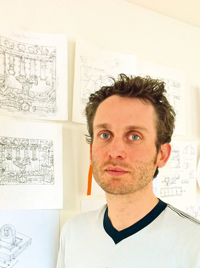
bastiaanvanrooden
 

Regional, national, international

Dachcom, located in the Rheineck border triangle, was founded in 1983 by Christin and Otto Gmeiner as a design studio. Today, the integrated communications agency employs 64 people across 5 locations and ranks 14th in the BSW rankings.

It doesn't always have to be Zurich. In Rheineck SG, a small graphics studio has developed from a kitchen table to a BSW agency with 5 locations and 64 employees within 25 years. Dachcom is now ranked 14th among the "leading Swiss agencies" - and sees further opportunities for development.

"The agency location is not a criterion for us. The team and the composition of talent are decisive. People from Germany, Austria and Switzerland work in our agency. We have learned over the years to let the different mentalities become a strong unit. We look after clients in Munich, Stuttgart, Salzburg, Zurich, Bern and Lugano," says Otto Gmeiner, introducing his agency in the "elevator pitch".

The co-founder of Dachcom completed an apprenticeship as a typographer in eastern Switzerland, trained as a designer at the Kunstgewerbeschule in Zurich and as an advertising and marketing specialist at Sawi in Biel and at the then Institute for Sales and Commerce at the University of St. Gallen. His partner in life and business, Christin Gmeiner, also comes from the region and was self-taught in advertising and communication. In 1983, the two decided to work as a couple in a studio partnership. "This step was not, in our minds, a move to self-employment, but simply a desire to bridge our creative work as designers in a meaningful way in the tension between a job that had passed and a new one," they recall. "Young and unencumbered. Maybe even a little naïve. Financial security was not important. One could live with little. There were no customers. After a mailing and a few phone calls, we were then able to inspire the first clients with our work."

At first, the couple did business in their private apartment. Soon, however, they had to rent a neighboring apartment. After seven years, the studio already employed 10 people. In 1988, a large agency property was purchased in Rheineck. The range of services was constantly expanded. Consulting, strategy, conception, text and web marketing were added to the graphic studio. "It takes luck, joy and curiosity. Also perseverance, if once three presentations in a row do not work. But something new has always developed."

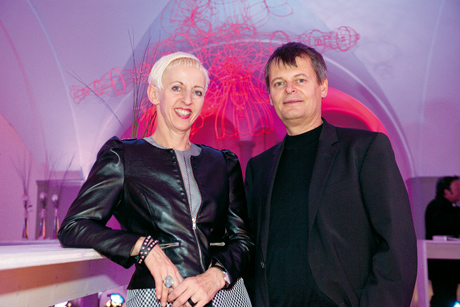
The company Dachcom is owned equally by Christin and Otto Gmeiner. Christin Gmeiner is responsible for networking and organizing the various Dachcom locations, is the point of contact for employees, and is responsible for personnel development. Despite this broad range of responsibilities, she still finds time to look after selected customers. Otto Gmeiner is responsible for customer and strategy consulting and for new business development.

He is supported in this by Hans Peter Kammermann. The two attended the School of Applied Arts in Zurich together. Kammermann worked in the display sector at Möbel Pfister and for 12 years in the media and publishing business, most recently as marketing manager at the Aargauer Tagblatt. After a stay in the USA, he met up again with his former school friend. Since then, Kammermann has contributed his broad expertise to the development of various diversifications within Dachcom.

For years, Heinrich Gmeiner, Otto's brother, has also been responsible for creation at the Rheineck site as CD together with Bernd Leisner. Structurally, the agency works with two creative teams and two consulting teams. There are currently 29 people working at the agency's Rheineck location.

The other branches are formally independent in legal terms and are each managed by a site manager. Dachcom has also been present in Lindau (Germany) for several years. There, 8 people work primarily for customers in southern Germany, such as Real i. S., a subsidiary of Bayerische Landesbank. Also 8 people work at Dachcom in Schaan (FL). The location is managed by Christoph Mähr and Alexandra Hofmänner. An important and long-standing customer at this location is Flumroc. "Liechtenstein is a small country. But in order to gain a foothold there, you have to be able to appear locally with your own company."

The border region was very important to Dachcom early on - which is also expressed in the name (D-A-CH). "Constance, Lindau, Bregenz, Dornbirn is our private living space as well as our catchment area," explains Christin Gmeiner. In 2003, a full-service agency with around 10 people was added at the Winterthur location, which is now managed by Röne Bertschi. At that time, the long-established agency was struggling with succession problems and now forms Dachcom's bridgehead to the advertising mecca in Zurich. In order to efficiently serve new clients in the Bern area, an additional consulting office was opened in Worb in 2009.

The management sees an advantage of the different locations in the broad geographical customer-industry structure, which means security. "Our agency stands on different legs. Clear team sizes, close to the customer, with a broad experience and service portfolio in the background, that's our recipe."

In order to be able to manage all these locations optimally, Dachcom has invested heavily in the relevant IT tools and is now very well networked. The various locations result in synergies in terms of capacities, but also in the creative area. If a certain push is needed, several agencies are ready and waiting. The employees work across locations and are project- and customer-oriented. Competition between the individual locations also makes sense. Currently, one team each in Winterthur and Rheineck are in the same pitch. In this way, different ideas and solutions can mature independently in an initial phase and then be brought together for the decisive presentation.

The subsidiary Dachcom Digital is used for the creative and technical implementation of web marketing projects. This is also based in Rheineck. However, the twelve specialists do not work in the parent company, but in a branch office in a baroque manor house. This historic building offers "a stimulating field of tension" for ideas in which technology and creativity cross-fertilize. Dachcom can pride itself on having played a pioneering role in the Internet sector in Switzerland.

Dachcom Digital was founded as a stock corporation back in 1999. As a specialist from the very beginning, Thomas Kessler is a driving force together with Markus Scheffknecht and Manuel Schmidhauser. Otto Gmeiner sees the spatial separation from the parent company as an advantage. The digital area can thus develop into a real hot spot and thus also attract exciting specialists.

Otherwise, he says, it's no problem to find good people for an advertising agency in the border triangle. "There are many creative people who grew up in this border region and like to come back to their old home after a professional detour in Vienna, Munich or Zurich. The border region suits us well," says Christin Gmeiner.

There is no visible Dachcom style on the outside. On the inside, however, the pragmatic approach is typical. "From the very beginning, we work across divisions and always as part of a larger team." At Dachcom, no one acts like a king, not even the owners. Accordingly, the goal is not to participate in creative competitions that are as dazzling as possible. "We are doers. If the performance is right, other attractions will inevitably result," the creatives at Dachcom are convinced of their working style. Proof of this attitude: various employees of the first customer, Flawa-Watte, are now in charge of completely different companies. But they became new customers and continue to work with Dachcom.

Once a year there is the D-Day, a central "party" for all 6 locations. When more than 60 people come together then, Christin and Otto Gmeiner realize what has been able to develop over the years from their spontaneous idea with their own studio in their small apartment. The recipe for success? "Perhaps due to our impartiality and due to the special location in the border region, we simply took different paths and logically expanded our sphere of activity across the nearby national borders with additional agency locations. We listen well to our clients and implement needs we think we can identify quickly and easily. We do things the way we think they should be done without being influenced by the competitor environment."

And the future? Dachcom Digital is to be further expanded this year. For the other locations, continuous growth is the order of the day. In addition to the entrepreneurial daughters, there are also two physical daughters. In the meantime, they also work in the family business. ¬Myriam as a communications planner, Simone as a graphic designer. Andreas Panzeri

Dachcom - the team
"What is important for us is the whole team and the interaction of the individual talents with each other. In addition, the leading people naturally bear the responsibility. The site managers are Jürgen Paudert, Lindau (D); Röne Bertschi, Winterthur; Christoph Mähr, Schaan (FL); Markus Scheffknecht, Digital, and Christin and Otto Gmeiner, Rheineck. Hans Peter Kammermann is responsible for U-Development. Heinrich Gmeiner and Bernd Leisner are responsible as CDs. The consulting groups are headed by Röne Frommelt and Didier Graf. The creation groups in Rheineck by Hubert Stemer and Martin Küng. In Dachcom Digital, Thomas Kessler is CD and Manuel Schmidhauser Head of Projects."

Core competencies
Dachcom develops integrated communication solutions for clients from the D_A_CH countries. This includes analyses, positioning and the development of brand worlds, the development of communication concepts, communication design, CI-CD concepts, editorial and text, project management and overall implementation, web marketing, web screen design, web GUI interfaces, technical implementation of web-based functionalities (CMS, PIM, MAM).

dachkom
 

The House Agency opens its doors in Zurich Seefeld

The House, an agency based in Zurich, was founded in early 2011. Its focus is on blending online and offline experiences. In response to information overload, the agency consistently embraces the following philosophy: «Simple, fast, creative.».

The agency is questioning today's communication processes/methods with the aim of massively increasing the efficiency of campaigns. This writes the agency in a message. The agency operates on an interdisciplinary basis according to the principle that only the market determines what is successful.
 
The agency has already won its first clients. The 8-member team knows each other from their time together at other agencies and is currently led by Peter Trüb, Nico Podgorny and Gerry Flückiger, who will actively accompany the start-up phase.

Publisuisse: Sales up 35 million francs

The advertising sales agency Publisuisse generated net revenue of just under 322 million Swiss francs in fiscal year 2010. This significantly exceeded the previous year’s result (287 million Swiss francs) by a significant 12 percent. Net revenue from the sale of traditional TV advertising for SRG SSR programs amounts to approximately 300 million Swiss francs.

The other business areas (TV and radio sponsorship, cross-media) also posted a total of CHF 21 million, a significant increase of 11% compared to the previous year's result in these areas. Net profit after tax amounted to CHF 1.4 million.

After a difficult economic year in 2009, with sales declining in all of Publisuisse's business areas, the Swiss economy recovered much faster than expected. Driven by strong growth in electronic media, the entire advertising market benefited from this development. Television further expanded its position as the leading medium and the advertising industry increasingly used the qualitative advantages of SRG's premium products to place its messages. Publisuisse wrote this in a press release on Thursday. The intensified activities in the area of new customer acquisition also had a positive impact on the business result.

Although the economic forecasts for 2011 predict a slight slowdown in the economic upturn, the advertising marketer continues to assess the outlook for the advertising market as positive. This is also shown by Publisuisse's good sales performance in the first quarter. In addition, the moderate liberalization of the legal framework conditions for SRG programmes allows for a slight optimization of Publisuisse's offering.
 

Swiss Diabetes Foundation: Media Prize 2011 announced

The Swiss Diabetes Foundation has announced its media award for the second time. The call for entries is open to all professional media practitioners in Switzerland who published an article (in print or online) on the topic of diabetes mellitus in 2010.

The content must cover topics relating to general information about diabetes, timely detection, appropriate treatment, training or prevention of diabetes. Scientific publications in medical journals, public reports and the like are not eligible. The prize money is CHF 5,000. The prize will be awarded on November 12, 2011, during the 2nd Swiss-German Diabetics Day in Basel.

The purpose of the Swiss Diabetes Foundation is to promote and support scientific research into diabetes mellitus and related medical and socio-medical examinations, to provide general information about diabetes, its timely detection and appropriate treatment, and in particular to provide training for diabetes sufferers. The foundation writes this in a press release on Presseportal.ch.

Written submissions must be sent to the Secretariat of the Swiss Diabetes Foundation, keyword: Media Prize, Rütistrasse 3a, 5400 Baden, including original publication and CV, by March 31, 2011. The jury, which consists of five experts, will notify the winner in writing by the end of June 2011.
 

Summa cum laude for the NZZ

After it became known that Defense Minister Karl Theodor zu Guttenberg allegedly plagiarized a large portion of his dissertation, the media have been reacting to the story and using it as a hook.

The NZZ am Sonntag is using the plagiarism allegations to promote its subscription. The minister is also said to have copied from the NZZ's weekend edition. Since Guttenberg's doctoral thesis was ultimately awarded "summa cum laude", the advertising motif now also has the top academic grade. And so the NZZ advertises with "Summa cum laude - University of Bayreuth" for its Sunday edition.
 

High voltage: Green envelope from Cashgate restaged

Last summer, the Zurich-based advertising agency Hochspannung won the pitch for the personal loan and leasing provider Cashgate. In the meantime, the overall campaign, which has been on display throughout Switzerland for several months, has been realized.

The central element of the new campaign is the green envelope, which has long been used as a key visual at Cashgate. The agency has added a smiley face to the originally blank envelope, giving it a new meaning. The aim of the new advertising campaign is to strengthen the brand, raise awareness and further increase the acceptance of personal loans.
 
The campaign can be seen in several waves on posters, advertisements, mailings, Internet banners and various below-the-line measures throughout Switzerland.
 
Responsible at Hochspannung, Zurich: Tom Fäh, Stefanie Fricker, Marco Huber, Matthew
Katumba, Alex Taiganidis. Photography: Marc Straumann. Responsible at Cashgate: Edwin C. Dünki, Anita Bain, Ladina Baumann.
 
get_footer();