Second chance on the second screen
More and more often, people’s attention while watching TV is focused not on the large main screen but on mobile devices—this presents new opportunities and challenges.


Those who are not familiar with the second screen phenomenon from their own experience can rely on figures about its prevalence. The "Media of the Future 2017" study commissioned by Publisuisse showed that 37% of study participants also use the internet several times a week or every day while watching television. And according to a survey by the market research company Nielsen, 40% of Americans and Brits who own a smartphone or tablet use it once or several times a day while watching TV, compared to 20% of Germans and 30% of Italians.
In addition to smart TV (see Werbewoche 10/2012, p. 24) and catch-up TV (see Werbewoche 12/2012, p. 27), second screen is another trend that is eroding the actual reach of TV advertising. The audience may be gathered in front of the TV, but their attention is often elsewhere. According to another Nielsen survey, 61% check their emails and 34% check sports results during a program. However, the connection to television is not completely lost: 37% searched for information in connection with the current program. The fact that 27% searched for relevant product information following TV commercials shows the potential for commercial communication. And the fact that 22% searched for coupons or special offers shows where the use of second-screen advertising can be used. It is also interesting to note that visiting social media sites during the program (47 %) and during commercial breaks (45 %) remains attractive.
This development in consumer behavior cannot be ignored. The opportunity to find new ways to reach audiences, to inspire them and to market the newly acquired advertising inventory has given rise to a number of start-ups, especially in the USA. There are social networks specifically geared towards television, social program guides and services to find suitable programs as well as applications for the remote control. There are services (often as white labels for broadcasters) for checking in to programs, discussing them, collecting points and providers that create special second-screen content and corresponding advertising, as well as social TV analytics service providers, for example for the distribution of second-screen content.
The second screen business is currently the Wild West of the TV industry - many are trying their luck, but only a few will make ends meet and get off to a good start. The reason for this is quickly clear: hardly any consumer wants to deal with countless apps on their second screen - which is why a relatively rapid consolidation is to be expected. Cross-channel second-screen platforms will emerge that combine various activities, differentiate themselves from one another with different features and thus compete for the favor of customers and consumers. So that users do not have to constantly click again, but instead receive new content on the second screen in sync with the action on the main screen, some second-screen advertising networks use technology to recognize the current program via the microphone or camera of the second screen (so-called audio/video fingerprinting). Because second-screen devices are often extremely personal objects, consumers can be targeted in the same way as with online advertising.
The second screen phenomenon gives broadcasters in particular a second chance to defend themselves against revenue losses fueled by other trends such as smart TV and catch-up TV. Two obvious use cases are news and sports: an app on a second screen platform can provide additional information: Additional maps to news events, selected links to further information or statistics and athlete portraits. At the end of February, RTS television in French-speaking Switzerland launched a second-screen pilot of this kind for the main edition of the Tagesschau, which has now been discontinued during the summer (http://info.rts. ch/2eecran/). In future, TV shows will be developed with two parallel storylines, one for the main screen and one for the second screen. Here, the protagonists can interact directly with the audience ("Should I go out with Ben or Greg?"). Extraordinary text passages can be displayed for sharing via social media, or there are references to the current soundtrack (including a download link). In this way, advertising messages ("I love my red dress - get it here now!") can be distributed free of restrictions (such as product placement). Mobile coupons (see Werbewoche 8/2012, p. 36) can be distributed in parallel to TV commercials via apps, which not only increases brand loyalty but also makes the actual success of the advertising directly measurable when redeemed.
When it comes to the application of such practices in our country, the hurdles are immediately apparent: Are the costs of creating parallel content for the second screen worthwhile in our mini-markets? How can parallel content for purchased programs still be put to good use after they have been distributed in our original market (if the red dress mentioned above is not available in our country and is now completely démodé anyway)? The solution: TV shows are planned from the outset for simultaneous international distribution, including integrated merchandising via a dedicated e-commerce channel.
The approaches described here for TV advertising on the second screen are still hardly widespread in Germany - with one exception: web TV services such as Wilmaa or Zattoo offer program-related interaction options, even if these do not take place on a second screen. A good example is the European Football Championship: Wilmaa offered live tickers, competitions with live, historical or fun questions as well as team voting, and users could share content via Facebook and Twitter. This is at least a first step towards conquering the second-screen market, and it will be interesting to see who will position themselves and how in the near future: Will it be the heavyweights from overseas or neighboring countries who will also be able to establish themselves here, or will there be domestic companies who will be able to win this market for themselves? Will there be an EU-sponsored initiative and/or one (or more) Swiss specialty companies?
Christoph J. Walther
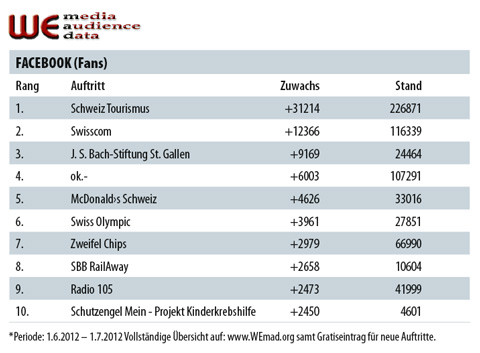
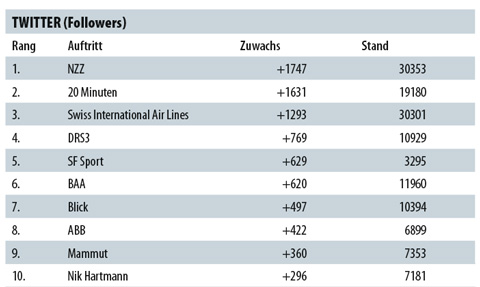
The current social media high-flyers
Who gained the most in the social media hit parade on WEmad.org in June*.