Paid content - opportunities for the media industry?
A study by Transaction Consulting aims to determine whether users are willing to pay for content.


Low sales levels are no longer the short-term phenomenon of economic crises, but a sign of a sustained structural crisis. Market share and sales in the German daily newspaper and magazine market have been falling sharply since 2000. From 2008 to 2015, a loss of EUR 500 million in sales is forecast for consumer magazines alone in the advertising market in Germany (VDZ, Booz & Co. study).
Publishers are facing an enormous structural change and a sustainable adaptation of their business model: is it possible to improve quality and efficiency while making savings at the same time? New business models must be developed and introduced in order to remain viable. Although sales in the digital sector have increased disproportionately in recent years, they are far from being able to compensate for the losses in the core business. The crisis is exacerbated by ongoing and recurring cost-cutting programs and staff reductions, including in editorial offices. These are jeopardizing the quality of content production and thus the core competence of publishers.
Results of the study
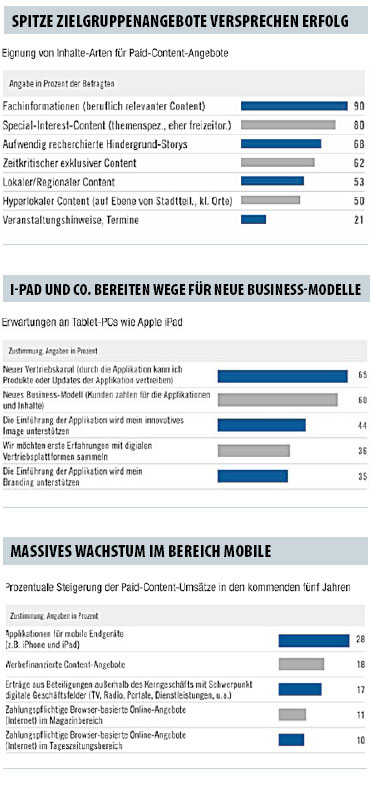
The study shows that new hardware - even or especially if it is from Apple - does not yet provide the publishing industry with a new business model. Experts see the new iPad as a great opportunity for the industry, but at the same time warn against viewing it as a panacea. Digital paid content offerings are rather a first and decisive component of an urgently needed comprehensive digitization strategy. Media experts expect the launch of the iPad and other tablet PCs to first and foremost create a new business model and a new distribution channel. This also appears to be urgently needed, as the industry is required to massively increase its sales via digital channels. Currently, publishers are still a long way off the 30 to over 50 percent forecast for 2015 with an average of 5 to 12 percent digital sales. According to the study participants, content categories such as specialist information, special interest and extensively researched background stories are best suited to paid content business models. New content concepts and multimedia-linked content as well as location-based services are decisive for the success of paid content offerings. The majority of respondents plan to introduce paid content offerings in the next twelve months: 33 percent of them within the next six months and 20 percent within the next twelve months.
Two thirds of respondents want to use existing digital platforms (e.g. iTunes) to distribute their content, half plan to work with a partner from the industry and 38% want to set up their own infrastructure. However, when it comes to customer data access, two thirds of respondents do not accept platforms without access to customer data.
Conclusions and challenges
The majority of respondents expect digital business to account for more than 30% of sales in 2015. In order to exploit these growth opportunities, existing and new customer relationships must be transferred to the digital world and new business models must be designed and implemented.
Of course, paywalls - i.e. the differentiation of paid areas or content - mean a decline in website traffic and therefore less advertising revenue. But overall, revenues will increase in the medium and long term. This will be offset by income in the form of digital subscriptions.
At the same time, publishers gain registered and profiled customers who can be monetized.
Differentiating between paid and free content offerings is one of the most demanding and important challenges for the launch of digital paid content offerings. The business models have not yet been tested and there are no patent remedies. However, there is no way around a clear distinction between paid and free content offerings. Planned testing and optimization is an important prerequisite for the success of paid content offerings.
Expectations for the iPad and apps are very high. The majority of respondents expect the highest sales growth in apps for iPhone and iPad. Initial surveys in the USA appear to confirm these expectations: The average prices for iPad apps ($ 5.79) are almost four times higher than those for the iPhone ($ 1.51).
Closer to the target groups, but on all channels: Target group-specific and cross-media channel products - the differentiation of content between existing channels such as print and online, but also the integration of new channels such as mobile and iPad - are the right way forward.
New customers need to be reached in the Facebook generation.
Interaction between readers and editors through social media is the decisive factor here, driving business forward and turning casual readers into the digital customers of the future with enormous potential in the long term. The Huffington Post generates over 2.3 million comments every month from 800,000 registered users.
By integrating social media offers, traffic to the website from social networks increases disproportionately and can compensate for the loss caused by a paywall. Referrals from social networks to ABCNews.com have increased by 250% in recent months. The development of mobile offers is of crucial importance here.
Dr. Marcus Garbe, Managing Partner at Transaction Consulting
Objectives and methodology of the study
Objective
- Highlighting the status quo at the companies surveyed in the media industry
- Identifying new revenue potential through paid content
for the media industry
- Identification of the need for action at the companies surveyed (new
Business models, new content and navigation concepts, new payment models,
organizational adjustments, new sales and partner models)
Methodology was developed with the study partner FACIT Digital:
- Qualitative part: Expert interviews in Germany and Switzerland to identify opportunities and obstacles in the period March-May 2010.
- In total, more than 30 discussions were held with paid content managers from the following companies: Verlagsgruppe Handelsblatt, Ringier AG, NZZ-Verlag, TAMedia, Axel Springer AG, Deutscher Pressevertrieb, dpa Deutsche Presseagentur, asv Vertriebs-GmbH, Rheinische Post, Burda Medien, Sevenval (YOC AG) and various payment and platform providers.
- Quantitative part: Online survey of industry experts in Germany and Switzerland in May 2010. Net sample: n > 100. Data collection and analysis by FACIT Digital, Munich
Publishers are facing an enormous structural change and a sustainable adaptation of their business model: is it possible to improve quality and efficiency while making savings at the same time? New business models must be developed and introduced in order to remain viable. Although sales in the digital sector have increased disproportionately in recent years, they are far from being able to compensate for the losses in the core business. The crisis is exacerbated by ongoing and recurring cost-cutting programs and staff reductions, including in editorial offices. These are jeopardizing the quality of content production and thus the core competence of publishers.
Results of the study
The study shows that new hardware - even or especially if it is from Apple - does not yet provide the publishing industry with a new business model. Experts see the new iPad as a great opportunity for the industry, but at the same time warn against viewing it as a panacea. Digital paid content offerings are rather a first and decisive component of an urgently needed comprehensive digitization strategy. Media experts expect the launch of the iPad and other tablet PCs to first and foremost create a new business model and a new distribution channel. This also appears to be urgently needed, as the industry is required to massively increase its sales via digital channels. Currently, publishers are still a long way off the 30 to over 50 percent forecast for 2015 with an average of 5 to 12 percent digital sales. According to the study participants, content categories such as specialist information, special interest and extensively researched background stories are best suited to paid content business models. New content concepts and multimedia-linked content as well as location-based services are decisive for the success of paid content offerings. The majority of respondents plan to introduce paid content offerings in the next twelve months: 33 percent of them within the next six months and 20 percent within the next twelve months.
Two thirds of respondents want to use existing digital platforms (e.g. iTunes) to distribute their content, half plan to work with a partner from the industry and 38% want to set up their own infrastructure. However, when it comes to customer data access, two thirds of respondents do not accept platforms without access to customer data.
Conclusions and challenges
The majority of respondents expect digital business to account for more than 30% of sales in 2015. In order to exploit these growth opportunities, existing and new customer relationships must be transferred to the digital world and new business models must be designed and implemented.
Of course, paywalls - i.e. the differentiation of paid areas or content - mean a decline in website traffic and therefore less advertising revenue. But overall, revenues will increase in the medium and long term. This will be offset by income in the form of digital subscriptions.
At the same time, publishers gain registered and profiled customers who can be monetized.
Differentiating between paid and free content offerings is one of the most demanding and important challenges for the launch of digital paid content offerings. The business models have not yet been tested and there are no patent remedies. However, there is no way around a clear distinction between paid and free content offerings. Planned testing and optimization is an important prerequisite for the success of paid content offerings.
Expectations for the iPad and apps are very high. The majority of respondents expect the highest sales growth in apps for iPhone and iPad. Initial surveys in the USA appear to confirm these expectations: The average prices for iPad apps ($ 5.79) are almost four times higher than those for the iPhone ($ 1.51).
Closer to the target groups, but on all channels: Target group-specific and cross-media channel products - the differentiation of content between existing channels such as print and online, but also the integration of new channels such as mobile and iPad - are the right way forward.
New customers need to be reached in the Facebook generation.
Interaction between readers and editors through social media is the decisive factor here, driving business forward and turning casual readers into the digital customers of the future with enormous potential in the long term. The Huffington Post generates over 2.3 million comments every month from 800,000 registered users.
By integrating social media offers, traffic to the website from social networks increases disproportionately and can compensate for the loss caused by a paywall. Referrals from social networks to ABCNews.com have increased by 250% in recent months. The development of mobile offers is of crucial importance here.
Dr. Marcus Garbe, Managing Partner at Transaction Consulting
Objectives and methodology of the study
Objective
- Highlighting the status quo at the companies surveyed in the media industry
- Identifying new revenue potential through paid content
for the media industry
- Identification of the need for action at the companies surveyed (new
Business models, new content and navigation concepts, new payment models,
organizational adjustments, new sales and partner models)
Methodology was developed with the study partner FACIT Digital:
- Qualitative part: Expert interviews in Germany and Switzerland to identify opportunities and obstacles in the period March-May 2010.
- In total, more than 30 discussions were held with paid content managers from the following companies: Verlagsgruppe Handelsblatt, Ringier AG, NZZ-Verlag, TAMedia, Axel Springer AG, Deutscher Pressevertrieb, dpa Deutsche Presseagentur, asv Vertriebs-GmbH, Rheinische Post, Burda Medien, Sevenval (YOC AG) and various payment and platform providers.
- Quantitative part: Online survey of industry experts in Germany and Switzerland in May 2010. Net sample: n > 100. Data collection and analysis by FACIT Digital, Munich