
News curators instead of journalists?
With social news apps, such as Flipboard for the iPad, consuming news becomes a fun and easy experience, as they bring together news channels from a wide variety of sources under a visually appealing interface.


Information Overload: In the race to capture the public’s attention, every avenue is being explored: Communications departments in companies, organizations, and government agencies are expanding and constantly feeding websites, blogs, and social media channels with text, audio, and video content—which is increasingly being consumed on the go. Those who want to reach their target audience provide clarity—not just more news noise.
Social media: While it was still common twenty or thirty years ago to announce news at a press conference in front of journalists, such news is now readily available online directly from the sources. Before the mainstream media picks up on it, the news has often already made the rounds via social media channels—from Twitter and Facebook to bookmarking services like Digg. The way news is disseminated in these digital realms provides insight into its relevance to specific target audiences. Whereas news agencies used to be responsible for making an initial selection to separate the important from the unimportant, this function is now performed by the networked masses.
Startups: Recently, particularly in the U.S., a number of startups have emerged that aim to support the curation process with technical solutions. Many of these services rely on social media platforms and analyze the information obtained through them. In addition, much of this information is increasingly available as structured news feeds (in RSS or Atom format), which facilitates its automatic processing. Some providers cover the entire production process—from identification to publication and feedback—while others focus on specific aspects with standalone solutions.
Together, these factors have led to the hype or trend of content curation. This isn’t about individual bloggers; rather, it’s intended to help the marketing and communications departments of companies and organizations better promote their messages. A good example is IBM’s Smarter Planet marketing campaign, which aims to demonstrate how the world is becoming smarter through interconnected devices. The website http://smarterplanet.tumblr.com/ regularly features curated articles from the web on this topic, focusing on new technology products. Comments highlight how such developments contribute to the Smarter Planet vision.
Advocates of the growing trend toward content curation cite the following benefits in particular for curating content in a professional setting:
Thought Leader: Curated content helps a company’s website become the go-to resource for its customers and within the industry. By publishing original content alongside references to third-party content, a company can establish itself as a thought leader. This approach highlights the company’s own perspectives as well as important announcements from competitors.
Community: Such a website can be enhanced with social media features so that users can communicate with each other and with the curator.
Service: A well-curated website becomes the first place stakeholders turn to for information on a particular topic.
Monitoring: Those who establish curation structures can use them to easily track current developments in relevant fields. For example, they can monitor mentions of their own brand and products across numerous social media channels and websites so they can respond accordingly. Or they can use them to monitor competitors’ activities. And to efficiently maintain internal information repositories as part of knowledge management.
Cost Reduction: If the curation processes are optimized, communications staff will be able to work more easily and comprehensively.
Revenue: If the curated website is well-designed and resonates with its target audience, it will also attract sponsors and advertisers.
If content curation, as described here, gains traction, it could profoundly transform the media landscape in the long term. From a strategic perspective, this will once again significantly lower the barriers to entry for new providers looking to compete in the media market. Curation is a part of journalism that can now be easily carried out outside of publishing houses using curation tools. For newsrooms—from daily newspapers to trade publications—it will become even more difficult to achieve a sustainable competitive advantage. This is because, within their areas of expertise, institutional curators and editors can easily provide information more quickly and in greater depth than many existing media outlets. Added to this is the fact that such communication initiatives do not need to be directly financed by the (reader or advertising) market, but can be justified by indirect benefits, such as an enhanced reputation.
But curation isn’t just for the big and powerful. Even smaller players—such as NGOs, protest groups, politicians, and artists—can carve out a niche for themselves with a constantly updated news overview and make a name for themselves among their target audience. They, too, rely on social media channels and aggregators (such as Google News) and make up for the lack of specialized staff and appropriate software solutions with greater dedication.
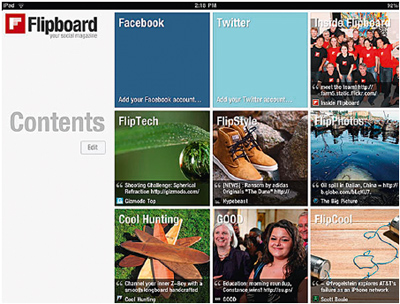
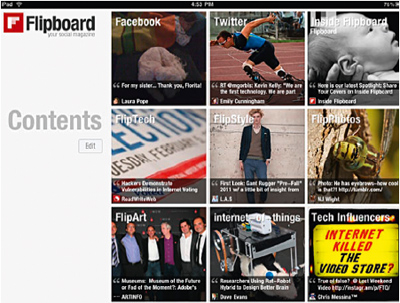
The chances for market-changing and groundbreaking innovations are particularly high when multiple trends reinforce one another. This is exactly the case with so-called social news apps. The best example of this is Flipboard, which Apple named one of the four Apps of the Year for 2010. Flipboard aggregates content from Facebook and Twitter, as well as other sources such as Google’s RSS reader. And it doesn’t just aggregate any content—only content from sources that the user has selected in advance, including new curated news channels. But instead of simply creating a collection of links, the app features a visually appealing magazine-style layout that is optimally tailored to the reading experience on the iPad. The web service Paper.li works on the same principle and has also been operating successfully for about half a year. Here, too, information from Twitter, Facebook, and online sources such as blogs is used to generate a personalized online magazine for the web browser.
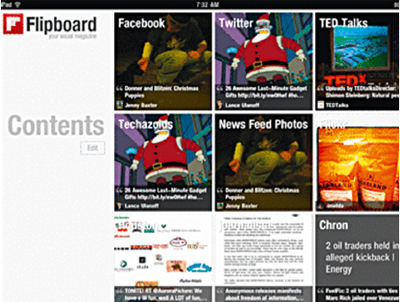
With Flipboard or Paper.li, all the free content on the web—from citizen bloggers to global newspapers—looks just as polished as it would in a professionally designed magazine. Using these apps is just as simple and enjoyable. No wonder, then, that there are already quite a few imitators. Whether it’s local politics, regional soccer, or trends in fashion and music: on devices like the iPad and with apps like Flipboard, curated channels come together with other media offerings and can be consumed effortlessly and seamlessly—and, of course, for free.
These trends are revealing a new value chain for the news industry for the first time. As before, sources bear the burden of getting their messages out to the public—messages that can be disseminated without further editing. As described, news selection is based on the response on social media, combined with the expertise of curators. Here, one funding model is replacing another: whereas it was originally printers who promoted their businesses with current stories and subsequently employed journalists as publishers, in the future, influential companies and organizations will finance these tasks in the hope of enhancing their reputations. Consumers pay (as with radio and television) for the devices and connection costs, but generally not for the content on online channels.
To get back to reality: Even in the communications departments of large companies, there are still hardly any Chief Curation Officers, nor is the topic merely an online fad limited primarily to the U.S. It’s quite possible that, in the near future, driven by a classic American gold-rush mentality, there will be attempts to fill every conceivable subject area with curated content first. If the concept proves successful in the battle for attention, it remains to be seen how long it will take for the first serious content curators to emerge in the Swiss internet scene—and who they will be.
Christoph J. Walther


