Campbell & Jones implements sustainability campaign for Jelmoli

To promote Jelmoli’s commitment to sustainability and «Green Act Day,» the Zurich-based agency Campbell & Jones launched a campaign featuring sustainability ambassador Karen Fleischmann.

The Zurich department store Jelmoli has launched the "Green Act" in 2021. The strategy is intended to consolidate sustainability as an essential value within the company and to continue through future partnerships and activities.

With the "Green Act," the omnichannel department store wants to assume social responsibility and has appointed Karen Fleischmann as a sustainability ambassador as part of the initiative.

Together with Fleischmann, sustainability is to be lived and passed on in the long term and beyond shopping. Thus, on "Green Act Day," which will be held on Saturday, March 26, 2022, various events, innovations and products will be brought to life at Jelmoli.

The campaign by Campbell & Jones is intended to promote "Green Act Day" to customers and at the same time to pay tribute to Jelmoli's manifested sustainability strategy.

With the statement "We Act Green" Jelmoli wants to show responsibility and draw attention to the topic. The subjects with ambassador Karen Fleischmann, photographed by local producers, are intended to highlight the importance of proximity and trust in regional partners, as well as the relevance of the increased use of regional products at Jelmoli, in addition to a modern visual world. This message runs through the entire production, from the content of the subjects to the outfits and locations.

Various subjects will be played out in moving image and still format on the most important social media channels starting next week.


Responsible at Jelmoli: Cécile Moser (Head of Marketing & Communication), Carmen Hirzel (Content Lead), Martina Piechocinski (Digital Marketing Management). Responsible at Campbell & Jones: Chelsea Horiuchi, Marc Steimer, Oscar Martin (idea, concept and implementation). Responsible at Neighborhood Productions: Josy Le (DoP), Bon Wongwannawat (Photography), Giada Giorgio (Hair & Make Up), Daniela Correia (Styling). Responsible at Clockwork Digital: Sandro Jungi (Founder).

Swissfilm Association reorganizes and plans a new appearance

Peter Beck, the long-time president of the Swissfilm Association, is stepping down after 17 years. At Thursday’s meeting, the members elected a new board and approved a new organizational structure.

Swissfilm Association Executive Director Susann Vogel (left) and outgoing Association President Peter Beck (right). (Images: zVg.)

The Swissfilm Association, the association of advertising, commissioned film and TV producers, has reshuffled its board of directors at its general meeting on Thursday. Peter Beck had already announced early on that he was stepping down as president of the association after 17 years.

In the course of his departure, the organizational structure of the Swissfilm Association will be adjusted and tasks will be redistributed. Instead of the presidency, there will now be a chairmanship of the board, which will rotate on an annual basis. In return, the office will be strengthened, according to the association's statement.

In addition to managing the day-to-day business, Managing Director Susann Vogel, together with Project Manager Katia Bonadei, will take on additional tasks. This in close coordination with the new board and the members.

Managing Director Susann Vogel now manages the projects that are initiated by the board or from within the association. "I no longer have one contact person, but at least eight. In the future, the office will increasingly be where the threads come together," says Vogel.

For the year 2022, Levente Paal of WirzFraefelPaal Productions will take over as Chairman of the Board.

At the same time, the association is getting a fresh look. A new website is in the works and the logo is getting a redesign.

EU Commission investigates Meta and Google for online advertising

The Facebook group Meta and Google are suspected of distorting competition in online advertising. The EU Commission is investigating the two companies.

An agreement between the two companies could be aimed at excluding competitors, said Margrethe Vestager, the EU Commissioner responsible for competition, on Friday. Google rejected the suspicion.

Cooperation between Google and Meta weakens competition

Google and Meta are essentially competitors in the online advertising market. However, following an agreement in 2018, Facebook also participates in auctions for advertising space on a Google platform.

Google, for example, uses the Open Bidding system to auction online advertising space on websites or in apps in real time. Facebook's Audience Network platform takes part in this.

The Commission fears that the cooperation could weaken competing technologies and exclude them from the market for display advertising. So-called display advertising includes, for example, classic banners that are displayed on websites, but also pop-ups or other graphic advertising elements on websites.

Google defends itself against the accusations

The UK Competition and Markets Authority (CMA) also announced that investigations had been launched against Google and Meta on suspicion of distorting competition. "We are concerned that Google may have colluded with Meta to hinder competitors who provide operators with important services for displaying advertising on the internet," said CMA head Andrea Coscelli.

A Google spokesperson replied that the claims about the agreement were false. Facebook's Audience Network will not receive any benefits that would help the service to win auctions. Instead, the deal would strengthen competition.

In the US, several states are already taking legal action against the deal. Among other things, they are claiming that Facebook has stifled the development of its own competing platform with the agreement. (SDA)

Drop8 makes Ameos known throughout Switzerland

To raise awareness of Ameos among Swiss nursing professionals and attract new talent, the healthcare provider partnered with Drop8 to launch an image and employer branding campaign.

The campaign is intended to increase awareness of Ameos in Switzerland among the target group of nursing professionals. In addition, a targeted digital strategy should draw the attention of potential new employees to the attractive employment conditions at Ameos Spital Einsiedeln and motivate them to apply.

In order to reach the narrow target group as efficiently as possible and without major wastage, various targeting solutions were used. In addition to the digital online measures, programmatic DOOH placements were selected to reach care professionals with digital outdoor advertising in addition to conventional display advertising. All measures were fully programmatic.

According to Drop8, Ameos saw a significant uplift in applications and brand awareness among its target audience as a result of the digital campaign.

"The use of Programmatic DOOH enables us to seamlessly integrate outdoor advertising into the digital mix. All digital advertising measures can now be efficiently coordinated from a central location, resulting in a significantly more attractive return on media investment for our customers," explains Monty Meier, Managing Director of Drop8.

"The Drop8 team took an in-depth look at our brand and our challenges in advance and planned a customized and very efficient campaign with us. During the runtime, the performance of the various activities was closely monitored and the campaign was continuously optimized to ensure high visibility among the relevant target group," adds André Sidler, Head of Marketing and Communications, Ameos Region South / Locations Switzerland.

Ceres Media for AMS: It's the inner values that count

AMS Agro-Marketing Switzerland has launched the new Suisse-Garantie campaign, «It’s what’s on the inside that counts.» Ceres Media is responsible for planning and media, while Fairfactory handled the creative work.

The marketing organization of the Swiss agricultural and food industry AMS celebrates its 25th anniversary in 2022. One of the achievements of AMS is the guarantee brand Suisse Garantie. As a guarantee mark of origin, Suisse Garantie checks whether the labeled products are really made with Swiss raw materials and in Switzerland.

With the current advertising campaign, Suisse Garantie wants to show the uniqueness of agricultural products from Switzerland in spectacular close-ups and draw attention to their inner values.

"A strawberry from Switzerland, for example, looks exactly like a strawberry from Almeria in Spain, and yet it is not the same strawberry. What you don't see are the inner values: transport routes, cultivated land, climate, water, soils, sustainability, social conditions. There are clear differences," explains AMS President Urs Schneider.

The importance of AMS for agriculture is great. Around 80 percent of the income of farming families results from the sale of their products or services. Today, Coop, Migros, Volg, Denner, Spar, Aldi, Lidl, Prodega and McDonald's offer products marked with Suisse Garantie.

Studies also show that the origin of food is strongly weighted: In a survey conducted by GfK in 2021, 81 percent of respondents say they usually or always pay attention to Switzerland as the country of origin when buying food. 67 percent say they pay attention to Suisse Garantie when doing so.


Responsible for AMS: Urs Schneider (President), Denis Etienne (Managing Director). Project management Suisse GarantieMarcel Portmann (Proviande), Martin Ruest (Swissmilk). Impact measurement: Reto Grolimund (Swissmilk). Responsible at Ceres Media (media strategy and planning)Caroline Nagiel, Alessandro Giuliano. Responsible at FairFactory (creation): Kurt Schmid, Claude Schaub. Responsible at Stories (Film): Florian Nussbaumer, Pascal Walder (DOP). Photo posters: Photography Phil Müller.


IGEM and Wemf determine typology of Swiss media use

Based on the representative Digimonitor study, the electronic media interest group IGEM and WEMF AG für Werbemedienforschung have identified a media usage typology with five types of digital media usage in Switzerland.

Type 1: Analog

The analogs, with 1.83 million people (27%), represent the largest population group. Analogs are the oldest type, with an average age of 69. Analogs use linear TV and radio and teletext the most of all types, but are the least well equipped in terms of devices. Thirty percent of this group are offliners, and one in three analogs do not have a smartphone. The analogs use social media, messenger and streaming the least.

Type 2: Classic

With 1.76 million people (26%), Classics represent the second largest group. Their average age of 49 is very close to the population average of 48. Classics are the most likely mainstreamers in terms of usage. They make above-average use of linear TV and radio, as well as mobile payments. They also have a high affinity for Facebook and gaming.

Type 3: Always-on

1.1 million people (17%) belong to the always-on group, which is the youngest group with an average age of 26. Always-on use online in all facets. They are the biggest users of gaming, various social media platforms, video and music streaming, and tend to use mobile media. Radio and TV are used more often than average by this group on the move, and streaming is most frequently done on the move - on a laptop or smartphone.

Type 4: Tech-savvy

At 0.8 million people (13%), the tech-savvy are the smallest group and also the one with the lowest proportion of women. At an average age of 43, they are slightly younger than the population average of 48. Tech-savvy individuals are very well equipped with technical devices, have a high affinity for Apple products and most frequently use a tablet or smartwatch. They use TV and radio more often than average, and prefer time-shifted TV. Those with an affinity for technology use e-banking and cashless payments with their cell phones most frequently. They have the largest user base of business platforms, often use video conferencing tools, stream a lot of music or videos and listen to podcasts.

Type 5: Selective

1.1 million people (17%) belong to the selectives. At an average age of 44, they are slightly younger than the population average of 48. Selectives use TV and radio with below-average frequency and use media specifically with a functional focus. In comparison, they communicate most frequently via Threema or alternative messenger services and use their smartphone more frequently than average for e-banking and cashless payments. In the audio area, they prefer to listen to podcasts.

Major differences between media usage types

According to the survey, there are particularly strong differences in the social media use of the types. Facebook is particularly popular with the classic media usage type. Instagram, Pinterest, Snapchat, Twitter and TikTok are in front among the always-on. LinkedIn is used more often than average by the tech-savvy and selective. But there are also striking differences in the use of gaming, TV, radio, video and music streaming, podcasts, e-banking, electronic gadgets, messengers and video conferencing tools.


The Media usage types were formed using factor and cluster analyses. All the results on media and device use from the Digimonitor study were used as type-forming characteristics - excluding demographics and interests. The five types thus reflect as much of the variance in the use of electronic media and devices as possible.

The Digimonitor study has surveyed the use of electronic media and devices in Switzerland every year since 2014. The data is representative of the Swiss resident population aged 15 and over (6.7 million people), because offliners and people without a fixed network connection are also surveyed. On behalf of the Interessengemeinschaft elektronische Medien (IGEM) and WEMF, the Link Institute surveyed a total of 1,980 people in April and May 2021, of whom 1,016 were in German-speaking Switzerland, 762 in French-speaking Switzerland and 202 in Italian-speaking Switzerland.

Universal Pictures: Change in marketing management

At the end of March 2022, the current Marketing Director, Reto Philipp, will leave Universal Pictures International Switzerland after a total of 18 years. Mirela Schick will succeed him.

Reto Philipp started as Product Manger at Universal's Home Entertainment Distribution in 2004 and moved to theatrical distribution in 2015. "In his many years with our company, Reto Philipp has had overall responsibility for the marketing campaigns of our theatrical films over the past seven years. We sincerely thank Reto Philipp for his outstanding commitment," said Managing Director Emin Soysaler on Reto Philipp's departure. 

Mirela Schick will succeed her as Marketing Director at Universal Pictures International Switzerland on April 1, 2022. Schick has been with Universal's marketing department for 20 years in various roles. Most recently, she led the Product Management and Digital Marketing team as Senior Product Manager.

Commenting on the new appointment, Emin Soysaler says: "With Mirela Schick, we were able to recruit a very competent and loyal personality from our own ranks for the position of Marketing Director," Soysaler elaborates. "In her many years of work in the cinema industry, she has been able to demonstrate her excellent campaign planning and team management skills on several occasions."

Farner Consulting Switzerland expands Board of Directors with Beat Brechbühl

Dr. Beat Brechbühl has joined the Board of Directors of Farner Consulting in Switzerland. As a member of the Board of Directors, the business lawyer and entrepreneur will support Farner’s growth strategy in Switzerland.

Brechbühl is Managing Partner of the law firm Kellerhals Carrard. According to a statement from Farner, the doctor of law is one of Switzerland's leading business lawyers and focuses on mergers & acquisitions and innovative start-ups.

Beat Brechbühl is also a lecturer in entrepreneurship at the University of Bern and holds several directorships in prestigious financial, commercial and sports companies.

He maintains a lively exchange with politics and society in his civic engagements, including as co-founder of the Swiss Venture Club and as Vice President of the Bonny Foundation for Freedom and on the board of the Economic Society of the Canton of Berne. He was awarded the Bern Chamber of Commerce's Entrepreneur Prize in 2021.

Andreas Schaffner becomes Editor-in-Chief of Sphere

Andreas Schaffner will become editor-in-chief of Sphere. He will thus join Souad Dous, Elsa Floret, and Jérôme Sicard on the editorial board of the financial magazine, which was founded in Geneva and Zurich in 2016.

In his role, Andreas Schaffner will steer and further strengthen the editorial development of the title, according to a statement issued on Thursday. The financial magazine Sphere has focused on the Swiss financial center since its inception, in particular on issues relating to asset management. The title is distributed in a circulation of over 7,000 copies, is available in a French and a German version, and publishes six issues per year, two of which are dedicated to institutional investors and one to independent asset managers.

At Sphere.swiss up-to-date content and videos dealing with asset management are published on a regular basis.

Schaffner has many years of experience in business and financial media, both in audiovisual, print and digital channels. The former Editor-in-Chief and COO of CNN Money Switzerland has been involved in business and finance for over 20 years. He has worked as a reporter and in management positions at various titles and media companies, including at CashSRF, AZ Medien and the Blick Group.

"Since its beginnings tries Sphereto present the Swiss financial center not only as it is today, but as it should be tomorrow. To achieve this, we focus on the figures who animate it, with their visions and plans," Souad Dous, founder and partner of the group, is quoted as saying in the release. "We want to continue on this path and provide content that delivers real value to financial decision-makers. We will be able to provide them with even more practical information, show them solutions that will help them develop their business."

Andreas Schaffner lives near Zurich, has a master's degree in law from the University of Basel and postgraduate studies in journalism from the MAZ in Lucerne. He also earned an MBA at Durham University in England.

Jung von Matt Brand Identity creates fresh market presence for Freshhaus

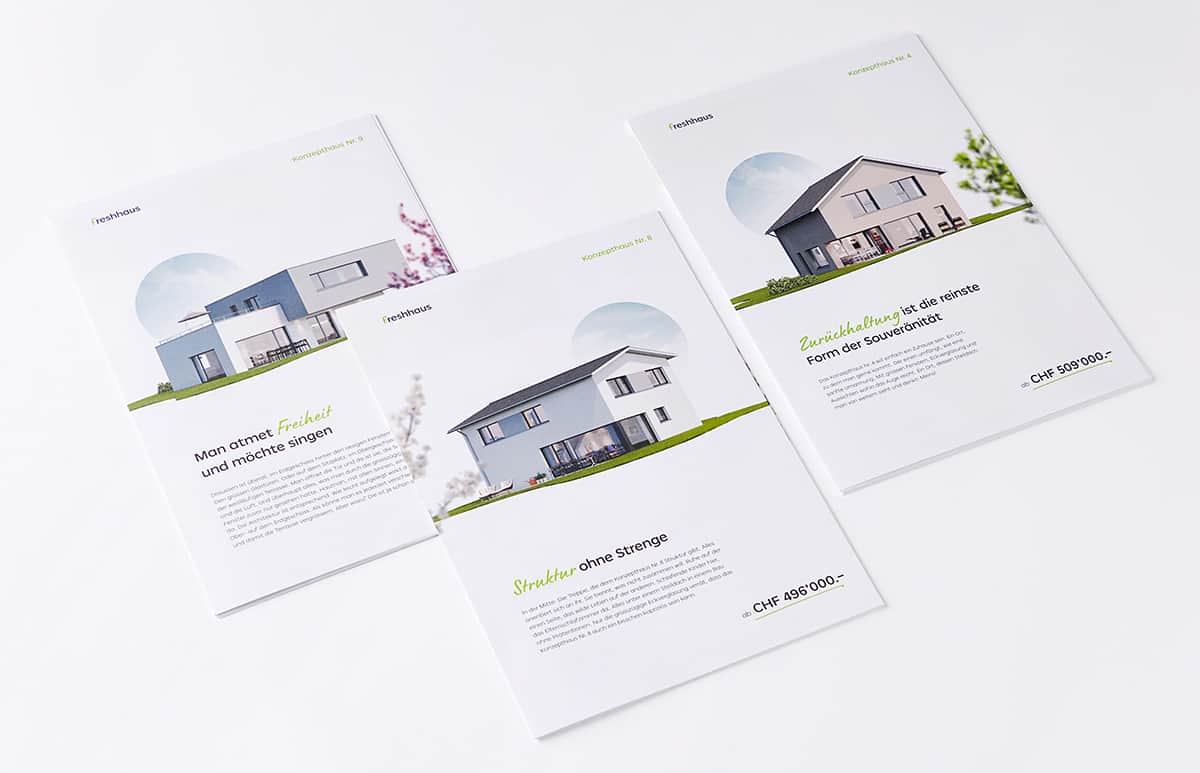
Jung von Matt Brand Identity redesigned the brand for the relaunch of dream home builder Freshhaus. With clear brand positioning and a fresh appearance, various touchpoints were rethought, from sales documents to the website.

Freshhaus has been building individual single-family homes throughout Switzerland for many years. As a general contractor, Freshhaus assumes overall responsibility for the construction project and assists future homeowners with construction consulting, architecture, construction management and interior design.

In the past, however, Freshhaus was repeatedly confronted with prejudices against prefabricated houses and had to repeatedly prove that a concept house is not a prefabricated house.

In order to eliminate these prejudices once and for all, Freshhaus - together with Jung von Matt Brand Identity - has further developed its own brand with the aim of highlighting the brand's differentiating services and addressing customers more emotionally.

In joint workshops, the agency and the company developed a brand story that would sum up the unique selling points: Individual and high-quality concept houses that make the wishes of future homeowners come true through full support, flexibility and cost guarantee.

Enabling individual life dreams

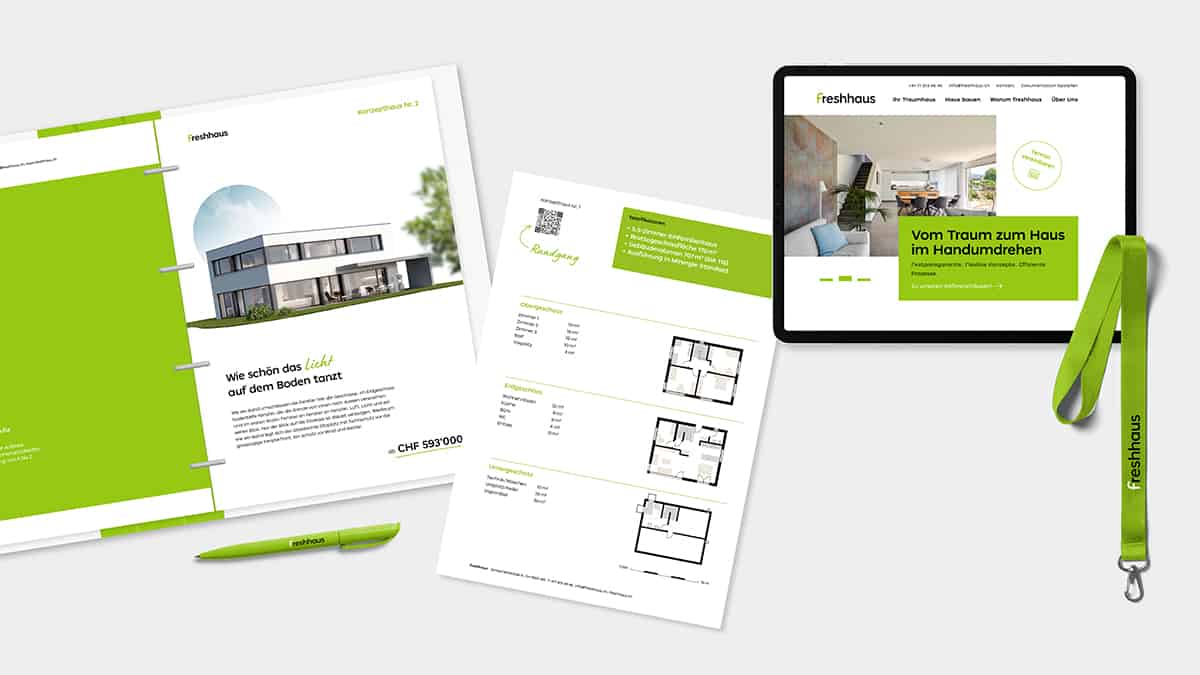
In order to express the brand history even more strongly in the brand design, the individual design elements were further developed. The logo and the colors were modernized and refreshed. In addition, floor plan animations were developed to make it clear that Freshhaus does not simply place ready-made house templates on the plots.

The various Freshhaus concept houses can be visited via digital tour and experienced with the help of a 360-degree view.

The brand experience taken further

Further touchpoints were also developed on the basis of the new brand experience: From a print media concept to sales documents and a new website. The website was implemented in close cooperation with the digital experts from Jung von Matt Tech. Using a brand-first approach, a modern, digital brand experience was created based on Webflow. The website should impress with its simplicity, user-friendliness and striking corporate language.


Responsible at Freshhaus: Ivana Milanovic, André Kressebuch, Kerry de Zilva. Responsible at Jung von Matt Brand Identity: Alessandra Bally, Julius Jäger (Strategy), Monica Bühlmann, Boris Stoll, Christina Widmann (Design). Responsible at Jung von Matt Tech: Andrin Gorgi (implementation, project management), Stefanie Pfeffer (project management), Manuela Tappe, Michelle Scholz (design).

Fewer girls than boys consider themselves talented

Girls generally have less confidence in their talents than boys—a difference that is particularly pronounced in economically advanced countries. In one country, however, the situation is exactly the opposite.

A Pisa study shows that girls believe less in their own talents than boys of the same age. (Image: Unsplash/Bekah Allmark)

On average, 15-year-old girls believe less in their own talents than boys of the same age. This was the result of a special analysis of the 2018 international Pisa study, for which more than 500,000 students in 72 countries were surveyed. The differences are greater the higher a country's economic development status and the better the performance of the students surveyed. Clotilde Napp of the University of Paris-Dauphine and Thomas Breda of the Paris School of Economics published their Results in the journal Science Advances.

The Organization for Economic Cooperation and Development (OECD) usually conducts the Pisa studies every three years. The international comparison of schoolchildren covers the 38 OECD countries and 34 other countries. In addition to skills in mathematics, science and reading, students' attitudes are also recorded through their agreement with certain statements. In 2018, one of these statements was, "If I fail, I'm afraid I might not be talented enough." Across all respondents, 47 percent of boys and 61 percent of girls agreed with this statement.

Self confidence suffers

"The belief that they are less talented than boys can affect girls' self-confidence and lead them to protect themselves and therefore avoid challenging situations and opportunities," Napp and Breda write. They attribute the finding to a gender-specific talent stereotype: according to the study, boys are considered more talented than girls in many areas, especially math. Previous studies found that parents consider their male offspring to be more talented and that most girls and boys portray an adult male when asked to draw an intelligent person.

Saudi Arabia is the only country in the Pisa study where girls believe more strongly in their own talents than boys. For all the others, it was the other way around. In the predominantly highly developed OECD countries, the difference between the sexes on this issue is more pronounced than in the other countries - although equality between women and men is also more strongly realized there. The authors of the study attribute this paradoxical result, among other things, to the fact that individualism is more firmly anchored in the more prosperous societies and that self-realization and self-expression are more important.

Girls are less competitive

Napp and Breda found a close statistical correlation with willingness to compete, as measured by the statement: "I like to work in situations involving competition with others." Here, the gender difference was nearly as pronounced as for belief in one's own talent. The same applies to self-confidence and the expectation of working in a profession in information and communications technology later in life: In all these categories, the girls scored lower than the boys.

Surprisingly for the researchers, the gender difference in talent belief, competitiveness and self-confidence was greater the higher performing the students were. Although high-achieving girls would have every reason to believe in their own talent, significantly more good students than good female students considered themselves talented. (SDA)

Master of Swiss Web 2022: The nominees have been determined

On April 7, 2022, the Best of Swiss Web Awards will be presented for the 22nd time. The nominated projects stood out from a total of 351 submissions during the judging process and are now competing for the top prize.

The project "Relaunch Css.ch" won the title "Master of Swiss Web 2021" at the award night of Best of Swiss Web. (Bils: BoSW)

This year, ten projects are up for election as "Master of Swiss Web 2022". The decision as to who will become Master of Swiss Web does not rest with the jury alone. The BoSW community also has a vote. The final score will be determined in equal parts by the votes of the jury, the readers of Netzticker and the visitors of the award night on April 7, 2022.

Subscribers of the Net tickers can vote for their favorite from March 15 to 22. Everyone who is a registered subscriber by March 14, 2022 is eligible to vote.

Master of Swiss Web 2022

The nominees

Project Client Contractor
Covid-19 Dashboard Federal Office of Public Health FOPH Interactive Things | Shiftcode
Live video consultation of Migros specialty stores Migros Specialty Market Migros Aare News Business
Glace glass configurator Glass Trösch Holding Intersim
Kunsthaus Zurich Visitor Guide Kunsthaus Zurich Three-pole
Liiva - digital companion for every dream home Liiva Merkle Switzerland - a dentsu company
Property Captain Property Captain Tech Property Captain Tech
Runtime Ochsner Sport Thjnk Zurich
S-GE Goglobal Cockpit Switzerland Global Enterprise S-GE Cando
Thommen Medical B2B Webshop Thommen Medical Eyekon | Intelliact
Zürich Tourism Autumn Campaign 2021 Zurich Tourism Capture Media

Source: Best of Swiss Web

Double weighting in the creative ranking

Since 2019, the agencies and service providers that were successful in the "Best of Swiss Web" and "Best of Swiss Apps" awards benefit from the double weighting of the points achieved in the Swiss Creative Ranking, which is organized annually by m&k advertisingweek.ch is conducted and published. The rules and weightings are determined by the Art Directors Club Switzerland in collaboration with the leading participating agencies. ADC Switzerland has decided to give the higher weighting to Best of Swiss Web. 

get_footer();