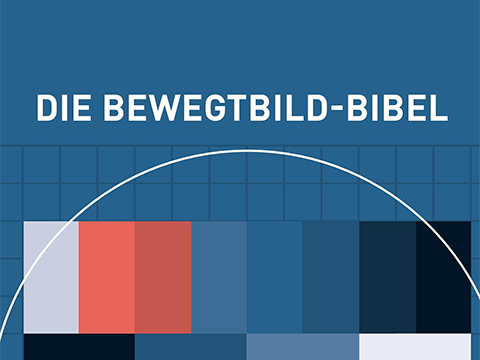
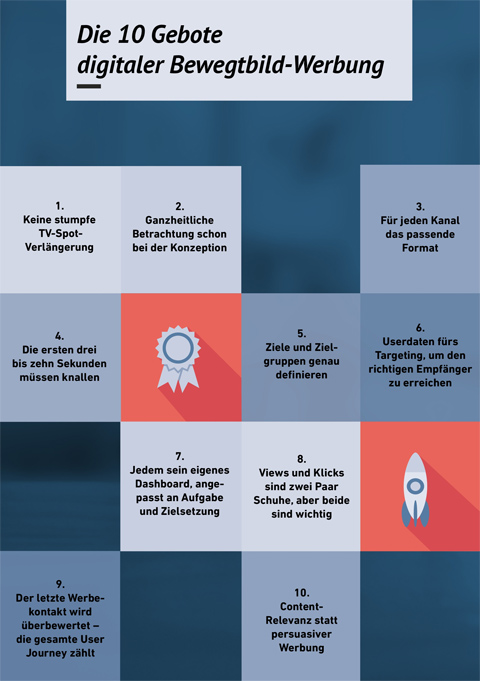
The market for digital video advertising is growing. Facebook recently opened its Audience Network for video advertising. Experts expect that not only Facebook, but also other players such as YouTube, Amazon and others will launch further offerings for advertisers in quick succession. "Marketing managers urgently need to come to terms with the fact that digital moving images can no longer simply be a by-product for TV extensions. They must finally think about their video campaigns in a holistic way," demand Ben Prause, CEO of eprofessional and Christoph Rohs, Managing Director of elbdudler. The two agencies have jointly written a moving image bible and set out the ten commandments of digital moving image advertising that marketing managers should know.
1. no blunt TV spot extension
Moving image advertising for TV and the web works in fundamentally different ways. Users only accept advertising on the Internet if it really interests them. Frontal advertising, on the other hand, is out. Be aware of which mechanics work and how, and consider the user's context of use. Simply extending the TV commercial to the web does not work.
2. holistic approach right from the design stage
Make it clear in advance what you want to achieve with your video and include the objective in the design phase. Successful moving images are the result of the interplay between creation, technology and targeting.
3. the right format for every channel
The various moving image channels differ in terms of the available video lengths and content requirements. The better a format is tailored to the respective channel, the better it will perform. A video on Instagram, for example, must also work without sound, while Facebook Live is particularly suitable for exciting live events. Take this into account when planning your video production.
4. the first three to ten seconds must pop
In the digital world, users decide in the first few seconds whether to continue watching a video or cancel playback. Convince viewers right at the beginning of the clip, especially with strong, visual moments. The advertising message should also come across in the first ten seconds.
5. define goals and target groups precisely
Think carefully about who you want to reach with your content. Target groups can be clustered in great detail via the digital moving image channels. Based on your chosen target group, you can select the right channels and formats for your campaign. Because not every channel is suitable for every target group.
6. user data for targeting to reach the right recipient
Most video publishers such as YouTube, Facebook or Twitter offer target group-based targeting based on CRM data and/or website visitors. Both options promise great success. You should definitely make use of these options. You can also use a lookalike audience, which localizes statistical twins, to supplement your targeting if necessary.
7. everyone has their own dashboard, adapted to the task and objective
The requirements for the visualization of campaign results and reporting are high. Dashboards help to measure, analyze and evaluate results and maintain an overview of the relevant KPIs. Before setting up the dashboard, ask yourself who it should be for and select it according to your task and objective.
8. views and clicks are two different things, but both are important
Views can be used to track how often a video has been displayed, while clicks show how often a clip has been actively started by the user. You should definitely take both metrics into account when measuring your success.
9. the last advertising contact is overrated - the entire user journey counts
If only the last web contact is taken into account, the user's previous clicks and views are neglected. In order to obtain a sound basis for decision-making, all advertising contacts within the user journey must be included. This is the only way to understand how users move through the Internet and what influence your advertising media have on user behavior.
10. relevant content instead of persuasive advertising
Focus on the content instead of the advertising message. With compelling and relevant always-on content, you will remain present in users' feeds in the long term.
About the moving image bible
For the project Moving image bible the digital agency Eprofessional and the creative agency Elbdudler have joined forces. Under the motto "Successful moving images are the result of the interplay between creation, technology and targeting", the authors shed light on the opportunities and challenges of digital moving image campaigns in a practice-oriented manner. In addition to a glossary explaining the most important terms, the bible also provides an overview of online strategies, formats, channels and key figures. The moving image bible is available for download in return for contact details.