Silicon Valley is one of the most important locations for the IT and high-tech industry in the world. It is the southern part of the metropolitan region around the cities of San Francisco and San José - San Francisco Bay Area. The whole region is about 70 kilometers long and 30 kilometers wide. Nowhere else is the attraction for technicians and inventors so great, nowhere else is the innovation density and networking so strong. Yet it all began on a small scale in a garage - where William Hewlett and David Packard, both graduates of Stanford University, founded Project HP with just over $500. The first HP product was developed in a garage in Palo Alto in 1939. It is now considered the birthplace of Silicon Valley. "The garage still looks the same today," van der Touw said, "except the door is green today." Economically, the region's development was spurred around 1951 with the creation of the Stanford Industrial Park. This research and industrial area next to Stanford University was probably the main driver for subsequent development, Peter van der Touw recounts after his visit to Silicon Valley: "They didn't want students to go to big companies after graduation, but instead to realize their own projects on site." In this way, new impulses were to be triggered in the economy. Soon, graduates of the university and former employees of electronics companies were founding small companies in Silicon Valley. They developed their own ideas and products. The main figure in this development was Professor Frederick Terman. As a member of the engineering faculty at Stanford, he encouraged his students to start their own companies as early as around 1938 and invested in many of them himself. This resulted in companies such as Hewlett-Packard. It was also Terman who spurred the development of the Stanford Industrial Park (now Stanford Research Park) in 1951. The university leased portions of land to high-tech firms, after which companies such as Eastman Kodak and General Electric moved into the park. According to the story, the growth of Silicon Valley was also due to Terman's efforts to create relationships between Stanford and various technology companies in the area. During the proliferation of computer technology in the 1960s and 1970s, high-tech companies increasingly flocked to Silicon Valley - such as Apple, Google, Adobe, Oracle, Cisco, Dell, Facebook, Tesla and Amazon.
"Fail fast, fail cheap"
Today, Silicon Valley is almost overcrowded. Three million inhabitants live on an area of 2100 square kilometers - around 40 percent of the inhabitants are foreigners. "Inventors and geniuses from all over the world come here to promote their project and find an investor," says Peter van der Touw enthusiastically. Because nowhere else are so many companies founded, is so much invested in start-ups, do so many attempts fail. However, the failed attempt is not condemned, on the contrary: "A failure is seen as a learning episode for the next start-up," says van der Touw. Failure is almost an important part of success, he said. "Fail fast, fail cheap," is the startup motto in Silicon Valley. But it's not just the way failed projects are dealt with that is much more open and transparent. Collaboration, too, is actually based on mutual exchange instead of competition; interactive cooperation and mediation replace rivalry fights. This atmosphere is also appreciated by some Swiss companies. Swisscom, for example, has had an outpost in Silicon Valley since 1998 and is driving innovation. Last fall, for example, Swisscom invested in the startups Ava and Crowd. Together with Archilogic, Gamaya and Monetas, they were among the winners of the third Swisscom Start-up Challenge and completed a one-week mentoring program in Silicon Valley. Ava has developed a smart bracelet that helps couples plan for pregnancy. Ovulation can be reliably predicted, and a mobile app discreetly displays fertile days. Ava was already preparing to enter the U.S. market last fall, opening an office in San Francisco. Swisscom is investing around two million Swiss francs as part of a seed round together with Zürcher Kantonalbank ZKB and various business angels.
Digital revolution
If you want to deal with digital transformation in Silicon Valley, you can't get past Moore's Law. "Moore's Law is responsible for the fact that there is a digital transformation or a digital revolution," says van der Touw. We're talking about a 1965 insight by Gordon Moore regarding technology advancement that still holds true today. Moore made his observation shortly after the invention of the integrated circuit. Moore's Law states that the complexity of integrated circuits can be regularly doubled with minimal component cost. It refers to the doubling of the integration density, i.e. the number of transistors per unit area. Or in terms of the current application - the storage capacity of a 1970s computer today fits on an iPhone memory card. This advance in technology can indeed be described as the essential basis of digital change - the reduction in the size of the elements with a simultaneous increase in the size of the microchips, or storage capacity. Thus, the name silicon ("silicon ") also comes from the research and industrial complex in semiconductor and computer technology in the Santa Clara Valley.
Start-ups in Silicon Valley
The currency in Silicon Valley lies primarily in stock options. This means that anyone who invests in a start-up benefits from the company's growth with stock options. "The most famous example is probably Google's chef, who became a millionaire with stock options as a salary component," says van der Touw. So Silicon Valley is not just a business valley for engineers. But engineers also have a different status in Silicon Valley - in addition to higher wages than in the high-cost country of Switzerland, for example, employees also receive stock options - "no wonder the innovative and high-performing technicians are migrating to the Valley," says van der Touw. In addition to the impressive facts and the extraordinary atmosphere in Silicon Valley, some start-ups also caught van der Touw's eye because of their uniqueness. Autodesk Autodesk is a Californian software company for digital 2D and 3D design. They use an effective project to show how artificial intelligence is used. The assignment is to design a new racing bike using various parameters. Based on the data in the system, the algorithms automatically suggest various models in a restricted playing field. "In the so-called deep learning process, the system thus starts to learn on its own," says van der Touw. So the new ideas of the models come from the system - based on the input. The same principle also works for high-rise buildings, for example. As soon as the system has been fed the necessary architectural data, it independently suggests various models - and also 3D prints them out. "Of course, the knowledge of structural engineers, architects, engineers and other experts has already been incorporated here," says van der Touw, "but then the system independently calculates various proposals." Thus, after entering the system once, one receives a template that can be expanded as desired and does not require recalculation each time - "the system does it right away itself." Internet of Things According to van der Touw, the Internet of Things is also a big topic in Silicon Valley. Apps are being developed, for example, that collect pollen levels, medication purchases and other data - thanks to this data, allergy sufferers can get an overview of the current pollen levels in various regions before they go to the site themselves. An inhaler uses GPS to find those zones in the region where the most asthma attacks have been detected. Agricultural sensors work on the same principle, providing information on crop status, water quality and temperature in fields of various sizes. Data can be shared and viewed via a cloud. Ubiquitous information sharing "Innovations like this are particularly beneficial for internal communication at companies whose employees work primarily in the field," says van der Touw enthusiastically. For example, he says, the builder can provide news to employees at all construction sites via the Beekeeper app - an app or wristband is very practical here. He himself has already considered whether Notch Interactive could use such a tool.
Ursina mason
IN BRIEF
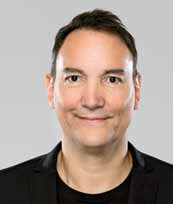
Peter van der Touw brought the latest figures and developments from Silicon Valley, including from Ecosystems Ventures - a company that provides capital for startups. He traveled to Silicon Valley as part of an Executive MBA with HTW Chur's Digital Transformation pilot class. The Executive MBA class visited Google, Oracle, Cisco, HP, Salesforce, Autodesk and Swisscom, among others, as well as many startups. The EMBA Digital Transformation lasts one year, on Fridays and Saturdays - plus one week in Berlin and one week in Silicon Valley. As a final project, each student writes a master's thesis. "This MBA has brought me a lot so far, especially inspiration and networking with the course participants," says van der Touw. For example, the EMBA class owed a visit to Oracle in Silicon Valley to Heinz Hodel, Emmi CIO and van der Touw's fellow student in HTW Chur's Digital Transformation pilot class. Van der Touw also has a personal connection to Silicon Valley. His uncle Marnix Dillenius emigrated from Holland to Palo Alto because he worked as an engineer at NASA.
Internet of Things is a big topic in Silicon Valley.
Apps collect data on pollen levels and medication use. This gives allergy sufferers an overview of pollen in different regions.
Agricultural sensors provide information on crop status, water quality and temperature in fields of different sizes.
Autodesk is a California-based 2D and 3D digital design company. Once the
system has been fed with the necessary architectural data, it independently suggests
various models and also prints them out in 3D at the same time.
The biggest mistakes made by failed startups
are according to van der Touw:
- Single founder: At least two persons
must be present at the start of a project,
a technical and an economically oriented
Founder.
- Bad location: Venture capitalists want
drive no more than an hour to reach the
Start-up to visit. A Swiss start-up,
that a capital raising in Silicon Valley
plans, it is imperative to be there on site.
- Stubbornness
- Diversification instead of focus
- Premodern: It makes little sense to use a product
to design the mental and technical
Basic attitude of the company too far
ahead is.
- Poor calculation of financial resources:
The money really has to go into the product.
- To give up already after the first fail.
Facts & Figures
- The most important IT and technology location
worldwide: Three million inhabitants live on
an area 70 kilometers long and 30
Kilometer width.
- Silicon Valley is the southern part of the San
Francisco Bay Area, includes the Santa Clara
Valley and the southern half of the peninsula
of San Francisco and extends from San Mateo
to San José.
- The part of the name Silicon ("Silicium") refers to
on the research and industrial complex
in semiconductor and computer technology, consisting of
from over 1000 companies in the Santa
Clara Valley.
- In the USA - and thus above all in Silicon
Valley - around $290 billion annually will be
invested. In the rest of the world 210 billion
USD.
- The economic development of the region
began around 1951 with the establishment of the Stanford
Industrial Park - driven by Frederick
Terman.
- A location of high technology became the
Silicon Valley with the spread of computer technology
since the 1960s / 1970s.
- Among the best known companies are
today Apple, Adobe, Amazon, among others,
AMD, Cisco, Dell, eBay, Facebook, Google,
Hewlett-Packard, Intel, Oracle, Symantec,
Yahoo, Tesla and Uber.
- Inventors and employees come after completed
Technology study always
still with the largest share from Stanford - on it
follows Harward, MIT and Berkley.
- Venture capitalist awards funds in five phases,
starting at 1to 3 million. The first
Phase of investment is the most risky,
but relatively the cheapest.
The goal of the start-ups is therefore to regularly receive funds
and thus to obtain the next phase of the
investment to achieve.
- Around 1000 new start-ups per year.
- One start-up out of 100 is very successful.