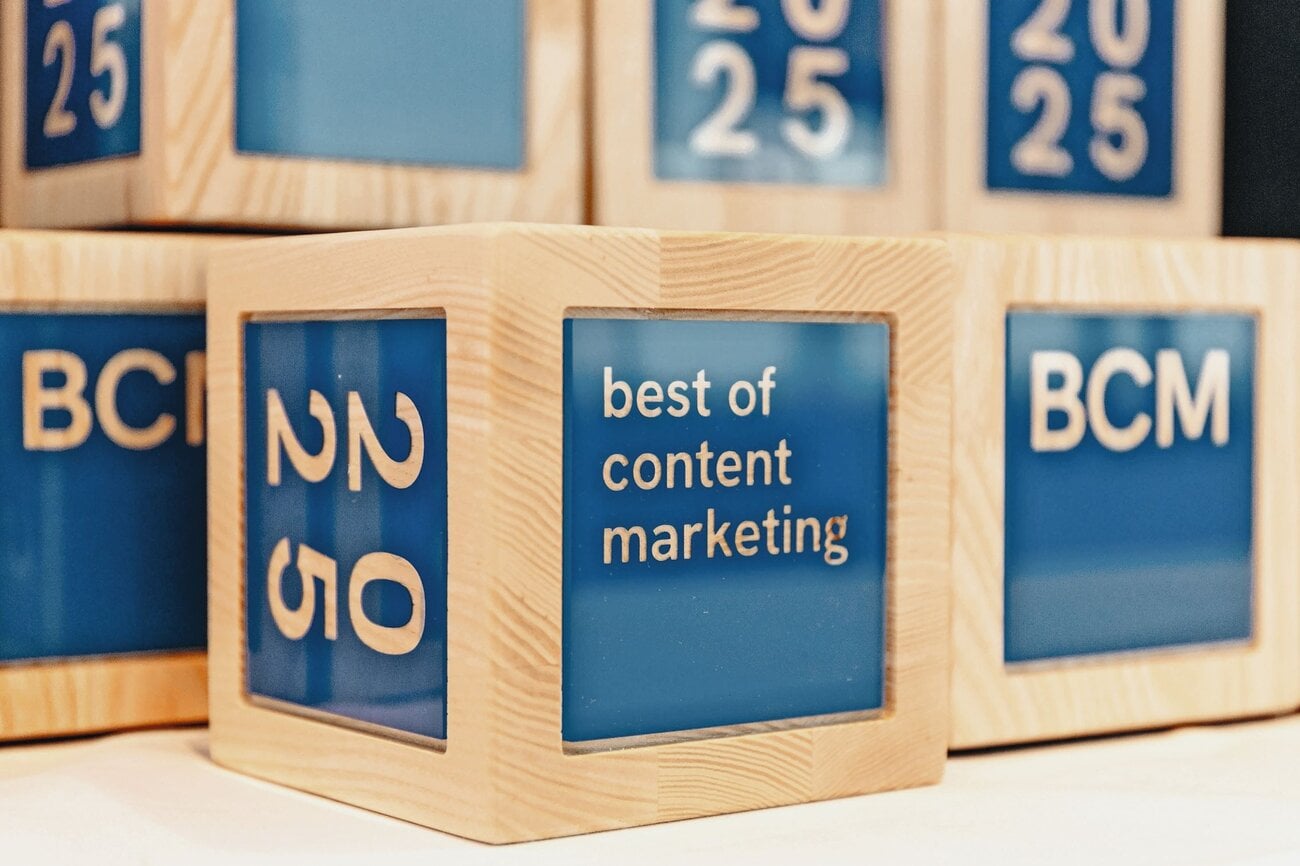
The new courage to do the unusual

Current trends from the Best of Content Marketing Awards.

Bild:BCM
Picture: BCM

Companies are bringing other companies on board as cooperation partners for their communication, becoming livestreamers themselves or letting content creators report unfiltered from their corporate headquarters - welcome to Content Marketing 2025!

Unusual - that is the attribute that unites many of the winning cases of this year's Best of Content Marketing Awards (BCM). The paths they take are very different and follow the target groups. Four examples from the awards that demonstrate the courage to be unusual

Employer branding on Twitch
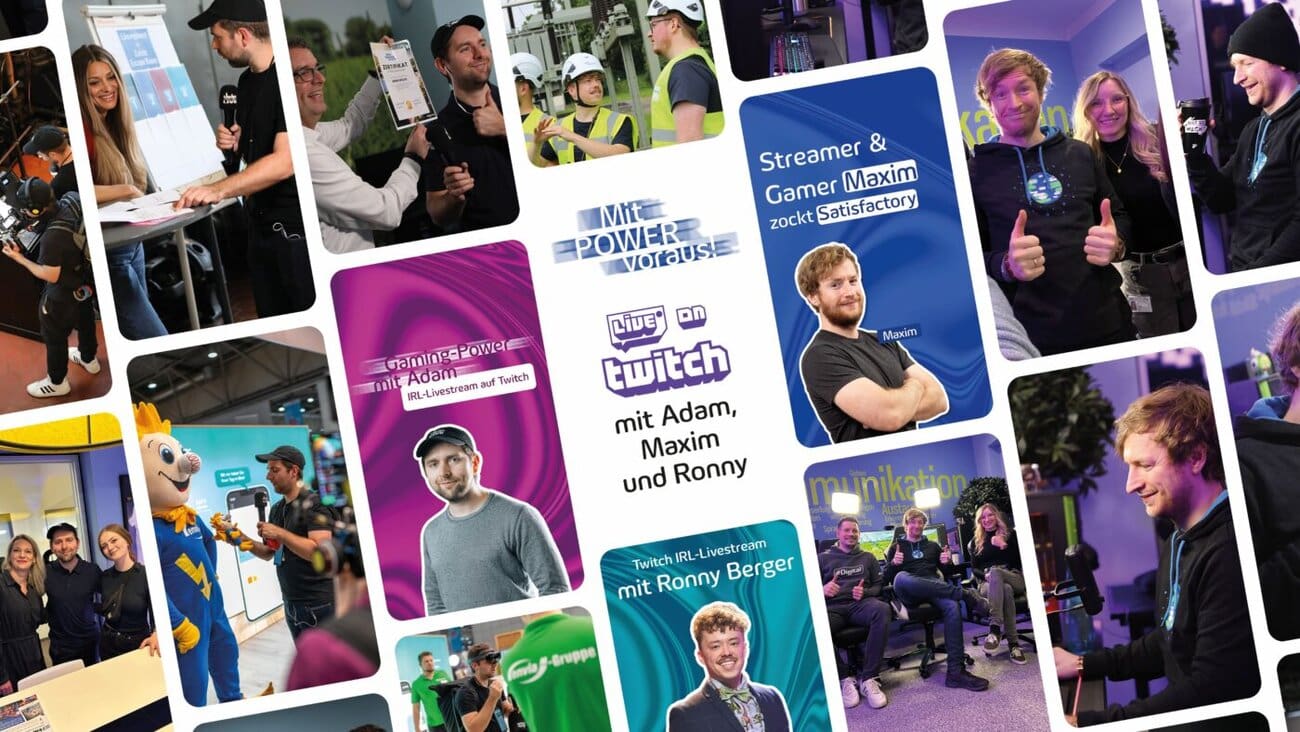
"The Twitch channel requires courage - and makes this employer branding strategy absolutely unique!" was the verdict of the jury of the Best of Influencer & Content Creators Award (BICC), which is part of the BCM award family, on the gold prize winner in the "Employer Branding" category: the Twitch campaign #mitPowerVoraus by envia Mitteldeutsche Energie AG and the Wildstyle Network agency. The idea behind the campaign: to report live and at eye level on energy topics and work at an energy supplier on the GenZ gamer channel par excellence, Twitch. Included: interactive events and challenges that the Twitch gamer community knows and expects. Well-known Twitch streamers were recruited as hosts, who were on location at the company headquarters and in the region with their cameras. In addition to reach and awareness, the campaign also had a real impact on recruitment, according to envia: 100 new trainees in 2025, setting a recruitment record for the company.

Deutsche Bahn shows what it's like
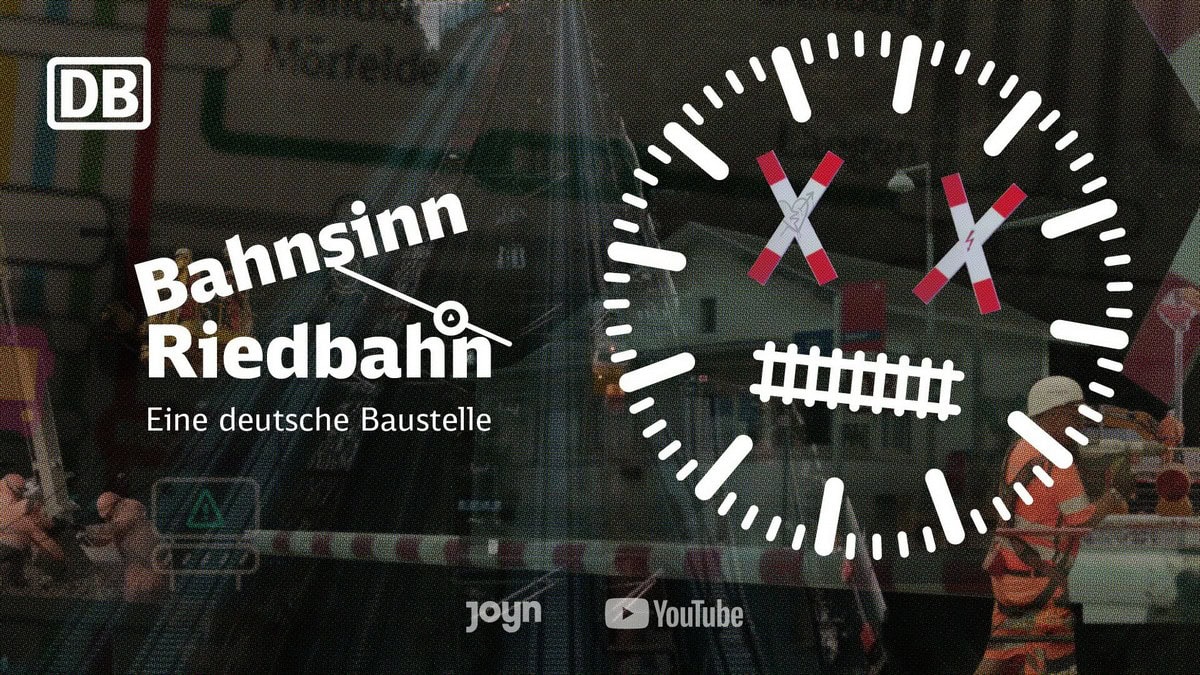
Deutsche Bahn also went down the path of live documentation to accompany a mammoth construction project in the West German rail network, the renovation of the Riedbahn. The construction phase, which was to be completed in a record time of five months, was accompanied in a documentary series on Joyn - with all the highs and lows of the project. In terms of communication, the company was breaking new ground: "Bahnsinn Riedbahn" was the first streaming documentary by a German company on Joyn and immediately landed in the top ten of all documentary formats on the channel. Bold in both content and format, the project was rewarded by the BCM jury with two gold prizes and a Grand Prix: "A courageous and cleverly staged campaign, unsparing towards the publisher. It demonstrates attitude and inspires a rethink. It conveys a spirit of optimism that extends beyond the project and embodies exactly the spirit that we currently need in this country. Bravo!"

Sponsoring cooperations for corporate communications

Also live, but as a one-off event, the "Carrera Racing Night" was launched in November 2024 and won gold and a Grand Prix at the BICC Awards. Together with the Pilot agency, Carrera created a contemporary streaming event reminiscent of classic TV formats - with the power of well-known influencers and Knossi as the driving force. Teams of three influencers each had to compete in various challenges related to cars and racing. The unusual thing: Carrera brought other brands and companies on board for this elaborate communication measure: the ADAC, Aral and other themed brands. A step that has rarely been taken in the world of traditional corporate communications and was particularly positively highlighted by the BCM jury.

The success proves the approach right: thanks to the combined reach of the brands and influencers, the campaign achieved a social buzz of over 17 million views.

The magazine of the century

The third Grand Prix winner of the BCM year 2025 is classic in the channel selection, but unique in its long-term nature: the "Century Magazine" of the National Cooperative for the Disposal of Radioactive Waste in Switzerland, Nagra. Together with the storytelling agency Schroten, it publishes a magazine every year - for 100 years. That's how long it will take to build the Swiss nuclear waste repository, where the waste from 50 years of nuclear energy is to be disposed of.

Nagra is meeting the content challenge of communicating such a complex and unpopular topic with a comprehensive communication architecture across all content marketing channels - from podcasts to the annual edition of the print magazine. "100 magazine issues for 100 years - a great concept that fits perfectly with the topic of 'final disposal' in its long-term nature! With its multi-channel approach, the communication is a convincing offer for discussion with the critics of the repository. The original initial idea is skillfully implemented," praised the BCM jury.

All winning projects of the BCM Awards 2025 can be found in the digital winners' magazine

"Unusual - that is the attribute that unites many of the winning cases at this year's Best of Content Marketing Awards (BCM)."


Timing of the BCM Awards 2026

1.

The Best of Corporate Print Award (BCP) is open to any type of content-driven corporate communication that is published in printed form: Customer magazines, employee

magazines, corporate books, printed annual reports, etc.

2.

All content-driven corporate communication projects and products can be entered for the Best of Content Marketing Award (BCM), regardless of the media used. In all categories, a distinction is made between regular communication measures (blogs, customer magazines, corporate social channels, podcasts, etc.) and campaigns, so that the resulting different requirements and approaches can be taken into account.

3.

The Best of Influencer & Content Creators Award (BICC) is open to all content-driven communication measures created by and with influencers / content creators.


The submission phase for all BCM competitions begins on February 2, 2026 and ends on April 30, 2026

Keeping an eye on customer benefits

Column: If you want people to choose sustainable products, you have to speak their language.

The other day I was leafing through the ETH magazine on the subject of sustainability. A parade of innovations: sustainable cement, new materials, the future in bright green. Researchers enthusiastically explain their technologies, and I can already see it before me: the green future, shiny, visionary, a bit like a science fiction trailer in the eco version.

And honestly, I understand that. If you research or develop something yourself, you quickly fall in love with your own idea. Some even affectionately call their project their baby. But if you take off your rose-tinted, sorry, green glasses for a moment, the question arises: does the rest of the world actually see this added value? Or to put it another way: why should anyone buy this sustainable cement, except because it is more sustainable and usually more expensive? I find myself looking for the actual customer benefit as I read. Perhaps it was well hidden among the technical terms. Or maybe it wasn't there at all.

One of my favorite exercises, which works wonderfully in lectures as well as in company workshops, is therefore: Explain the added value of your product without using the words sustainable, CO2-neutral or environmentally friendly. It quickly becomes surprisingly quiet in the room. Because, hand on heart, sustainability is not a customer benefit in itself. Of course, there are industries in which there is no way around it from a regulatory point of view - we'll leave that out of the equation for now. But for most people, sustainability is a nice bonus, not a reason to buy. Even if they like to say otherwise in surveys. But attitude does not necessarily lead to the corresponding behavior. This is where the well-known attitude-behavior gap comes into play.

This means that if you want people to opt for sustainable products, you have to speak their language. B2C customers decide in seconds, so there is no time for long sustainability reports. And B2B customers? They too are rarely this mythical homo oeconomicus who navigates through the day with Excel and a moral compass. They are people, with emotions, routines, preferences and pressure to make decisions.

In short: if you want to convince people, you need a clear benefit. One that can be explained without technical jargon and without moralizing. Sustainability can be a part of this, but it is never the whole.


About the author

Prof. Dr. Johanna Gollnhofer is Associate Professor of Marketing and one of the co-directors of the Institute for Marketing and Customer Insight at the University of St. Gallen (IMC-HSG).

Bild: zVg. HSG / Bearbeitung: Silvan Borer
Image: zVg. HSG / Editing: Silvan Borer

Sponsoring Women to Success

A while ago, I was talking with a colleague about our respective experiences with women’s and men’s networks, and we quickly realized that they don’t necessarily overlap.

Bild: zVg
Image: Courtesy of

I joined the IVY Female Collective, a boutique network for women, in 2020. The Collective was started by founder Lisa Robben with the intention of creating real connections between ambitious women to support and inspire each other. I still remember the feeling of being in a room for the first time with so many women who are all well-disposed towards each other and share similar experiences. I had some of the most valuable conversations of my life at the IVYs and learned a lot for my career path.

Some time ago, I was talking to a colleague about our respective experiences with women's and men's networks and we quickly realized that they don't necessarily coincide. While he was visibly amazed at the deep conversations and close connections within the IVYs, I was surprised at how much direct or indirect business he had generated from his network to date. The bottom line was that our conversation could be summarized as follows: I had mainly used my network for mentoring, he had mainly used his for sponsorship. This is a major difference, because while mentoring primarily means exchange, advice and knowledge transfer, sponsorship means active advocacy. And only the latter actively promotes the career of another person: Doors are opened, projects are arranged and recommendations are made.

According to the KPMG Global Female Leaders Outlook 2025, 76 % of women name their personal network as the most important factor for professional success. I, too, have always been aware that the right contacts can help me to advance in my career. Nevertheless, I used my network for exchange and coaching, but not to directly drive the success of my business. Science says that I am not an isolated case.

The study Gender Differences in Networking by Friederike Mengel from 2024 bundles research from the field and comes to the following conclusion: women tend to form more cooperation-oriented networks, while men network more strategically and allocatively. Other studies confirm that women are more often offered mentoring, while men are more often offered sponsorship. The analysis of LinkedIn data also shows that men send contact requests to people in higher positions more frequently in a professional context, while women use the platform more to communicate and maintain relationships with existing contacts.

So women actually network differently to men. One reason for this is "personal hesitation": women tend to have moral reservations about "instrumentalizing" relationships and also underestimate their abilities and their own benefit within a network. Both are the result of female socialization.

Don't get me wrong: exchange, advice and knowledge transfer are valuable and should definitely be maintained. But the proportion of women is falling and diversity programs designed to prevent this are becoming less common. The Allbright Foundation recently published a new report on the proportion of women on German boards: After years of positive development, the proportion of women is now stagnating at a low level (19.7 %) and men are also being used more frequently again for new recruits (from 37 % to 20 %).

I am aware that people cannot change behaviours based on their socialization overnight. This also applies to networking. That's why I have a suggestion. Let's start with this: Every time someone asks you for a referral for a project, panel or speaking gig, or when you have assignments of your own, ask yourself this question: "Do I know a woman I can refer?" Open the door. Let's sponsor women to success.


Aissu Diallo is Executive Director Digital Excellence at the Düsseldorf-based creative agency Butter. She is also Chairwoman of the GWA Young Board.

"The monster is voracious"

The dominance of monopolistic tech platforms threatens our democracy. In this interview, media scholar Prof. Dr. Martin Andree explains what politicians, CMOs, and each and every one of us can do to turn things around, and asks: What are we actually waiting for?

Bild:unsplash.com
Image: unsplash.com

m&k: Martin Andree, your books paint a bleak picture of the future of our democracy. What is the biggest problem - and how did it get this far?

Martin Andree: The biggest problem is that European democracies have allowed the monopolization of public goods by US tech monopolists. Public goods are those that are actually indispensable for our existence - such as our modern media, i.e. social media, video, audio, messengers, etc. Those who monopolize them have endless opportunities to exploit the dependencies for blackmail. And that is exactly what is already happening.

Your new book "War of the Media" begins with a quote from Jan Delay and Udo Lindenberg: "Everything is fucked up and everything is finished and all you can say is, 'Woulda, woulda, coulda', yeah man At first it didn't matter, because it always works somehow You never did anything, but now it's too late." Sounds like the "war of the media" has long since been decided...

I describe this in the book as the "possum strategy": the possum plays dead when it is attacked. We have also been playing dead with dark tech companies and their monopolies for at least ten years. By 2013 at the latest, when it became known that the dark tech companies had passed on our data to the US intelligence services, it must have been clear to everyone that there was a huge problem here. We thought like the possum: The predator will go away. But it has only grown to gigantic size since then - because we were simply asleep.

In your book "Big Tech must go" from 2023, you wrote that we still had until 2029 to take countermeasures. But that was before the Trump administration. What has changed since then?

I correctly predicted back in 2023 that dark tech companies would also use their power in the political sphere. In reality, however, the political encroachment came faster and more radically. Fundamentally, little has changed - the dark tech companies have always pursued an anti-democratic, libertarian ideology. Fifty years from now, people are more likely to say: "How could people be so stupid back then and not realize that?" The libertarians have never kept their plans secret - if you read "The Sovereign Individual", a cult book in the tech ecosystems, you'll get the shivers. In 1997, the script was already formulated according to which democracy is being destroyed today. Incidentally, the authors already called the desired anti-democratic system change "information warfare" back then. If people are now frightened by the title of my book, I say: "I didn't make it up."

The platforms control the formation of political opinion and undermine competition - to what extent?

Around 60 percent of mass media attention today is in the digital world. This is almost completely controlled by the tech monopolies, primarily Alphabet (Google, YouTube) and Meta (Facebook, Instagram). These companies decide who gets to see what information. Anyone who understands a little about how tech companies make their money knows that traffic manipulation is not an epiphenomenon - on the contrary, these companies make their money based on traffic manipulation. It's crazy how blindly people believe the platforms' promise of neutrality. And it's even crazier that the irradiated right-wing "self-thinkers", who constantly see evil elites, censorship cartels and dark conspiracies at work behind all analog media, follow the most evil elite of our time, the tech oligarchs, like a horde of blind sheep.

"If we want to change something, we have to turn the tide now."

"We haven't heard the shot yet," you write. Don't we want to hear it? 

Under the conditions of monopolies, metaphorically speaking, we are all in bed with dark tech. This is not just the case for users, but in all areas of our society: brands, retail, start-ups, SMEs, television, publishers, film. Wherever I go, everyone tells me: "These tech companies are really bad." When I say: "Then do something about it", they often say: "Yes, our members are split on this because they also depend on the traffic. That's why they'd rather not make a big deal of it." Incidentally, the same conflict leads to cognitive dissonance. People know that this is wrong, even schizophrenic. But they have no real way out under monopoly conditions. That's why they suppress the issue.

What role does AI play in this process?

From the perspective of my research, AI is "only" an extension and dynamization of processes that we have been observing for years and decades. So above all: the total devaluation of content. I would even say provocatively: content had already lost 80 to 90 percent of its value before that. AI is "only" the shot in the back of the neck. But the same monopolization here. The same expropriation processes. And the same shift in value creation, away from content and towards the pure monopolistic granting of access.

To what extent do marketing and CMOs have the opportunity to make a difference?

If the CMOs were smart, they would understand that the mechanics described above - i.e. the shift in value creation away from content towards monopolistic access - will be just as deadly for their business model in the medium term as it already is for broadcasters or publishers. One example: According to an analysis by consultants Oliver Wyman, 30 percent of all manufacturers are already no longer earning money on Amazon. This is because Amazon is sucking more and more added value out of the transactions. When the Amazon monopoly vampire has sucked out the last drop of blood, it throws you away - because it has collected all the data over the years and can therefore immediately copy the strongest brands and bestsellers. Amazon already has more than 140 own brands. Dark tech is a crocodile, it is hungry and it will keep on eating. Anyone who is still doing well and thinks they will be spared in the medium term must be very naive. Now we can still fight back together. The more potential comrades-in-arms are devoured by the crocodile, the more difficult it will be to fight back.

When did you realize that the situation was becoming threatening - and to what extent can you make a difference through your initiatives?

My first scientific publication on the digital monopolies was in 2010, I published about it in the press in 2012 - but nobody was really interested. The discourse belonged to the cool digital evangelists. Society only woke up about ten years later, after Musk bought Twitter and turned it into his personal propaganda machine. Politicians are now also discovering the topic, but far too slowly. The dark tech companies are now closing the bag. If we want to change something, we need to turn the tide now.

Our cover story is "Efficiency". The US platforms are an efficient channel for many advertisers and promise fast performance. Why is this wrong?

I would dispute the efficiency outright. I keep hearing the same thing from all corners - namely a sharp drop in advertising impact. Even worse: because large parts of the digital funnel are now controlled by AI, those responsible often don't even know why. And even worse: unlike in the past, the metrics of tech companies are not audited by external studies. We have no neutral monitoring of these values. It's the same here as with AI: everything flashes great, but we no longer have any understanding of how all this stuff came about. We are completely incapacitated. And that's why it's even cynically consistent when Zuckerberg announces that he now wants to take over the entire agency business. Because if we no longer understand it ourselves, we won't be needed anymore.

What political or legal measures would be particularly urgent?

We know how to unbundle monopolies and enable competition. We could force platforms to use open standards. Youtubers could publish their content on a dozen competing platforms with the same click. They would no longer be trapped in YouTube's prison - and the platforms would compete for the best content. More money would end up with the creators, less with the platforms. We can also open up platforms - so that traffic outside the silos is possible again. Finally, we can prohibit platforms from earning money with punishable content such as defamation, racism and discrimination. Together with Karl-Nikolaus Peifer, I have formulated some very specific proposals (mstv2go.de). So far, politicians have not had the courage to implement such proposals.

What can each and every one of us do ourselves?

We can of course use alternatives such as Mastodon or Ecosia - but we need to get into political action. This is about the free media. A functioning public discourse is the basis of our democracy. It's worth fighting for.

If you look ten years into the future: What does the scenario look like?

We are behaving like a bird that has been in a cage for so long that it can no longer imagine leaving it, even though the door is wide open. After all, an uprising against Trump and tech has huge potential. We wouldn't simply leave the digital markets of the future to the US monopolists without a fight and could really take off here in Europe. And we would also save our democracy. So you have to ask the other way around: what are we waiting for?


Prof. Dr. Martin Andree teaches media studies at the University of Cologne. He has been researching the power of big tech companies for more than 15 years and is the author of eight books. Andree became known for his "Atlas of the Digital World", the first holistic scientific survey of the digital world (2020). He was awarded the Günter Wallraff Special Prize for Freedom of the Press and Human Rights for his bestseller Big Tech muss weg. Andree is the founder of the digital company AMP Digital Ventures GmbH with a focus on full funnel consulting and implementations.


Latest books

Big Tech must go (2023) |The digital corporations are destroying democracy and the economy - we will stop them; analysis of digital monopolies and the consequences for democracy and the economy. Campus publishing house

War of the Media (2025)| Dark Tech and Populists Take Over; Political Essay on the Threat to Democracy and Media Freedom. Campus Publisher

Martin Andree bei einer seiner zahlreichen öffentlichen Auftritte. Bild:zVg
Martin Andree at one of his numerous public appearances. Picture: zVg

WEMF provides neutral podcast data

Podcasts are becoming increasingly popular, and with that, the advertising industry’s interest is also growing. But how can we reliably measure which formats are listened to, how often, and which target audiences they reach? To ensure the market can rely on credible figures, the WEMF promotes transparency through its Podcast Audit and the MACH Strategy intermediary study, thereby creating a solid foundation for media planning.

Podcasts are being listened to more and more frequently. Audio content can be consumed conveniently and regardless of location - whether on the way to work, during sport or at home. For many people, this makes them not only an entertainment medium, but also a practical source of information. The range is constantly growing: in addition to large media companies, many small providers and independent podcasters are also producing their own formats. This diversity makes podcasts a varied part of today's media landscape.
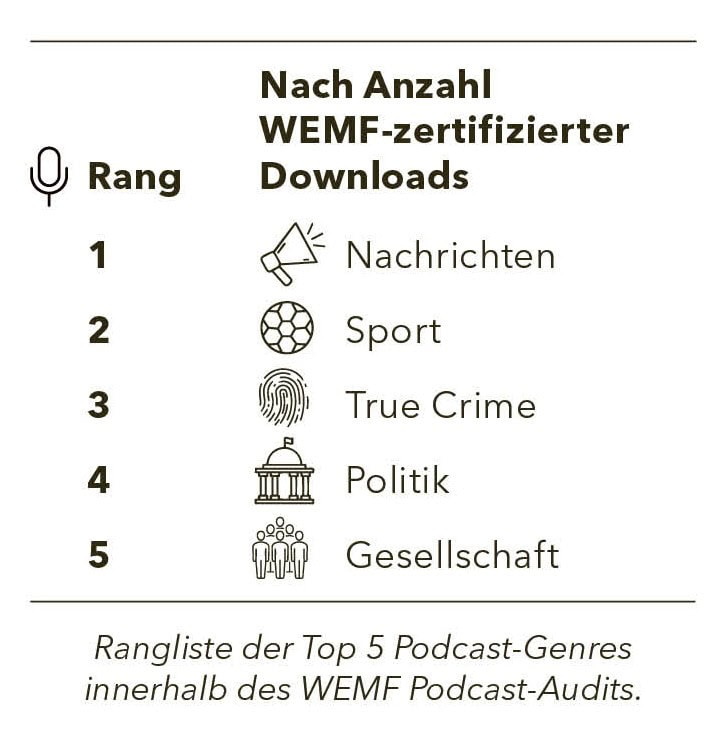


As usage increases, podcasts are also becoming more interesting for advertisers to reach an attentive audience and address target groups in a targeted manner. This is exciting for advertisers - provided they can rely on neutral and comparable data on podcast usage. This is precisely where WEMF for Advertising Media Research comes in. As an independent authority, it provides valid data on the use and distribution of podcasts in Switzerland and certifies download figures.

Reliable data creates trust in the advertising market

The WEMF offers two key tools for this: the WEMF Podcast Audit and the Regular Usership (RUS) Podcast indicator in the MACH Strategy intermedia study. The podcast audit publishes the download figures for certified podcasts and thus enables monthly analyses, among other things. These show the total number of downloads in the current and previous month, the percentage change, the number of episodes published in the current month and the total since the start of the audit. This allows transparent time series to be created for each podcast. Producers of podcasts benefit from reliable figures, increased visibility and a credible sales argument to advertisers. The WEMF acts as an experienced and established auditor, providing neutral and verifiable data.

In the MACH Strategy intermedia study, podcasts are identified as a separate media category. The study records people who listen to podcasts at least several times a week and enables a detailed analysis according to socio-demographic characteristics such as age groups and regions. The data shows that the regular use of podcasts is increasing and that young people under the age of 34 in particular are among the core listeners. The 2025 edition of MACH Strategy also shows interest in 19 different podcast genres for the first time. This information is valuable for media planning because it helps to analyze target groups and target them with the right podcast selection. The chart above shows the various genre preferences of the Swiss population, segmented by age and gender.

Podcasts are becoming a professional advertising channel

In terms of content, the news, sport and true crime genres currently dominate the podcasts identified by the WEMF and generate the most downloads. They appeal to a broad audience and therefore offer attractive advertising environments.

With the combination of independent measurement and reliable usage data, WEMF ensures greater transparency in the growing audio market. This creates trust among advertisers and at the same time strengthens the position of podcast producers. Podcasts are no longer a niche phenomenon, but an integral part of media usage - and thanks to credible data, an increasingly professional advertising channel.

"The transparent and neutral figures of the WEMF Podcast Audit provide convincing arguments to win advertising customers for podcasts."

WEMF Podcast Audit

With the podcast certification, WEMF offers the advertising market more transparency in the audio sector through fair and verified figures. The certification enables comparable and valid download figures for podcasts in Switzerland. This allows media houses and podcast producers to prove the reliability of the reported delivery statistics and make their podcasts visible in the advertising and media market. The data is published once a month in the NEXT>LEVEL tool, which is widely used by the industry.

Learn more


MACH Strategy

WEMF's national intermedia study MACH Strategy is the central tool for efficient and data-based media planning. It combines socio-demographic information and consumption data with media usage data. This makes it possible to analyze which channels or channel combinations have the highest reach potential for a target group. With 18 directly comparable media types, it enables the largest national comparison of intermedia:

Press, cinema, television, streaming (audio / video), radio, podcasts, internet in general, websites / apps, social media, messenger services, gaming, out-of-home (≥ 55 inches), DOOH (≥ 55 inches), digital signage, public transport, POS (point of sale), direct mail, e-mail marketing,

Learn more

The European AdTech trap

Why We Must Act Now. Or: How Google, Meta, and Others Are Draining Value from Europe—and What Publishers Can Do About It.

Illustrationen: unsplash.com / Sanja Djordjevic
Illustrations: unsplash.com / Sanja Djordjevic

The European media landscape is facing the fundamental problem of the dominance of US technology platforms in the digital advertising market. Google DV360 controls the programmatic infrastructure. Performance Max - Google's fully automated AI campaign across all channels - has systematically absorbed budgets of traditional campaign types since 2022 and reached a peak of 82 % of e-commerce ad spend in May 2024.

The situation is particularly dramatic for advertisers: Those who want to build brand awareness, book premium placements or test creative formats are forced into the performance-max black box. The system automatically invests 30-50 % of the budget in display placements - but on which sites, in which context, with which formats, Google's algorithm decides all of this without any possibility of intervention.

The consequence: display campaigns with branding objectives are converted into performance campaigns - regardless of whether this fits the brand strategy. After adjustments, advertisers can see where their budget ends up, but they cannot control it proactively. Brand safety only works reactively: problematic placements can only be ruled out after the brand has already appeared alongside questionable content.

"If the advertising infrastructure is in the hands of a few US corporations, the financing of independent media hangs by a thread."

For publishers, the situation is becoming a mirror image: they are being degraded to anonymous inventory suppliers. Although they receive payouts, they lose all transparency: Who is the advertising client? What campaign objectives are being pursued? What is the total budget behind it, what margin does Google keep? What is the strategic context of placements? All this information disappears into the black box. Publishers supply raw material inventory, Google controls the value chain, direct customer contact is lost.

The figures speak for themselves: the European digital advertising market grew by 16 % to 118.9 billion euros in 2024. However, this growth mainly flows to the platforms. Social media grew by around 25 %, retail media - dominated by Amazon - by around 20 %. Video advertising exploded: streaming services with advertising such as Netflix recorded over 200 % growth, social video over 30 %. Traditional display only grew by 14 %. Value creation is systematically migrating to the platforms, while traditional publishers are being structurally left behind.

With AI Max, the situation is getting even worse. Google is shifting campaign budgets to Conversational AI and AI Overviews. Publishers are facing a double negative scenario: on the one hand, they are losing more and more of their search traffic due to AI-supported search functions such as Google AI Overviews. On the other hand, advertising budgets are increasingly flowing into AI-optimized Google products - away from traditional campaigns. The systemic challenge: advertisers have to trust Google, but cannot independently observe or verify its behavior. There is a risk that Google will prioritize its own goals, such as sales and margins, without this being comprehensible. To make matters worse, 89 % of the sources used in AI responses do not come from the top 100 search results. The previous reach models are becoming obsolete.

"Massive traffic losses are just the beginning. Traditional display ads need to reinvent themselves."

In Europe, in addition to regulatory frameworks, initiatives are being worked on to counter Google's dominance. The Digital Markets Act (DMA) obliges gatekeepers to achieve greater interoperability and data transparency. The Digital Services Act (DSA) sets standards for advertising transparency and accountability. The EU AI Act creates scope for the responsible use of AI. But regulation alone is not enough - it creates scope, but not business models.

The creeping loss of added value

European publishers and advertisers are not only losing transparency and control - they are losing money. But it's about more than just tech fees. The platforms are becoming intermediaries between advertisers and publishers. Advertisers lose direct access to their target groups and have to rely on the data curated by the platforms. Publishers lose direct contact with their advertising customers - the business relationship becomes a pure transaction. The authority to interpret reach, target groups and campaign success lies with Google, Meta and Co.

To make matters worse, Google's preference for last-click attribution - also in Performance Max and AI Max - systematically distorts the evaluation of campaign contributions. Publishers who make a significant contribution to the customer journey in the upper funnel phase remain invisible. Another issue is that of independence. If the entire digital advertising infrastructure is in the hands of a few US companies, the financing of independent media is hanging by a thread. An algorithm update, a new AI function - and European publishers are facing the abyss.

AI integration drastically increases this dependency. Performance Max optimizes fully automatically - but according to whose criteria? The optimization follows Google's goals: maximum revenue, maximum margin, maximum loyalty to its own ecosystem. Whether these goals coincide with the interests of advertisers or publishers remains unclear.

European counter-movements

Resistance is forming in several European markets. The Ozone Project in the UK shows that cooperation works: The consortium of British premium publishers reaches over 95% of the UK digital population and offers programmatic access with full data control through partnerships with OpenX and The Trade Desk. The recipe for success: shared audience platform, shared inventory, but individual brand identity.

DPG Media in Belgium goes further: The fully owned ad stack saves up to 40% of AdTech fees and massively reduces Google dependency. In France, Media Square is benefiting from the tough regulatory course: the 220 million euro fine against Google in June 2021 has forced concrete changes. Google had to commit to improved interoperability with header bidding, grant all buyers equal access to auction data, make bid optimization more transparent and give publishers more control over pricing rules. This forced opening has given Media Square room to maneuver. Germany is taking a solid but cautious approach with initiatives such as d-force.

"Instead of 27 parallel initiatives, Europe needs an interoperable, scalable system with common standards, open interfaces and a shared infrastructure in the future."

The Swiss approach: OneDSP bundles premium inventory from over 40 media brands, reaches more than 50 % reach in Switzerland and relies on cookie-independent targeting via OneID (1.8 million directly addressable users). With Adform as DSP and Decentriq as DMP and Data Clean Room for privacy-first targeting, the approach is forward-looking: 100 % GDPR/DSG-compliant, data sovereignty, full transparency and AdTech made in Europe. The advertising budget flows directly to the publishers, who have sovereignty over the technology as shareholders. It remains to be seen whether a market of 9 million can counter the dominant platforms in the long term - or whether OneDSP can serve as a blueprint for pan-European scaling.

The advertisers' view: What is still missing?

From the advertiser's perspective, gaps remain. Google DV360 offers a comprehensive solution: DSP, DMP, reporting, attribution, cross-device tracking, AI optimization - all from a single source. The European alternatives can score points: Reach (Ozone or OneDSP deliver significant coverage), transparency (advertisers know where their budget ends up), cost efficiency (less tech fees) and GDPR / revDSG compliance (from obstacle to USP).

But there are still shortcomings: most initiatives remain nationally limited, pan-European campaigns are complicated to book and innovation in the area of algorithmic optimization is lagging behind. Particularly critical: there is a lack of independent measurement standards that go beyond Google's last-click attribution. Without alternative and neutral metrics, valuable campaign contributions remain invisible - a structural problem that massively weakens the superiority of the European alternatives.

Between disruption and reinvention

The integration of AI represents a turning point for the entire advertising industry. Generative AI is not only changing how advertising is displayed - it is fundamentally questioning the raison d'être of traditional paid advertising. If AI assistants such as ChatGPT, Perplexity or Google's AI Overviews serve users directly without them ever landing on publisher websites, the age-old principle of "attention to content in exchange for advertising funding" will collapse. Massive traffic losses are just the beginning. Traditional display ads need to reinvent themselves.

European publishers face a double challenge: not only do they need to develop new forms of advertising that work in AI-dominated environments - they also need the technological infrastructure to do so. Publishers need to invest in development and innovation themselves: Native integration in AI responses, contextual recommendations in conversational interfaces, sponsored insights in generative search results.

OneDSP with Decentriq shows to some extent how privacy-first AI can work on European infrastructure. But this requires investments on a scale that many publishers shy away from - and, above all, cross-border cooperation.

Europe must grow up

The European AdTech industry is facing a fundamental decision: either it accepts the role as a supplier for US platforms - with all the consequences for value creation, transparency and independence. Or it uses the regulatory and technological opportunities to establish an independent, AI-supported infrastructure for the open web. The good news is that serious work on independence is already underway in various European markets. The Ozone Project, OneDSP and DPG Media models prove that cooperation and innovation are feasible and can offer a credible alternative. What is missing is not ambition or competence - but scaling. This is precisely where the opportunity lies: pan-European cooperation could bundle and multiply these national strengths. Instead of 27 parallel initiatives, Europe needs an interoperable, scalable system with common standards, open interfaces and the prospect of a shared infrastructure. The technology is there. The regulation is there. The successful models are there. What is missing now is the willingness to cooperate across borders.

Europe must act now - before platform dominance becomes irreversible. The clock is ticking.


The new marketing playbook

Why traditional approaches fail and how brands can finally find their bearings again in a complex ecosystem.

Source: unsplash.com

New technologies, channels and formats are driving a constant growth in opportunities, tasks and challenges in marketing that can no longer be captured one-dimensionally and linearly. Interactions, interferences and reinforcements arise in real time; small impulses can have an enormous impact - or fizzle out. Anyone who tries to understand these dynamics with (mono-) causal models, funnels or rigid KPIs will fail due to their complexity.

Pure efficiency thinking and the belief in specialization do not help either - silo thinking is the result. However, the players in brand communication, sales, customer experience, content, data analysis and (technological) innovation are not only closely intertwined today - they form a marketing ecosystem whose advantages need to be leveraged. Similar to a flower meadow, vitality is not created through control, but through diversity, adaptation and maintaining the right relationships.

But this is precisely what many marketing organizations find difficult. Four developments reinforce these challenges and show how dynamic and interconnected the "marketing playing field" has become:

First: fragmentation instead of focus

In many organizations, marketing is growing faster in breadth than in depth. New channels, tools and metrics are constantly emerging - but rarely with a clear strategic embedding. What begins as diversity often ends in overload: initiatives stand side by side instead of paying into one another.

Example: The "Panini effect" aptly describes this phenomenon: companies collect marketing activities like stickers - and realize too late that the album is never complete.

Secondly: Attention without effect

In digital communication, success is too often defined by visibility. Reach, likes and views generate short-term confirmation, but rarely a lasting effect. Marketing teams get caught up in operational reaction loops, driven by algorithms rather than strategy.

Example: The social media impact discussion shows how strongly many brands focus on short-term response signals - and neglect relevance, trust and brand value in the process.

Third: Dependence on systems and platforms

Today, technological ecosystems structure how companies communicate, analyze and make decisions. At the same time, there is a growing dependency on large providers whose logics and interfaces can hardly be influenced. Knowledge and skills are being outsourced.

Example: The so-called vendor lock-in means that marketing departments invest more time in tool maintenance than in strategy - and lose their creative freedom.

Fourth: Disruption through generative intelligence

Artificial intelligence is changing how content is created, how information is found and how brands remain visible. This is fundamentally shifting search, recommendation and perception logics.

Example: The emerging discipline of Generative Engine Optimization (GEO) is forcing brands to think about new forms of visibility in AI response systems - a playing field where rules, responsibility and control are just beginning to emerge.

In this mixed situation, it can easily happen that marketing managers lose their bearings between countless options, contradictory KPI worlds and external "best practice recipes". A framework is needed that provides stability and flexibility at the same time - and this is exactly where the idea of the playbook comes into play.

Why we should talk about playbooks

In recent years, there has been more and more talk of the "playbook" in marketing - a kind of handbook that promises to have a clear answer to every challenge. The idea behind it: Just as sports teams operate with set plays, companies should survive in the market with tried and tested strategies. Playbooks provide orientation, especially in an increasingly complex environment. They help to set priorities, structure decisions and use resources efficiently. However, the more popular the concept becomes, the greater the risk that it will degenerate into a tranquillizer pill - a seemingly ready-made solution in a world that no longer adheres to fixed rules.

The term playbook originally comes from American sport, particularly American football. There, the playbook contains the defined moves of a team - detailed sequences, roles and reaction patterns that are coordinated with each other. It is not a rule book, but a strategic collection of options that are tested in training and used according to the situation. Successful teams such as the New England Patriots or the Kansas City Chiefs are known for constantly developing their playbooks in order to be able to react to opponents, the course of the game and environmental conditions. The decisive factor is not sticking to individual plays, but the ability to recognize patterns, adapt and improvise.

This logic was adopted by management consultancies and tech companies in the 2000s - initially in sales management (sales playbooks at IBM, Oracle and Salesforce), and later in marketing and product management. The idea caught on because playbooks fulfill a practical need: They combine strategy with implementation, theory with practice and knowledge with action. In organizations that are increasingly agile, networked and knowledge-intensive, they offer a form of "collective intelligence". Properly understood, a playbook is not a checklist, but a framework that creates common principles - whether on the playing field or in the market.

The problem - the wrong opponents, the wrong playing field

All too often, marketing managers come across "one-best-way" recommendations that are presented as provocative truths. Added to this are artificial opposites such as "branding vs. performance" or "customer acquisition vs. customer retention". These dualisms appear clear, but are deceptive. Marketing is rarely an either-or - it is a constant balancing act between different goals, time horizons and budgets. At the same time, a KPI jungle is growing, cultivated by detail-loving digital providers who use key figures less for better control than for their own justification. While we lose ourselves in reporting loops, we lose sight of the bigger playing field.

Today, marketing has not only become deeper, but also broader: Sponsoring, co-branding, influencer cooperations, customer experience programs, pop-up concepts, dynamic pricing - the arsenal is growing. However, anyone who believes they can win with a static playbook is playing a game that has long had new rules.

The real playbook - not a recipe, but a framework

Playbooks are not bad per se. However, they should not be seen as a rigid blueprint, but must be individually developed and continuously updated. This begins with the courage to question supposed best practices and to break down apparent contradictions.

An effective playbook is a living document:

- It reflects changes in the market, anticipates customer behavior and adapts moves flexibly.

- It defines success metrics that match the brand's strategic DNA - from short-term efficiency to long-term brand strength.

- It structures the extended playing field, consciously prioritizes and only integrates new disciplines if they contribute to the overall game. The human in the game ("human in the loop") remains crucial. AI can analyze, simulate and even provide creative support, but it does not understand brand identity, cultural nuances or moral consequences. A playbook therefore needs both: data-based logic and human judgment. Only then will true brand management emerge - conscious, consistent and responsible.

What works in practice

Experience from various industries shows that playbooks are particularly successful when they combine strategy, empowerment and culture.

- In retail, Läderach uses structured brand and channel playbooks to standardize customer experiences across touchpoints - from product range logic to employee behavior. The company has translated its brand values and CX principles into operational guidelines.

- In B2B sales, analyses by Bain & Company show that companies such as Bühler and Trumpf are measurably more successful with modular sales playbooks. They combine data analyses with clear recommendations for action ("next best actions") and increase closing rates and customer satisfaction.

- In digital marketing, companies such as HubSpot and d.velop use playbooks as a learning and management platform. They bundle process knowledge, templates and campaign guidelines, accelerate the onboarding of new employees and significantly increase lead efficiency (HubSpot Case Studies 2023).

- In sports and lifestyle marketing - for example at Nike or Red Bull - playbooks are used for global orchestration: they define the core principles of the brand and at the same time give local teams the freedom to tell culturally appropriate stories.

What all successful examples have in common is that playbooks are not seen as a control instrument, but as a learning system. They provide orientation without paternalism - and promote personal responsibility in the sense of living brand management.

Conclusion - an end to the rigged game

Today's marketing game is often biased - by platform logic, agency interests and outdated thought patterns. If you continue to blindly copy, you remain an extra in someone else's game. Developing your own playbook, on the other hand, means taking back control of your own marketing logic: consciously, reflectively, flexibly - with people at the center. Because if you master your own moves, you're not just playing along - you're leading the game.

*Prof. Dr. Marcus Schögel, University of St. Gallen (HSG), President of the Swiss Marketing Association (gfm).

gfm Trend Conference March 11, 2026

On March 11, 2026, the gfm Swiss Marketing Association invites you to the trend conference "The New Marketing Playbook - Which disciplines are relevant in marketing and how can a CMO be successful?" in the Aura Event Hall in Zurich. Take this opportunity to get to know leading minds and real practical cases - and get your ticket today. An investment that will pay off for your marketing in the long term!Ticket at >gfm.ch

Learnings from the playbook practice

1.

Playbooks are not a document, but a process. They must be maintained, tested and constantly updated.

2.

The goal is coherence, not lockstep. Good playbooks create clarity without stifling creativity.

3.

Technology doesn't play the whole playbook - in the end, people decide the moves.

"Those who master their own moves don't just play the game - they lead it."


"Don't chase butterflies" - Why brands need confidence to stay relevant

Create gardens and let the butterflies enjoy them—why brands need confidence to stay relevant. An article by Andy Bartneck, Head of Media at iundf.

There is a deep-seated reflex in our industry: When things get difficult, we resort to more activity. More campaigns. More channels. More performance. We run after the next impulse - always hoping that it will be the decisive one.

Chasing Butterflies

Some time ago, I came across a quote from Brianna Wiest: "In German, they don't say 'spend your time wisely. They say: If you chase butterflies, they fly away. But if you build a beautiful garden, they come."

Marketing often feels like constantly chasing after butterflies - always on the move, always with an eye on what's just escaping. A garden, as Brianna Wiest describes it, works differently. It is created by planting and caring for the right things and creating the space for life to grow. Some things flourish quickly, others take time. Some things come as a surprise, others never do. And yet something remains: a place that invites and attracts.

Brands that live confidence act like gardeners. They invest in what lasts - in clear values, in a recognizable attitude, in the trust of their customers. They create experiences that not only work today, but last. Patagonia. Rituals. Rivella. NZZ. Different industries, different target groups - but a common language: consistency in a changing world. The opposite of this is not wrong marketing, but a different rhythm. Brands that are constantly on the lookout for the next fleeting moment end up in a perpetual motion that fails to take root. They attract attention - but hardly any loyalty.

Confidence in marketing means broadening your view: from the next campaign to the overarching goal. It means knowing your own brand identity so clearly that every activity - whether branding, media, creation, data analysis or POS experience - makes this core tangible. It means showing courage: trying out new formats, using AI as a creative partner, entering into unusual alliances and questioning KPIs in such a way that they enable growth instead of inhibiting it. This is not a retreat from the world of performance. On the contrary. A strong brand does not sell despite long-term work, but because of it. Campaigns that build on a solid brand core are more efficient, more effective and more sustainable - because they are based on trust that is already there.

Confidence is not a luxury

Confidence is not a feeling. It's a decision: to build what lasts - even when no one is looking. Brands that cultivate their gardens don't just harvest today - they create a place that people return to again and again. Just like butterflies that "know" which garden is best suited to their lives and where they are safe.

At iundf Media, we work in precisely this area of tension: developing brands in such a way that they sell today - and grow in the long term at the same time. We call this building the brand while making the sale. This is only possible if we don't stop at the placement of campaigns, but go deeper: into the identity of a brand, into the culture of its target groups, into data and insights, into creative approaches that remain relevant.

Confidence is not a luxury, but a tool. It allows decisions to be made not out of fear, but out of conviction. It creates the basis for using media budgets not just for short-term peaks, but for sustainable impact. And it makes the difference between a brand that is constantly fighting for attention - and one that people return to again and again voluntarily.

Andy Bartneck, Head of Media bei iundf Media.Bild: iundf
Andy Bartneck, Head of Media at iundf Media Image: iundf

"French Fries", "French Size" or "Frenchise"?

The «franchise» business model, based on partnership, is less well-known than one might think. It is also often misunderstood. Sometimes it is viewed as exclusively related to the restaurant industry or strongly associated with France. The author will address these associations and highlight how «franchising» has evolved today.

Illustration:unsplash.com
(Illustration:unsplash.com)

The proximity to French fries is not only due to the sound: In many restaurant franchise systems, "French Fries" are important components of the menu, the core product or the name - as in the German concept "Pommes Freunde" or the Dutch concept "Mr. Frit". The French association points directly to the origin of the term, as medieval France is considered the "birthplace of franchising". Here, privileges were granted to third parties who were allowed to produce and trade in the interests of the state for a fee.

Franchising has now developed into a globally successful growth and market penetration strategy, with around 12,000 franchise brands worldwide. But the prejudices remain. Because when I ask students, workshop participants or ChatGPT which franchise system comes to mind first, it's "McDonald's". Regardless of the fact that franchising is at home in almost all sectors today.

Franchising - how does it work?

Franchising is a partnership-based growth strategy for companies. To make this possible, the business concept with which expansion is sought is standardized as far as possible. This ensures that the success factors and quality features of the concept can be transferred to the franchisees without loss and can therefore be delegated. Franchisees pay fees for the time-limited rights to use the brand, business concept, products or services, support and marketing and also invest in equipping their business.

From "Mama goes dancing" to "Damn Plastic"?

Franchising can be used universally and across all sectors. The financial commitment varies depending on the strategic objectives, the technology used and the uniqueness of the business concept. "Mama geht tanzen", a start-up founded in 2022 by two young mothers in Wuppertal, Germany, has grown with its event concept through franchising and is already represented throughout the DACH region, the Netherlands and France. If you visit the "Museum of Illusions" in Geneva, it is one of 55 locations of the successful experience museum. The first "Museum of Illusions" was established in Zagreb in 2015 and now offers immersive experiences in 25 countries via franchising. For the "GreenCouchPotatos", as they are affectionately called by the Austrian franchise system "Damn Plastic", there are opportunities to buy sustainable alternative products to plastic variants and generally join this sustainable movement.

Franchising can be adapted in a variety of ways and used for expansion, whether in the skilled trades, education sector, hotel industry, retail, care, non-profit organizations and many more.

Franchising in the age of AI

Artificial intelligence is being used in franchise systems to optimize the range and processes in line with the times. For example, the French system "King Jouet" uses AI to optimize the packaging of its board games. Its aim is to reduce its ecological footprint and manage resources better. The German system "Global Office" uses voicebots and intelligent interface communication to offer optimal 24/7 customer service. A key factor in the success of franchise systems is operational efficiency, both externally and internally. AI tools can not only handle customer support effortlessly, but also many of the day-to-day administrative tasks involved in supporting and training franchisees. The French real estate system "Guy Hoquet" offers employees and franchisees interactive training modules with avatars in order to respond quickly and precisely to their needs. Comprehensive operating manuals can respond optimally to users' questions through the implementation of AI.

People as a success factor

In addition to all the technological features, franchise systems organized as partnerships have the advantage that the success factor "people" plays a decisive role. Franchisees do not simply join a sales community as partners, they are accepted into a "franchise family" of the respective franchise system. The community spirit practiced and moderated by the respective system is of inestimable motivational and communicative value. Creating this interpersonal balance between system-specific rules, AI-driven technological processes and the partners' individual scope for development is increasingly becoming a sustainable success factor for franchisors who think and act sustainably.

Veronika Bellone is the founder and CEO of Bellone Franchise Consulting GmbH and Professor of Marketing at the FHNW School of Business. Together with her partner, she writes specialist and non-fiction books as well as business thrillers on current topics in the franchise business.

"A decisive factor for the success of franchise systems is operational efficiency, both externally and internally."

Special features of the expansion strategy

1

Franchisors expand with the financial participation of franchisees.

2

Business founders set up their own business with a proven business idea.

3

The business concept is constantly evolving through the mutual exchange between franchisors and franchisees.

Prof. Veronika Bellone.

Podcast: Audio only was yesterday

Podcasts are no longer just listened to—they’re now enjoyed as videos and even experienced live. From an audio medium to a format that engages all the senses: What this means for advertisers.

Bilder: unsplash.com
Images: unsplash.com

When 20,000 people come together to see their idols live, sit trembling at their computers to get their hands on one of the coveted tickets and look towards the stage in the evening with shining eyes, it's all about the big show. And so it was last summer, when so many fans gathered on two evenings to experience their stars up close - but it wasn't about music. This time, two podcasters were invited to the arena, with huge success: Kaulitz Hills, the podcast of Tokio Hotel stars Bill and Tom Kaulitz, went on tour, live on stage. "Dress up", the twins urged their viewers in advance, dressed in evening wear for the live podcast. Their success shows that podcasts are no longer just a niche side-show medium, but are at home on the big stage.

The figures also prove this: According to the latest podcast report from Seven One Audio, the popularity of the medium continues to grow. 63% of 18 to 49-year-olds now listen to them regularly - among 18 to 29-year-olds, the figure is 73%. This puts podcasts ahead of radio as an audio medium (70 percent) in this target group for the first time.

In 2023, the figures were significantly lower, at 32% (18 to 49 years) and 43% (18 to 29 years). Daily usage time increased from an average of 7 to 9 minutes between 2023 and 2024 - an increase of 28.5%. The user structure is also changing: while it was initially mainly men who used the medium, there are now more women.

Video use is booming

But it's no longer just about listening - podcasts are also becoming increasingly popular in video form: according to the Podcast Study 2025 by Podstars by OMR and Appinio, 42% of Germans consume them regularly and more than half would like a video version of their favorite podcast. 70 percent of video podcast users have already seen advertising in them. The most frequently used platform for this is YouTube. At the end of February, Google announced that YouTube now has more than 1 billion monthly active podcast users worldwide. "A medium that began as a pure audio medium has evolved into something completely different," the press release stated.

This means that new players are entering the market; there are new opportunities for podcasters to earn money and there are also advantages for advertisers: "With their visibility on this platform, podcasts increase the recognizability of brands and companies and enable multidimensional storytelling," explains Dino Giglio, founder and CEO of the Swiss podcast production company Audiokanzlei (see interview). "Video content is also preferred by search engines, which improves the findability of brands and companies and increases traffic on all communication channels." The visual component also provides more opportunities for product staging, and: Video content is usually created for the promotion of podcasts on social networks anyway.

Difficult demarcation

But there is another side to this: "YouTube works independently of the traditional podcast ecosystem," Giglio admits. "Analytics are not passed on to the podcast host, which makes it difficult to evaluate and compare reach. YouTube also does not allow dynamic advertising, as is common in traditional podcasting. Only host-read ads and sponsorship are permitted, and these must be clearly labeled."

Daniel Schmidt, Head of Audio Strategy at Mediaplus, is also rather critical of the boom in video podcasts: "The problem is that podcasts are ancillary media; videos are no longer the core of the original idea. The question that arises is: are video formats still podcasts at all? Spotify now publishes video content from other platforms 1:1 and lists it in the podcast charts. This makes little sense to us and makes it difficult to differentiate between the environments."

Spotify, says the expert, is becoming a multimedia platform with new rules instead of an audio streaming service. In addition, the elaborate and professional formats are pushing smaller niche offerings to the sidelines. Although the development of the market is positive, it is changing the USP of the medium. Nevertheless, despite the growing interest in video, audio remains the preferred format: the podcast study shows that two thirds of podcast listeners would still prefer pure sound when choosing between audio and video.

More courage!

Schmidt would like advertisers to be more courageous when it comes to podcasts - especially when it comes to popular genres. According to Podstars by OMR, true crime is the most popular category alongside comedy, but advertisers fear a lack of brand safety in the context of stories about murder and manslaughter. Schmidt believes this is wasted potential: "Brands could position themselves dominantly here and listeners would understand that the brand has nothing to do with the case. TV demonstrates this well." The market is developing, becoming more professional and larger. What is still missing are uniform standards. According to audio expert Daniel Schmidt, there are different definitions of the respective advertising positions and formats, but also major differences in measuring the advertising impact of campaigns. "What is needed are common research approaches or reach transparency, as there is in radio." Another hurdle: podcast hosts have a say in advertising insertions. Although this is important and correct and makes the form of advertising authentic and credible, it makes the planning of native ads extremely difficult.

Three languages in Switzerland

In Switzerland, there is another hurdle: the diversity of national languages. Cheyenne Mackay, Head of Content and Deputy Managing Director of Podcastschmiede, calls this a "special case": "The French and Italian podcasts radiate into neighboring countries. It is difficult for Swiss-German productions to find listeners in neighboring countries, where the comprehensibility of the language is a major hurdle. This means that the Swiss German market is limited to around 5 million listeners and can therefore only grow to a limited extent." She would like to see cooperation in the DACH region in order to boost growth across borders and calls for more networking and exchange.

It certainly helps that the Swiss podcast market is making a name for itself with very unusual campaigns: in March, the audio law firm launched Switzerland's first podcast streetcar together with VBZ. While the streetcar travels through Zurich at night, the participants use headphones to immerse themselves in true crime cases from "Under Suspicion"; further formats are planned. The 2nd Suisse Podcast Festival was also a real hit, with 36 live podcasts across all genres, from politics and investigative journalism to crime, sport, entertainment, education and activism. Also brand new is the podcast radio station "Suisse Podcast" on DAB+ from Audiokanzlei, where well-known and new Swiss podcasts are broadcast. On the radio, on the streetcar, on the big stage and on more and more channels in the digital space: there can no longer be any talk of a secondary medium here.

"Not just listening - podcasts are also becoming increasingly popular in video form."

Let go of control

Fixed office hours and mandatory in-office time are a thorn in the side of most employees today. Yet many companies still find it difficult to do away with them entirely—and to trust their teams. With clear rules and the right tools, this major shift can be a success.

Illustrationen: unsplash.com / Chloe
Illustrations: unsplash.com / Chloe

A debate about working from home raged on social media in the summer. On LinkedIn, X and Instagram, Carsten Maschmeyer railed against the Axel Springer publishing house, which wants to almost completely abolish the home office for its employees. "Anyone who forces employees back into the office is really living in the last century," said the German entrepreneur and start-up investor known from "Die Höhle der Löwen". For him, the fact that the Berlin media company imposes compulsory attendance, especially on Mondays and Fridays, shows that the management does not trust its own people. Maschmeyer continued to rant. That personal responsibility and drive were falling by the wayside. But that good work comes from freedom and responsibility. That leadership has nothing to do with control. His theses continue to be the subject of lively online discussion under the hashtag #Mitarbeiterführung.

If control is passé - how do you lead today? Just let go and trust? And how much freedom can employees actually tolerate? Some time ago, Lukas Fütterer discussed the big question of "How to lead now?" with managers for the organizational consultancy Metaplan. After the pandemic, working from home has become the new normal - which is turning everyday life upside down. "We were particularly interested in the question: What are the rules of the game for organizations?" says Fütterer, describing the aim of the survey to find clues about the new management style.

Standardized rules for everyone, as it used to be? That's out of the question: Today, every company has to set its own rules that suit its needs. However, the New Work consultant believes that binding framework conditions are an absolute must: "If there is to be more freedom in day-to-day work, there are more options - which is good and desirable. But there is also less to guide employees when situations are open or contradictory". In plain language: more freedom for employees also leads to more management effort for line managers. "They can no longer refer to established processes," explains the expert.

In contrast, different new arrangements are emerging in companies everywhere. At some, the team meets twice a week in the office. Others have a weekly team day. Or there is an intensive three-day meeting once a quarter. Or they get together for a monthly dinner to replace the coffee breaks. The Metaplan consultant doesn't really care how often these meetings take place. However, he finds one thing important: "Seeing each other live often creates a closer connection than purely virtual formats in a work context." Especially for newcomers to the profession, who also learn from observing their colleagues and are better able to classify informal expectations. "Managers should work with their team to decide on a face-to-face format and frequency that suits their situation," he recommends.

Trust instead of control

Another novelty in the new world of work is managing by objectives. Targets that were previously often agreed with managers now apply to all employees. "Instead of talking about the status quo on a daily basis, milestones and KPIs are set for individual projects," observes Fütterer. Status updates bridge the time in between. "This gives employees regular opportunities to bring their questions to the table," explains the consultant. "And managers don't end up in the situation of looking at a result that is far from what they had imagined."

And then there is the issue of trust. The prerequisite for this is that line managers get to know their team members better - perhaps even from a more private side. This is also suggested by the Metaplan study. According to the study, the majority of respondents believe that a stronger personal bond between employees and managers is crucial. "You put your private self on display more in order to build trust," the authors of the study quote one HR manager. It is also becoming more important to express appreciation for achievements in a more personal way and to show greater sympathy for employees' private challenges. The study reveals that it is no longer enough for the organization to formally acknowledge that you are doing your job. Physical distance obviously requires more human closeness. Not all managers have yet understood that employees demand this.

Swantje Benussi has also observed this. As a coach who has been supporting managers and supervisory board members for many years, she co-founded the company OneSome in Munich two years ago. Her offer: personality development - and not just for the "carpet floor", but for everyone. To this end, she has developed a program that provides automated coaching and therefore costs less than personal consultations. "Everyone wants to develop," she explains her democratic business idea. "We want to recognize ourselves, be effective and help shape the world."

Trend towards greater proximity

The new trend towards more closeness comes at just the right time. The ability to create a genuine interpersonal connection seems to be the icing on the cake that turns mere superiors into real managers. "This includes the boss taking a close look at the employee in question: What does she want? What can he do? And how can personal goals be reconciled with company goals? According to Benussi, employees should also prepare themselves well in order to provide managers with the right input. This is where OneSome comes into play, for example. The coaching program asks certain questions: What drives me? What do I believe? Where do I want to develop? How do I become successful?

Boss and employee are moving ever closer together. "When employees enjoy their work, they also perform well and this should be appreciated," emphasizes the OneSome founder. "It's important that managers take notice rather than control." In general, the company headquarters should not be a symbol of control - but of "social life". This is how Benussi describes it: "The office provides a connection between employees and thus a bond with the company." In return, working from home gives employees the freedom to pursue their job more flexibly, as it best suits their daily routine. Working mothers and fathers in particular don't want to miss out on this.

On the other hand, freedom within one's own four walls should not be confused with complete autonomy. Iris Salomon, Senior Vice President Sales at Salesforce, points this out: "Employees are looking for leeway that suits their job and the reality of their lives." Companies need to offer a culture of trust, supported by transparency, clear communication and smart technologies that make everyday life easier. Fixed office hours and attendance requirements may provide guidance, but they are no longer the benchmark for productivity, says Salomon.

The US software company therefore has a flexible framework that is geared towards the respective needs and working styles of its employees. Whether at the desk or at the kitchen table at home, the Slack productivity platform is the central hub for all information and interactions. "People use channels to exchange information on specific topics and projects as well as within organizational units, where they can find all files, documents and project tools for successful, asynchronous and hybrid work," explains the Salesforce manager. The Slack AI function helps to summarize the content of channels and threads and search for information in natural language. Salesforce has also introduced a platform to support employees in their careers. There, AI agencies help to identify suitable learning opportunities, contacts or development paths. "This makes both personal development and the work of managers and HR teams easier," says Salomon. Carsten Maschmeyer, who is driven to white heat by authoritarian presence culture, should like this. He writes: "If you want to lead, you have to be able to change. Again and again. Because leadership means keeping pace with the world."

"Just let go and trust? And how much freedom can employees tolerate?"

"Anyone forcing employees back into the office really is living in the last century."

The trust paradox

Why We Want Personalization—But Resist the Algorithms Behind It

Bilder: unsplash.com, zVg
Images: unsplash.com, zVg

In "Brave New World", Aldous Huxley created a society in which everyone feels cared for, pampered and safe. Everything is predictable, everything is perfectly tailored. In today's digital reality, personalization sometimes fulfils a similar function. We get exactly what we want - according to the algorithm - before we even think about it. But we have to ask: personalized for whom?

Use technologies that we do not trust

We live in what Cornell University researchers call the "trust paradox" - the public's puzzling willingness to support or use AI-powered technologies that they don't trust. A recent study by KPMG confirms this state of affairs: only 46 percent of people worldwide are willing to trust AI systems, and 54 percent of respondents say they are suspicious of AI. The public's concerns about AI have three main causes: Malfunction (bias, inaccurate results), misuse (misinformation, manipulation) and overuse (deskilling, loss of human interaction, erosion of privacy).

In the context of personalization, the "trust paradox" manifests itself clearly through concerns about privacy, algorithmic bias and the gradual erosion of human agency - the focus of this article. We want the benefits of algorithms that know us, but we resist the very mechanisms that enable this knowledge.

Abundance leads to paralysis rather than liberation

We live in what psychologist Barry Schwartz has called the "paradox of choice", where abundance leads to paralysis rather than liberation. Every day, the average person is confronted with more information than their ancestors processed in a lifetime, yet our cognitive architecture has remained unchanged since survival depended on quick decisions.

In an age of information overload, personalization serves as a filter to help users navigate the overwhelming choice and find what matters most to them. From recommendation algorithms to intelligent chatbots that provide instant help, personalization illustrates how AI has become the driving force behind modern digital experiences. Personalization is often praised for its ability to boost business performance. A study by McKinsey shows that it can reduce customer acquisition costs by up to 50 percent, increase revenue by 5 to 15 percent and boost marketing ROI by 10 to 30 percent. The study found that fast-growing companies generate 40 percent more revenue from personalization than slower-growing competitors.

However, the convenience of personalization comes at a cost that we are only beginning to understand. While its business value is clear, its impact on individual wellbeing and society as a whole is still unclear.

Why we fear what we use

The invisibility of algorithmic processes leads to a fundamental paradox: we crave the convenience of personalization while instinctively resisting the mechanisms that enable it. The most obvious concern is privacy - any personalized recommendation requires the collection, analysis and storage of intimate details about our preferences and behaviors. However, this is just the surface of deeper algorithmic challenges that shape our digital experiences in far more subtle ways.

The hidden costs of being "known"

One of the most subtle shortcomings of personalization lies in how recommendation systems treat those who don't fit the mold. Platforms like Netflix, Amazon or YouTube often rely on collaborative filtering - suggesting content based on the preferences of users with similar behavior. For many users, especially those whose tastes are mainstream, this works remarkably well.

However, personalization becomes less personal if you don't fit the statistical average. If you belong to a minority group - be it in terms of culture, age or niche interests - the system may not have enough data to accurately represent you. As a result, the algorithm makes assumptions based on behaviors it has observed in others, not you. It provides you with the "average taste", not your taste. This leads to a silent erosion of relevance. The system thinks it knows you, but in reality it is projecting someone else's profile onto yours.

This bias is exacerbated when algorithms rely on "proxy variables" such as zip codes, educational background or device type, which correlate with protected characteristics such as ethnicity, gender or income. Uber's algorithm could hide more expensive options for modest neighborhoods - your zip code tacitly determines your choices. Even in the absence of explicit discriminatory intent, such proxy variables can encode social hierarchies into machine learning systems.

When optimization excludes

We continue to engage with targeted advertising systems - clicking on ads, making purchasing decisions based on algorithmic recommendations - even as we become increasingly aware that these same systems can systematically exclude entire groups, tacitly reproducing societal inequalities. Consider how these algorithms work: They predict our likelihood to interact based on past behavior, stated interests and demographics. When an algorithm learns that men are statistically more likely to click on high-paying job ads, it begins to display these job offers predominantly to men. Women - who are just as qualified and interested - simply don't see them. The algorithm is not malicious, but efficient. And this efficiency systematically excludes.

A notable example of this was Amazon's development of an AI recruitment tool that was trained on the CVs of previously hired employees - most of whom were men. The system began systematically downgrading applications that contained the word "women" or came from all-female universities. The algorithm did not consciously discriminate, but merely reflected the biased training data. This leads to "algorithmic redlining" - a digital exclusion that takes place below the threshold of conscious awareness. If certain groups have had less exposure to educational or career ads in the past due to systemic barriers, the algorithm learns not to "waste" impressions on them. The system converts past discrimination into future restrictions, creating a feedback loop in which those who are already disadvantaged receive fewer opportunities for advancement.

Financial algorithms can regularly charge minorities higher interest rates for identical loans, perpetuating economic inequalities through seemingly objective calculations. The system learns that certain groups have been treated differently in the past, and then treats this inequality as a pattern to replicate rather than a problem to solve. Back in 2013, research by Latanya Sweeney showed how this manifests itself even in seemingly neutral contexts: Google ads for criminal records showed up more frequently in searches for names commonly associated with black people than in searches for names commonly associated with white people.

This raises a fundamental question: If personalization leads to different treatment of different users, is it acceptable for people to be shown different content, prices or opportunities just because the system thinks they are certain people? Personalization on a large scale doesn't just affect individual experiences - it can systematically change access to opportunities for entire populations.

Overcoming the paradox

To solve the trust paradox, strict controls are needed to ensure that personalization algorithms operate fairly and transparently and that users retain meaningful agency. Personalization is not inherently problematic - when designed according to human-centric principles, it can truly improve the way we discover, learn and choose. The key lies in what personalization systems are optimized for. When algorithms prioritize long-term user satisfaction over short-term engagement and are regularly screened for bias, personalization can fulfill its original promise: to make our information-rich world more manageable and our decisions more meaningful.

We need both the empowerment of the individual through AI literacy and systemic reforms that embed ethical principles into AI design - what scientists call "AI for the social good". Without such measures, we risk what Oxford University researchers call the "erosion of human self-determination" - a gradual abandonment of human agency in favor of algorithmic mediation.

The choice we face

The choice we face is clear: we can build Huxley's world of comfortable digital conditioning, where algorithms know us better than we know ourselves and gently guide us to predetermined outcomes. Or we can create a bolder new world - a world where technology augments human agency rather than replacing it, where personalization serves our authentic choices rather than manipulating them.

The difference lies not in the sophistication of the algorithms, but in our courage to demand that they serve human flourishing and not digital conformity. The trust paradox will only be resolved if we can use these powerful tools without surrendering our autonomy to them.

The author

Dr. Magdalena Zabicka-Wlodarczyk is a researcher and practitioner with over 15 years of industry experience in a multinational retail company, specializing in market research, cross-cultural collaboration and strategic decision making. She lectures on customer behavior in the context of new technologies, including artificial intelligence and cross-cultural marketing. She is currently a visiting scholar at the ZHAW. Her research focuses on human-centered approaches to AI, such as diagnosing employee attitudes towards AI and examining the role of leaders in its adoption. She is also involved in initiatives to promote AI literacy in education and training.

Dr. Magdalen Zabicka-Wlodarczyk
get_footer();