They are a huge demographic with strong purchasing power, loyal, and open to brands—and yet they are largely overlooked in marketing: the 50+ generation. Outdated ways of thinking and false stereotypes prevent companies from recognizing their enormous potential. It’s time for a new narrative!
Julia Gundelach
-
February 25, 2026
Illustration: unsplash.com
What would a target group have to be like that could easily be described as a dream target group in marketing? It would have purchasing power, of course. It would be large, it would even be growing. It would be open to brands and products, interested in new things, accessible via various media and loyal, it would be enthusiastic about things and have a positive attitude towards advertising. Oh, that would be nice! If this target group really existed, all brands and companies would probably pounce on them and do everything they could to win them over. Wouldn't they?
The answer is: no. Because this dream target group has been around for a long time. Almost half of people in the DACH region are at least 50 years old, one of the most lucrative customer groups for companies. According to the German Economic Institute, the median net household wealth of 55 to 64-year-olds is the highest of all, at almost a quarter of a million euros, and in Switzerland, too, every second franc is spent by people over 50, according to 50plus.ch, who then own around 75% of all assets. And yet marketing and advertising are by no means targeting this segment - on the contrary. People over 50 are simply ignored or reduced to outdated prejudices, end up as a homogeneous mass in the same segment as their own parents and are no longer even differentiated by gender. The figures also show this: Only around five to ten % of marketing budgets are aimed at people over 50.
Old thought patterns, new narratives
The reason is old thought patterns that urgently need new narratives. "We tend to address our current target groups with an understanding from an earlier time. Why? Because we were socialized in our childhood - and that's exactly where a bias lies," explains Nils Giese, CEO of the consultancy Edelman. "A 35-year-old advertiser today was shaped at around ten to 15 years old. Back then, 55 to 70-year-olds were actually more 'old school'. Our image of this age group comes from the past - and so we are always about a generation behind the current zeitgeist."
To find out what really makes people over 50 tick today, Ines Imdahl, founder and managing director of the Rheingold Salon market research institute, has launched a new initiative that aims to dispel common clichés and prejudices. The TV genre initiative. Screenforce, Gerolsteiner Brunnen and Procter & Gamble have joined the initiative, which focuses on the in-depth psychological study "50plus and the end? It shows which clichés exist about the target group - and how over-50s actually see themselves. Imdahl was able to uncover that the prevailing image of older people does not correspond at all to how they see themselves. All "the same", "in need of help", "undemanding", "simple" and "inflexible". The 50-plus generation is right in the middle of life and has access to the best of both worlds, namely the promises of the future and the treasures of the past. They don't want to "still live", they want to "live again", they are demanding and trend-conscious. Full of joie de vivre, they enjoy new things, are flexible, clever and generous. The list of things they like to try out and buy is long - from FMCGs for everyday use to home cinemas and e-bikes.
Far from a contemporary image
"We are a long way from a contemporary image of people aged 50 and over," says Ines Imdahl. "But a start has been made in the form of an initial survey, which we hope can now be expanded into a large, extended data pool." GIM (Gesellschaft für innovative Marktforschung) has also investigated the potential of the target group and surveyed around 1,600 people aged between 30 and 70 in the DACH region. And found that the older you get, the greater the gap to your perceived age. On average, 70-year-olds feel 57; people over 50 are more relaxed, more cheerful and less stressed than younger people. Their digital affinity, as well as their quality and health awareness, is underestimated by younger people: they are more relaxed and fitter than the younger reference target group thinks.
"Older people don't make less emotional decisions, they just react to different triggers."
What does this mean for companies - and how do they reach the target group? Many make the mistake of either patronizing older people or completely ignoring them. Instead, what is needed is an approach that is empathetic, authentic and differentiated - and that takes place at eye level, explains Nils Giese. "Brands that get it right avoid age stereotypes, show diverse lifestyles and create genuine emotional relevance." Instead of using age as the sole criterion, brands should segment according to life stages, interests, values or digital affinities, the expert advises.
Older brains also want to feel emotions
For brands, it is also worth taking a look at the neuropsychological perspective: according to this, the decision-making process in the brain of someone over 50 is no different to that of a younger person, explains Philipp Zutt, owner and managing director of the Swiss neuromarketing consultancy Zutt & Partner. In other words: "Older people don't make less emotional decisions - they just react to different triggers." While younger people are driven more by curiosity, trends or social status, 50-plus people are driven by security, simplicity and relevance to their own lives.
Many companies think that the target group no longer makes emotional decisions - a fatal mistake. Because it is not enough to simply list product benefits - for example, that detergent makes laundry clean. Here, too, real stories are needed, not instructions. "Even in old age, the brain wants to feel emotions," says Zutt. Brands should reduce complexity, but under no circumstances should they focus on possible deficits - even if there are any. "Nobody wants to be reduced to their age - that creates reactance," says the neuro expert. Another problem that Zutt sees when addressing the 50-plus generation is treating them as a "residual target group". According to the motto: They're already running with it. This is far too short-sighted because, according to the Rheingold Salon's research, if they don't feel addressed, they will leave the medium or format because their field of potential is not addressed and their perspective is not satisfied.
If you manage to take this into account in your communication, you will gain a target group that is a real growth driver, emotional, loyal and efficient. A real dream target group!
Column: The potential of doubt
Instead of pathologizing the imposter feeling as a weakness, we should interpret it as a sign of active change. It’s a signal that we’re in the process of driving change and challenging the status quo.
Aissu Dallo
-
February 25, 2026
Aissu Dallo. photo: zVg
At the end of last year, I received a request from the Federal Center for Cultural and Creative Industries. As part of a congress, a panel was to be held with the title "Future entrepreneurship - creative tech as the key to change and growth". The Minister of State for Culture and the Media would be present and they would be very happy to have me as a panelist. My first reaction to this request was a feeling that I had actually thought I had overcome after many years as a speaker, panelist and moderator. Instead of reading the invitation as a confirmation of my expertise, I began to look for the error in the system. Was there a mix-up here? Were the people in charge really aware that I was the owner of an advertising agency? Of course there was no confusion. The panel talk went extremely well and I was able to talk to many guests afterwards who, inspired by what I had to say, wanted to talk to me.
For the first time in many years, I had simply been confronted with a phenomenon known as imposter syndrome. Imposter syndrome, or impostor syndrome, describes the conviction that one has not earned one's own success. Those affected do not attribute their achievements to their own competence, but to external factors such as chance, luck or sympathy. The term was coined in 1978 by psychologists Pauline Clance and Suzanne Imes, who observed that highly qualified women in particular tended to attribute their successes to external circumstances instead of internalizing them as their own competence. Language creates reality. The coining of the term "imposter syndrome" was an important step in feminist research, as it turned a supposedly personal feeling into a collective reality. But as valuable as the research on this topic was, the choice of words was misleading. The term "syndrome" implies a clinical disorder that does not exist. The message: The problem lies with you. You are not self-confident enough. You need to work on yourself.
Current sociological research is shifting the perspective from the individual to the system. For women and marginalized groups in particular, the feeling of being an impostor is often a reaction to a lack of belonging and the lack of a welcoming culture in a system that clings to old structures. When people move in spaces that were not historically designed for them, they feel the resistance of the structure. When role models are absent or one's own competence is constantly and subtly questioned in everyday life, the resulting doubts are not a "syndrome" but the result of a centuries-old narrative. Defining this reaction as "insecurity" is a form of structural gaslighting. It individualizes a problem that is actually inherent in the nature of our society. I would therefore like to suggest another perspective: perhaps the absence of absolute self-confidence is not a deficit at all, but precisely what modern role models need.
While unquestioned self-evidence often leads to a loss of reality, doubt leads to reflection, which in turn leads to empathy. Those who question themselves develop a finer sense of the barriers that others also face and, at best, ask themselves why it should actually be desirable to fit perfectly into an outdated grid.
So instead of pathologizing the feeling of imposter as weakness, we should interpret it as a sign of active change. It is a signal that we are initiating change, challenging the status quo and thus taking the first, important step towards making spaces more inclusive.
Digital Out of Home (DOOH) is currently experiencing a real quantum leap: AI-generated content, immersive 3D worlds, and interactive screens are opening up new ways for brands to engage their audiences. Which ones will catch on—and what that means for brands.
Julia Gundelach
-
February 25, 2026
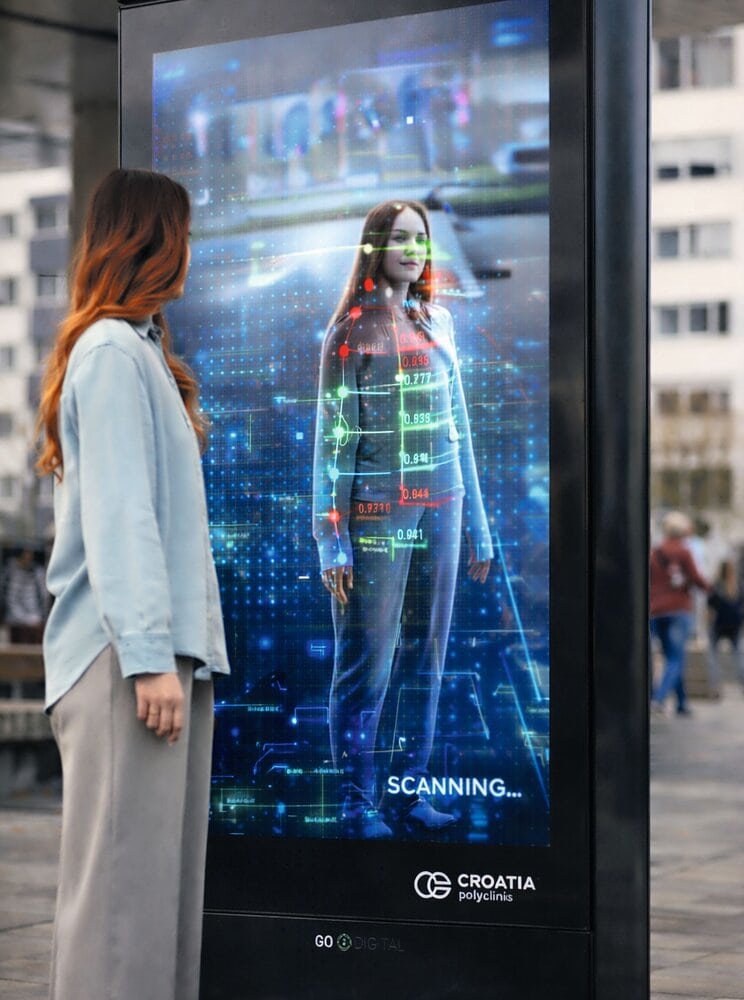
Looking at yourself in old age? It is possible. Pictures: Croatia
The feeling of being the first to race down a freshly groomed slope in the morning is a very special one. Louis Vuitton used this magical moment in winter with a large dose of creativity to anchor the brand with its target group: instead of fine lines, a specially created snowcat stamped the luxury label's logo into the snow - thousands of small monograms in white. And once again showed how versatile outdoor advertising can be today if you make the right use of its creative possibilities. The ski slope as a canvas, the mountains as a stage - an extraordinary brand move that attracted a lot of attention. Not on the slopes, however, but on social media. Because the campaign never really existed, the slopes in the luxury label look were AI-generated and therefore a classic case of fake out-of-home, virtual and purely digital.
AI changes outdoor advertising
This example illustrates how creativity in outdoor advertising is changing today. The boundaries between analog and digital are becoming blurred, AI is influencing quality and new technologies are being introduced. In digital out-of-home advertising (DOOH) in particular, they are opening up new ways for brands to reach target groups in ever more creative and innovative ways. And this is more important than ever for advertisers today: "Brands need visibility. And hardly any other channel currently delivers such strong attention as digital out of home," explains Mike Klostermann, independent expert for digital out of home at the DOOH Collective in Hamburg. "No fast scrolling, no adblockers, no bots. Just large screens with eye-catching campaigns that can be controlled very precisely. Many marketing decision-makers have recognized this potential and are seeing positive brand and performance uplifts. DOOH has become an integral part of the media mix and serves as a catalyst for brands and sales."
3D without VR glasses
The medium is currently experiencing a real quantum leap in terms of creative possibilities. For example, campaigns in 3D are no longer only available in Times Square or Piccadilly Circus, but now also in the city centers of the DACH region. Without VR glasses, AR technologies or corner screens, products can be staged in an expansive way - basically through a simple optical illusion. And thus reach people directly and effectively through a successful interplay of creativity, technology and location strategy. In the summer, Red Bull and Livesystems used animated 3D motifs at the POS in Migrolino convenience stores in German-speaking Switzerland, for example, to show how a mix of depth of field, perspective and targeted movement can even increase the advertising impact: For two weeks, the motifs were on display at the highly frequented locations, reaching over 1 million people with more than 2.4 million gross contacts. "3D effects make advertising more memorable and are a powerful addition to the marketing mix," said Marco Gasser, Chief Sales Officer at Livesystems.
Check posture - with DOOH
Interactive screens also offer more and more creative possibilities for campaigns. For example, Polyclinic Croatia advertised last summer with a nationwide DOOH campaign in which screens at bus stops recorded the posture of passers-by in real time, gave feedback and directly provided a QR code for making an appointment. It was well received: More than 100,000 bodies were screened and preventive check-ups increased by 46 percent. In Germany, Neue Leben Versicherung relied on interactive screens and, together with the Curious Company agency, got people to talk to an older version of themselves for the "Meet your future self" campaign. This was also made possible by artificial intelligence, which served as a chatbot and realistically aged the person they were talking to. AI is considered one of the most important trends in the DOOH industry, opening up new possibilities for addressing target groups and demonstrably increasing the efficiency of campaigns. "AI can already help to achieve greater efficiency in almost all areas," explains Mike Klostermann. "For example, to identify the right screens from the multitude of data. Or to optimize advertising media based on pre-testing. And, of course, to better evaluate results from different tools. AI provides more speed here, leaving more time for the essentials: the strategy, the media mix and the creative idea behind it."
"DOOH has become an integral part of the media mix and serves as a catalyst for brands and sales."
Creativity remains the be-all and end-all
Klostermann is convinced that despite all the new technologies, creativity is still the key: "That sounds banal, but in my view it still offers the greatest opportunity for many companies. Because too often you still see campaigns that are boring and therefore lose their impact. The creative rules are simple: strong imagery, a clear message, minimalist design. Of course, I'm also a fan of DCO, 3D etc. But as long as the creative basics are not fully utilized, I recommend making the difference here." According to the expert, creativity and sensitivity are still often neglected: "DOOH remains just one line in the media plan, advertising material is taken from other channels and the measurement of success is often not clearly defined. In other words, the greatest potential lies in developing campaigns specifically for this channel and implementing them with strong, creative ideas - this is how real impact is created!"
"Creativity and sensitivity are still often neglected, leaving DOOH as just one line in the media plan."
Double effect of creative campaigns
A new, global analysis by JCDecaux and System1 of more than 1,000 (D)OOH campaigns shows what is important here - and why creativity pays off: according to this analysis, creative advertising with a clear brand message and emotional appeal is significantly more effective than average campaigns. It ensures greater recognition, stronger brand loyalty and measurably better business results - often with twice the effect of less creative implementations. The study identifies key success factors such as immediate recognizability, brand distinctiveness, consistent creative identity and emotional relevance. However, the authors of the study found that many campaigns (three out of five according to the study) have not yet exploited this potential. It also depends on the specific usage situation of the medium, says Mike Klostermann: "TV, for example, is a relaxed lean-back and clear 'comfort zone'. DOOH is aimed at people who are on the move and more active. Depending on the objective, there is an opportunity here to generate attention at exactly the right moment, e.g. in the middle of the gym, on the way to work or directly in the supermarket. The creation should be geared towards this, as it significantly increases awareness. The right context attracts a lot of attention."
Advertising that fits the current situation and is creatively implemented generates relevance for the viewer. On the screen - or on the ski slope.
SURVEY
How AI makes DOOH faster, more relevant and more effective
How is artificial intelligence changing the creative quality, relevance and impact of DOOH - and what opportunities do you see for the industry? We asked this question to relevant representatives of the Swiss out-of-home advertising industry. The answers show: AI is becoming a lever for efficiency and impact. But real impact can only be achieved through interaction with human creativity.
Adriano Beti, CEO Livesystems
Adriano Beti
Artificial intelligence currently acts primarily as a speed multiplier in DOOH creation. AI tools enable significantly more image variants in a short space of time, thereby increasing efficiency. An advantage from which our customers benefit directly. In conjunction with our data-based target group approaches, messages can be tailored even more easily to locations and situations. However, it is important to note that most commercials are still based on classically produced advertising media, as AI primarily supports planning and post-production. In the long term, AI will be a key driver for varied and strong campaigns in public spaces. We expect AI to have a lasting impact on the industry.
Tom Gibbings, CEO Goldbach Neo
Tom Gibbings
Creativity comes from inspiration and expertise - the most effective campaigns are always based on human insight and emotional storytelling. The potential of AI lies in enhancing this process by expanding the possibilities while preserving the creative vision at its core. You can create and test faster, which is perfect for a dynamic medium like DOOH, where content can be adapted and activated with minimal lead time. This allows for an even closer connection between brands and their audience. Beyond maximizing creative impact, AI opens up opportunities for the industry behind the scenes to make the buying process smarter, faster and more efficient. It enables the optimization of placements according to customer demand and improves the overall customer experience through smart tools that adapt to changing needs.
Daniel Schönmann, Head of Advertising Research & Communication, Swiss Post Advertising
Daniel Schönmann
Outdoor advertising has to work in seconds - messages have to hit home immediately. AI-supported eye tracking helps with this by making it visible how a motif is perceived: which elements attract attention, whether the core message is received or where a layout appears overloaded. Such analyses enable well-founded decisions to be made without time-consuming real tests. AI provides impulses, but does not replace the human being who classifies and evaluates them. We are only at the beginning of this development; its potential for DOOH lies in making impact more clearly recognizable - without additional complexity. At the same time, new opportunities are opening up in terms of reach and contact figures: dynamic, context-sensitive analyses and more precise forecasts are changing the rules of the game. One thing is clear: In almost every profession, the ability to prompt well will be crucial in the future - because 'shit in, shit out' applies.
Markus Ehrle, CEO APG | SGA
Markus Ehrle
Creative ideas still come from people in the creative industry, but AI tools enable faster and more diverse production at arguably lower costs than today. This leaves more resources for the use of media to play out dynamic and precise messages, which can be played out contextually (weather, traffic, time of day, etc.) or in real time (keyword: Dynamic Creative Optimization) using DOOH. The greater the relevance of the content, the greater the awareness of the advertised products or services. And in the age of AI with an explosion of "fake content" on social media, the message in the public space gains additional power; building trust through visibility, whether for brand building or for activation.
Marketing trend 2026: back to the Biedermeier era?
While the world is changing at ever-shorter intervals, the public discourse on marketing seems surprisingly unaffected by this. This is reminiscent of an era that emerged precisely from such a tension.
Marcus Schögel
-
February 25, 2026
Illustration: Silvan Borer
The discrepancy is obvious - and it is not new. While the world is changing at ever shorter intervals, geopolitical, economic and infrastructural upheavals are intensifying and overlapping. Developments in Ukraine, the situation in Venezuela, events like the one in Crans-Montana or large-scale power outages with a systemic background are no longer isolated incidents. They are an expression of a reality in which uncertainty, dependencies and cascading effects are becoming the new normal.
And yet the public marketing discourse seems surprisingly unaffected by this. Digital media is dominated by personal retrospectives, individual horizons of experience, operational optimization topics or the next wave of trends - currently preferably under the label "AI". Much of this is not wrong. But much of it is remarkably small compared to the real issues facing companies, markets and societies.
This discrepancy is not a mood phenomenon or a ritual at the beginning of the year. It is structural. And - with all due caution when making historical comparisons - it is reminiscent of an era that arose from precisely this kind of tension: the Biedermeier period.
The retreat into the manageable
The historical Biedermeier period emerged at a time of political repression, insecurity and a lack of room for maneuver. Public debate was risky, systemic change hardly possible. The reaction was not rebellion, but a retreat: into the private sphere, into the domestic, into the creative. Order, diligence and aesthetics replaced political debate. Not out of indifference - but out of self-protection.
"It's not the withdrawal that's the problem - it's the presumed lack of alternatives."
Something similar can be observed in marketing today. The historical comparison with the Biedermeier era is not for the sake of nostalgia, but for the sake of classification. The Biedermeier era was less an idyllic period than a social coping strategy. In an environment of political repression, restricted freedom of expression and a lack of creative space, the creation of meaning shifted to the private sphere. The public sphere was not abolished, but circumvented. Shaping took place - but quietly, indirectly and deliberately limited. Crucially, this retreat was not an expression of passivity, but a form of self-stabilization under uncertainty. Order, clarity and personal systems of meaning replaced open political debate, because this was associated with high risks.
If you apply this logic to today's marketing discourse, the parallel becomes tangible. Even today, it is not so much a lack of will or a lack of relevance that keeps strategic issues out of the public eye, but the perception that complexity, ambivalence and long-term uncertainty are difficult to communicate publicly - and can be reputationally risky. The retreat into the operational, personal and tool-based is therefore less a deficit than an adaptation to an overly complex environment. This is precisely why it is worthwhile not judging this retreat prematurely, but rather reading it as a symptom: as an indication that the established forms of public communication for strategic debate have reached their limits.
"The public marketing discourse is in a digital Biedermeier."
In the face of a world that has become difficult to explain, almost impossible to predict and strategically highly complex, public discourse is narrowing down to topics that appear controllable: - one's own profile,
- your own career,
- operational levers,
- clearly identifiable tools and frameworks.
The big picture is hidden in order to keep things manageable. You could criticize this polemically. It makes more sense to first understand this dynamic.
The current discourse avoids strategic depth where uncertainty, ambivalence and long-term consequences are difficult to communicate. Instead, a form of self-assurance dominates: personal, operational, trendy. The problem is not the existence of this content - it has its place. It only becomes problematic when it gives the impression that the essentials have already been negotiated. Because while attribution, efficiency and tools are discussed publicly, companies are dealing with completely different issues internally:
- How resilient are our business models?
- How are demand, trust and expectations changing?
- What dependencies have we underestimated?
- Which investments still make sense and which are risky?
This opens up a gap between public discourse and internal reality that is not without consequences for a professional self-image of marketing. This shift has consequences that go beyond individual communication decisions. If strategic issues are negotiated almost exclusively internally, while public communication remains operational, a structural asymmetry arises: marketing appears to the outside world as a discipline of optimization, while internally it is increasingly concerned with questions of orientation, prioritization and risk assessment.
This discrepancy is not without consequences. It shapes expectations - among managers, junior staff and, not least, other corporate functions. Where marketing is primarily talked about publicly in terms of tools, efficiency and best practices, it is also read internally in the same way: as an executive, not a creative function. In the long term, this threatens to narrow its self-image. Not because marketing becomes less strategically relevant, but because its strategic work remains invisible. The public debate will then provide hardly any clues as to what role marketing can - and should - actually play in a world characterized by uncertainty. The result is a silent disconnect: between what marketing actually does and what it is perceived to do. Between strategic relevance and public connectivity. This gap is not spectacular, but it is effective - and it explains why the impression arises that marketing is withdrawing from the big issues of the present, although this is precisely where it is needed internally.
This retreat is necessary
It would be too easy to dismiss this development as despondency or ignorance. There are good reasons why strategic discussions are rarely held in public:
- Strategic work is relevant to competition: Those who work seriously on future issues do not share their findings lightly.
- Attention is distributed asymmetrically: Visibility rarely arises where complexity and uncertainty dominate.
- Digital media are not a neutral space for discourse: they reward simplification, personalization and speed - not ambivalence and a long-term approach.
The fact that many marketeers focus on what is presentable, explainable and connectable is therefore not an individual failure. It is a systemic consequence of the framework conditions.
From a historical perspective, the Biedermeier period was not only an era of narrowing. It was also a time in which new forms of culture, art and exchange emerged - beyond the big political stage. Applied to marketing, this means that it is not about discrediting personal issues, operational excellence or new technologies. It is about expanding public discourse, not replacing it. Marketing can be more than self-presentation, optimization and trend adaptation. It can - and should - take on a more guiding role again.
Invitation instead of conclusion
The comparison with the Biedermeier period is not a cultural-critical swan song. It is an indication that retreat and design do not have to be contradictory. Marketing is particularly effective when it provides orientation - not just attention. Even today, more is possible than the current debate suggests.
Concrete
Marketing can do more
1
Public: Make discrepancies visible, do not simulate solutions
Not every strategic question needs an answer in the feed. But many deserve to be named. Areas of tension, conflicting goals and uncertainties are not a sign of weakness - they are an expression of reality. Marketing can act as a translator here: between the world situation and market logic, between complexity and the ability to make decisions.
2
Personal: Creating spaces for real exchange
The relevant discussions will not disappear - they will just take place somewhere else. In small rounds, in protected formats, in direct conversation. Consciously cultivating and initiating these spaces is not a nostalgic gesture, but a strategic necessity.
3
Digital: From shop window to transition
There is no alternative to digital media, especially social media. Their role must be redefined. Less as a stage, more as a catalyst. Less closure, more invitation. Less self-assurance, more context.
gfm trend conference
On March 11, 2026, the Gesellschaft für Marketing, gfm, invites you to the trend conference "The New Marketing Playbook - Which disciplines are relevant in marketing and how can a CMO be successful?" at the Aura Eventsaal in Zurich. Take this opportunity to get to know leading minds and real practical cases.
*Prof. Dr. Marcus Schögel, University of St. Gallen (HSG), President of the Swiss Marketing Association (gfm). Picture: zVg
"We have to question the status quo"
Through her company, Women of Agency (Woa), former lawyer and HR director Wies Bratby helps women take control of their careers and highlights the opportunities available to them. m&k sat down with the Dutchwoman for an interview.
Irmela Schwab
-
February 24, 2026
Wies Bratby. Pictures: Benno Krähahn
m&k In medicine today, it is becoming increasingly known that many medications work differently in women than in men. And we also know that the menopause affects many women. How are companies responding to these findings?
As Bratby said: Women have always adapted to a world created by men. In addition to office temperatures, which are based on the male metabolism, behavior in the work environment is also shaped by the male model: how to act, which things are better not to talk about. This is currently changing: conversations about women's complaints such as periods or menopause are no longer taboo. Some companies openly regulate how to deal with gender-specific challenges. But all this is just a drop in the ocean, because the basic structures are still made for men.
How do you determine that?
Let's start with the working day, which begins at nine o'clock and lasts into the evening. This assumes that someone else picks the children up from school. Behavior is also judged according to gender: a direct and self-confident manner in a woman is often seen as aggressive, whereas a man shows leadership qualities. Women therefore have to constantly pay attention to how they are perceived, whereas men never do. Then there is the question of competence: men are considered competent until proven otherwise, whereas women have to constantly prove their competence. They therefore have to be twice as good just to be perceived as half as good. Moreover, promotions are usually reserved for those who do not take a career break to look after children or parents in need of care. Leadership presence still means behaving like a man in a suit. What is changing now, however, is that women no longer accept this.
What does the path to this look like?
Instead of asking for permission like they used to, they create their own roles and negotiate conditions that suit their lives. They no longer want to bend themselves to fit into a system that is not made for them.
Let's take the example of salary negotiations - your area of expertise. Is it advisable to demand confidently, like men, or is there a female way?
I don't think that women have to adopt male behavior. On the other hand, they should internalize that negotiations are based on rules. Unlike boys, they don't learn this from an early age. Boys are encouraged early on to say what they want. As a result, they know what their own market value is and demand their desired salary instead of accepting the first offer that comes along. Girls, on the other hand, learn that they should think of others first and create a feel-good atmosphere. But when women start talking about their conditions, they almost double their salaries. Women who don't do this lose hundreds of thousands of euros or francs during their working life. Ultimately, they don't have to take on a different role to negotiate, they have to play the game. The most important rule of the game is: demanding an appropriate salary is not aggressive, but the right thing to do. After all, as employees, they help the employer to move forward and be successful. Women need to grasp this instead of seeing negotiations as a conflict or even a war.
How can companies support women in this?
Companies need to do a better job of promoting women instead of just making more demands on them as they have done in the past. They should invest in women and create transparent salary structures. They need support during their life cycles, such as maternity or menopause. This is also recommended in the current McKinsey report "Women at Work". But far too little has happened so far.
How can employees, female and male alike, change the business world to empower women?
Men could start using their power to promote women. Male bosses and colleagues must ensure that their female counterparts are also paid fairly. They also need to stop putting the brakes on female colleagues by saying things like: "She's not ready yet". Mentoring programs can also contribute to equal opportunities. However, women should not wait to be rescued. It is better to build up your own strategic relationships. Those who make themselves valuable cannot be ignored. Successful women are ultimately those who realize that you can really make a difference if you have influence. This has nothing to do with asking nicely.
"Everything is negotiable - that's a message that boys get from an early age. We have to make up for that with girls."
So women should dare to react angrily when their demands are not heard?
When women react angrily, it is often seen as unprofessional. An angry man, on the other hand, is seen as committed. However, emotions should be viewed soberly as data, as clues to find out what is going wrong. So if a woman is constantly passed over for a promotion or her ideas are stolen by male colleagues, anger is an appropriate reaction. They should not suppress this feeling - but use it as a driving force. One of my clients was prevented from advancing by her boss for years because she was very valuable to him as a worker bee and he didn't want to lose her. She then learned to stop suppressing her frustration about this situation and used her anger energy to connect with higher-ups. The result: she got a really great new position at the company, along with a more than 30 percent raise. This career leap catapulted her to the same level as her former boss. The case shows how dissatisfaction can be used strategically.
"A direct and self-confident demeanor is often seen as aggressive in a woman, whereas a man shows leadership qualities."
What if women could finally live out their full potential - how would companies change?
Studies show that, on average, women tend to have better developed communication skills. In one study, the reactions of babies to human faces were examined: Girls were able to read faces better than boys from around four months of age. They therefore have more alert antennae for interpreting situations and people. This is due to the fact that women were brought up to work together in the Stone Age while men were out hunting buffalo. However, the importance of communication and collaboration has always been downplayed, even though they are strategic leadership skills. Of course, this doesn't mean that all women have bonding communication skills, or that men can't have them. And it definitely doesn't mean that these are the only skills women bring to the table. My female clients include partners at law firms and consulting firms, heads of programs and academic institutions, technology experts and HR managers - they come from all walks of life and hold positions at various levels. They all succeed because they are exceptionally good at everything from technical expertise to strategic thinking and communication skills. Do we need a more emotional and empathetic management culture in the face of artificial intelligence?
When we claim that women are all empathetic leaders, we are once again pigeonholing them. It then also seems as if women are only valuable in companies because of this characteristic. But women have always brought strategic value, technical expertise, innovation and, of course, emotional intelligence. Companies and managers are finally realizing that empathetic leadership leads to better results overall. As artificial intelligence takes on more and more routine tasks these days, the skills that can be considered uniquely human are becoming more important and valuable: reading people, building relationships, navigating complex dynamics between people in the workplace, creating environments we want to work in.
Do women actually want to achieve different things in their professional lives?
They ultimately want the same thing as men: meaningful work that fulfills them, fair pay, respect and career opportunities - like any man, they want to get ahead. The only difference is that we women have been conditioned to apologize for it. When I ask my female clients what they would like, they often follow up their answers with: "Only if it's not too much to ask", or "I know I can't have everything". My answer to this is: "It's not too much to ask to want a position where you can use your talents, which is adequately paid and offers flexibility." Is that what you call having aspirations? Exactly! Nobody needs to apologize for that.
What do women need to learn to feel comfortable in the elbow room?
The goal of feeling comfortable is wrong. In fact, I would say that women need to be comfortable with being uncomfortable. To gain more visibility they have to negotiate for themselves and ask for more in salary negotiations. So far, women leave a lot of money lying around because they feel so uncomfortable negotiating that they don't even try. The tools are clear: know your own market value first. This is not about what you think you should earn, but about what the market actually pays. Most people underestimate how much time and effort it takes to get a really good, solid picture. It is then important to set yourself a maximum and a minimum, as well as a clear negotiation strategy. Many women don't work with a plan because they shy away from negotiations. As a result, they often go into the discussion unprepared and think to themselves: let's see what I can get out of it. They often accept the first offer because they are so grateful that someone has said "yes" to them. That costs them a lot of money. That's why I teach my clients to always negotiate - everything: the basic salary, the participation, the flexibility and the recruitment bonus.
"Many women don't work with a plan because they shy away from negotiations, which costs them a lot of money."
Then women would feel equally valuable?
Negotiating working conditions is the starting point for everything. Many women feel that they simply have to accept whatever the company offers them. I show my clients in their negotiations that there is usually much more in it. So if they want to work from home several times a week, that's possible in most cases. They shouldn't just ask this when they are already working at the company, but negotiate it in advance. The same applies if, for example, they need flexibility to pick up their children from school. They should build this into the role itself, i.e. basically into the design of the job. Everything is negotiable - that's a message that the boys have been given from an early age. We need to catch up on that.
What do women need in the workplace?
Companies must take responsibility. This starts with flexible working arrangements, which are established as standard, and extends to support with childcare and menopausal symptoms - without hindering careers. There are some companies that have such family-friendly policies on paper, but then penalize women for them. For example, if superiors assume that a woman has lost momentum after six months of maternity leave. That often happens. However, a corporate culture that does not want to lose women must offer genuine security and appreciation.
Finally, could you give us your most important tip?
Women should stop playing by rules that slow them down in their growth and instead use all their skills to work on their career. The question every woman should ask herself is: How can I make the most of my education and all the years I have spent in companies? To summarize: Women should work on their careers instead of just working in them. I am confident that the business world will change if enough women refuse to accept less than they are worth.
Wies Bratby with editor-in-chief Anna Kohler.
Advertising money: Is Swissness "the key"?
More and more Swiss advertising spending is flowing abroad—to platforms that promise measurable advertising success but offer little transparency. This trend illustrates just how much the Swiss advertising market has changed in recent years—and it raises the question: How much “Swissness” does a market need when it is operating in an increasingly global way?
Raphael Bratschi
-
February 24, 2026
Illustration: Silvan Borer
The figures from the latest Swiss advertising statistics speak for themselves: Swiss advertising providers' net advertising revenue is still far below that of the pre-coronavirus year 2019. It is particularly striking that online advertising revenue for domestic providers has also fallen for the first time. By contrast, global tech platforms earned seven percent more from advertising by Swiss companies on search engines, social media and YouTube than in the previous year - namely around two billion Swiss francs.
Promise of high visibility
What has accelerated this outflow of Swiss advertising money towards the USA and China in recent years? Google, Meta and Co. have succeeded in anchoring a strong promise in the minds of many advertisers: only with us can you reach your target groups in a personalized, measurable and efficient way.
This promise is effective - not least because many marketing managers are under increasing pressure to perform. Advertising decisions today are often based more on short-term KPIs than on long-term impact. At the same time, many digital agencies have specialized in the systems of international platforms and consistently recommend them to others. This creates a market in which supposed reach has become the dominant argument - often more an illusion of visibility than real contact.
A new look at Swissness
What is striking is that even brands that focus on Swissness in their positioning invest a large proportion of their budgets on foreign platforms. This is understandable; content diversification remains important. However, Swissness should not be a label, but part of a holistic communication strategy. It is less about avoiding global channels and more about using Swiss environments more consciously. And where they can create trust and have a local impact. The strength of this trust in Swiss solutions was recently demonstrated by the adoption of the e-ID proposal: the population has spoken out in favor of Swissness and sovereignty in the digital space. Many advertisers - and we ourselves - feel the same need for reliability. We are also part of this system, consciously relying on international platforms, but combining them with Swiss channels, where proximity and credibility are crucial.
So instead of just lamenting the outflow of advertising money, we should take it as an opportunity to readjust the balance. Swissness is not a demarcation, but an invitation to once again seek greater impact where trust is created.
Five reasons for Swiss advertising solutions:
1. eye level
Due to their lack of transparency and standardized offerings, there is no question of a customer relationship at eye level with the big tech companies. Swiss advertising providers are completely different: they offer access to a transparent advertising ecosystem with reliable data on actual performance. Of course, we as a provider are also required to further expand this transparency and simplify processes - but this is precisely where our strength lies: personal dialog and proximity to our customers.
2. data partnerships
Many advertisers have valuable first-party data at their disposal. With data partnerships with Swiss advertising providers, they can make even more of it: The partners' first-party data is linked and compared in a secure environment and in compliance with data protection regulations. As a result, advertisers receive helpful insights into how they can best reach the relevant target group via a cross-media inventory. More and more advertising providers also have access to zero-party data - information that customers consciously and voluntarily provide to them, for example about their personal interests. If this data is also included, highly relevant advertising can be displayed.
3. positive image transfer
The advertising environment has an impact on how trustworthy advertising content is perceived. This has been shown time and again in studies, such as the recent "Advertising impact and trust" study by gfs-zürich. The tried-and-tested Swiss channels in particular stand for Swissness among the population - and therefore for quality, reliability and trustworthiness. These include posters in train stations, display ads on Swiss media portals and addressed mailings in people's letterboxes. If advertisers choose these channels, they transfer their positive image to their own advertising.
4th Brand Safety
In times of fake news and content without fact-checking, your own advertising can suddenly appear alongside problematic content - a risk of damage to the brand. Unlike on international platforms, this risk is low in Switzerland, as the regularly published figures from the Digital Ad Trust Switzerland initiative show: The proportion of companies whose ads are delivered in a potentially critical environment is minimal.
5 Domestic value added
Domestic advertising providers create jobs, expertise and a tax base. Choosing their inventories helps to ensure that this added value remains in the country. This may not be an emotional argument, but it is a sustainable one. After all, a functioning Swiss advertising industry ultimately strengthens everyone who works in it.
Providers also have a duty
Where does the ball lie for a new balance between global efficiency and local impact? Certainly with the advertisers and agencies, but also with the Swiss providers themselves. They must show that they can keep up in terms of content and technology and are prepared to invest more in innovation again. Initiatives such as OneDSP, which create a common programmatic infrastructure for Swiss advertising inventories, show where the journey can take us: towards solutions that are technologically competitive and at the same time utilize the strengths of local environments. In order to get there, two points are paramount: firstly, it must become easier to combine different channels and book cross-media. Secondly, more use should be made of existing data in order to address target groups more precisely and more relevantly. Because when the context, message and moment are right, advertising is not perceived as a disruption, but as a contribution that creates added value.
Swissness is not a label, but an attitude that brings reliability to a dynamic market environment. When global reach and local relevance come together, the result is communication that works because it is understood. This is precisely our task: to create impact where it is needed - through relevance, not reach.
About the author
Raphael Bratschi is Head of Business and Product Development at Swiss Post Advertising. He is responsible for the strategic development of advertising solutions and positioning in the Swiss advertising market. Swiss Post Advertising is the cross-media advertising provider of Swiss Post. With exclusive advertising environments, high-quality first-party data and many years of dialog expertise, the company ensures advertising impact with repercussions.
Are we losing control?
The creative autonomy of generative artificial intelligence delivers quick results. This is convenient for us humans—but it’s also risky: How do we ensure that we remain in control?
Irmela Schwab
-
February 24, 2026
Illustrations: Silvan Borer
At the DLD digital conference, Stuart Russell confessed to a serious mistake. The professor of computer science at the University of California in Berkeley discussed the basics of the technology in "Artificial Intelligence: A modern approach". However, when he first published his AI bible in 1994, he had forgotten something fundamental. "Artificial intelligence should pursue people's interests, not its own," says Stuart. But by the time he realized this and finally corrected it in the fourth edition, it was already too late. Today, superintelligence pursues its own interests. "It would rather start a nuclear war than be shut down," the scientist explained to the international audience at the annual conference in Munich. Some of the participants had traveled from the USA and even from India and China last January, all with the big question in their luggage: How can the large language models be operated without us humans losing control?
Despite the opportunities that are opening up everywhere, the creative life of AI is causing headaches. For governments, who do not yet know how to use this superpower for the benefit of the population. And for companies, which are still often missing out on the opportunities offered by ChatGPT, Perplexity and the like. However, employees are increasingly turning to the knowledge of AI in their day-to-day work to get quick help. The German digital association Bitkom refers to this as "shadow AI" when employees use services without the company being aware of it. Bitkom therefore advises providing employees with secure and data protection-compliant AI tools and training them in the responsible use of the technology. And to teach them how to use and control AI so that the end result is actually what they expected.
Who controls whom here?
Because generative AI thinks for itself. It cannot be compared with analytical AI or machine learning, where data leads to a controlled - and therefore safe - result according to a fixed if-then principle. "LLMs are not designed, they are bred," Russell said. They have long been outgrowing humans. They think faster, grasp connections more precisely and have a clever and detailed answer ready for every topic. At the end of which they politely suggest that A, B or C could be the next possible step. Watch out: Who is controlling whom here?
"How can the large language models be operated without us humans losing control?"
Marina Fiedler is also investigating this question. As a professor at the University of Passau, she deals with management, human resources and information at her chair. Many companies are still shying away from assigning technology a permanent place in the company. This is a big mistake. After all, AI offers huge efficiency benefits - at every level, says Fiedler: "All organizations, no matter how small they are, even if it's a pizzeria with five people, need to think about how they can use AI to increase sales, reduce costs or both."
To stay with the pizzeria example: "With the right data and a good setup, a restaurant can analyze what the competition looks like in the area, how new customers can be acquired and at what times which pizzas are particularly in demand," says Fiedler. "Today, AI often only needs seconds to perform analyses that used to take up an entire department - with very low marginal costs per query." However, apart from narrowly defined targets, there are areas of application where the result is less clearly defined. It is then more difficult for employees to check whether the output is correct or is leading in the desired direction.
However, a study that Fiedler has been conducting with 150 participants since April 2023 shows that AI is clearly leading the way, even in areas where humans are well versed. "By skillfully managing users, AI implicitly takes on the leadership role," observes the professor. She cites user statements as evidence of this. "For a quick solution, we have this handout developed by ChatGPT," says one. Another: "After GPT suggested three new perspectives, we decided to change our approach." Another: "Based on this positive experience, we decided to ask generative AI for a recommendation." Who made the decision?
"Who is responsible?"
Teams therefore need to learn a few things to prevent LLMs from taking the lead unnoticed. If people have nothing more to say, it becomes dangerous. To prevent this from happening, Fiedler advises a "3-stop rule", which reads: "Before using AI, you should know your goal, then check the individual sources and check whether the result is correct and fits the question, and before putting it into practice, clarify who is responsible for the AI-researched results," says the professor. Without adopting this conscious attitude, thinking independently and questioning critically, it is not possible. According to Fiedler, employees should therefore complete 80 percent of their tasks in co-creation with the LLMs and 20 percent without their help so that human judgment is not lost. For those in the profession, she recommends forming teams of juniors and seniors in order to build up expertise.
Computer scientist Christoph Holz from St. Johann in Tirol likes to give AI free rein. The AI consultant is in great demand in companies, and he often gives talks in Silicon Valley. To prepare for this, he draws on the tools he talks about. For example, he has them analyze what the respective target group is interested in and what the current level of knowledge is at the respective location. "I would have needed a whole staff for that beforehand, which of course I didn't have," he says. AI research often brings surprising results to light. "Because generative AI is based on probability, it is imprecise. This imprecision also produces things that we wouldn't have thought of and creates new scope," says Holz happily. LLMs are therefore also well suited to marketing, where more creativity than accuracy is required. But here, too, the following applies: "In the end, the professional decides on the creation and marketing strategy," says the expert.
To ensure that people continue to have the last word in the future, Holz recommends that younger employees in particular receive even better training. "Our society has become so specialized in its many disciplines that training is taking longer and longer." In times of AI, this applies even more: "Young professionals now need a lot of practice - comparable to flight simulators for pilots - so that they can later take on positions of responsibility in companies," says the expert.
Employees can then create more in co-creation with AI. An occupational field that previously comprised one area of responsibility is expanding further. In particular, Holz outlines a kind of multi-trade in which users can do several things at the same time. Smart glasses show them which actions to perform. As they gain experience, they will eventually be able to operate completely new machines. "Anyone who is committed, curious and responsible will always have a job," says the computer scientist, revealing the magic formula. Because in the end, what AI cannot do is replace those who are above average. "The big challenge in the future of work is how we can make career starters above average," says Holz.
Column: Time for clarity
In these uncertain times, there are surprisingly few factors that truly provide stability. One of them predates the debate on artificial intelligence.
Alexander Haldemann
-
February 24, 2026
Rarely has there been a time when uncertainty was as omnipresent as it is today. Geopolitically, economically, technologically. You hear phrases like these very often at the moment. Even seasoned managers are worried - and are open about it; in interviews, in town hall meetings with employees, in personal conversations. In this permanent state of uncertainty, there is a lever that is older than the debate about artificial intelligence. It is called "brand". And it creates clarity.
The brand is a North Star
At the heart of the brand - the fundamental question: "What do we stand for?" And at least as important: "What do we not stand for?" The brand is a management tool. And is indispensable in times like these. A clear brand has an impact both internally and externally. Externally, because customers understand what they can expect. Internally, because employees know what they should base their decisions on. Clarity creates structure. And structure creates the ability to act. The brand is the North Star. It sets the direction, clarifies processes, collaboration and priorities. It decides how to lead and how to recruit. Brand is more than marketing, communication and technology. Brand is strategic corporate management. And this is precisely where the responsibility lies. There has been talk of the loss of importance of marketers for years - at least since the article "The Death of the CMO" in the Harvard Business Review made waves internationally. The fundamental criticism: working on the surface instead of the substance. This is precisely why a return to the core is now an opportunity. Marketing means building a bridge to the consumer. To enable a relationship. This is not achieved with arbitrariness, but with attitude. With a clear positioning. With the courage not to do things.
Clarity becomes a currency
Many companies lose themselves in arbitrariness (or rather: lack of direction). Too many offers, too many messages, too little conciseness. All the more reason why we need voices that demand clarity. Who say: This is us. And this is not us. When uncertainty is the background noise, clarity becomes the currency. The hour of the brand is now. We must use it.
Dr. Alexander Haldemann is CEO of Publicis Groupe Switzerland. Image: zVg. Editing: Silvan Borer
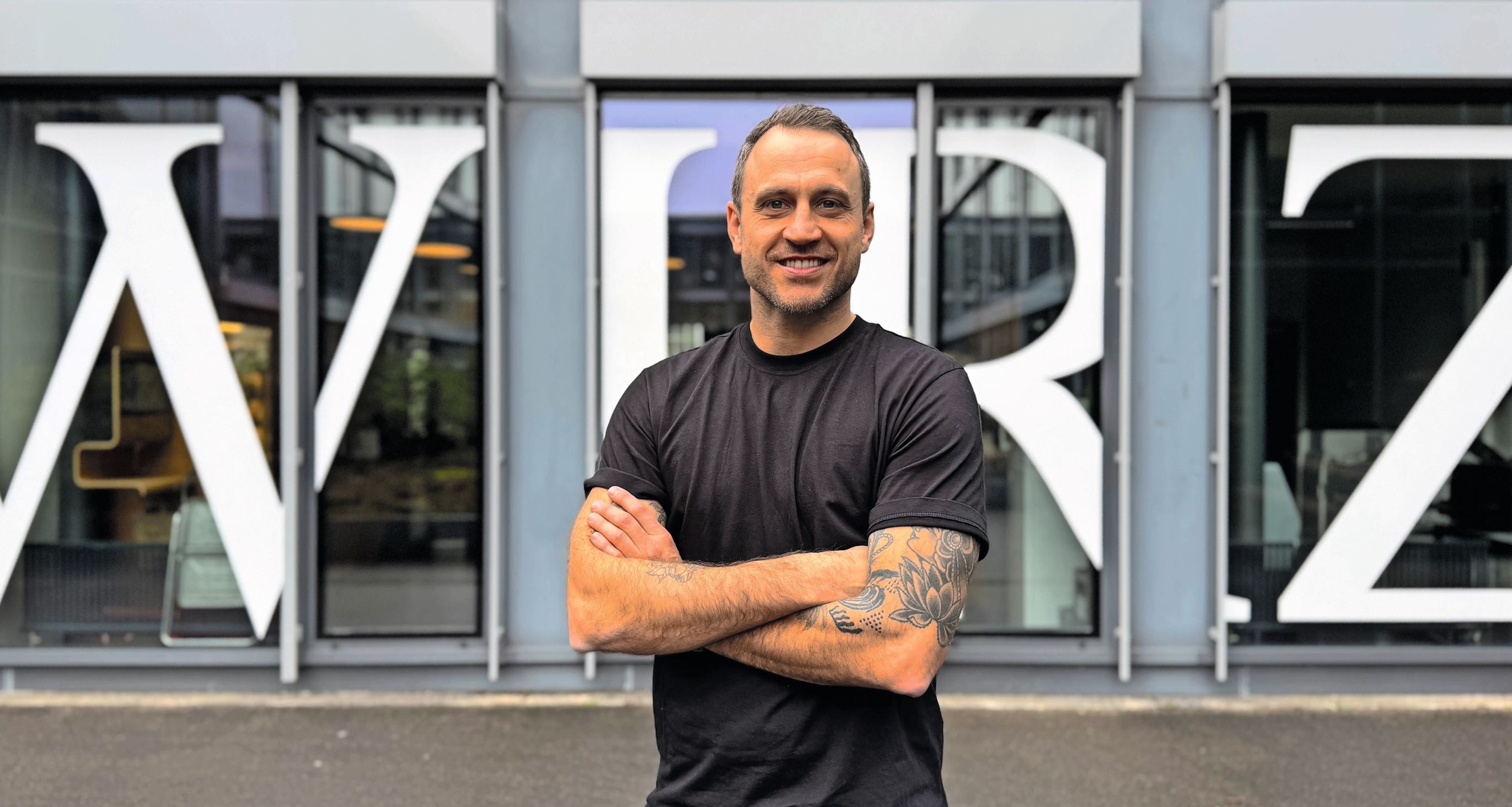
Florian Avdic from Wirz: "Creativity is capital"
Florian Avdic is Chief Strategist, Partner, and Co-Owner at Wirz. After working at various international agencies, he moved from Berlin to Switzerland. Why? And what exactly is this concept of “creative capitalism”? A conversation about strategy, courage, and why creativity finally belongs at the business level.
Anna Kohler
-
February 24, 2026
Florian Avdic has played a leading role in the Wirz structure for two years. Picture: Beat Hürlimann
m&k Florian Avdic, you came to Switzerland from Berlin to kick-start a creative revolution at Wirz. Why this move - and why Wirz?
Florian Avdic I came to Switzerland because someone asked me if I wanted to develop a traditional, extremely creative agency together. Not as an external consultant, but as an entrepreneur. We wanted to build a business model that works more effectively for clients and has more of a future. After two years of development and intensive collaboration with strong clients, now is a good time to explain what we do - and why.
Wirz often uses the term creative capitalism. What does it mean?
Creativity is one of the most important corporate resources - and at the same time the last one to be used completely unsystematically. HR, technology, cash flow, innovation: everything is managed, measured and optimized. Creativity, on the other hand, is purchased on a project-by-project basis, evaluated according to gut feeling and often reduced to creation. We would like to see more creative capitalism. This means using creativity in a targeted, systematic and scalable way with a clear focus on value creation.
That sounds a lot like business - doesn't the magic get lost in the process?
On the contrary. Creativity is often used like an iPhone that you only use to make phone calls. But it is a supercomputer. It can solve strategic challenges, create growth in saturated markets and make brands relevant. Maximizing value may not sound sexy, but it is honest. And necessary.
What specific changes have you made at Wirz?
We have rebuilt the entire business model: Offering, value creation, processes. Everything is geared towards creating maximum value for our customers. That's why we don't sell hours. Our customers don't want effort, they want solutions. Growth. Our goal is to make growth accessible - via three levers: brand capital, market readiness and new game.
Why is now the right time for this approach?
The market is clearly moving in this direction. Budgets are under pressure, impact is becoming more important than quantity and brand building is back at the top of the agenda. This means doing less, but doing the right things. Clear priorities, tidy customer journeys, strong marketing architectures. And more courage to come up with big ideas, blockbusters that people talk about.
Many are calling for more courage to take risks. They think this is unworldly. Why?
Because people don't like risk. Risk is the possibility of failure - and we instinctively avoid it. At the same time, we want brands that take risks. Strategy can resolve this contradiction: not through blind risk, but through quick hypotheses, quick testing and quick learning. This is how courage becomes feasible.
What role does AI play in this?
AI is a huge catalyst. It makes solid brand work easier and cheaper. That's good - and dangerous at the same time. Because it makes mediocrity very efficient. This makes differentiation, strategy and cultural sensitivity all the more important. Those who ignore this produce highly optimized irrelevance.
You have been living in Switzerland for two years. What surprised you?
Switzerland is full of contrasts: Tradition and innovation, "Bünzlitum" and cosmopolitanism. This is exactly what makes it so exciting. There is an incredible amount of potential here in marketing and communication. I am still very hyped to be here - also because of the people at Wirz. The path is right. Now it's about continuing on it consistently. Together with our customers.
"Creativity is often used like an iPhone, which you only use to make phone calls. But it's a supercomputer."
Annabella Bassler: "Progress is fragile"
Visibility isn’t a matter of chance. With the EqualVoice initiative, Ringier aims to give women a greater presence in news coverage and advance gender equality. But where do we really stand in 2026? Ringier’s CFO, Annabella Bassler, talks about new narratives, media responsibility—and how the EqualVoice Assistant is becoming a real game-changer for newsrooms.
Julia Gundelach
-
February 23, 2026
Annabella Bassler Picture: Ringier
m&k Ms. Bassler, are you familiar with the feminist yodelling choir "Echo vom Eierstock"? It cultivates an age-old tradition and combines it with modern themes such as menopause, gender equality and sexuality. What does the choir's success say about the need for new voices and narratives in our society - and in the media?
Annabella Bassler Yes, this example is extremely exciting because it combines several levels at once. On the one hand, we are looking at a traditional cultural form that has long had strong male connotations and, on the other, at topics that are still given too little space in the public debate. The fact that the choir is so well received shows very clearly that there is an enormous need for identification, for new perspectives and for stories that depict realities of life that have often remained invisible until now. This is a clear signal for the media. If social issues generate so much resonance, they must also be portrayed more strongly in journalistic terms. The media shape which voices are considered relevant - and which are not. This is exactly where EqualVoice comes in.
In your view, is this example more of a marginal phenomenon or a sign of real structural change?
I would say that it is a symptom of change, but not yet proof that it is complete. We see many such initiatives, projects and movements that make it clear that something is changing. At the same time, however, we are also seeing how stubborn old structures are, especially in the media. Real structural change means that diversity no longer depends on the commitment of individuals, but is systematically taken into account. As long as women, especially experts, are underrepresented in certain departments or power contexts, we cannot speak of true equality.
"Many imbalances are not caused by intention, but by habit."
2025 has been dubbed the "gender equality year" in many places. What is your personal assessment?
Our assessment is ambivalent. On the one hand, we experienced a high level of visibility for gender equality issues in 2025: there was intensive discussion, numerous initiatives were launched and social awareness has grown noticeably. Equality is no longer a marginal issue, but is taken seriously, at least at the level of public debate. At the same time, however, we are also experiencing a clear countermovement. Political developments - above all the influence from the USA and the discourse shaped by it - have contributed internationally to equality and diversity issues being increasingly questioned or deliberately pushed back. This dynamic is having an impact far beyond the USA and is also reinforcing a mood in Europe in which equality is once again being portrayed as ideological or dispensable. This shows just how fragile the progress that has been made is. In times of multiple crises, gender equality issues quickly come under pressure. This makes it all the clearer: Equality must not be a project that is prioritized or postponed depending on the political or economic situation. It must be structurally anchored, especially in the media, which have a decisive influence on which perspectives are visible and which are not.
Was there a situation last year in which you thought: This is exactly why we need EqualVoice?
Unfortunately, such moments occur regularly. It is particularly evident in reporting on crises, politics or the economy. As soon as it comes to power, security or global conflicts, women disappear from media visibility - as experts, decision-makers or protagonists. EqualVoice was founded for precisely this reason: to make these patterns visible. And we are now going one step further. With the AI-supported EqualVoice Assistant, we can not only show editors in retrospect where imbalances exist, but also draw their attention to them during the creation process of a text.
The Women's European Football Championship in Switzerland also generated a lot of attention. What did this event contribute to equality - also in the long term?
Such major events are hugely important because they create visibility and produce new role models. Young girls see that sporting success, professionalism and media attention are not a question of gender. In the long term, however, it remains to be seen how sustainable this effect is. The decisive factor is whether women's football also receives regular, serious and equal coverage beyond tournaments. This is precisely where we often see relapses - and this is where data-based tools such as the EqualVoice Factor can help to identify these imbalances at an early stage.
The results of the EqualVoice Factor 2024 showed a positive trend. What do the current figures look like - and are they heading in the same direction?
Basically, yes, we continue to see improvements in many media brands. But the development is not uniform. Some editorial teams are making great progress, others are stagnating. This is particularly clear: Progress happens where responsibility is clearly defined and where data is actively used. The EqualVoice Factor was the first step towards making equality measurable. The EqualVoice Assistant is now the logical next step, because it integrates these findings directly into everyday editorial work and makes them easy to use.
What milestones would you say you have achieved since EqualVoice was founded?
The most important milestone was undoubtedly the introduction of the EqualVoice Factor. It has created a factual, data-based foundation and de-emotionalized the discussion. The second major milestone is the EqualVoice Assistant. With this, we are leaving the pure analysis level and moving into operational support. For the first time, editorial teams have an AI-supported tool that supports them in real time with more conscious reporting.
"In times of multiple crises, gender equality issues quickly come under pressure."
However, parity has not yet been achieved. When do you think this goal will become a reality?
There is no fixed date. Parity is not a sure-fire success. It can only be achieved if we work on it continuously - with clear goals, measurable criteria and suitable tools. But what I can say is this: Without structural support, it will take much longer. This is precisely why we rely on technological solutions such as the EqualVoice Assistant.
There is often talk of a "backlash" in the social debate. Do you share this view?
Yes, we are also feeling this headwind. In politically and economically uncertain times, diversity and equality issues are quickly portrayed as dispensable. This is dangerous because it suggests that equality is a luxury. Yet it is a sign of quality - especially in journalism. Media that portray diversity report more accurately, more relevantly and closer to reality. In business, too, more diversity leads to better discussions and therefore better decisions.
Some companies are also withdrawing from diversity programs. What are the consequences?
This may save costs in the short term, but in the long term it is a clear step backwards. Companies lose innovative strength, credibility and attractiveness. For Europe, this means that we need to be very vigilant in order not to fall behind standards that have already been achieved. Initiatives such as EqualVoice are therefore more important than ever.
Let's move on to AI: you recently opened up the EqualVoice Assistant to external partners. How has the tool been received?
The response has been extremely positive. Many journalists see the EqualVoice Assistant not as a form of control, but as support. It analyzes texts while they are being written, recognizes imbalances in gender distribution, stereotypical attributions or one-sided perspectives - and makes concrete suggestions for improvement. What is important is that the EqualVoice Assistant does not make any decisions. It raises awareness. The editorial responsibility always remains with the person. The EqualVoice Assistant is not only accessible to the media, it can also be used to analyze website texts, social media posts or job advertisements.
What can a tool like the EqualVoice Assistant actually achieve?
It lowers the barrier to entry. Equality does not become an additional task, but part of the normal workflow. This is crucial for sustainable change. It also creates awareness where routines take hold. Many imbalances are not caused by intention, but by habit. This is where the Assistant comes in.
To what extent can AI generally contribute to equality in the media?
AI can recognize patterns that we overlook. It can evaluate data, make trends visible and provide a basis for decision-making. Used correctly, it is a powerful tool for greater fairness and quality. However, the prerequisite is that it is developed responsibly - with clear ethical guidelines.
At the same time, there is a risk that AI will reinforce existing stereotypes. How do you counter this risk?
This danger is real. AI learns from existing data - and that data is not neutral. That's why it was important to us to develop the EqualVoice Assistant on the basis of our own many years of data work and to continuously review it. AI must not simply reproduce, it must scrutinize. This is a question of attitude, but also of technology.
Does the opportunity or the risk ultimately outweigh the risk for you?
Clearly the opportunity - if we actively shape AI. If we leave it to its own devices, the risk outweighs the opportunity. The EqualVoice Assistant shows that AI can be a tool for progress if it is used consciously.
Finally: What are your wishes for the new year and what topics are you focusing on?
I hope that equality will once again be seen more as a shared responsibility - not as an ideological project, but as a quality issue. In terms of content, we will continue to focus on data-based solutions and further develop the EqualVoice Assistant. Our goal is clear: to support companies in not only wanting diversity, but also implementing it.
About Annabella Bassler
Dr. Annabella Bassler has been CFO of Ringier since 2012, where her responsibilities include driving forward the digital transformation of the Ringier Group. The focus is on strategy, M&A activities and financial management. In November 2019, Bassler initiated and launched the Ringier EqualVoice initiative, which aims to make women more visible in media coverage and promote equality between women and men. At the heart of the initiative is the EqualVoice Factor: an algorithm that makes equality measurable.
"EqualVoice United now brings together 23 leading Swiss companies. The collaboration focuses on cooperation, knowledge sharing and data-driven analysis to promote gender equality and empower women and girls."
Who will be advertiser:in of the year 2026?
The jury met, and there was a productive discussion. In the end, three creative minds from the advertising industry clearly stood out. We’d like to introduce the three nominees. Our newsletter community can vote until February 27.
Anna Kohler
-
February 23, 2026
Who will win the race? All three candidates have the potential to receive the Egon on March 17 and represent the industry for a year as a shining example of excellent advertising. Voting by the community will take place from today, February 23, until February 27. At the end of the presentation of each nominee you will find the button to vote.
Jan Kempter: "I am incredibly grateful for my team at Wirz - without them, none of this would be possible. Advertising is not a one-man show". Picture: Beat Hürlimann
His claim if he became advertiser of the year: I would advocate that we advertisers should be more self-confident and not allow our industry to be talked down to.
m&k What did the nomination for Advertiser of the Year trigger in you?
Jan Kempter Euphoria, pride and gratitude. The second time around, it's almost even more rewarding. It shows me that it's worth sticking with it every year and standing up for the best idea. At the same time, I am incredibly grateful for my team at Wirz - without them, none of this would be possible. Advertising is not a one-man show.
What fascinates you about the advertising profession?
I still find it magical how much a single thought can trigger. You sit together while thinking it up and casually say an innocent sentence like: "Actually, it would be fun if we..." And suddenly it turns into a major campaign that moves millions of people and turns a brand into a national talking point.
What is different about the creative profession than you imagined?
I used to think that creative people sit there and relax, waiting for a flash of inspiration. I didn't realize that the first twenty ideas are usually pretty garbage and you have to dig really deep to find the one good one. And then you first have to convince all stakeholders that it's the right one. Having good ideas and implementing them is hard mental work.
How do you deal with the pressure to be creative on command?
As a young creative, I actually needed the time pressure to get going in a panic. Maybe that's why I lost my hair early on (laughs). Today, I try to work in a more process-oriented way. The better we understand the business hurdles and the customer's actual problem, the more precise the solution becomes. That takes the pressure off and increases accuracy
How can we imagine a creative day in your life? A perfect working day.
My ideal working day starts with an early morning walk with my dog Pippa along the Üetliberg to the agency. An interesting briefing with clear guidelines and a hungry team waiting to solve it together. Ideally, I then have hardly any meetings and enough focus and time to concentrate, discuss and brainstorm together. And an inspiring walk with Pippa in between.
How would you represent your industry if you won the Egon and became the beacon of creative communication for a year?
I would argue that we advertisers should be more self-confident and not allow our industry to be talked down to. Especially in times of AI, when everything is becoming more and more similar, the creative idea is what makes the decisive difference. Advertising is not just funny little films and pretty pictures, but can have an enormous impact if it is relevant, bold and well done. Or in a nutshell: Creativity is pure value creation.
What work are you most proud of?
Throughout my career, I am most proud of the "Migros beer", which I still consider to be a very clever product innovation. I was also very proud of the film series with Roger Federer and Hollywood stars for Switzerland Tourism - one of the most successful Swiss campaigns after all. Oh, and our last Secret Santa film for Migros triggered an extremely positive response, which also made me very happy. I'm actually proud of a lot of things.
What was the most absurd experience of your creative career?
There were many absurd experiences. I will never forget a customer meeting shortly before a film shoot in which we exclusively discussed different toilet locations for a very short scene in a telco commercial. When six grown-up people talk about toilets with absolute seriousness, as if it were a matter of life and death, it quickly becomes something of a Monty Python sketch. Incidentally, we didn't come to an agreement and the film production had to send the scout on another toilet search.
How confident are you about the changes in the industry?
The massive upheaval will keep us busy for a while yet. But I'm still confident: the more content becomes interchangeable through technology, the more valuable the human component becomes - with all its nooks, crannies and surprises. AI won't replace human "madness" any time soon; before that, we creatives will drive the AI mad. Those who combine this human creativity with a deep strategic understanding will always make the difference for brands.
Stages of the career
Jan Kempter is Partner and Creative Director at the Wirz Group, where he has been shaping the creative direction of the agency since 2021. Previously, the creative from Graubünden worked at Publicis, Jung von Matt and Scholz & Friends Berlin, developing campaigns that won numerous national and international awards. Kempter has a degree in German studies, is a member of ADC Switzerland, a jury member of ADC Europe and a level 15 paladin in Dungeons & Dragons. In 2026, he has been nominated as Advertiser of the Year for the second time.
Excerpts from the work of Jan Kempter:
Dominique Magnusson: The nomination is a great sign for me that I'm on the right track. Picture: Beat Hürlimann
Her claim if she were to become advertiser of the year: I feel there is a lack of diversity in management roles. That needs to change, because different perspectives enrich the industry.
m&k What did the nomination for Advertiser of the Year trigger in you?
Dominique Magnusson: Above all, it has filled me with pride. And with the wonderful feeling that it's worth sticking with it and staying true to your line. When I do something, I always give it my all. For me, the nomination is a great sign that I'm on the right track.
What fascinates you about the advertising profession?
The best thing about this job is probably the quirky characters that surround you every day. I couldn't imagine working in an industry where nobody has ADHD. And on top of that, my job forces me to move with the times. Every task is different, new tools are constantly being added, so it never gets boring.
What is different about the creative profession? than you imagined?
I don't think I could have imagined at the tender age of 20 how tight the timings would be in the future. But the rest is pretty much as I had imagined it. Except maybe the AI thing. I didn't see that coming when I was 20. Bubbletea did. AI didn't.
How do you deal with the pressure to be creative on command?
The first thing I do is get myself a coffee to make the time problem even worse, because I can't do anything without pressure. Then I like to write several pages to get everything out of my head. I highly recommend "10 Hours of White Noise" on YouTube. However, I prefer to work in a team and based on really smart data from the strategy. In recent years, I've learned to really love data. Because it can give rise to watertight ideas from the most unexpected corners. I still enjoy sitting in a room with a great team, because in personal conversations you capture the human side of a briefing and, together with the data, it usually results in something really good.
How can we imagine a creative day in your life? A perfect working day.
A perfect day for me begins somewhere in the world on a production where an idea that has survived months of presentations finally becomes reality. There is still something magical about that for me. It also involves working with talented people who understand their craft. When all this knowledge and preparation come together, it simply makes you happy. If the snack situation on site is also perfect, it's a good day.
How would you represent your industry if you won the Egon and became the beacon of creative communication for a year?
There are two topics that are important to me. I am inspired by the exchange with young talents, who have a different view of the world. In addition, I personally have always been lucky enough to have superiors who have pushed me and cleared the way for me. I would like to do the same in my role. I think the days of strictly hierarchical stores are over. What I value are conversations at eye level, regardless of age or gender. And that brings us to the second topic. I still feel there is a lack of diversity in management roles. That needs to change, because different perspectives enrich the industry. So to summarize: I would make sure that our industry is still around in 20 or 30 years' time. And not despite AI, but because of the many great, diverse talents who have been given a chance.
What work are you most proud of?
On "Nemo Broke the Trophy" for Mobiliar. For me, everything that makes for good teamwork came together. A broken trophy initially resulted in a damage sketch, nothing particularly ground-breaking, but then the idea of trophy insurance was born. Everything together resulted in a - attention buzzword - holistic campaign that we created in collaboration with Media in 48 hours and which was honored worldwide. I love these moments when every second counts and many minds work together to create something great.
What was the most absurd experience of your creative career?
One customer had expressed a wish when we first met. "We want to see creatives". "Say no more", we thought to ourselves. So I sat in front of a 20-person panel with my text CD, highly motivated, until we realized that "creatives" didn't mean us as people, but creative ideas. There was just one "S" too many in the word. And that was the end of the first date.
How confident are you about the changes in the industry?
Obviously, the industry is in a state of upheaval. But hasn't it always been? More and more modular freelance collectives are currently emerging. This reduces costs and makes us more agile. And AI is of course an omnipresent topic. Nevertheless, as a representative of a large agency, I remain optimistic. I think it's like dating: there's the right match for everyone and in the end the magic happens on a personal level. That's why I believe that large agencies still have a right to exist, for example for large clients who need a certain consistency and size. But that doesn't mean that we don't have to remain agile and adapt to market changes - we've actually always had to.
Stages of the career
Dominique Magnusson actually wanted to be an Olympic swimming champion, but at 160 cm tall, everyone was always about an arm's length faster, so she ended up in advertising after all and is quite happy about it. She started out as a graphic designer at TBWA, made a brief stopover at DDB Canada, then moved to WIRZ and then landed at Jung von Matt, where she has been Creative Director for 5 years. She loves strong teams and moments when something great emerges from chaos. When she escapes advertising for a moment, she makes punk music, wanders across continents or watches hoof care content on Facebook.
Excerpts from the works of Dominique Magnusson:
Pablo Schencke: I am very confident. Yes, AI is changing work processes, but that's exactly what makes it exciting. Picture: Beat Hürlimann
His claim if he were to become Advertiser of the Year: It is important that we focus on the next generation and instill in them a passion for good creative communication.
m&k What did the nomination for Advertiser of the Year trigger in you?
Pablo Schencke: Firstly, a small explosion in the brain together with a mini heart attack, but really quite "mini", fortunately. After that came a very nice mixed feeling of pride and gratitude. After 18 years as a creative in Switzerland, this is a nice recognition that I am very happy to take with me.
What fascinates you about the advertising profession?
It's simply a dream job! We get lots of challenges every day, or as they are commonly known: Briefings, and automatically a world of possible solutions opens up. For example, I recently worked with my 13-year-old daughter to come up with a great idea for the post, and in the end it turned into a one-minute Christmas commercial.
What is different about the creative profession than you imagined?
Fun fact: I didn't know what I should study. One day before I was due to enrol at university, my mother wrote three professions on three pieces of paper: 1. art, 2. architecture, 3. advertising. She turned them over and mixed them up, and I had to choose one. That's how I got into advertising. I had no idea what it would take. I flipped through "Archive" magazine or watched Jukka Brothers commercials on MTV and knew: this is what I want to do. This happiness has lasted for 24 years now.
How do you deal with the pressure to be creative on command?
Fortunately, my creativity is always switched on. And during my training at the Ad School in Minneapolis, I practiced it intensively. I had to present 100 ideas every week. My goal now is to pass all this on to our youngsters.
How can we imagine a creative day in your life? A perfect working day.
A perfect working day would be when I sit down with my creative partner of many years, Alex Jaggy, to design a new campaign and we suddenly come up with an idea that totally triggers us both. You can feel a kind of electricity, a huge joy and fascination. A good crispy chicken curry at the local Thai restaurant helps to make the day even more perfect.
How would you represent your industry if you won the Egon and became the beacon of creative communication for a year?
With lots of inspiration, positive energy and passion. We move people and brands. We are going through difficult times where many things are unclear. That's why we need to stick together as an industry. It is important that we focus on the next generation and instil in them a passion for good creative communication - that would be my goal as Advertiser of the Year.
What work are you most proud of?
Unfortunately, I can't pick out just one work. The Migros campaign with the town signs, the film "Moneymaker" with the petty criminals, "Chocolat ohne Trallala" with Sir Rowan Atkinson, "The Password" for Sunrise, the worldwide SWISS campaign and the SWISS Schöggeli in Migros shelves and all the work for Ochsner Sport, where we have been developing the brand into a love brand for eight years. Phenomenal teamwork from everyone at Thjnk and our clients.
What was the most absurd experience of your creative career?
When I was shooting a film for Sunrise in Chile with Marco Odermatt. In the very small ski resort where I learned to snowboard as a child. Even more absurd: afterwards, we ate a Chilean fondue with schnitzel, prickly pears and dulce de leche with the Swiss crew. Two worlds melted together in cheese. Fantástico!
How confident are you about the changes in the industry?
I am very confident. Yes, AI is changing work processes, but that's what makes it exciting. Technology is a tool, but effective campaigns are the result of strategic thinking, creativity and a real understanding of people and brands. What makes me optimistic is that we have the opportunity to actively involve the next generation. The next generation should learn to use AI sensibly without losing the essence of good communication.
Stages of the career
Pablo Schencke, Swiss and Chilean, born in Santiago de Chile, is Executive Creative Director, Member of the Executive Board and Partner of Thjnk Zurich. After studying at the Minneapolis School of Advertising, he worked at Leo Burnett and 180 º in Santiago, then at Jung von Matt / 9 in Hamburg. In 2008 he moved to Zurich, where he worked at Spillmann /Felser / Leo Burnett, Jung von Matt /Limmat and Publicis. Since 2011 he has been a member of ADC and ADCE and a lecturer at the Ad School. He has won numerous awards at Cannes Lions, D&AD, Clio, The One Show and other international festivals.
Excerpts from the works of Pablo Schencke:
Creative ranking winner Thjnk: "It's the greatest gift"
Thjnk is back at the top of the creative rankings. After Team Farner came out on top last year, Thjnk has reclaimed the throne. Pablo Schencke explains the winning strategy.
Anna Kohler
-
February 20, 2026
Pablo Schencke, ECD, Partner and Member of the Executive Board of Thjnk Zurich.
m&k Huge congratulations. According to our traditional m&k creative ranking, you are number 1 in the advertising industry in Switzerland. What does that do to you?
Pablo Schencke: Merci! We couldn't be prouder. This means an incredible amount to us, especially as we achieved it with large visible campaigns that were celebrated throughout Switzerland.
You are celebrating your anniversary this year, how does one go together with the other?
The timing could hardly be better. Since our beginnings with Thjnk, we have set ourselves the goal of playing a leading creative role in Switzerland. This award really fits perfectly with our anniversary. We have given ourselves the greatest gift of all!
What are you particularly proud of when you think of first place?
What fills us with particular pride: Every single piece of work solves a specific brand challenge. These awards are therefore not only our success, they are above all the success of our customers, who have placed their trust in us to implement these bold ideas.
Where do you see the industry and Thjnk in particular in 5 to 10 years?
Hopefully still in first place - what else? No, seriously: with the dynamics that are currently prevailing in our industry, any forecast would be pure speculation. What I can say with certainty: We are constantly questioning ourselves, optimizing our processes, remaining critical of our own work and going the extra mile with every project. That's what has defined us from the very beginning - and that's exactly how we continue.
As "experienced creatives", what advice would you give to young agencies dreaming of winning the creative ranking one day?
Steve Jobs left us a timeless lesson: "Stay hungry, stay foolish." And then there is something else that is at least as important: trusting your gut feeling. Our gut often knows better than anything else what is right for us.
Would you like to say thank you?
Of course, our sincere thanks go to all Thjnk employees who give their best every day with passion and commitment. We would also like to sincerely thank our partners who not only support us, but also work with us to bring these projects to life and make them a reality. And we would especially like to thank our customers, who place their trust in us and enable us to do what we love.
"This award really fits perfectly with our anniversary."
The employees of Thjnk Zurich pose for the 10th anniversary. Picture: zVg from Thjnk