Last but not least: New shoes for France's wonder feet

The public ennoblement of an athlete does not take place through the awarding of trophies or titles: An athlete can only call himself a star when he gets his own shoe cobbled.

The public ennoblement of an athlete does not take place through the awarding of trophies or titles: An athlete can only call himself a star when he has his own shoe made. And once such stars have been chosen and fitted with shoes, the advertising budget of their outfitter often knows no bounds. Just think of basketball stars such as Michael Jordan or Charles Barkley, whose Nike shoes were advertised in lavish commercials. The former still benefits from this today, years after his retirement as an active ball thrower. Thousands of people are still putting several hundred francs on the table to be able to strap at least a hint of the sportiness of "His Airness" to their feet. Competitor Puma is currently making a name for itself. For the new finches of the French football stars Franck Ribéry (FC Bayern Munich) and Nicolas Anelka (Chelsea) the sporting goods manufacturer had two original commercials filmed. Striker Anelka falls under the control of a countrywoman working as a dominatrix. Her condition: "Only if Anelka is allowed to play in the Champions League against Bordeaux with the new shoes will he be released." We are assuming that Chelsea coach Felipe Scolari will go along with this deal.

Agence Trio spreads Christmas cheer for Lotterie Romande

Lotterie Romande has brought its Rubello Noël à Vie back to life. To communicate this, the advertising agency Agence Trio has launched a campaign that brings Christmas and cinema to mind.

Lotterie Romande has brought its Rubello Noël à Vie back to life. To communicate this, the advertising agency Agence Trio has launched a campaign that brings Christmas and cinema to mind.
The Noël à Vie campaign appears on posters and web banners, in press advertisements and in a TV commercial and is distributed via direct marketing.
Responsible at Loterie Romande: Véronique Chassot. Responsible at Agence Trio: David Narr (client consulting), Michael Kamm (strategic planning), Aline Di Silvestro (concept/text), Christophe Lacorbière (graphics), Christophe Lacorbière, Laurent Huwyler (multimedia). Photographer: Pascal Habousha. Production: Le-Studio Production.

img081126_trio_noelavie

Switzerland-Austria 3:1

The Epica Awards have been presented in Paris. Three Swiss agencies scored highly.

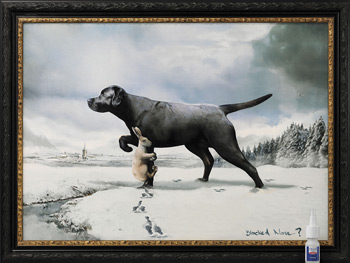
Journalists from the European trade press gathered in Paris last week to judge 4945 entries from 51 countries for the Epica Awards 2008. The highest number of entries came from Germany (1230), Sweden (589), France (491) and England (358). The Swiss creatives came in 9th place with 122 entries, just ahead of Russia. Switzerland also made a good showing in the judging. Three agencies can look forward to an Epica Award. Advico Young & Rubicam was honored in the Print category for its Rowen musical instruments. In the same category, Saatchi & Saatchi Simko made it with the "Hounds" subjects for Otrivin. A third award went to Ruf Lanz for their engineering recruitment idea on behalf of McKinsey & Company.
By way of comparison, the Austrian agencies, which submitted 102 entries, only slightly fewer than the Swiss, had to make do with just one award.
In addition to the Epica in nine categories, there are also five Epica d`or in Paris. Three of these went to Great Britain. DDB London won the coveted Gold Award in two categories: the TV Grand Prix went to the Volkswagen Polo spot with the singing dog, which had already won Silver in Cannes. In addition, DDB London won the Grand Prix Press with an ambiguous campaign for Marmite snacks: you either love them or hate them, depending on your perspective. The third British winner was Lowe London for John Lewis in the Outdoor category with the "Shadows" campaign, in which numerous consumer products draw the silhouette of the respective target audience on the wall.
The interactive Epica d`or went to the Swedish agency Great Works for Absolute Vodka. TBWA Germany received the Grand Prix in the Integrated Campaigns category for the same client.
It was striking for Werbewoche editor-in-chief Pierre C. Meier, who represented Werbewoche and thus Switzerland among the 29 jurors in Paris, that equally exotic and amusing commercials from more exotic countries such as Egypt were able to surprise the jury. A "rather special joke" is the trend in the Scandinavian countries. England has lost some of its legendary humor, but the French were as charmingly playful as usual. Germany's advertising is more rational.
Andreas Panzeri
1290582277_img081126_epica1
Advico Young & Rubicam: Rowen.
1290582277_img081126_epica2
Ruf Lanz: McKinsey & Company.
1290582277_img081126_epica3
1290582277_img081126_epica4
1290582277_img081126_epica5
1290582277_img081126_epica6
Saatchi & Saatchi Simko: Otrivin.

Fishing hooks in the sea of information

Anyone who fishes in the Mediterranean Sea moves in waters with a great diversity of species and a dense population. Today, the media are the fish that fight over the users' worms. Guest commentary by Josefa Haas, Head of the Media Institute.

The worm must taste good to the fish, not the angler. Media people like to use this statement by former RTL boss Helmut Thoma to talk their way out of bringing poor quality to the public. Like many a metaphor, this one also characterizes the view and documents a widespread attitude among media managers in the 1990s: "We can fob off the dumb audience as cheaply as possible. The main thing is that the bill works out for us in the end." The question is why these gentlemen are in the media business at all: they obviously neither value their products nor treat their customers as kings.
Cynicism and arrogance make you blind. Anyone who has done a good deal with the worms for a long time easily misses the moment when the roles are redistributed: How do the worm suppliers behave when the public becomes fishermen? Then they can hardly be fobbed off with a worm. What comes into the net or onto the fishing rod is sorted mercilessly. At best, the bad ones end up back in the water. The fish that the fisherman likes must meet a number of quality requirements: It must be fresh, not too fishy or too coarse, firm in the bite and of a certain weight. Anyone who fishes in the Media Sea moves in waters with a large variety of species and a dense population. Today, the media are the fish that fight over the users' worms.
Fishing for ideas - anyone who indulges in this passion will find a paradise of links and associations in the media world. I came across the fish in a trendy magazine. There was talk of a new trend: Fishing in the urban environment. Fishing is making a comeback in urban waters. Alongside partying, sport and surfing in the digital world, trendsetters are apparently engaging in an activity that requires patience, attention and time. For outsiders, fishing is an utterly boring and inefficient sport, where the muscles are mainly used for finding locations and balancing while standing. The meditative gaze into the water, the loose grip on the rod so as not to miss the slightest tug, then the determination with which the fish is pulled out of the water at the decisive moment. The young and the wild are obviously looking for moments of concentration again. Time is slowed down when fishing. There is plenty of time to give your own thoughts free rein. Multitasking and instant information require even the fittest minds to take a break from time to time.
The free publications are reminiscent of the novel "Salmon Fishing in Yemen", which is well worth reading. In an environment that is generally considered a desert for content printed on paper, there are always colorful fish to be found. A selection of magazines can be found in the pubs and stores of iPhone owners. These free publications focus on reading material and photography. There is an issue tailored to each target group. There is even a separate magazine for bloggers. In terms of publishing, they do not surprise with any major innovations. The classic magazine language dominates in terms of typography and image selection. The texts are personal essays. Advertising and editorial are not always distinguishable. However, the editors are guided by the traditional publishing trade: they reach their readers with interesting content at their meeting points and offer an attractive advertising medium.
Media providers, whose users are now swimming away, can find out on the web why a salmon was caught in the Rhine near Basel for the first time since the 1950s. The noblest fish are also the most demanding. It is precisely these that are most prized by fishermen. Today's media users are no longer passive fish that can be lured with worms. Today, they can choose from a sea of offers. Depending on their lifestyle and current needs, they are guided by different requirements. They expect differentiated offers with specific qualities. However, these must be clearly defined and consistently implemented. Media providers can breed these fish with great attention: Swiss media waters with salmon, trout and large pike ensure that fishermen do not have to go fishing in foreign waters.

Imprint: Ringier also lays off employees without need

The professional association Impressum accuses Ringier of using the current decline in advertising revenue as a pretext to reduce or restructure its workforce without encountering significant resistance. The announced efficiency improvement program appears to be implemented exclusively at the expense of the employees.

The professional association Impressum accuses Ringier of using the current decline in advertising revenue as an excuse to reduce or re-select staff without much resistance. The announced efficiency improvement program appears to be implemented exclusively at the expense of employees, according to a press release on Wednesday. However, it is also being done at the expense of the readership, as reduced editorial teams mean reduced journalistic quality.
From the employees' point of view, the redundancies are incomprehensible, especially as they are being made without any obvious economic need, writes Impressum. The successful and largest Swiss media company said it would close 2008 with a 10 percent increase in turnover. At the same time, further acquisitions should follow the purchase of online portals.
According to the association, the concern now lies with the dismissed media professionals who have put all their energy and professionalism into Ringier products and have now ended up on the street through no fault of their own. It will be very difficult for those affected to find suitable employment in the media sector. Impressum is calling on Ringier's management to look for alternatives to the redundancies in cooperation with the personnel committee and the associations.

A bluff is not enough

Even big promises are binding: OFCOM takes the licensed broadcasters at their word.

Did the radio and TV stations that came away empty-handed simply bluff too little in their license applications? Possibly. But OFCOM wants to hold all operators to their assurances.
Ringier is notoriously upset that its radio station Energy Zurich did not receive a license. But what particularly annoys Group CEO Michael Ringier is that DETEC only assessed the written applications submitted and not the Energy program broadcast to date. "Next time, we'll lie through our teeth to get a license," he grumbled on 19 November during his traditional autumn
media talk.
Ringier is not the only one trying to suggest that it was primarily the best bluffers who were awarded concessions and that (allegedly) honest applicants were left empty-handed. His opponent Roger Schawinski has also taken the same line - at least with regard to the awarding of concessions in south-eastern Switzerland and Rüebliland. Although the winners there, Hanspeter Lebrument and Peter Wanner, had so far achieved little or nothing in terms of training and quality control, they had presented "grandiose plans in their applications in order to score points", Schawinski ranted on Persoenlich.com.
But what particularly annoyed the radio pioneer was that DETEC accepted these promises on paper from Lebrument and Wanner, but did not take into account the fact that he, Schawinski, had practically trained over a hundred of the most successful and best employees in today's electronic media in Switzerland. He continued: "If I had announced that I would send three employees to the Columbia School of Journalism in New York every year, I would probably have received the concessions in Aargau and Graubünden."
Marcel Regnotto, Head of the Organizers Section at the Federal Office of Communications (OFCOM), reacts calmly to such accusations. "In the initial disappointment, some people overshoot the mark," he says. However, he is adamant on the matter itself: Bakom and DETEC certainly have no interest in awarding the license to the best liar, he said. That is why it was already made clear to the applicants in the invitation to tender that they had to state their intentions precisely - and that these would subsequently be declared binding. "It was therefore clear that we would take the candidates at their word," said Regnotto.
But how? Regnotto describes a control system on three levels. On the one hand, every event organizer has to set up its own quality assurance system. In the near future, he will also select his "evaluator" from a number of experts appointed by Bakom. Every two years, this evaluator will report to OFCOM in writing on how he assesses the progress of the respective radio or TV station and what measures he proposes. Furthermore, every broadcaster is accountable to OFCOM in terms of pay levels and working conditions. "We also have the means to check this information," emphasizes Regnotto. Institutes are commissioned with the third level, program analysis in the information sector. And their reports are published.
If it turns out that a broadcaster is blatantly violating its promises, Bakom will take action as part of a supervisory procedure, says Regnotto. The office can reduce the amount by up to 50 percent for broadcasters with fee splitting. And where there is no splitting money, the license can be restricted, suspended or even withdrawn.
Regnotto does not deny that such proceedings take a very long time. "However, as the sanctions have a drastic character, they will also have a prophylactic effect," he is convinced. In any case, the instruments are ready and Bakom is also willing to use them to enforce the performance mandate.
But how rigid are the DETEC requirements? Do they not restrict the broadcasters too much? Regnotto says no. The DETEC guidelines do not affect the choice of music or the target audience. "We only hold broadcasters to their promises in the area of information. This gives the organizers enough freedom to position themselves in a changing media market," says Regnotto.
When asked whether the new guidelines are stricter than before, he says: "This impression is not misleading." Although the expectations of broadcasters are only slightly different from the previous ones, the legislator is demanding more stringent controls. "This is also because the fee-financed broadcasters now receive considerably more money."
According to Regnotto, the budget available to OFCOM for future program research in the private sector amounts to around CHF 300,000 per year. This expenditure is "acceptable" in relation to what is at stake - "namely a diverse media landscape".
Back to Radio Energy Zurich. According to DETEC, no further frequency is available. Nevertheless, a theoretical question is permitted here: assuming that another Zurich frequency does come to light - would Energy then automatically be entitled to it? "No," says Regnotto clearly. Because if such a fictitious case were to occur, the Federal Council would first have to amend Annex 1 of the RTVA. This defines all coverage areas and the number of licenses. The new broadcasting station would then have to be put out to public tender. "Energy would therefore not be the first candidate on the waiting list to receive this free slot ex lege," says Regnotto.
Markus Knöpfli

Federal Council applies for approval of beer and wine advertising on TV

In future, Swiss television channels will once again be allowed to advertise beer and wine. A corresponding softening of the ban on alcohol advertising in the Radio and Television Act (RTGV) was proposed by the Federal Council on Wednesday.

In future, Swiss television channels will once again be allowed to advertise beer and wine. A corresponding softening of the ban on alcohol advertising in the Radio and Television Act (RTGV) was proposed by the Federal Council on Wednesday.
With this relaxation, the national government wants to enable Switzerland's definitive participation in the EU film promotion program Media and thus avoid Switzerland being at a disadvantage compared to foreign TV advertising windows. This amendment to the Media Agreement was submitted to Parliament on Wednesday.
The matter was referred back to the Federal Council by Parliament in December 2007. Both councils wanted to retain the ban on advertising for alcohol, politics and religion. However, the ban clashes with the EU's "Television without Frontiers" directive, which comes into force in 2009 and whose adoption is a condition for Media participation.
The Federal Council has now reached a compromise with the EU to amend the text of the agreement: The stricter advertising regulations can be enforced as part of an arbitration procedure, provided they are proportionate, non-discriminatory and in the public interest. The ban on religious and political advertising as well as advertising for spirits and mixed drinks such as alcopops can therefore be upheld thanks to this procedure.
The situation is different for advertising for beer and wine. As this is already permitted for local TV broadcasters under the current RTGV, the argument of health and youth protection will hardly suffice to justify a ban on advertising for some TV programs vis-à-vis the EU.
For this reason, the Federal Council is applying for a revision of the RTGV at the same time as approving and financing the media agreement, which will allow beer and wine advertising. It assumes that the impact on consumer behavior will be minimal, as alcohol can already be widely advertised in the other mass media.
Different reactions
The Federal Council's proposal received a mixed reception. The CVP described the proposal as unsatisfactory: the Radio and Television Act had only recently been revised. After intensive discussion, Parliament had largely retained the ban on alcohol advertising, CVP General Secretary Reto Nause told SDA.
In its decision, the Federal Council is arguing as if advertising had no influence on people's consumption habits, explained Michel Graf from the Swiss Agency for Alcohol and Other Drug Problems (SFA). If this were really the case, there would have been no advertising for a long time. He called for the lifting of the advertising ban to be softened. According to Graf, commercials for beer and wine should only be broadcast after 9 pm.
Television providers reacted positively. "We welcome the Federal Council's desire to create a level playing field between domestic and foreign television providers," said SRG spokesperson Daniel Steiner.
The SVP is only partially in agreement with the Federal Council's proposal. It only wants to allow the repeal on private broadcasters, but not on the SRG.
The Media program supports the development, international distribution and marketing of European films as well as the education and training of filmmakers. It has a total budget of 755 million euros (1.245 billion Swiss francs). Switzerland's contribution amounts to CHF 41.07 million, spread over seven years.

SFLB designs luxury restaurants from waste containers

SFLB has launched an advertising campaign for Bread for All and Fastenopfer to raise awareness of food waste. Various waste containers in Zurich and the surrounding area have been transformed into restaurants. The containers are intended to draw attention to the fact that the wasted food is missed by other people.

SFLB has launched an advertising campaign for Bread for All and Fastenopfer to raise awareness of food waste. Various waste containers in Zurich and the surrounding area have been transformed into restaurants. The containers are intended to draw attention to the fact that the wasted food is missed by other people.
In Switzerland, over a third of all food we buy ends up in a container, writes SFLB. Because we buy too much, divide it up too badly or, more generally, waste too much. Now the containers designed by SFLB in Zurich and the surrounding area are drawing attention to this. The campaign by Bread for All and Fastenopfer is intended to address people at the moment they throw something away.
Responsible at Bread for all/Lenten charity: Matthias Dörnenburg (Fastenopfer: Head of Marketing and Communication), Anne Bickel (Bread for All: Head of Marketing and Communication). Responsible at Spillmann/Felser/Leo Burnett: Pablo Schenke (Art Director), Christian Schäfer (Text), Martin Spillmann, Patrick Suter (Creative Director), Charlotte Gut (Consultant).
1290582273_img081126_abfallcontainer_sflb
img081126_abfallcontainer2_sflb

Lycos closes down: 500 employees lose their jobs

The European Internet portal Lycos is to be discontinued. As announced on Wednesday, the Executive Board and Supervisory Board of the Dutch company have decided to cease operations.

The European Internet portal Lycos is to be discontinued. As announced on Wednesday, the Executive Board and Supervisory Board of the Dutch company have decided to cease operations. The domain business, the shopping business and the Danish portal are to be sold. The unprofitable web hosting and portal business will be closed down completely. This means that 500 of the 700 employees will lose their jobs, 230 of them at the German subsidiary in Gütersloh.
The German media group Bertelsmann floated the company, which was originally jointly owned with the US company Lycos Inc, on the stock exchange in March 2000 and now holds a stake of around 32 percent, as does the Spanish company Telefonica.
Thanks to acquisitions, the company based in Haarlem in the Netherlands even briefly became Europe's leading Internet portal. However, Lycos Europe has not managed to earn enough money in all these years. In the first nine months of this year, a loss of 17.1 million euros was accumulated.
Lycos Europe was ultimately unable to assert itself against competition from search engine operators such as Google and Yahoo, Internet providers such as United Internet or networking sites such as Facebook. The company also struggled with falling advertising revenues and high costs.
Lycos is struggling with falling sales and is in the red: In the first 3 quarters of 2008, losses amounting to 17.1 million euros accumulated.

G+J Germany lowers profit forecast

The magazine publisher Gruner+Jahr has lowered its profit expectations for Germany. The lowering of its long-term return targets for the coming years is due to the overall economic situation, G+J Germany CEO Bernd Buchholz told Horizent.net.

The magazine publisher Gruner+Jahr has lowered its profit expectations for Germany. The lowering of its long-term return targets for the coming years is due to the overall economic situation, G+J Germany CEO Bernd Buchholz told Horizent.net.
The magazine publisher's current cost-cutting plans include the dismissal of 110 editors from "Capital", "Impulse" and "Börse Online" and the closure of the locations of these magazines. A new central editorial office for business topics is to be set up in Hamburg. The society magazine Park Avenue will also be discontinued from January next year. The magazine's turnover should have tripled in the coming years. Buchholz went on to say that he had lost faith in this in view of the economic crisis.
The internal redundancies are now being negotiated as part of social plans. According to Buchholz, there can be no talk of a harsh approach. The conditions of their severance agreements and social plans are significantly fairer than at other media companies.

Orange is the color of togetherness

Saatchi & Saatchi Simko is launching the new brand vision for Orange.

Facebook or Tilllate are a contemporary expression of the fact that people want to connect. Mobility is an equally collectively organized concept for modern car rental. Coop and Migros are cooperatives that make life more pleasant. The Red Cross has brought international solidarity from Switzerland to the world. And finally, democracy was "invented" in our country. The theoretical foundation for Orange's new brand vision can be based on a convincing need: "Together we can do more."
This claim, which should rather be described as a commitment, expresses "the core of the Orange brand vision for the next generation", explains Pascal Schaub, strategist at Saatchi & Saatchi Simko. Its parent company in London came up with the broad outlines of the campaign. Now the message "Together we can do more" is being adapted to the local environment and used in 22 countries. In Romania, for example, the idea was implemented with a large art exhibition where many people worked together to create a gigantic object from old car tires. In Poland, a "Celebrate Christmas together" campaign is underway.
Adventures in the Swiss mountains
In Switzerland, Saatchi & Saatchi Simko took its cue from the British film concept. But instead of a bike race like on the big island, the Swiss have opted for a shared adventure in the local mountains. "I'm nothing without my friends, but with them I can do anything." With this idea, the international campaign introduces the vision of Orange as a brand.
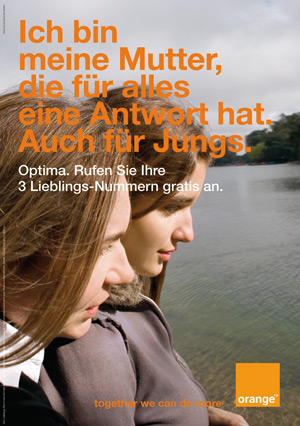
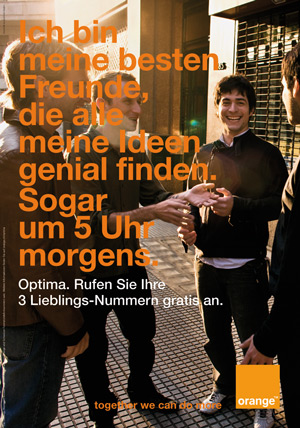
In the same style, Saatchi & Saatchi has now developed a real-life Swiss film story about a patrol run for the Optima price plan: "I am Marc Boesch and thanks to three people who are close to me, I have mastered the challenge of my life." With the Optima price plan, each subscriber can choose three numbers that they can call free of charge for an unlimited period. The Optima offer accounts for over 50 percent of Orange's total revenue in Switzerland.
The film is therefore intended to visualize: Orange gives you the tools to build communities yourself. Orange is thus positioned as an integrated telecoms provider that "focuses on people, their emotions and their personal experience". In doing so, the brand is building on social changes that can be observed worldwide. The time of pure ego-centricity is over. People are once again defining themselves more through the "we" and what they experience in the group. They are realizing that they can achieve more together with other people and develop themselves further than if they try to tackle life's challenges alone.
> About the film
The new Orange campaign therefore also features people in the print subjects who explain how they change and develop through interaction and communication with other people. "The Orange brand has always thrived on emotions and focuses on people," explains Andreas S. Wetter, CEO of Orange Switzerland. "The new campaign now takes this approach a step further by positioning Orange as a telecommunications provider that focuses on people rather than technology."
The campaign will shape Orange's entire presence in Switzerland over the coming months. The first subjects will gradually be supplemented by further stories based on true events involving Swiss people.
After Switzerland, it will be the turn of Spain and Poland, followed next year by nine European countries and the other Orange companies in Africa and the Middle East.
Andreas Panzeri
1290582278_img081126_orange1
1290582278_img081126_orange2
1290582278_img081126_orange3

Film also needs an image

KSB/SJ, in collaboration with the Zurich Film Foundation, gave three young talents an opportunity: They shot commercials for a campaign promoting the art of film.

Yes to film" was the slogan for the popular and very successful advertisement for the Zurich Film Foundation in 2004. The campaign from the KSB/SJ studio made a significant contribution to the city's referendum being passed. Since then, the Zurich Film Foundation has been promoting professional filmmaking by providing financial support mainly for the development and production of feature films, short films, animated films and documentaries for the cinema.
The Filmstiftung was endowed with a starting capital of 20 million francs when it was founded and has since been able to distribute 8 to 9 million annually. In addition to funds for production, prizes are also awarded for successful films. Last week, these Zurich film prizes were awarded in Winterhur. For example, CHF 20,000 went to Micha Lewinsky for the romantic drama "Der Freund". Sabine Boss was honored with 10,000 francs for "Das Geheimnis von Murk". In the "Succès Cinéma" category, feature films that were able to attract at least 30,000 viewers to the cinema were rewarded. As a kind of consolation for the flop at the box office, "Tell" by Mike Eschmann received 180,000 francs in accordance with the regulations, while "Breakout" by the same director received 250,000 francs for 70,000 viewers.
This year, a competition was also launched among 13 filmmakers to promote young talent on the one hand and to promote the image of the Filmstiftung on the other. The concept was again developed by KSB/SJ and enabled three young talents to produce one commercial each. Oliver Rihs shot "Love", Simon Nagel "Spiel" and Carmen Stadler "Schnee". (pan)
get_footer();