Werbewoche employee Markus Knöpfli on successful timing.
Editorial
-
December 3, 2008
After weeks of rumors, Tamedia finally let the cat out of the bag: The Zurich-based company is examining whether the Bund should cooperate with the Tages-Anzeiger or merge with the Berner Zeitung (BZ). A decision will be made in six months. The matter is delicate, because the reaction of Bund readers is open. In any case, they will have to get used to a different political way of thinking. It is therefore hardly a coincidence that communication is taking place now and the decision has been scheduled for mid-2009. On the contrary, the dates have been cleverly chosen in terms of marketing strategy. This is because the main phase of the subscription renewals is also about to begin for the Bund. By the end of February at the latest, it will be clear whether Bund subscribers will remain loyal to their favorite newspaper despite the upcoming realignment. If they stick with it or even manifest a "now more than ever" mood, a collaboration with the Tagi makes sense. However, if they turn their backs on the Bund, a merger with the BZ is likely. This is free market research. The reactions of advertisers can be sounded out in a similarly favorable way, especially during the Christmas season.
To the point: anyone can save
Even for the most steadfast optimists, something seems to be becoming clear: The global economic crisis has finally reached the media industry. Not only in the USA and Germany, but also in Switzerland, media companies are looking with trepidation to an uncertain future.
Editorial
-
December 3, 2008
Even for the most steadfast optimists, something seems to be becoming clear: The global economic crisis has finally reached the media industry. Not only in the USA and Germany, but also in Switzerland, media companies are looking with trepidation to an uncertain future. Everyone knows that there is a threat of losses on the advertising side. But no one knows how big they actually are and how big they will become. No one knows how long the crisis will last. No one knows what can be done about it. Neither the publishing powers that be nor the ubiquitous consultants who were already buzzing around the individual publishing houses in the good times, working out theoretically promising strategies, helping to launch new, retort-bred titles onto the market, and trying to sniff out internal savings potential like sniffer dogs. Drastic cost-cutting measures are therefore being implemented in an attempt to save what is considered worth saving. Rationalization, focusing, optimization of processes, cost transparency, return on investment - these are the buzzwords. There is a hectic pace everywhere, with cutbacks being made all over the place. Editors are downsizing, budgets are being cut, editorial teams are being shrunk back to health, as the saying goes, or even merged, as the WAZ Group is currently doing in Germany, where four titles are to be managed by a single editorial team in the future. A lot is also happening at Gruner und Jahr. A title like Park Avenue, which was launched three years ago to great fanfare, is being discontinued with a bang. In the future, the publishing house's four business titles will be supported by only one, altogether much smaller editorial team. Savings are being made at Süddeutscher Verlag. The Holtzbrinck Group will not continue its video portal WatchBerlin next year. There is no end to the bad news from abroad. Markus Knöpfli summarizes the unfortunate situation in Switzerland in the article on page 21. It is clear that a media company, like any other business-managed company, must also initiate measures if the economic outlook is poor. These interventions are often drastic, and the steps taken hurt because they entail drastic changes. Things that have become dear and traditional have to be thrown overboard as ballast so that the ship does not sink. That is unpleasant. But perhaps the whole thing is also an opportunity. In recent years, there has been a lot of discussion, talk and lecturing about the fact that the Swiss media landscape is in a state of flux, but the real innovations that were supposed to take this trend into account have failed to materialize. Perhaps they are coming now, and they are sorely needed. Pierre C. Meier, Editor-in-Chief [email protected]
The financial crisis comes at the right time for many
Be careful when media companies justify their job cuts with the financial crisis. They often want to solve structural problems.
Editorial
-
December 3, 2008
The bad news from the media industry keeps on coming: one company after another is making savings, cutting jobs, letting people take early retirement or sending them a pink slip. Edipresse, a media company in French-speaking Switzerland, kicked off the round of cutbacks in this country by announcing the elimination of 50 jobs in the summer - after having already eliminated 8.5 jobs in November 2007. Shortly afterwards, a redundancy announcement came from Neuchâtel: the newspapers Express and Impartial, which belong to the French media group Hersant, are also facing a phase of redundancies - originally there was talk of 15 job cuts, but following a protest strike by staff, the extent is still under discussion. At the end of October, it was rumored that Basler Zeitung Medien would be reducing its editorial staff by 15 percent, which was never officially confirmed. Just a few days later, PubliGroupe and NZZ AG announced that they too were making cuts. PubliGroupe intends to reduce its workforce - primarily in the area of advertising sales (Media Sales) - by 250 jobs worldwide, while NZZ announced an internal "review of all areas" without specifying the number of redundancies. They would be "in the low double-digit range", it said. In November, Ringier, AZ Medien and Weltwoche followed suit with plans to cut jobs. Ringier will part with 22 employees, AZ Medien will cut 30 jobs and the extent of the cutbacks at Weltwoche is still open. The fact that Tamedia is now examining two projects for the Bernese daily newspaper Der Bund - a cooperation with the Tages-Anzeiger and a merger with the Berner Zeitung - shows that this group is no exception. Tamedia is currently careful not to talk about redundancies. But no matter which project is ultimately realized, it will definitely involve job cuts. The need to save and cut back is generally attributed to the effects of the financial crisis. Also by journalists. But is this really the case? A few things make you wonder. For example, it is astonishing that the downsizing plans should be necessary so soon after the peak year of 2007. For the Bund and Weltwoche, a few fewer advertisements might make a difference - they have been on a knife-edge economically for some time. The other publishers and Publi¬Groupe, on the other hand, made profits. Where are the cushions from the fat years now? It is also strange that the downsizing plans primarily affect the print sector. All this tends to indicate that it is not primarily the financial crisis that is the reason for the reduction in print, but that the structural problems in the print industry are continuing, perhaps somewhat more acutely than before. By structural problems, we mean the increasing use of free newspapers, the Internet and Sunday titles instead of daily subscription newspapers, and the associated outflow of advertising money into these media. The slipstream of the banking debacle Here and there, but rarely enough, this has been communicated. Last week, for example, the cantonal employment office in Neuchâtel rejected Express and Impartial's application for short-time working on the grounds that this was only possible in the event of economic problems, whereas the two newspapers' financial problems were of a structural nature. An astonishing verdict against the spirit of the times. But a look at the advertising statistics shows: The office is probably right. The volume of advertising at Express and Impartial has so far remained at the same level as the previous year, and there are no signs of the financial crisis. It seems to be serving Hersant as a pretext. Tamedia's communication on the two Bund projects was almost pleasantly honest. The Zurich-based company refrained from sailing in the slipstream of the banking debacle, instead writing in the press release about "declining readership figures and the shift of advertising expenditure to the Internet". And that the federal government has not been able to stand on its own two feet economically for years. Structural problems, in other words. They are also likely to play a key role in the current downsizing elsewhere. Take AZ Medien, for example, where the decline in advertising in the flagship Aargauer Zeitung already began a year ago, parallel to the launch of the Sonntags. At Neue Zürcher Zeitung, too, it is difficult to believe that the financial crisis is having an impact at this stage - advertising volumes up to and including (black) October were at the previous year's level. CEO Albert P. Stäheli confirmed this indirectly when he said that the NZZ wanted to "anticipate market developments". Markus Knöpfli
Drawing the structural future with a red pencil.
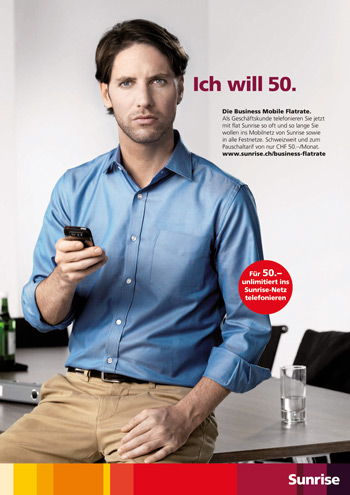
Make as many flat-rate calls as you want
The agency Brot und Spiele communicates the first business mobile flat rates in Switzerland from Sunrise.
Editorial
-
December 3, 2008
Sunrise Business announces the flat rate: With the first business mobile flat rate in Switzerland, business customers can now make unlimited calls. Previously, flat rates in Switzerland only existed for the provider's own networks. Sunrise is now the first telecom company to offer unlimited calls to the mobile networks of Swisscom and Sunrise as well as to the entire Swiss fixed network. Companies can choose from three different flat-rate offers, depending on the function and working methods of their employees. This choice is also the core message of the new Sunrise B2B campaign. It was implemented by the Zurich advertising agency Brot und Spiele. In the "I want 100" motif, for example, the manager who often makes business calls while on the move and has therefore opted for "flat swiss" at a price of CHF 100 per month makes his case. In an initial phase, this subscription will be advertised intensively with two motifs targeted at men and women. At the beginning of next year, the other offers "I want 50", "I want 10" and "I want 100, 50 or 10" will also be on display. Communication will take the form of advertisements, posters, clips, microsites and cross-media. The photos were taken by Oliver Nanzig from Zurich. (pan)
Former Radio RSR cadre in court
A former executive at the French-speaking Swiss radio station RSR has been sentenced to a suspended fine for allegedly downloading child pornography onto his office computer. The French-speaking Swiss radio station had dismissed him effective October 1.
Editorial
-
December 3, 2008
An ex-manager of the French-speaking Swiss radio station RSR has been sentenced to a conditional fine for allegedly downloading child pornography images onto his office computer. The radio station had dismissed him on October 1. The investigating judge issued the penalty order in November, a fine of ten daily rates of CHF 100 for downloading hardcore pornography. However, the former RSR manager did not accept the punishment and the case will now go to court. According to the cantonal investigating judge, investigations are still ongoing. The crisis management and communication of the RSR management were criticized in connection with the case.
Head of the Week: The Swiss Maker
As the new CEO of Scholz & Friends Zurich, Erich Baumgartner has ushered in a new phase of market presence. This phase aims to establish a more distinct Swiss profile and, soon, to achieve further growth.
Editorial
-
December 3, 2008
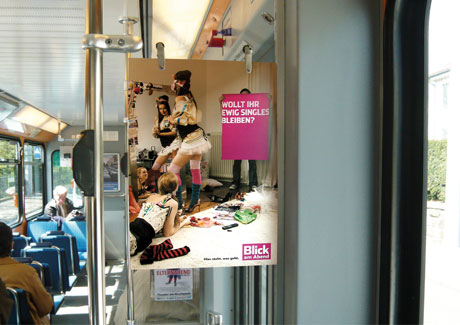
Scholz & Friends Zurich has "incredible potential that has yet to be awakened," analyzes Erich Baumgartner after 100 days in his new position of responsibility. The newly appointed CEO is convinced: "The Scholz & Friends network also works in Zurich. We live 'The Orchestra of Ideas' and have already achieved a very good basis with our clients after five years in Switzerland." But there is more to come. With Erich Baumgartner, Scholz & Friends wants to initiate a new phase of market presence in Zurich, in which the branch of the top German agency is to gain an independent Swiss profile. To this end, the aim is to achieve growth "in line with the importance and economic strength of the country," Frank-Michael Schmidt, CEO of the Scholz & Friends Group, also explained when Baumgartner was appointed. After an initial offshoot in 2003, Scholz & Friends Zurich was relaunched in 2006 as a "proper and independent agency" and currently has over 20 employees developing holistic communications solutions for brands such as Balisto, Blick and UBS. Katrin Seegers, who built up Scholz & Friends in Zurich as Managing Director, became a mother in July and therefore returned to Berlin. CD Jan Leube also wanted to return to Germany. He took over the creative leadership of an agency in Berlin as Chief Creative Officer at the beginning of 2008. In this ideal phase for a second take-off, the network once again sought contact with Erich Baumgartner, having already held advanced talks with him in 2006 about a commitment. For the network with 1200 coworkers predominantly in Europe it was "a central thought" that after the first structure now a Swiss is to lead the agency into a further future. With Erich Baumgartner, Scholz & Friends Zurich is to gain "an independent profile" and still reflect the "family values" of the parent company. In order to expand its position, the network plans to make further substantial investments in its Zurich location. Soon, the agency will move to new premises on Förrlibuckstrasse. "At Konradstrasse, with only one and a half floors, we have reached the limit. You have to give air to be able to grow further," Baumgartner is pleased to say. He also likes the modern spirit of optimism in Zurich West. Growth - also through acquisitions Scholz & Friends wants to grow in Switzerland not only with new mandates and new people: "We are also looking to expand with acquisitions. The strategy reflects the image that Scholz & Friends cultivates throughout Europe with its various agencies and offshoots, each with its own special discipline, such as Scholz & Friends Dialog, Interactive or the PR unit Agenda. With this in mind, Baumgartner is on the lookout "for good teams and interesting companies." The acquisitions are also intended to make the location policy a bit more fragmented. "We want to secure our presence beyond Zurich," explains the CEO, who knows the Swiss communications scene inside out. Like many of his generation, Erich Baumgartner slipped into the world of advertising "without any great ideas about this industry. As fate would have it, however, he was able to join one of the best addresses right away. In 1981, he found his first job at the DDB agency run by advertising legends Max Wiener and Rodolphe Deville. Here, Baumgartner learned his trade in the classic way with media and consulting. After five years, he moved onto the merry-go-round of further experience at various agencies such as McCann Erickson, GGK Zurich and Advico Young & Rubicam, and also once on the client side at Philips Switzerland as Head of Marketing Communications. At Publicis, Baumgartner later headed a consulting group as a colleague of Beat Mühlemann, who later became head of Migros advertising. That was at the end of the 1990s "in the great days of Farner Publicis" with international budgets such as Coca-Cola or British Airways. Baumgartner's masterpiece, however, became Swiss Post's Yellow Youth Account. "This weighty financial campaign for Swiss Post made a real splash for years back then." Baumgartner therefore dared to take the step into self-employment. He took a stake in Matter & Partner, together with Wirz Partner Holding. "That was an interesting maneuver, moving into completely different dimensions in a smaller agency," the current CEO recalls of the exciting time. "In a large agency, you work as a consulting group leader embedded in a made nest. You do have to work a lot and develop with the client. But the entrepreneurial challenge in a small agency is more exciting. You simply learn more because everyone has to do everything." Not the last to close the door He then wanted to bring his entrepreneurial experience back into a large network. Baumgartner headed the Lowe Lintas GGK advertising agency in Zurich for four years, with clients such as Orange, Volkswagen and Credit Suisse. The bank's mandate then became a stumbling block for the agency. For Baumgartner, however, it wasn't actually the loss of that budget, but "our inability to react very quickly to the new situation" that led to the bad end. "I had agitating discussions with my supervisor about strategy, and then that was also the reason why I left. Because I didn't want to be the last one to close the door." Among various options and also offers from clients, including from the financial business, Baumgartner decided once again to go into business for himself. The small boutique Glamour Engineering specialized in cultural events. Baumgartner was to help turn Glamour World into a proper communications agency with a focus on cultural marketing. He discovered: "This is a very interesting and also lucrative business, but you have to be part of this very special world. But I wasn't. I'm a specialist in marketing and communications, and I'm particularly comfortable in this field." So the offer from Scholz & Friends in ¬Baumgartner's biography also came at just the right moment. Here he can now do everything again. "I'm really excited about our integrated interaction, because for me the orchestrated thinking and acting of all disciplines is not only the future of a successful agency, but has been actively lived in the Scholz & Friends network for years." Strong reputation built With clients such as UBS Key Club and Blick am Abend, Scholz & Friends Zurich has succeeded in building a strong reputation in Switzerland over the past two years. In the ADC ranking, the agency made it into the top 10. In the biography of a creative, the agency name has long been an illustrious address. In a survey of 500 advertisers by the Handelszeitung, Scholz & Friends also scores very positively. And this name recognition is an "extremely important factor for business success in Switzerland," Baumgartner is convinced. The better known and bigger you are, the easier it is to get onto the shortlist for pitches. Once you're in that loop, you attract more customers and interesting employees. In addition to his commitment to the agency, it has always been important for Erich Baumgartner to be involved in the field of education. He served on the board of Sawi and was a member of the SW examination board. After completing an executive MBA in business administration at the University of Zurich in 2005, he also lectured himself. In the years of self-employment, however, he had to cut back on some of these commitments. Embedded in a functioning structure at Scholz & Friends, the new CEO now hopes to ramp up these "extra-occupational commitments" again somewhat. "You can't just consume, you have to give something back." In his free time, Baumgartner does moderate sports, enjoys cooking and eating, and is interested in many areas from politics to music. His private and professional curiosity keeps him open to culture of all kinds. He also enjoys this together with his wife Lisa. He met the former advertiser during his time at Advico. "In this sense, this station has also been clearly and sustainably worthwhile for me, for which I am still grateful to Bruno Widmer today," he laughs. Andreas Panzeri
With the mandate for Blick am Abend, Scholz & Friends has made a name for itself beyond the advertising industry.
Flop of the week: The Bern model on the brink
The Bund should either enter into an editorial partnership with the Tages-Anzeiger (TA) or merge with the Berner Zeitung (BZ). Tamedia is reviewing options and plans to make a decision by the middle of next year.
Editorial
-
December 3, 2008
The Bund is to either cooperate editorially with the Tages-Anzeiger (TA) or merge with the Berner Zeitung (BZ). Tamedia is examining corresponding concepts and intends to make a decision by the middle of next year. Without editorial cooperation, Der Bund no longer has any economic prospects, Tamedia announced on Monday. Two projects are being examined: Editorial cooperation between Der Bund and Tages-Anzeiger is running under the project name "TagesBund". The aim would be to offer the readership of the two titles a jointly developed mantle. It would be conceivable, for example, to exchange editorial content to a large extent or to share some of the departmental structure. In this case, the "Berner Modell" with two independent daily newspapers in one publishing house would continue to exist. In the "Berner Zeitung & Der Bund" project, a merger of the two editorial offices is being examined. The economic strength of the Berner Zeitung offers a good starting point.
Press dispute in Italy: Berlusconi rails, Murdoch sends mass emails
Berlusconi takes a shot at the Italian press. The heads of Italy's biggest newspapers, including Corriere della Sera and La Stampa, should "change their jobs", said the Prime Minister, according to Italian media.
Editorial
-
December 3, 2008
Berlusconi takes a shot at the Italian press. The heads of Italy's largest newspapers, including Corriere della Sera and La Stampa, should "change their jobs", said the Prime Minister according to Italian media. The background to these comments is the dispute over the government's plan to make pay-TV more expensive. An economic stimulus package passed last week provides, among other things, for an increase in VAT for pay-TV from 10 to 20 percent. This had triggered protests, as it primarily affects Berlusconi's biggest competitor in the private TV sector: Rupert Murdoch and his satellite broadcaster Sky. The VAT increase would cost Sky Italia 210 million euros in the coming year. The pay-TV station has launched an advertising campaign against this measure and asked its subscribers to write protest emails to the Prime Minister's Office. With the "mail bombing", Sky Italia wants to force the government to reverse its controversial decision. The tax increase does not affect the rich, but millions of families who subscribe to Sky primarily to watch football matches. Berlusconi once again came under fire for his dual role as head of government and owner of the country's largest private media group.
Budget win: Blue Spirit brews new corporate design for Heineken
Blue Spirit has won the Heineken pitch. The communications agency will develop a new corporate design for the brewery group.
Editorial
-
December 2, 2008
Blue Spirit has won the Heineken pitch and will develop a new corporate design for the brewery group. A new concept became necessary following the takeover of Eichhof by Heineken. The aim is to manage the respective brands hierarchically, the agency writes in a press release. Various measures will be implemented before the end of 2008.
Responsible at Bluespirit: Gerry Flückiger (CEO), Marina Magoley (Account Director), Peter Trüb, Tizian Walti (Text/Concept), Fritz Kreis (AD).
Polyconsult for Energie Wasser Bern: Saving electricity at the push of a button
Editorial
-
December 2, 2008
BZM Media: Head of Human Resources and Head of Print Shop released from their duties
The management of Basler Zeitung Medien (BZM) has suspended Chief Human Resources Officer Stephan Gugelmann and Printing Plant Manager Christian Gysin. On Monday, December 1, 2008, the two members of the executive board were dismissed effective immediately.
Editorial
-
December 2, 2008
The management of Basler Zeitung Medien (BZM) has dismissed Stephan Gugelmann, head of human resources, and Christian Gysin, head of printing. On Monday, December 1, 2008, the two members of management were dismissed with immediate effect, according to Online Reports. BZM spokesman Walter Schäfer cited "differing views on the strategic direction" as the reason. Stephan Gugelmann took over from Beat Bucher, then Head of HR, on July 1, 2006 and has been in charge of HR for the entire Group since then. The 40-year-old was previously with Ringier. He will be succeeded by Claudia Wahlen, previously Head of HR at Birkhäuser + GBC in Reinach. The 34-year-old Christian Gysin has been technical manager of the printing center since May 1, 2007. The dual management at the top of the BaZ printing center, which was introduced a year and a half ago, will be abolished. Felix Bitterli, previously responsible for marketing and sales, will once again be the sole head of the printing center, replacing Gysin in this role.
Last but not least: YouSinfonie
YouTube is launching what it calls the «world’s first online symphony orchestra.» The highlight, however, will take place offline.
Editorial
-
December 2, 2008
YouTube is launching what it describes as the "first global online symphony orchestra" and is being supported by institutions of distinction: The Berlin Philharmonic Orchestra, the Bamberg Symphony Orchestra, the London Symphony Orchestra, Carnegie Hall, and so on. In a competition, musicians from all over the world are invited to record their skills on video and upload them to YouTube. They are asked to play their own piece and interpret an original composition. The trick is that the finalists' own contributions will be compiled into a YouTube symphony, which will then be performed in Carnegie Hall. So it's not quite so online. It is also to be hoped that the result will be a symphony and not a cacophony. It will certainly be an exciting experiment. So here's a tip: get your Stradivarius out of the box and post your contribution by January 28, 2009 on Youtube upload.