Like YouTube - simply better
The American online video site Hulu impresses with its "less is more" advertising strategy.


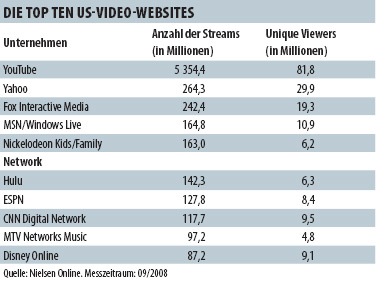
Many internet projects by the major TV networks and film studios in the USA have failed miserably in the past. So when the two major media companies NBC-Universal and News Corporation launched their online platform Hulu.com in March of this year to counter copyright infringements against their own products through YouTube, expectations were not too high. But then something unforeseen happened: just two months after its launch, the project had secured a place among the top ten video websites. With its 1,000 TV episodes and 400 feature films, it is now in sixth place, ahead of industry leaders such as AOL and CNN.
One of the main reasons for its success is that Hulu wanted to differentiate itself from its main competitor YouTube right from the start. While Google's YouTube is still regarded today as a collection point for creative amateurs and semi-professionals with their user-generated content, Hulu exclusively offers professional goods. The most popular downloads are established TV hits such as "The Simpsons", "Family Guy", "The Office" and "24". Nevertheless, Hulu CEO Jason Kilar, who used to work at Amazon.com, integrated an important YouTube element into the site: content sharing.
One of the main reasons for its success is that Hulu wanted to differentiate itself from its main competitor YouTube right from the start. While Google's YouTube is still regarded today as a collection point for creative amateurs and semi-professionals with their user-generated content, Hulu exclusively offers professional goods. The most popular downloads are established TV hits such as "The Simpsons", "Family Guy", "The Office" and "24". Nevertheless, Hulu CEO Jason Kilar, who used to work at Amazon.com, integrated an important YouTube element into the site: content sharing.
Each user can publish excerpts from the available videos on their own blog or website or send them to friends by email. "The Internet is all about sharing and community, not just a single website like Hulu," says Kilar. For this reason, the content is also publicized through other distributors such as Yahoo, YouTube, MSN or MySpace. Even links to the competitor sites of ABC and CBS are listed when a user searches for programs from these two networks on Hulu.com. According to Kilar, Hulu content has been linked 1.5 million times to over 60,000 different websites.
The use of advertising on Hulu is also considered innovative. Instead of the usual eight minutes of commercial breaks on television, 30-minute programs only contain one two-minute break. This has the effect that viewers are more likely to remember the advertised product, which in turn enables the operators to charge higher prices per clip. The site, which started out with ten advertisers, now has more than 100 sponsors to choose from, including General Motors, Procter & Gamble, Bank of America and Nissan.
"Did you like the advertisement?"
In a survey commissioned by the companies, 76% of the 18,000 respondents said that the length of the commercial breaks was just right, taking into account the fact that the product is free. They also reported an average 22 percent higher recall value of the advertising, with 28 percent even stating that they wanted to buy the product. Given the choice between four 30-second commercials and a long-form ad lasting two minutes, 88% preferred the single clip. "It all boils down to hypertargeting," says Brad Adgate, Research Director at media research company Horizon Media. "The longer consumers interact with an ad clip online, the more precisely you can tailor advertising to users."
In future, consumers will even be given the opportunity to express their opinion on whether they liked the advertisement or not. "Consumers don't like being forced to watch something they don't find relevant," says Lori Schwartz, Senior Vice President of the Emerging Media Lab at advertising group Interpublic. "As soon as you give them a choice, they start to think about it."
The company's success has even led to predictions that Hulu could soon catch up with its competitor in terms of advertising revenue, despite YouTube's overwhelming user numbers. The media research company Screen Digest estimates the advertising revenue of YouTube, which only provides three percent of its videos with advertising clips, at 100 million dollars in the USA for 2008. The figure for Hulu, which is able to add advertising to practically all of its content, is expected to be 70 million. Next year, the figure is expected to reach 180 million dollars for both, although YouTube derives around half of its revenue from its international business, while Hulu is currently only available in the USA. According to the market research company eMarketer, a total of 505 million dollars will be spent on advertising in online videos in the USA this year, an increase of 56 percent compared to the previous year.
However, YouTube has learned from the problems of the past and launched a number of initiatives to reassure advertisers that the site does have high-quality content to choose from. For example, there is now a dedicated video channel exclusively for content from the CBS network. In addition, YouTube has just signed a contract with the film studio MGM to distribute its movie content on the Internet. The production companies Lionsgate and Fremantle, where the TV hit "American Idol" is produced, are also to receive their own video channels for their content. YouTube has even introduced a "Cinema" button, similar to Hulu's, which allows users to watch a video in widescreen format on the full screen. "YouTube has changed its business model to be more like Hulu," says Adgate. "This means that advertisers are becoming more important and not just the needs of users."
Although Hulu has already provided 50 million dollars for a marketing campaign, its success to date is based solely on word of mouth. But the site will attract an even larger audience when it launches in Germany, England, France and Japan as planned.
Gerti Schön

The cult program "American Idols" is soon to have a
get their own channel. Hulu has shown the way.
get their own channel. Hulu has shown the way.