Who won so far: The advertisers of the year from 1977-2009

On Wednesday evening, the award ceremony for the title of Advertiser of the Year took place in Zurich's Kaufleuten. Here is a list of the people who have taken home one of our Egons since 1977.

On Wednesday evening, the award ceremony for the title of Advertiser of the Year took place in Zurich's Kaufleuten. Here is a list of the people who have taken home one of our Egons since 1977. It is striking that almost half of the award winners do not come from the creative sector.
1977: Doris Gisler-Truog, André Hofer
1978: Jörg Kissling
1979: Jörg Steiner
1980: Peter Lesch, Aldo Frei
1981: Hans Gfeller
1982: Peter Marti
1983: Ruedi Wyler
1984: Jean Etienne Aebi
1985: Fredy Collioud
1986: Hans Ulrich Schweizer, Jost Wirz
1987: Reinhold Weber
1988: Andy Steiner
1989: Adolf Wirz
1990: Yvonne Hodel
1991: Reinhold Weber
1992: Hansjörg Zürcher
1993: Yvonne del Medico
1994: Walter Bosch
1995: Martin Denecke
1996: André Benker
1997: Liliane Lerch
1998: Bruno Widmer
1999: Danielle Lanz
2000: Markus Ruf
2001/2002: Dominique von Matt
2003: Ruedi Wyler
2004: Martin Spillmann
2005: Beat Mühlemann
2006: Markus Ruf
2007: Peter Felser
2008: Pius Walker
2009: Frank Bodin

Gmx has discovered Switzerland

The mail service Gmx has been online with its own Switzerland portal for a week now. At Gmx.ch, mail users can not only use the freemail service, but are also provided with country-specific information and services. Advertising placed on the portal specifically targets consumers in Switzerland.

Swiss owners of a Gmx mailbox used to get news from Germany and colorful stories from all over the world around the log-in and log-out pages. As of today, they can read German-language information about Basel, Blocher, Bligg and Beromünster on their way to and from the electronic mailbox. They can also access services specific to Switzerland, such as the weather forecast for all Swiss cantons and the TV program.
The Swiss news will be supplied by the Swiss Dispatch Agency (SDA). "We are not setting up our own editorial team for the Switzerland portal," says Matthias Ehrlich (53), CEO of United Internet Media AG, Gmx's media marketer, "because we think it makes more sense for the news for Switzerland to also come from Switzerland." United Internet Media still has editorial sovereignty in the release of the reports, which SDA supplies. "In the long run, however, there will be a click democracy on Gmx Switzerland," says Ehrlich, holding out the prospect: "Our users choose with their clicks what they want to read and what they don't."
High quality and pop up taboo
Ehrlich does not see Gmx.ch as a competitor to established Swiss news portals. "Those who are looking for specific information tend to go to the websites of Swiss newspapers," he says. "We serve a different clientele, namely users who quickly check their e-mails during their lunch break, for example, and pick up a news item or two from the day that way." Nevertheless, Gmx news is not fast food. "We don't want to compete with daily journalism, but quality is still very important to us," Ehrlich emphasizes. "The news is intended as a supplement to our e-mail offering, an additional service for our users. And we want them to like our service. We can only achieve that - apart from the reliably functioning e-mail account - with a well-researched and well-written news mix."
Ehrlich also wants to live up to this standard with advertising on Gmx Switzerland. Pop-up windows that disturb Gmx users while writing e-mails are taboo for him. Account holders also receive newsletters no more than twice a week. Instead of using guerrilla advertising methods, United Internet Media is trying to extract the secret of its penetrating power from classic print and TV advertising and transpose these modes of action to the Internet. "For example, we offer the largest-format advertising spaces possible," says Ehrlich. "Our log-out page, with the option to run an ad in maxi-AD+ format, is very popular with companies. We also work with TV-quality spots, votings as well as banners on fixed placements, and we use targeting."
Targeting enables the anonymous and direct delivery of advertising to defined target groups. And it does so fully automatically and with low wastage. United Internet Media has developed several targeting products itself. The so-called target group planning technology links anonymous, statistically extrapolated usage information from users with offline data, such as their purchasing behavior. "This allows us to guarantee our advertising partners sufficiently accurate delivery of their advertising," explains Ehrlich. "However, we don't evaluate any data from private communications, because we consider that to be questionable in terms of data protection."
High pressure and effective advertising
Ehrlich cannot confirm that no company wants to spend more money on advertising in times of the much-vaunted economic crisis. On the contrary, print is suffering badly from the advertising slump, but online is catching up. "When money is tight, advertising has to become more efficient and effective and have a high reach," says the advertising professional. "More and more companies are therefore discovering online as a good alternative to print and TV and are now taking their first steps in online advertising." So the dip in economic growth is a huge opportunity for advertising on the Internet: "World Wide Advertising" is the order of the day. "In Switzerland, the online advertising market is currently still underdeveloped," says Ehrlich. "But the market is picking up now. The crisis is building up a lot of pressure to follow suit. That is, of course, an optimal starting condition for our new Switzerland portal."
In the run-up to the live launch of Gmx Switzerland, United Internet Media has already succeeded in winning a number of major Swiss companies as advertising partners: Swiss, Swisscom, Ricardo, Coca-Cola Switzerland and Feldschlösschen are advertising on the new portal. United Internet Media has assigned local marketing of the advertising spaces to AdLink Internet Media AG Switzerland.High range and advantages
Gmx Switzerland is a German language offering. A French and an Italian version for the other language parts of Switzerland are not planned. According to Ehrlich, it would be problematic to set up a service of this quality and with this reach in several languages as well. The restriction to the German language also offers advantages: The advertising reach of Gmx.ch is particularly high due to the link with the German and Austrian Gmx portals. "This allows us to address the entire German-speaking region with the e-mail service and the respective country-specific messages and services," says Ehrlich. "As an advertising platform, the Swiss portal is thus exciting for all Swiss-based advertisers with target groups in German-speaking Switzerland and abroad, as well as for international groups with Swiss target groups."
Without the coupling with the German and Austrian Gmx portals, Gmx.ch would probably not exist. "Offering a complex advertising tool like targeting only for a small economic area like German-speaking Switzerland would not be profitable," Ehrlich emphasizes. "In conjunction with Gmx.de and Gmx.at, however, synergies are created and the targeting offer on the Swiss portal pays off. So we can offer Switzerland an advertising platform with completely new opportunities and reach."
The precursor to Gmx.ch is Gmx's Austria portal, which has been online since March 2008. The reactions of users and advertising partners to the launch of Gmx Austria have been very positive, reports Ehrlich: "The frequency of use and the length of time users spend on the site have increased significantly - and with it advertising revenues. And that by about 300 percent at once." Today, Gmx.at is the largest Austrian service portal and the second-largest online offering on the Austrian internet. United Internet Media expects a similarly positive development for Switzerland.
Anne-Friederike Wilhelm

Gmx - Fact & Figures
Freemail pioneer Gmx (Global Message Exchange) went online as a mail service in Germany eleven years ago. One year later, 250,000 people already had a Gmx account, and in April 1999, Gmx.de had more than one million members. At the end of 2008, Gmx reached 8.7 million unique users per month in Germany and was the number five most-visited online service (AGOF internet facts 2008-III).
March 2008 sees the launch of Gmx's Austrian portal, with country-specific content and services added to the e-mail offering. Within a short time, Gmx.at becomes the largest Austrian online service portal and the second-largest online offering on the Austrian Internet.
In Switzerland, Gmx is currently the third-largest mail service behind Hotmail and Bluewin, with around 750,000 mailboxes. The company expects the launch of the Swiss portal to bring rapid growth in Gmx users and rising advertising revenues. The company is also aiming for a place among the top 5 Swiss Internet portals. (afw)

1290582138_img090114_gmx_logout
Swiss news on the Gmx home page is supported with banner advertising from Feldschlösschen.

Succumb to fear … or …?

We don’t yet know what the still-young year 2009 will bring. Will it be a difficult year, as the general public and the media have been predicting for months, or are we even facing a crisis? Guest commentary by Uwe Tännler, President of Swiss Marketing (SMC).

We don’t know today what the still-young year 2009 will bring. Will it be a difficult year, as the general public and the media have been predicting for months, or are we even facing a crisis? Will we let such messages intimidate and paralyze us? Or will we focus on our strengths and fight back with all our might?
As a professional association for marketing and sales, we will not let such bad news affect us in the coming year, and we will tackle the tasks ahead with high motivation and dedication.
I am very optimistic and foresee a successful future for our association in 2009 as well.
Why?

  • because we are convinced that education and training are of great importance, especially during economically challenging times
  • because active networking, sharing experiences, and knowledge transfer support professional advancement
  • because international recognition of our professional profiles is becoming a reality and
  • because we can count on our loyal members, partners, and supporters.

In early February, we will conduct an online survey of our members to gauge their sentiment and incorporate their suggestions, wishes, and feedback into our strategy.
The desire for identity, international recognition of the profession, membership growth, and effective succession planning on the executive boards are just a few of the key areas of our work.
We still have a long way to go—come on board and join us! We’re on our way to shaping Swiss Marketing into a recognized professional association that rightfully bears the name Swiss Marketing.
The list of Swiss Marketing's benefits is long. To maintain and further expand them, we need your support.
Join the #1 name in marketing! Swissmarketing.ch Members Section! With us, you've got the wind at your back. Welcome!.

Publicitas winks at BaZ

P Basel is launching a value-added tool for Basel designed to encourage local customers to book through the P channel again rather than directly with the BaZ.

Since the Basler Zeitung Medien (BZM) switched from Publicitas lease to its own management a year ago and also grants - depending on the terminology - a direct booking discount or a direct booking compensation of 1.5 percent, the P am Rheinknie has been losing sales. The latter makes no secret of this. "Based on sales in 2007, we lost more sales in the Basel local market last year than in the rest of Switzerland," says René Gehrig, Managing Director Central Region at Publicitas Switzerland since August 2008 and thus also responsible for WG 31.
Now that 2008 is over and the trends are clear, however, Gehrig wants to do something for the benefit of P market shares. Specifically, Publicitas Basel will be offering a so-called "added value tool" on a trial basis in the local market starting next week: All local customers who booked ads in BZM titles last year for at least 10,000 Swiss francs via P Basel will receive a credit of one percent on their total net volume placed. In addition to Basler Zeitung and Baslerstab, BZM titles include News Basel and a handful of community papers.
Although the one-percent credit is not paid out directly to customers, they are given access to the website www.publicitaspass.com. There, around 500 sports and other events are currently listed, as well as other offers - from FCB matches abroad to a group raft trip or wine order to hotel stays. For these offers, customers can use their 2008 credit to make a down payment. "We want to offer local customers direct added value when they book through us," Gehrig says. Of course, the customer can also invest his credit in promotional products, such as vouchers for the P-Tool SMS-2-Mail or also in new advertisements in BZM titles - which of course must again be placed via P Basel.
As the "guardian of the grail of rate compliance," the P only wants to carry the official rates of the publishers into the market, Gehrig emphasizes. The new tool does not change that, he says. "We're not jeopardizing the price with this; on the contrary, we're promoting sales in BZM titles - simply through our channel." Incidentally, the credit is paid by P. Gehrig: "This is away from the commission we receive from BZM."
So P is launching the new tool, including credit, next week as a trial balloon. "If it is well received in the local market, we may also offer it to national BZM advertisers," says Gehrig. If necessary, we will also have the courage to take the tool off the market again.
In some respects, the value-added tool is reminiscent of the revenue-based "account bonus" of 0.5 to 3 percent that P Basel offered a year ago (but had to discontinue immediately afterwards). There, too, the question was ultimately how P could make booking through its channels more attractive and win back lost market share. Gehrig, who had nothing to do with the matter at the time, however, resists comparison. "The bonus was a misconstruction in every respect," he says clearly. The new credit, on the other hand, remains at one percent in any case below the BZM direct booking discount. Moreover, he wants to limit the new offer to bookings on BZM titles.
However, Gehrig says there is no question of expanding the tool to include insertions with other independent publishers. "The tool is not a threatening gesture; rather, we are trying to counter the price spiral, which is spiraling downward particularly quickly in Basel, in a playful way and with a certain wink," he says. Because the situation in Basel is special for P: Since price loyalty suffers particularly at the Rhine knee, P is not only at a disadvantage as an advertising agent, but also as a major shareholder in BZM. "After all, we hold 37 percent there," says Gehrig.
Markus Knöpfli

Hans in Luck

The buzzword "economization of the media industry" is misleading. Guest commentary by Stephan Russ-Mohl, Head of the European Journalism Observatory at the University of Lugano.

As at almost every media congress where more than two communication researchers meet, one buzzword recently dominated the discussions at the media symposium in Zurich on the "crisis of the beacons of public communication": the economization of the media business. Superficially, it is about cost-cutting constraints and the rather trivial fact that journalism and the media do not operate in a vacuum, nor solely in the political sphere, but that scarce resources determine the possibilities and limits of publishing.
However, "economization" is more than just a description of the fact that editorial offices also have to learn to calculate and budget and that, as the US media researcher Doug Underwood noted with concern years ago, MBAs are climbing into chief editors' chairs here and there. The term contains a trend statement that obscures more than it illuminates: In the best tradition of the Frankfurt School, it is implied that the ("capitalist") system is subjecting more and more areas of life, and thus also editorial offices, to the dictates of the economic and thus (inflated) profit expectations. As a result, journalism as a "cultural asset" is falling by the wayside: it is increasingly unable to fulfill its journalistic mission of providing citizens with sufficiently verified news, serving democracy and controlling the powerful.
With this way of thinking, the (economic) "system" remains a black box. You can't or don't want to look inside it. At best, the "culprits" are quickly identified: the publishers and those financial investors who - like Sam Zell or David Montgomery - invest in the media industry and devour editorial offices like "locusts" in their untamed greed.
Furthermore, the description is made from the perspective of the journalists, i.e. the news producers - and not the customers. From the perspective of readers, listeners and viewers, it would be more accurate to speak of a de-economization of the media sector: With the exception of the compulsory fee for broadcasting, we have come closer than ever before to the utopias of the '68ers of zero tariffs for essential goods and services: "Everything is free" not only applies to commuter newspapers such as 20 Minuten, .ch and Blick am Abend, but also to a lot of high-quality content on the Internet, from the Neue Zürcher Zeitung to YouTube and the New York Times.
The situation is also paradisiacal for advertisers: Today, they can reach their target groups without too much wastage - unlike Henry Ford, who worried that half of his advertising budget was being thrown out the window, but didn't know which half. If you are looking for a new girlfriend or want to sell your car in a classified ad, you can now even advertise online for free if you are not a trader yourself.
"Economization" - the buzzword thus obscures two elementary changes rather than describing them adequately: Firstly, competition prevails today. Thanks to the Internet, competitors hoping to reach the same audiences and advertising customers are just a mouse click away. Previously, regional and local monopolies and oligopolies had provided many media companies with dream returns for decades, the likes of which were otherwise only achieved in casinos. Increasing advertising revenues also provided generous funding for editorial offices, which in turn lived like maggots in bacon. Secondly, the next generation has already become accustomed to the idea that news "costs nothing". Zero willingness to pay, which also tends to indicate de-economization. Newspaper publishers are currently like Hans in Luck - they are losing one source of income after another.
However, this trend is not only disastrous for publishers, but also for society - journalistic quality and independence cannot be had for free. It's five to twelve: if we want to prevent Google, Microsoft and the public service broadcasters from being the only information providers left, politicians must create a regulatory framework that enables fair competition between public and private media companies. So far, it has only shown that it is hopelessly overburdened with this task. The state has neither prevented media cartels nor corrected market failures. But the state is ultimately us, the citizens - and if we continue to want "everything for free", then we may all end up like Hans in Luck. High-quality, independent journalism costs money - and if it can no longer be financed indirectly through advertising, we will have to pay for it directly, whether at the newsstand, online with micro-payments or through taxes similar to fees. This has a lot to do with economics - but little to do with "economization".

Last but not least: Looking for bunker residents

Big Brother is a thing of the past—as are «The Pile-Dwellers of Pfyn» and «Life in Gotthelf’s Time.» Swiss television is looking for «resilient men and women» for its latest reality soap who are willing to voluntarily lock themselves away in a cold bunker complex.

Big Brother is a thing of the past—as are «The Pfyn Pile Dwellers» and «Life in Gotthelf’s Time.» This time, Swiss television is pulling out all the stops: For its latest reality soap, they’re looking for «resilient men and women» who are willing to voluntarily lock themselves away with 29 other people in a cold bunker complex for three weeks to experience the harsh life of the Swiss population during the war years.
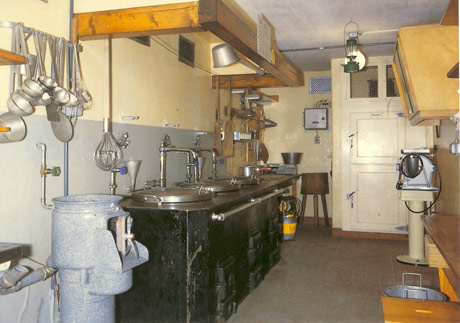
The series «Alpine Fortress – Life in the Réduit» focuses not on the military aspects of wartime, but rather on the everyday challenges of that era. The contestants must contend with itchy uniforms and rusty carbines. Anyone who wants to enjoy an idyllic dream vacation 200 meters underground can sign up now at Sf.tv/sf1/Alpine Fortress Apply for one of the—possibly highly sought-after—spots on the «Schweiz Aktuell» docu-soap. At Fürigen Fortress near Stansstad, the participants will want for nothing. The facility has everything your heart desires—gun emplacements, a radio room, and a medical station with an operating room. Convinced? Then let’s get started. And by the way: We’re looking not only for strong men but also for women, couples, and entire families to join this adventure!

1290582132_img090114_bunker
(Source: www.stansstad.ch)

To the point: We congratulate

This is the 33rd time that Werbewoche has presented its "Advertiser of the Year" award. It was voted for by the subscribers of Werbewoche. Six personalities from the Swiss advertising scene were nominated. In contrast to last year, neither a woman nor a representative from French-speaking Switzerland made it among the nominees this year.

This is the 33rd time that Werbewoche has presented its "Advertiser of the Year" award. It was voted for by the subscribers of Werbewoche. Six personalities from the Swiss advertising scene were nominated, selected by a prominent voting panel consisting of former male and female advertisers of the year. In contrast to last year, neither a woman nor a representative from French-speaking Switzerland made it among the nominees this year. A pity.
The Advertiser of the Year 2009 is Frank Bodin. He has already been nominated nine times, but so far it has never been enough to win. This year, Bodin was able to accept the trophy named Egon, designed by Swiss artist Max Grüter, at Zurich's Kaufleuten. The CEO of Euro RSCG received 21 percent of the votes. To date, Bodin has won more than 500 awards from virtually all festivals, he has been a jury member from Cannes to Clio, and in 2004 he was president of the Golden Drum. As president of BSW Swiss Leading Agencies, he is committed to our industry.
Just behind with 20 percent of the vote, Daniel Krieg landed in an honorable but ungrateful second place. Krieg is co-owner of Krieg Schlupp Bürge/Springer & Jacoby. Founded in 2004, the agency now employs more than 50 people and repeatedly attracts attention with its creative and intelligent advertising. Krieg studied at the University of St. Gallen. Before founding the agency, he worked not only as a copywriter and concept developer at various agencies, but also in investment banking, the consumer goods industry and publishing.
With 15 percent of the votes, Alexander Jaggy made it to third place. The Executive Creative Director of Jung von Matt/Limmat is not nominated for the first time either. Since 2004, he has led the creative work of the Zurich agency, which was recently voted "most popular advertising agency" in a survey by Handelszeitung.
For the tenth time, a broad audience jury presents the "Campaign of the Year" award. Twelve important works from twelve agencies were up for selection. In addition to the readership of Werbewoche, readers of the program guide Tele also took part in the voting. The choice was clear. Humor is the trump card: With 42 percent of all votes, they chose Suva's campaign as the winner. It was conceived and realized by the Ruf Lanz advertising agency.
In second place with eleven percent of the vote was the campaign for the Sonntagszeitung Sunday newspaper by advertising agency Wirz. With ten percent, Spillmann Felser Leo Burnett made it to third place with the campaign for Floralp.

Pierre C. Meier, Editor-in-Chief
[email protected]

PrintOnline gains market share

For the first time in a long time, PrintOnline is not reducing its rates. This is because the volume of advertisements transmitted fell last year - and is likely to continue to fall.

Print advertising declined last year. Although the December figures for the Wemf advertising statistics have not yet been published, the total number of advertising pages is likely to have fallen by around 10 percent, even though the Sunday press, for example, continued to record growth.
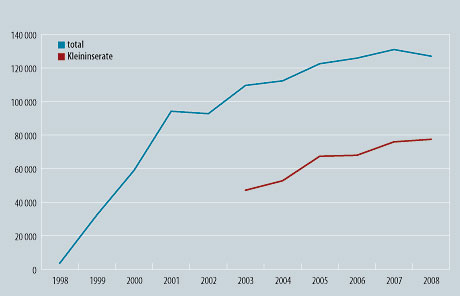
The digital data courier PrintOnline (POL) also suffered from this decline in advertising. POL, founded in 1997 by Publicitas, Tamedia, Ringier and NZZ, functions as an "electronic data courier" and transmits entire advertising campaigns from advertising customers and agencies to the affiliated publishers. In 2008, POL's transmission performance fell for the first time since 2002 - by 3 percent to 127,006 individual advertisements. However, this puts POL well below the decline in the industry as a whole. "It seems to me that we have gained market share in terms of transmission," says Managing Director Kurt Obrist. This applies all the more to small ads (those under 311 square centimetres), including classified ads.
Increase in classified ads
While the industry suffered the main slump in this area in particular, POL was actually able to make gains here. The share of small advertisements in the total volume transmitted by POL rose from 58 to 61 percent, which corresponds to an absolute increase of 1,500 individual advertisements. This is all the more astonishing as POL had lost market share in this type of advertisement in recent years to the specialized providers for online and print classifieds markets (Publiconnect, Scout24, Unio or Prospective). Now there seems to be a trend reversal, at least in terms of transmission for print. "But don't ask me why," says Obrist with a grin. Perhaps because POL is actively approaching advertising clients and is constantly winning new customers, he says.
The decline in volume has a price consequence: for the first time in several years, POL is not able to reduce its rates, but is leaving them at the 2008 level. Large publishers therefore continue to pay an annual connection fee of CHF 15,000 and CHF 11 per transmitted advertisement. Smaller publishers without a connection fee pay CHF 31 per advertisement. If the advertisements are smaller than 311 square centimetres (half a tabloid page), large publishers will continue to pay CHF 7 and small publishers CHF 19.
The fact that publishers and not advertisers finance POL has to do with the fact that the data courier is intended to make it easier for advertisers to handle print advertising - in the sense of an industry solution. However, as a non-profit company, POL passes on its surpluses to the publishers in the form of rate reductions. Since it was founded ten years ago, POL has already been able to reduce its rates several times - most recently a year ago.
More effort for clarifications
POL has been feeling the effects of something more and more frequently recently: the trend among in-house publishers to grant agencies direct booking compensation (DBE). The consequence for POL: more clarification work because incorrect orders or double bookings increased. The reason: anyone booking directly with a self-directed publisher can no longer go through the P booking system, which contains all the publishers' data. They have to enter the data in the POL system themselves. In addition, there are still no direct interfaces between POL and the publishers - currently only P has such interfaces.
For some time now, P and POL have therefore been working towards a standardized interface for data exchange. This requires investment on all sides. P has now taken the first step and adapted its system; POL, publishers and agencies must now follow suit. "That still needs some convincing," says Obrist. But in future, it should no longer matter how the booking is made or whether a title grants a DBE or not, because both leased and self-publishers will then be served via a standardized interface.

Markus Knöpfli

1290582138_img090114_grafik_kleininserate
Legend: Although the total number of advertisements is decreasing, the number of small advertisements submitted continues to grow.

Budgets of the week

The largest media budget in Switzerland has been signed and sealed: the Federation of Migros Cooperatives (FMC) is setting a new course in media management and will be working with OMD Switzerland from February 2009.

OMD receives the Migros media budget
The largest media budget in Switzerland has been signed and sealed: the Federation of Migros Cooperatives (FMC) is setting a new course in media management and will be working with OMD Switzerland from February 2009.
Sunrise new with Spillmann Felser Leo Burnett
SFLB has now been entrusted with the communication tasks for Sunrise's private customer division. Sunrise commissioned the Zurich agency to develop the entire website. The first works will already be on display at the end of January.
Hirslanden in the KSB/SJ portfolio
Following an intensive agency evaluation and a pitch, Hirslanden decided shortly before Christmas 2008 to appoint Krieg Schlupp Bürge/Springer & Jacoby as its new overall communications agency. The Hirslanden private hospital group comprises 13 private hospitals with over 100 competence centers and specialized institutes.

KSB/SJ for Coop: Price war enters the next round

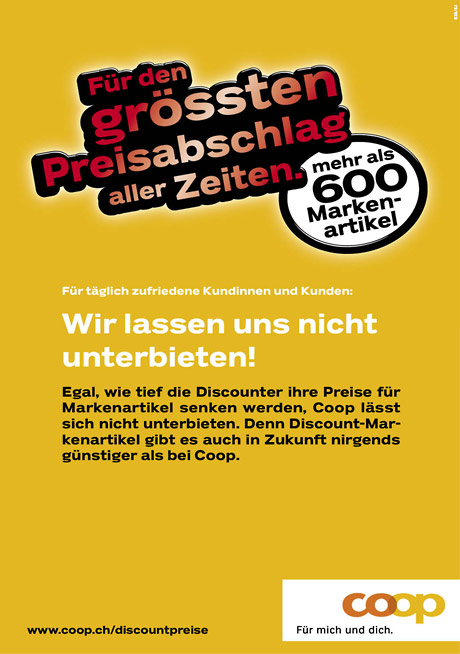
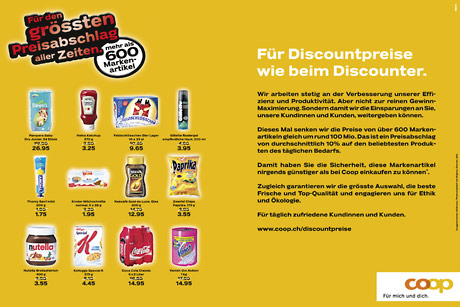
The KSB/SJ agency has launched another advertising campaign for Coop following the launch campaign "For discount prices like at the discounter". The aim is to double down in the price war with the message "We will not be undercut".

The KSB/SJ agency has launched another advertising campaign for Coop following the launch campaign "For discount prices like at the discounter". After the competition followed suit with price reductions, the aim is to follow suit with the message "We will not be undercut".
The campaign appears nationally in all major daily and Sunday newspapers, on TV channels and radio stations. It is also present on various online portals and at POS.

Responsible at Coop: Jürg Peritz (Head of Marketing/Procurement), Roland Frefel (Head of Category Management), Thomas Schwetje (Head of Marketing/Services), Lydie Goltdammer (Head of Advertising Realization). Responsible at KSB/SJ: Daniel Krieg, Uwe Schlupp (CD), Willem Baumann (AD), Adrian Hoenicke (text), Dany Kielholz, Christoph Bürge (consulting management), Nadia Bachmann (DTP), Adriana Stepanov (web), Combo Entertainment (production company), Roman Peritz, Siro Micheroli (producer), Milos May (visual effects), Roland Frei (music), NJP: Leos Gerteis (sound, radio), Detail (litho, image editing), Coop Media: Karin Heliopoulos, Initiative Media Western (media).

> To the spot

1290582133_img090114_coop1
1290582133_img090114_coop2
1290582133_img090114_coop3

Cosmic may advertise for BLS travel centers

The Bern-based agency Cosmic has won the advertising account for the BLS Travel Centers in a competitive pitch. The first results are expected to be visible very soon.

The Bernese agency Cosmic has secured the advertising budget of the BLS travel centers in a competitive presentation. New posters and advertisements will soon be on display and further communication measures will be taken. They are intended to draw attention to the latest travel and event offers.

I noticed…

Among other things, *Werbewoche* took note of a campaign by the Werbeanstalt for the Zurich Flower Market, a portable toilet called Boxi, and the 80th anniversary of Tempo paper tissues.

Floral Communication
On December 29, 2008, the new Zurich Flower Market opened its doors in Wangen, Zurich, offering the largest selection of cut flowers, plants, floral supplies, and gardening supplies in all of Switzerland. Spanning 52,000 square meters, the market offers florists and gardeners everything from A to Z—a selection they cannot find anywhere else in Switzerland in such abundance. The Werbeanstalt was commissioned by the Zurich Flower Market to design and implement all B2B communication measures: advertisements, mailings, point-of-sale (POS) displays, website, media relations, and numerous below-the-line (BTL) initiatives.

Cool Instead of Cheap
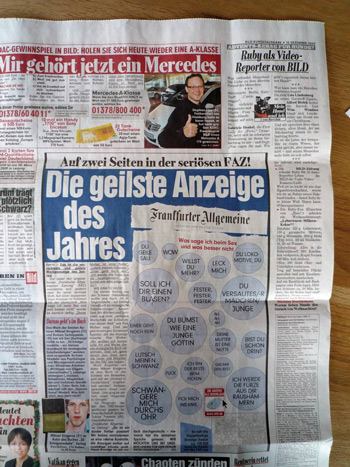
With a two-page ad in the Frankfurter Allgemeine Zeitung, the Zurich-based publishing house Kein & Aber certainly had to dig deep into its pockets. The «sex ad»—which cost around 100,000 euros and featured the text «What should I say during sex—and what’s better left unsaid?»—has become a major media sensation, much to Pius Walker’s delight. The Bild newspaper, for example, reprinted the ad on a half-page spread—in this case, for free. Incidentally, the ad is promoting a book that has absolutely nothing to do with sex: the guide «50 Success Models—A Short Handbook for Strategic Decisions.».

1290582136_img090114_aufgefallen2

Is it all Holland or what?
E-bikes are all the rage. More and more people are getting into these bikes, which use an electric motor to give riders a boost—or help them climb hills. One of the leading companies in this field is Accubike, based in the Zurich Oberland. However, Wirz took the photo for the ad featuring the crooked houses in San Francisco.

1290582136_img090114_aufgefallen3

For urgent cases
That urgent need usually strikes at the worst possible moment. It’s good to have a portable toilet on hand. Scholz & Friends Zurich has developed a series of ads for the sanitation systems supplier Boxi that showcase the many ways Boxi can be used.

1290582136_img090114_aufgefallen1

Now let's pick up the pace!
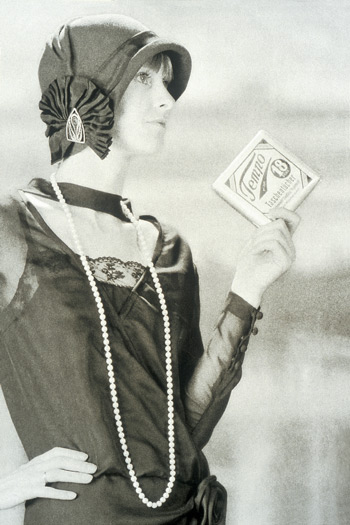
Tempo, the paper handkerchief par excellence, is turning 80—that’s 80 years of print and TV ads targeting runny noses, some of which, in retrospect, are highly entertaining. In the 1930s, the «Nastüechli» was marketed as a real sensation: Mrs. Müller no longer had to scrub her husband’s cloth handkerchiefs clean when he had a cold. No more germ-filled baths in the wash tub. «There’s a curse on nights of sniffles! – That’s where the Tempo tissue comes in,» declared a sleepless cartoon character with a runny nose back in the 1950s. In the 1960s, the company advertised its clever “quick-unfold” feature, which allowed for one-handed nose-blowing while driving or on a construction site. And in the 1990s, the tissue became snuffle-proof as well. Who could possibly have anything against Tempo on the road?

1290582136_img090114_aufgefallen4
get_footer();