Online advertising grows markedly

The latest publication from the Swiss Advertising Statistics Foundation shows that digital media, in particular, saw an increase in advertising revenue last year.

The statistics now also include projections for online advertising and advertising and promotional articles. The press remains the most important advertising category.

The Advertising Statistics Foundation has once again compiled net sales from the Swiss advertising market. Advertising sales totaling 5210 million Swiss francs were reported for 2015. This result is just below the previous year's level (-3 percent).

Since 2016, the advertising statistics now include figures on the development of online advertising. With an increase of 7 percent, sales in this area grew significantly compared with the previous year. The strongest growth can be seen in online display advertising, with +8 percent to 215 million Swiss francs. Sales of online directories were also up on the previous year (+5 percent).

Cinema and outdoor advertising with positive development

There were also positive developments compared to 2014 in outdoor advertising (+4 percent). Here, digital in particular increased, with a growth rate of 9 percent. Cinema advertising posted an increase in sales from CHF 28 million to CHF 34 million last year.

In contrast to online directories, business with printed address and telephone directories is declining (-12 percent). The TV (-3 percent) and radio (-5 percent) genres also recorded declining advertising sales.

As of this year, the advertising statistics now include the advertising and promotional products sector. Sales of these declined by 6 percent to 692 million Swiss francs.

Advertising pie remains stably distributed

Advertising revenues from the press declined year on year (-6 percent). However, with sales of over 1.4 billion Swiss francs, it remains the most important advertising category ahead of TV and direct marketing (see figure).

Bildschirmfoto-2016-05-28-um-10.24.20

In recent years, the Stiftung Werbestatistik Schweiz (Swiss Advertising Statistics Foundation) has tried unsuccessfully to collect comparable revenues for display advertising. Due to an improved response rate from the market, the figures for online advertising can finally be reported in 2016. With the inclusion of Promoswiss, sales for the area of advertising and promotional items are now also reported. This means that even more relevant advertising media are represented in the statistics. As the previous year's figures were also collected for both newly included advertising categories, comparisons with 2014 are possible.


Detailed explanations of net advertising revenues

wmss

Declining advertising market in Switzerland

Following the massive slumps in sales in 2009, the situation in the advertising market has stabilized. Nonetheless, sales have been declining across the board since 2011.

Development of advertising revenues does not run parallel to GDP

According to the latest SECO figures, gross domestic product has increased every year since 2009. The positive economic development does not run parallel to advertising investments. GDP no longer seems adequate, if not unsuitable, as an explanatory factor for the development of net advertising revenues.

Press: Advertising revenues down again

At CHF 1,436 million, net advertising sales in the Swiss press were 6.5 percent below the previous year's level. With a minus of 8.2 percent, the decline is greatest in the category of daily, regional weekly and Sunday press. Revenues from job ads are now only of marginal importance (CHF 65 million) and, in the case of the daily press, just reach a share of 8.8 percent of the total advertising volume.

Television: slightly down

Overall, the figures for TV advertising (including sponsorship of broadcasts) were down on the previous year, with revenues of CHF 749 million (-3.0 percent). The SRG stations' market share shrank to 48.6 percent. The advertising windows of the foreign stations increased their market share to 42.2 percent. The market share of the private Swiss stations remained virtually unchanged at 9.2 percent.

New: Online advertising: Marked growth

For the first time, the 2016 advertising statistics also include separate figures on the development of online advertising. Overall, sales from online advertising were significantly above the previous year's level at CHF 572 million (+7.0 percent). The strongest growth can be seen in the area of online display advertising, with +8.2 percent to CHF 215 million. Sales of online directories were also up +5.2 percent on the previous year at CHF 127 million. The online classifieds markets (jobs, real estate, cars) also saw significant growth (+6.8 percent) with sales of CHF 230 million. Figures for the search engine advertising sector can still not be reported due to a lack of willingness to report.

Cinema a clear winner in electronic media

Of the other electronic media, only cinema advertising showed a positive development (+21.4 percent). The figures for radio (-4.6 percent) and teletext (-19.0 percent) were again down on the previous year.

Out-of-home advertising: solid increase compared to 2014

Overall, advertising revenues for out-of-home advertising were above the previous year's level at CHF 449 million (+3.8 percent). Analog billboard advertising generated sales of CHF 345 million (+2.8 percent), while digital out-of-home (incl. adscreen) posted a growth rate of 8.9 percent (sales: CHF 36 million).

Decline in printed address and telephone directories

In contrast to online directories, business with printed address and telephone directories is in sharp decline. Sales fell by 12.2 percent to CHF 85 million in 2015.

Minor revenue losses in direct advertising

Revenues from distribution costs for addressed and unaddressed advertising decreased by 1.1 percent to CHF 1047 million

New: Advertising and promotional items record decline

Another new feature of the 2016 advertising statistics is the area of advertising and promotional articles. Sales in this area declined significantly by 5.7 percent to CHF 692 million.
 

Oliver Schibli becomes new Managing Director of Joiz

Internet and marketing specialist Oliver Schibli will become the new managing director of Joiz Switzerland. He succeeds Nicolas Bürer, who is stepping down at his own request to focus on his own business ventures.

Joiz CEO Alexander Mazzara explains: "We thank Nicolas Bürer for his great and very dedicated commitment to Joiz Switzerland. In the last two and a half years, he has succeeded in establishing Joiz in Switzerland and making the channel more mature with new programs."

foto-oliver-schibli

Oliver Schibli has extensive experience in online and offline marketing. He founded the first streaming company in Switzerland in 1998 (ITV Media). From 2002 to 2008 he worked for Bluewin Portal, last as Head of Product Management. Subsequently, he worked as Head of Sales and Head of Product Management for Tillate and for Ringier. In the last four years he was CEO of ricardolino.ch/ Olx.ch.

Joiz CEO Alexander Mazzara: "With Oliver Schibli we are able to sign a CEO who has a good track record in digital marketing, digital transaction business and online advertising and who has a broad know-how for internet technologies and internet markets in Switzerland and Europe. Under his leadership, we will further develop Joiz Switzerland into a leading provider of interactive and cross-media content."

Oliver Schibli in a statement: "I'm thrilled to be working with the experienced and very creative Joiz team. It is an exciting challenge for us as a team to make a program that appeals to a broader audience and is geared towards the ever-increasing number of mobile users. Together, we will ensure that Joiz continues to grow and that we establish interactive TV in Switzerland."

Four over five - high success rate in the KP exam

At the 2016 Federal Examination for Communication Planners, four candidates out of a total of 72 achieved an outstanding grade point average of over 5.0.

This spring, 72 candidates from all over Switzerland made the journey to Zurich and Biel for the federal communication planner exams. For 82 percent from German-speaking Switzerland and 66 percent from French-speaking Switzerland, the great effort they invested was more than worth it! They passed the professional examination, proving that they have mastered the three main subjects of communication planning, media and production. In the written examination for these subjects, the candidates were allowed to bring and use a federal folder with specialist documents for the first time in 2016. This help had no direct impact on the results, at least this year. Many candidates soon realized that valuable exam time was lost when leafing through the folder.

Four graduates from German-speaking Switzerland shone this year with an average grade of over 5.0. The best result in Switzerland was achieved by Nadine Kradolfer from Spiez with a strong final grade of 5.3, followed by Sara Hübscher (Zug) and Anja Roy (Schlierbach) in second place with a grade of 5.2. Dino Amantea from Baden also made it onto the podium with a score of 5.1. In French-speaking Switzerland, Diego Mediano from Lausanne achieved the best result with an average grade of 4.9. This means that a new, highly motivated cohort of professional practitioners is entering the varied and exciting world of commercial communication. The coveted professional certificates will be awarded on June 24 in Bern by the Chairman of the Examination Board, Urs Schneider.

You can find all successful candidates in this PDF.
 

Matter Gretener Lesch: Quickly switched for Place B

Matter Gretener Lesch has used the criticism of FCZ President Ancillo Canepa to promote storage space.

Only 24 hours after the idea was born, it already caused a lot of smiles in the "Blick": For their new client placeB, the nudge agency Matter Gretener Lesch cleverly used the FCZ fans' displeasure with Ancillo Canepa to advertise storage space.

fcz_0

Responsible at Place B: Manuel Gerber (Co-Founder and Chief Marketing Officer). Responsible at Matter Gretener Lesch: Daniel Matter (Creative Direction), Dominik Imseng (Text), André Schmid (Graphics), Verena Knof (Consulting).
 

Twint and Paymit merge

The five largest Swiss banks—Credit Suisse, Postfinance, Raiffeisen, UBS, and ZKB—along with the financial infrastructure provider SIX, the retailers Coop and Migros, and Swisscom have agreed on a joint solution for a Swiss mobile payment system.

It combines the strengths of Paymit and Twint and offers a platform-independent, competitive and customer-friendly solution for all market participants. In addition to the payment function, value-added services are key elements of the joint solution. The merger of the two current systems will take place in the course of fall 2016. Users and merchants of Paymit and Twint can continue to use the two systems as usual until the migration to the new platform.

Further development and operation will be transferred to a separate company in which the five largest banks and SIX will participate. It will be chaired by Jürg Weber and headed by Thierry Kneissler as CEO.

The nine companies announced open-ended exploratory talks for a joint mobile payment solution at the end of March 2016 (Werbewoche.ch reported). The aim of the talks was to clarify the feasibility of a joint, customer-friendly mobile payment system that could be rapidly disseminated and used throughout Switzerland both in stationary retail and for online purchases and other applications. In May, the talks took concrete shape, as reported by the Sunday press (Werbewoche.ch reported).

Strengths of both systems combined

The companies involved have now agreed to operate a joint mobile payment system that combines the advantages of the two systems Paymit and Twint, which were previously operated separately. The new system will operate under the "Twint" brand. There will be a comprehensive re-branding to reflect the joint Swiss mobile payment platform. The joint platform is open to all consumers and merchants - from wholesalers to espresso bars, banks, issuers of payment cards, acquirers and all other domestic and foreign market participants. It can be used across channels at the store checkout, in e-commerce, in apps, at vending machines, and between people. "We are now working flat out to migrate the two systems and make the joint platform available to all merchants and end customers in the course of fall 2016," explains Thierry Kneissler, who will head the new company as CEO.

The platform combines the strengths of Paymit and Twint. In addition, as with Paymit, each partner bank can release its own co-branded application, and retailers have Twint's option to integrate their own loyalty cards into the system. "I am glad that our efforts for innovative digital solutions in the financial sector have resulted in a joint whole here, where we were able to bring together the best of the two worlds," says Lukas Gähwiler, President UBS Switzerland.

Extensive functionalities

Users in particular will benefit from the joint payment solution, according to the statement. They will find broad acceptance in brick-and-mortar retail, be able to shop online and in merchants' applications, pay bills and use vending machines to pay for groceries, parking tickets, ski passes and other goods and services. Transfers among users will also continue to be possible. In addition, users can choose how they want to settle their mobile payment: the new payment solution accepts both the connection of a bank account and a credit or prepaid card, as well as prepaid top-up. Merchants also benefit from the joint solution: value-added services such as the integration of loyalty cards, stamp cards or promotional discounts (mobile couponing) are available to interested merchants and customers.

"We are very pleased that we now have a solution that is technologically innovative and where we have been able to combine the different functionalities of Paymit and Twint for the benefit of customers," says Alexandre Zeller, Chairman of the Board of Directors of SIX.

Thanks to the common standard, multiple integration of different payment solutions is no longer necessary, thus saving investment costs for merchants. The solution is technologically open to integrate existing and future transmission technologies such as Bluetooth, QR code and NFC. In particular, in addition to twinterminals (beacons), the payment terminals of all providers that are also available can be integrated into the system. This is with the aim of achieving the fastest and most widespread market penetration possible. Even micro-merchants or service providers can connect to the system without major investment. This will enable us to fulfill the Federal Council's mandate to provide a modern payment traffic infrastructure together with our partners from the Swiss financial center and the retail sector," adds Hansruedi Köng, CEO of Postfinance.

Own company

Operation of the joint solution will be transferred to a separate company called Twint AG, in which the five largest banks and SIX will have a stake and which will continue to work with existing strategic partners, including Swisscom for bank integration.

The BoD will be composed of the owners. Jürg Weber, Division CEO Payment Services of SIX, will assume the chairmanship. Thierry Kneissler will lead the company as CEO. He currently heads Twint, a subsidiary of Postfinance. "It will now be a matter of quickly translating the common will for an innovative and competitive mobile payment system into a high-quality service for consumers and retailers through reliable structures and processes," adds Jürg Weber, designated Chairman of the Board of Directors.

The implementation of the joint mobile payment solution is still subject to approval by the relevant competition authorities. Subject to these decisions, a joint solution should be ready for use in the course of fall 2016. Until then, users of Paymit and Twint can continue to use the services and functions of their provider. Existing contracts will be transferred depending on the solution.

Ad School Switzerland launches

Education Initiative for the Swiss Communications Industry: ADC, Leading Swiss Agencies (LSA), and the Account Planning Group (APGS) are jointly launching the Ad School.

Starting in mid-August, both a creation course for young art directors, copywriters and digital professionals and a strategy course for young strategists and consultants will be offered. Partners such as Google and the HWZ will also be on board.

Ad-School-Logo-t

The Ad School is new and yet experienced. It emerged from the ADC/BSW Creative School and takes its ideas into the present day. In other words, it is more digital and networked. Thus, it not only offers creative talents the tools, but thanks to the cooperation with the Account Planning Group Switzerland also young consultants and strategists a specific further education - with the course Strategy

At the Ad School Switzerland, the most gifted talents in the communications industry are to learn from the best representatives and lecturers in the industry. According to school president Peter Brönnimann, 37 top lecturers from Switzerland and abroad have been engaged. Google is a cooperation partner, and collaboration with the HWZ is also in the pipeline.

On August 18, the first part-time courses, lasting about four months, will start: The course Creation for young copywriters, ADs, graphic designers and digital as well as the course Strategy for consultants who want to further their strategic education.

In the creative course, creative talents such as ADs, graphic designers, copywriters and digital professionals are taught the theoretical and practical tools they need today: from strategy to idea generation and evaluation to media-appropriate implementation in a wide variety of channels - with a special emphasis on the digital challenges of today and tomorrow.
The 2016 lecturers of this course include industry giants such as Michael Conrad, Peter Felser, Martin Spillmann or David Schärer, as well as a variety of excellent digital specialists; including Michael Hinderling, Hansi Voigt, Remo Prinz, Christian Etter or UX specialist Adrian Zumbrunnen. In addition, Google is holding a one-day seminar on the topic of "Today's Mobile Moments".

The Strategy course is aimed at people who want to further develop the strategic challenges in an agency: How do we develop strategies that leave a lasting mark on brands and markets? What motivations and desires drive people and how do we use these insights to develop meaningful brand positioning that holds up on- or offline? How do we communicate brand values via extraordinary platforms and how do such concepts become successful cases?

The lecturers include strategy professionals such as Peter Felser (Serviceplan), Uwe Munzinger (Sasserath Munzinger Plus), Simon Rehsche (Heimat Zürich), Ester Elices (Publicis), Christoph Krick (brand consultant and lecturer), Matthias Breitschaft (Vorn Consulting), Christian Rieder (link), Rene Schwarz (namics 13), Michael Selz (OMD), Gordon Nemitz (Wirz), and other exciting marketing experts such as Geri Aebi (Wirz), Steven Goodman (watson), Bernhard Brechbühl (Storyfilter), Christoph Birkholz (Impact Hub), and Michael Conrad.

Ad-School-Dozenten

The students of both courses do a final project together - from the strategy to the final presentation. You can register now via Adschool.ch.
 

Cross-media Snapchat campaign

For Milk Day 2016, Swissmilk relied on Snapchat in addition to its usual channels. The Bernese agencies Klarkom and Newsroom Communication staged a cross-media love story around the bike freak Manu and the farmer's daughter Bianca.

Where do schoolchildren and young people spend their time digitally these days? That's right: where their parents and teachers aren't watching them: on Snapchat. 59 percent of 14- to 19-year-old Swiss teenagers use the trendy app on their smartphones. That's where Swissmilk got them in the mood for this year's Milk Day.

Virtual center

For Swissmilk, one thing is clear: milk should continue to be popular with young and old alike. Milk Day is therefore primarily a celebration for children, young people and families. The highlight is the concert by a well-known Swiss act at the main event - this year Bastian Baker played in Neuchâtel. To generate excitement and build anticipation, Swissmilk announced Baker's gig off- and online. The poster competition, in which a hundred schools from all over Switzerland created subjects on the theme "Swiss milk. Naturally good." also attracted attention in the run-up to the event.

To better reach its target groups on social media, Swissmilk has been setting up the #agdermilch newsroom on its own website since 2015. This shows vlogs, photos and other posts from Swissmilk before and during Milk Day and bundles all social media posts from the public. Milk Day, which is celebrated in more than 100 locations from Geneva to Herisau, is thus given a virtual centerpiece.

tagdermilch

Apron Communication

This year, Swissmilk further expanded its apron communication: The campaign, which was designed by Bern-based content agencies Klarkom and Newsroom Communication, also relied on Snapchat for the first time. Therefore, students who participated in the poster contest received an eraser with the Snapchat code printed on it, which led them directly to the messaging app. Success was not long in coming: the students became hundreds of Friends of Bianca & Manu and a dynamic exchange ensued. The snaps from the young people were extremely creative and demonstrated that this type of communication is very well received by this target group. "Important for the campaign was a meticulously thought-out content board that coordinated all snaps, vlogs and posts in terms of timing and content," says Marcel Suter, Partner at Klarkom.

Do cows actually snore?

Actor David Bühler as young bike freak Manu and blogger Kathleen Fuhrer as Bianca gave the campaign a German- and a French-speaking face. While Bianca has a romantic crush on Bastian Baker, Manu has fallen in love with the farmer's daughter Bianca. To please her, he spares no effort: he finds out about the world of cows and milk on a farm and in a dairy. In his articles, he plays the cool city dweller who wants to know whether cows sweat and snore. The story is told in countless snaps, Instagram posts and a good dozen vlogs.

On Milk Day itself at the Place du Port in Neuchâtel, the virtual world merged with the real one: Bianca and Manu had their hands full meeting the autograph requests of the youngsters. "To be successful, channels and content have to complement each other," says Brian Ruchti, executive member of Newsroom Communication, "a hip platform without a good story doesn't work."

Newsroom

In fact, in the ten days that the Newsroom was up, it received 8117 views from 6673 unique users. They stayed on the site for an average of 3:52 minutes. On social media, the reach was significantly increased compared to 2015. While the official hashtag had a reach of 15,049 unique users in 2015, this figure rose to 26,201 in 2016. Technically, the campaign relied on the proven content marketing tool from Newsroom Communication.

The milk party on the web: The Newsroom #agdermilch


Electronic media grow together

Advertising pressure on the Internet is increasing sharply. The TV sector is also continuing to grow. This is shown by the Goldbach Index (Gemi) figures on advertising pressure in April 2016.

Advertising pressure in the Internet sector is up 18 points in the GEMI in April and is now at a high of 964 points. TV also increases by 5 points. Radio loses 4 points compared with the previous month.

gemi

The total market for all media gained one point and now stands at 241 points. The electronic media sector gained 5 points and now claims 688 points. Compared to the previous year, this is already 8 points more.

gemi1_1


Great international interest in US election

CNN International Commercial commissioned a study that highlights the widespread international interest in the 2016 race for the White House. According to the results, most viewers turn to CNN to stay informed about the U.S. election.

CNN's outstanding ratings and website traffic in the US confirm this result, according to a CNN statement. To understand the global impact and interest in the US election, CNN commissioned independent market research firm Toluna to study the opinions, viewing and usage habits of adults from over 23 countries in Europe, the Middle East, Africa, South America, Canada and the Asia-Pacific region on the race for the White House.

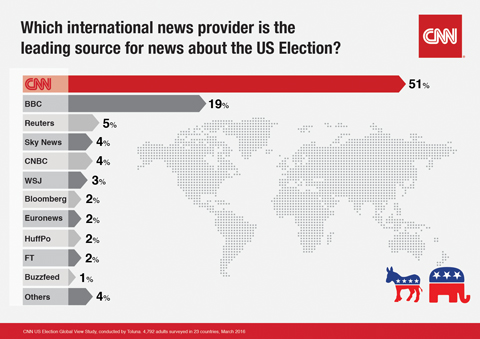
The results of the "CNN US Election Global View" study show that 51 percent of respondents watch or use CNN to find out about the current status and results of the US election. This means that CNN performs better than all other international news providers combined: BBC comes in at 19 percent, Reuters at five percent and Sky News at four percent. 78 percent of respondents watch or follow CNN regularly. 83 percent of them have used the CNN Politics service in the past week. The majority of respondents get their information linearly on CNN - 50 percent via TV, 31 percent via CNN.com, 14 percent via CNN's social media channels and eight percent via the CNN app. Commenting on CNN's coverage of the US election, 66 percent found the international news channel's information to be knowledgeable and intelligent, 64 percent considered it to be technically competent, 64 percent comprehensive, 62 percent engaging and 60 percent standard-setting.

Statistik2

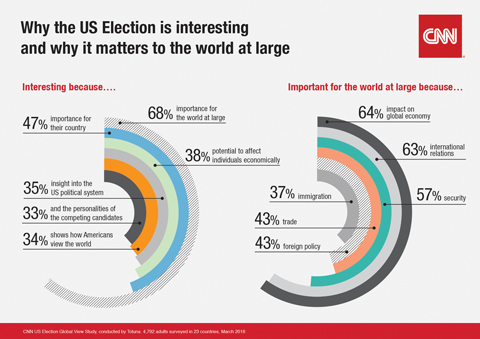
In addition to examining user behavior, the personal interest of the respondents in the US election also plays a role in the survey. The main reasons for this are:
- General international importance (68 percent)
- Importance for their own country (47 percent)
- Possible individual economic impact (38 percent)
- Insight into the US political system (35 percent)
- Indication of Americans' world view (34 percent)
- Interest in the incumbent presidential candidates (33 percent)

Respondents gave the following reasons for the global relevance of the presidential election:
- Important role of the USA in the global economy (64 percent)
- Impact on international relations (63 percent)
- Role of the USA in global security and the fight against terrorism (57 percent)
- Trade policy and a shift to a tougher US foreign policy stance (both 43%).

Statistik1

Why the US election is captivating the world...

A commentary by Petra Malenicka, Senior Vice President, Western Europe & The Americas, Advertising Sales, CNN International

It's a topic that everyone has an opinion on. Whether in meetings, on the plane or talking to my children - everyone is talking about the presidential election campaign in America, which seems to be heading towards a duel between Clinton and Trump. There is still some time until the final election in November, but the most diverse people I come into contact with are already captivated. This is reflected not least in CNN US's impressive ratings and website hits. But the question remains: beyond my personal experience, how relevant is the election for the international audience?

As a company that prefers to base its decisions on facts rather than intuition, we commissioned a study to understand how the world is following one of the biggest news events of 2016. Independent market research company Toluna analyzed the opinions, viewing and usage habits of adults from almost 5,000 interviews from over 23 countries in Europe, the Middle East, Africa, South America, Canada and the Asia-Pacific region. The results show such a high level of interest that even I was surprised: 85% of respondents consider the US election to be important for world events and 73% are personally interested in the race for the White House.

The main reasons for this are:
- General international importance (68 percent)
- Importance for their own country (47 percent)
- Possible individual economic impact (38 percent)
- Insight into the US political system (35 percent)
- Indication of Americans' world view (34 percent)
- Interest in the incumbent presidential candidates (33 percent)
The last point in particular piqued my interest. With all the discussions about the so-called "Trump effect", interest in the incumbent presidential candidate is only in sixth place.
Respondents gave the following reasons for the global relevance of the presidential election:
- Important role of the USA in the global economy (64 percent)
- Impact on international relations (63 percent)
- Role of the USA in global security and the fight against terrorism (57 percent)
- Trade policy and a shift to a tougher US foreign policy stance (both 43 percent)

It is clear that respondents around the world see this election as a defining moment in American foreign policy.

In addition to the global interest in the election, we were also interested in finding out how and through which channels respondents obtain information on the topic. The results of the study speak for themselves: more than half of those surveyed, namely 51%, use CNN to follow the current status and results of the US election. This means that CNN performs better than all other international news providers combined: BBC comes in at 19 percent, Reuters at five percent and Sky News at four percent. Even though we had hoped for this result, confirmation from an independent study is important for us. With so much on offer in the media landscape, the battle for attention and viewers is fierce. Another interesting aspect is which channels the respondents use to obtain information. The majority inform themselves linearly on CNN - 50 percent via TV, 31 percent via CNN.com, 14 percent via CNN's social media channels and eight percent via the CNN app. Contrary to the pessimism - linear television is alive and well, although it is being expanded to include digital offerings.

This study is an important tool to provide marketers and media professionals with a quantitative assessment of how engaged the world is with the current US election campaign. It is often said that the money follows the audience and with our advertising strategies we offer the opportunity to do just that. Now we have tangible proof of the public's thirst for knowledge about the presidential election, which we want to satisfy with the new show "State of the Race" on CNN International. My tip to national advertisers: Be part of what the world is talking about. Regardless of regional political developments and the upcoming election results in November - the US election cannot be ignored because the world is watching with great interest.
 

McDonald's goes new digital ways

TBWA\Zurich and Goldbach Interactive promote the current campaigns of McDonald's Switzerland in new digital ways: In the next few weeks, the campaigns for the Friends Menu and the new Pulled Pork Burger will be accompanied by interactive ads.

Mobile users are addressed according to location and time, for example at lunchtime in the vicinity of a McDonald's branch. Prominently placed out-of-home advertising rounds off the holistic presence. For the promotion of the Friends Menu with the well-known call "It's worth sharing," a mobile-only banner campaign was launched to suit the young target group. Via a WhatsApp share button, users can invite their friends to the Friends Menu with a personal message.

mac1_0

The new Pulled Pork Burger from René Schudel is advertised on the largest online portals using rich media ads. In the animated ad, the burger is slowly assembled ingredient by ingredient, in keeping with the advertising slogan "Probably the slowest burger in the world. Depending on the ad type, the burger is even topped depending on the user's scrolling behavior.

mac2_0

Due to their interactivity, the two digital campaigns allow the target group to access the product in a new way. Initial reporting confirms the success of the digital campaigns, which is also confirmed by Thomas Frésard, Food & Family Manager at McDonald's Switzerland: "The first results are already above the benchmarks set, which is why we will continue to use the ads.

Responsible at McDonald's Switzerland: Thomas Truttmann (VP Marketing, Communications, Public Affairs, Supply Chain), Thomas Frésard (Food & Family Manager), Severine Caspard (Marketing Consultant). Responsible at TBWA\Zurich: Angelo Sciullo (Art Director), Stéphanie Seematter (Graphic Designer), David Voges (Junior Copywriter), Tobias Jean (Digital Consultant), Esther Ortega and Ilenia Peluso (Account). Responsible at Goldbach Interactive (Switzerland): René Schoedon (Creative Supervisor), Jenna Uldry (Junior Consultant), Bunni Kuhn (Senior Frontend Developer), Benedict Ritschel (Rich Media-/Frontend Developer), Sandro Kohler (Senior Art Director Motion Picture).
 

Last but not least: Good design for a good cause

Since early April, graphic designers have been able to support SOS Children's Villages by submitting their poster designs for the Charity Creative Award. The best poster designs will be used in high-visibility advertising campaigns for SOS Children's Villages.

By visualizing the theme of talent in a designed poster, graphic designers can now use their talent and passion to win prizes and do good at the same time. Further designs can be submitted until July 15, 2016 via the Contest website be submitted digitally. Cewe-print.de will donate 100 euros per participant to SOS Children's Villages worldwide.

CCa

The winning poster design will become part of a communication campaign by SOS Children's Villages Global Partner. Selected winning posters will be exhibited at Photokina 2016. The 13 best poster designs will be rewarded with vouchers from Apple, Wacom, Cewwe-Print.de and Cewe Fotobuch as well as SOS Children's Villages sponsorships and page subscriptions. In addition, the winning posters will be published in Cewe-Print.de's "Charity Calendar 2017". (uma/pd)
 

get_footer();