Researchers do not see SRG in competition with private broadcasters
According to a study by the University of Zurich, the SRG is not a competitor to private media. Users of the SRG often consume private media as well, according to the 2024 «Yearbook on Media Quality.» The reach problem caused by competition from tech platforms, as well as the lack of willingness to pay in the online sector, is affecting all of the titles and platforms examined.


61% of SRG users also consume private media, as reported by the Research Center for the Public Sphere and Society Fög on Monday. In contrast, only 38% of people who do not consume SRG information programs do so. Commuter and tabloid media are also consumed significantly more often across all channels by SRG users than by non-users.
According to the study, the same also applies to the online sector. Only around four percent of all respondents only consumed SRG news online. This is significantly less than the proportion of respondents who only use commuter and tabloid media online (26%) or only subscription media (8%).
"Public media obviously encourages people to continue consuming news," said Linards Udris, deputy head of research at the Fög, at the media conference on Monday. The study shows "a complementary, supplementary use" rather than a crowding out of private media. "The displacement thesis does not apply," said Fög Director Mark Eisenegger.

Media have a reach problem
However, both private and public media are reaching fewer and fewer people: The number of so-called news-deprived people in Switzerland has risen to a record 46%. Although the quality of the media is good overall, they have a reach problem. News-deprived people are most likely to use media on social media, according to research director Udris.
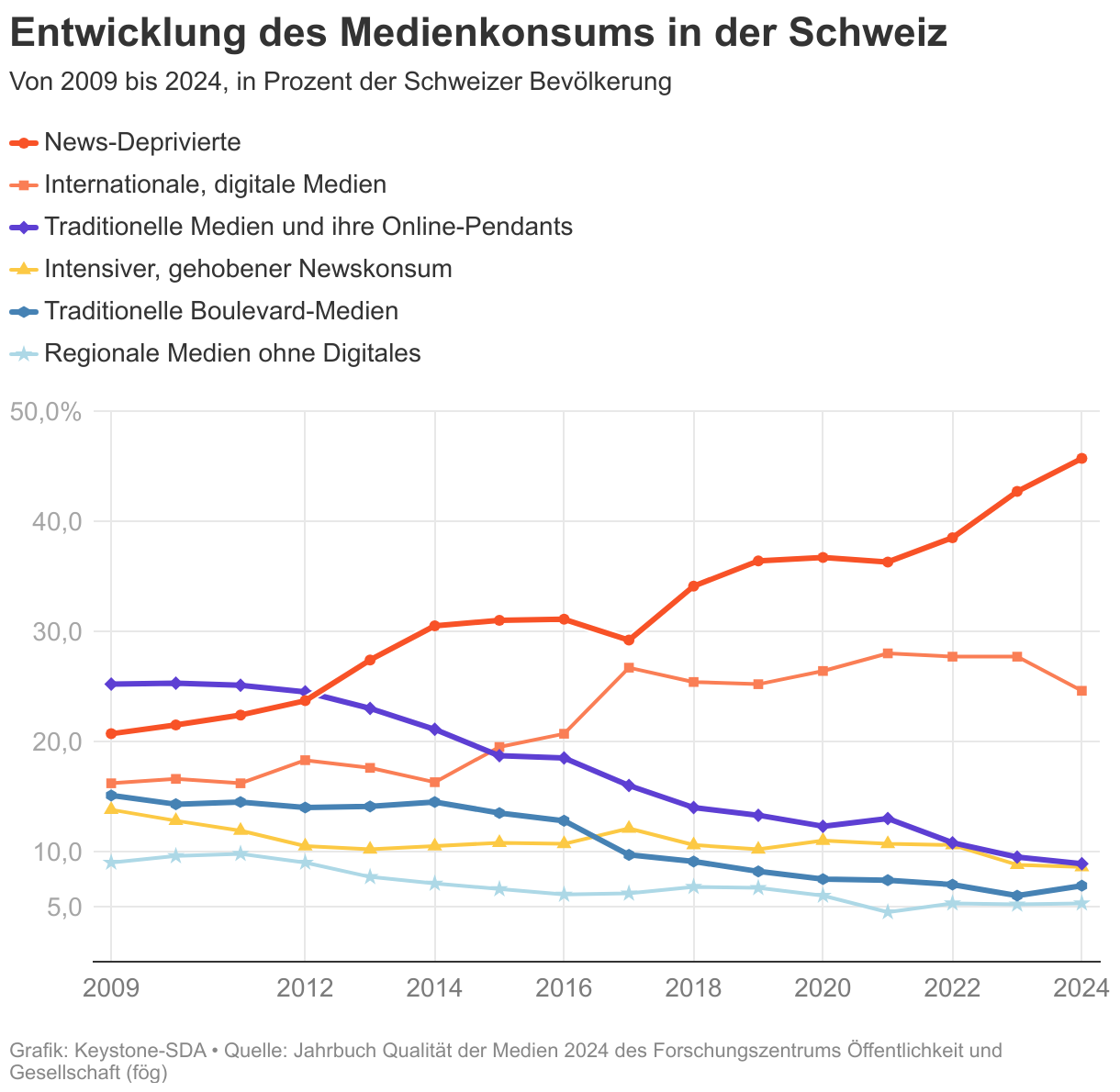
Due to the tight financial situation, there is also a concentration of media content, the yearbook continues. In regional reporting, for example, articles are increasingly being used more than once. The Fög considers a further loss of diversity at local and regional level due to fewer daily information offerings to be problematic.
The Fög recommends greater cooperation between public and private media. This is to counter the tech platforms that are siphoning off a large proportion of online advertising. According to Fög Director Eisenegger, these are the biggest challenge for all media - both public and private.
57 percent would not pay anything online
There is also a lack of willingness to pay, particularly in the online sector: 57% of respondents stated that they would not pay anything. A further 35% would be prepared to pay less than CHF 10 per month.
However, according to the study, the median for online subscriptions is CHF 18 per month. However, no statistical correlation was found between the use of certain types of media and the willingness to pay.
Whether online news is paid for or not depends more on the attitudes and socio-demographic characteristics of those surveyed. Men and younger people are more likely to pay. And those with a strong interest in news and politics are more willing to spend money on digital news services.
SRG scores highly for quality and trust
According to Fög, most respondents trust SRG news programs with 7 points on a scale up to 10. Le Temps and NZZ with 6.8 and 6.6 points. At the other end is the View with 5 points, on a par with GMX and Yahoo News.
On a scale of up to 10 points, the Fög attests the highest quality to SRF radio and television programs with 7.7 and 7.5 points respectively. Echo der Zeit" took first place with 8.1 points, ahead of "Rendez-vous" with 7.9 points, while private television was on a par with online subscription newspapers with 6.4 points.
Tabloid and commuter newspapers came last with 4.6 and 5 points respectively. However, the study expects long-term improvements in the areas of relevance and diversity as more hard news is published. This is thanks to journalistic changes that focus more on quality.

Great skepticism towards AI
The study also shows that the population remains skeptical about the use of artificial intelligence (AI) in journalism. Almost three quarters of Swiss people rate the risks of AI in journalism as high, even higher than in other areas of society such as politics or the military.
According to the study, the more AI intervenes directly in journalistic output, such as text or image production, the greater the skepticism. According to Fög deputy head of research Daniel Vogler, this may also be one reason why Swiss journalists are not prepared to use AI-generated news. However, the majority are in favor of using AI for translations, data analysis or research.

The Yearbook of the Media has been published since 2010. According to the Fög, the aim is to deepen the discussion about the quality of the media and to promote awareness of the achievements of information journalism in society. All types of media are examined, from press, radio and television to online and social media. The data basis is the Digital News Report of the Reuters Institute at Oxford University. (SDA/swi)