Moving image planning in transition
Today, moving images span a wide variety of channels. The spectrum ranges from traditional TV to streaming services, movie theaters, and social media, all the way to news platforms and digital out-of-home (DOOH) formats. This development is changing not only media consumption habits but also the way advertisers must plan video campaigns.


Today, moving image planning no longer means thinking in terms of channels, but in terms of user behavior. The focus is on attention, context and impact - regardless of the channel and screen.
Traditional linear TV is still very important in the Swiss media market. On the one hand, high net reach can still be achieved with linear TV. On the other hand, classic TV picks up viewers in a "lean back" situation. At this moment, the focus is on more relaxed, passive use; media content is consumed without actively "interfering" in the action (for example by quickly scrolling or swiping or when using gaming content). This passive use in turn has a positive effect on the advertising impact and thus on the overall success of the campaign, as the activation level of content and advertising is close to each other (source: Video Impact, SevenOne Media GmbH, January 2020).
Despite these advantages of traditional, linear television, linear TV usage is declining. There are increasing gaps in reach, particularly in younger age segments. These gaps can be filled - at least in part - by using moving image offerings that pick up the target audience in the same emotional state, i.e. address them in a comparable "lean back" situation. This includes streaming offers, but also replay ads. Outstream formats (such as those offered by news platforms) and social media formats, on the other hand, are less suitable, as the target audience is in a different emotional state when using them.
If you want to pick up the target persons in "lean back" mode, the TV screen remains central as the playout device, provided the TV is a connected TV, i.e. a device connected to the Internet (such as a smart TV). However, passive media consumption behavior can also take place on mobile devices, be it on a desktop or laptop or even on a smaller screen, whether at home or on the move.
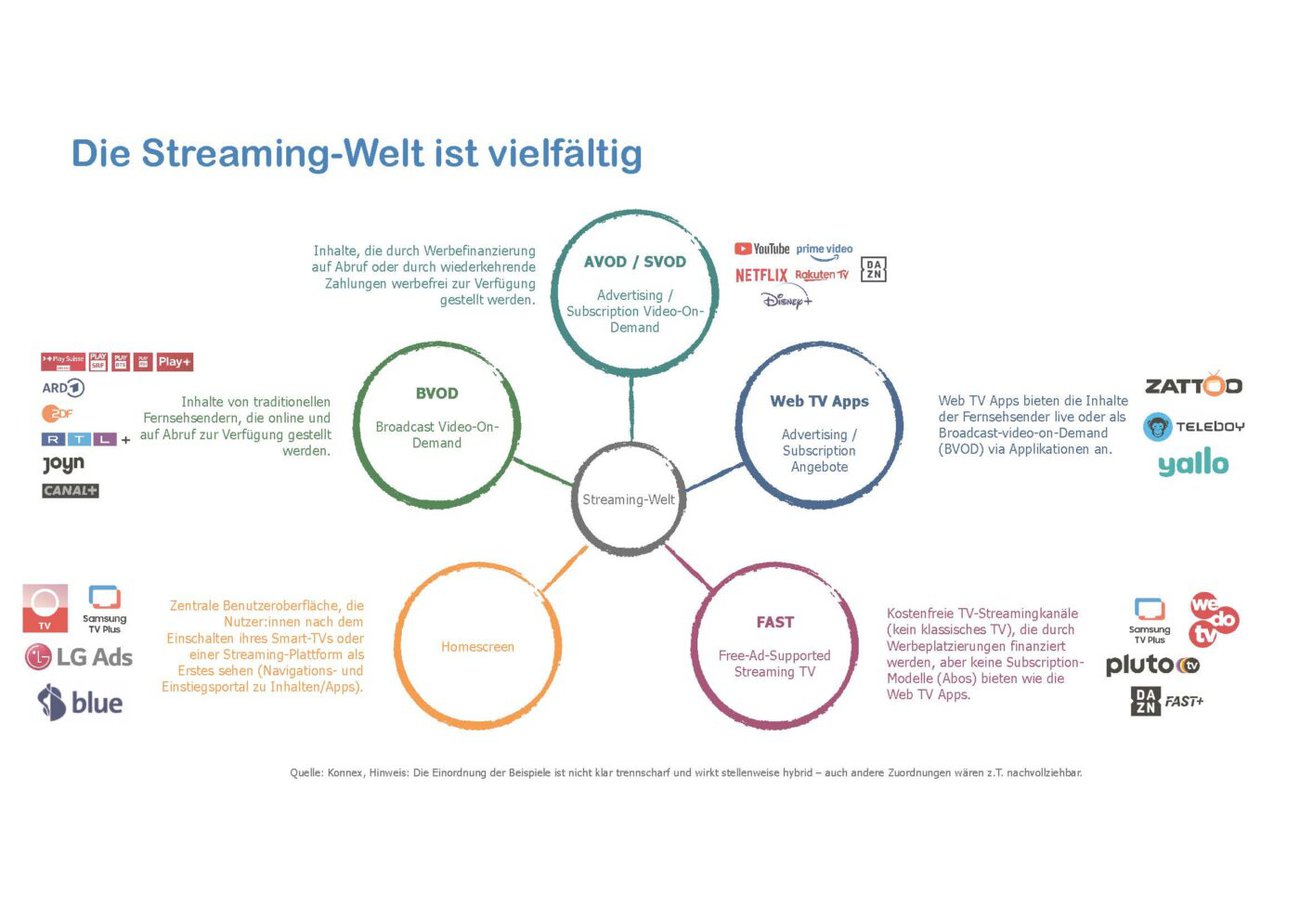
However, implementing holistic moving image planning that combines to form an effective whole is not easy. Even with a focus on the streaming world or even just the CTV sector (i.e. content that is played exclusively on a TV set connected to the internet), advertisers are faced with a highly fragmented ecosystem of platforms, publishers and end devices.
Although the various streaming services can be categorized by provider, type of service or financing, the same inventory is offered by several marketers, which leads to countless overlaps. Here is an example: pluto tv, a free, ad-financed streaming service from Paramount, can currently be booked to target Swiss users via Goldbach Media, Ringier, Screen on Demand and, of course, the Google advertising platform DV360, among others. No marketer can specify the priority of the bookings made through them.
Device owners (i.e. TV device brands such as Samsung or LG) are another market player alongside app and content owners as well as pure marketers. This multitude of providers marketing identical inventory increases the risk of campaign cannibalization. If the same campaign accesses the same advertising space across different platforms, it competes with itself and drives up bid prices. This in turn reduces the efficiency of playout. The advertiser can therefore only focus on as few providers as possible and exclude offers that are marketed by several providers, thus preventing double booking.
However, the streaming market is not only characterized by strong fragmentation on the marketer side, but also on the content supplier side. Irrespective of the risk of possible duplication, this generally makes it more difficult to control playout. The issue of brand safety therefore represents a further challenge.
In contrast, brand safety is a given for bookings in the linear TV environment (at best, the brand fit of certain environments can be discussed). Ad fraud is also becoming a risk with the increasing importance of streaming inventory. This involves the use of bots or fake CTV devices that simulate viewer numbers. As a result, advertisers pay for non-existent or unseen ad placements. Ad fraud can be countered by booking through established, trustworthy marketers. But here too, fraudsters are always one step ahead!
Another major challenge for holistic video planning is the lack of uniform research standards and metrics. When planning TV, we are used to obtaining reach and contact figures. With the exception of replay ads, there are no corresponding standards from the digital platforms. At the moment, it is primarily the gross reach of a campaign that can be measured, i.e. the number of video ads played. Multiple contacts can sometimes be identified at device level, but without personal information. Statements on the number of people reached or on incremental reach are therefore generally based on estimates. In most cases, these are based on login data. However, this does not say anything about who actually uses the media content played and whether only one or several people are sitting in front of the respective device (so-called "co-viewing"). At the same time, this means that in most cases it is not possible to work with target group criteria analogous to TV planning. It is necessary to work much more with environment-related criteria. This is not a disadvantage per se, as the relevance of age-related criteria is debatable. However, the comparability or "fit" with linear TV use is only possible to a limited extent.
This makes the test carried out as part of a joint initiative by Goldbach and Mediapulse to measure the net personal reach of online video ads and combine this with TV reach all the more interesting. The test run was carried out in October 2024 with a Migros campaign. According to the partners involved, the test was so successful that the possibilities of further developing the measurement approach are now being examined and the costs and refinancing options are being clarified.
Until a standardized and neutral measurement solution is available to the market, many assumptions and estimates still have to be made when planning and implementing overall moving image campaigns. The data provided by WEMF's MACH Strategy and IGEM's "igemDigiMonitor" on the use of various moving image platforms is a great help here.
Replay ads are advertisements that are displayed within time-shifted television. They are available on the Swiss advertising windows of German TV channels marketed by Goldbach Media and on CH Media channels and are expected to be available on SRG channels marketed by Admeira in German- and French-speaking Switzerland from January 1, 2026. Their performance can be evaluated both ex ante and ex post and in combination with linear TV campaigns using the TV replay ad data collected by Mediapulse.
Checklist for advertisers for holistic moving image planning:
- Definition of the relevant target group and analysis of their media usage behavior (e.g. using the MACH Strategy)
- Definition of the requirements for the emotional state in which the target group should find itself (based on the communication objectives or the advertising message and campaign content)
- Selection of relevant media channels and platforms and budgetary weighting based on reach potential, environmental criteria, etc. (Rule of thumb: for target groups aged 30 and over, linear TV is still a key medium; for younger target groups, the focus is on digital offerings)
- When booking digital offers: Selection of relevant marketers in order to maximize reach potential while avoiding overlaps.