Swiss advertising market on a slight upswing in 2014
The volume of the Swiss advertising industry increased by 1.75% in 2014. The growth is based on an increase in advertising in online and mobile media as well as sponsorship. These are the findings of the advertising market study by the Media Research Group.


The total communication volume for 2014 amounted to CHF 5.9 billion. This is CHF 125 million more than in the previous year. Online media (+ 100 million francs) contributed the most to this growth. However, sponsorship (+ CHF 50 million) and mobile media (+ CHF 25 million) also supported growth. Traditional media, on the other hand, suffered another loss of CHF 50 million.
Media spending, i.e. the expenditure of the top 750 clients on advertising in traditional media, amounted to CHF 3.075 billion in 2014. This is CHF 75 million more than in the previous year. However, this does not mean that traditional media are regaining strength. On the contrary. The decline of newspapers continues. In 2009, newspapers still had a market share of 33.7 percent, last year it was 21.1 percent and in 2014 it was 20.1 percent according to advertising clients. There is no end in sight to this nosedive. TV advertising is a different story. This soared from 22.5% to 30.9% in the same period. However, it suffered a decline to 28% in 2014.
Despite everything, 2014 will not be a bad year for advertising - thanks to online and mobile media. Online media managed to double their market share between 2008 and 2014. In 2008, they still had a market share of 9.3%. In 2014, it was already at 17.7 percent. In the previous year, it was still at 14.7%. The situation is similar for mobile media. In 2008, they were still at 0.5% and have now reached 2.5%. Online media have thus overtaken magazines and moved into third place behind TV and newspapers. For their part, mobile media have overtaken radio and handed the red lantern to cinema advertising.
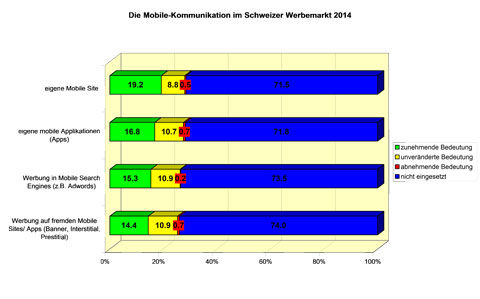
It is interesting to see which means of communication have enabled online and mobile media to achieve this position. The two charts show how many of the top 750 advertisers attach increasing (unchanged, decreasing) importance to the individual means of communication in their communication and how many do not use these means of communication.

Non-classical communication accounts for 47.7% of all communication. The biggest slice of the cake goes to sales promotion. Its market share has been at 13% for the past 5 years. The share of direct advertising is practically the same. However, its share is declining. In 2009, it still amounted to 17.2 percent. In 2014, it was only 12.9%. There is also a clear winner in non-classical communication, and that is sponsorship. In 2014, sponsorship increased its market share to 11.7%. In 2009, it was still at 9.8% and in the previous year at 11%.