Abstinence from politics
The digitization of the media landscape calls for a new media policy. The industry organizations affected are the first to be called upon to act, but they have no interest in doing so.


Farmers are different: when it comes to agricultural policy, the relevant issues are often followed closely by farmers' committees and the media. However, when it comes to media policy, no such commitment can be discerned in the sectors concerned. And it is about media policy: on the one hand, there is the partial revision of the Radio and Television Act (RTVA), and on the other, the National Council and Council of States have approved the motion "Safeguarding the state and democratic functions of the media" by the National Council's State Policy Committee, thereby ordering the Federal Council to provide "an overall view of the Swiss media landscape from a regional media policy and overall media policy perspective" together with "funding concepts". But even without concrete proposals, it has long been clear that the pressure of the digitalization of the media calls for new framework conditions, for which politics is ultimately responsible. However, there is no sign of a media policy debate, especially one that aims for fundamental reforms. This is also shown by the survey that Werbewoche launched on this topic before the summer vacations. Despite repeated appeals, the response rate was only about half that of other topics. And even in this small sample, the theses put forward for discussion were judged to be clearly controversial - with one exception: the thesis that it is "in the vital interest of the media industry to promote and actively help shape a new media policy" met with general approval.
Passive industry associations
However, anyone who thinks that the industry associations are active in this area is mistaken: the CEOs of Schweizer Medien, bsw leading swiss agencies and the Interessengemeinschaft Elektronische Medien (IGEM) all emphasized that their organizations are deliberately not active in the area of media policy. Peter Leutenegger, Managing Director of bsw leading swiss agencies, made it clear that they do not see it as their own task to actively shape or change the media landscape and are only committed to media diversity so that the needs of a broad public for information, education and entertainment can be met. He sums up the demands on politicians as follows: "What can be sold legally should also be able to be advertised." And IGEM Managing Director Ueli Custer points out that the broad background of IGEM members alone makes it impossible to adopt a common political position. (Other industry organizations, such as the Swiss Advertising Federation, are in a similar position). Meanwhile, Urs F. Meyer, Managing Director of the Swiss Media Publishers Association, reports that the Executive Committee has decided that it is "not appropriate to hold a major debate on media policy at the present time". At last year's retreat, a media policy manifesto was adopted, which is now being revised again, as there are "certain individual aspects" that need to be corrected. With regard to the upcoming media congress, he announced various position statements on current media policy issues. He mentions the fight to ensure that the distortion of competition by the SRG, which is financed by fees, does not increase, the promotion of payment models in the online sector, for example by means of an ancillary copyright, or the promotion of distribution with the post office, where daily and early delivery is concerned. There was also no lack of a media lobby in the new parliament: as Werbewoche pointed out at the beginning of this year, at least 38 of the 246 newly elected federal parliamentarians and 8 members of the Council of States are professionally or otherwise active in the media and communications sector. And there is no shortage of organizations with at least a partial media policy focus. For example, the "Association for Critical Media Use Arbus" has been around for a long time, four years ago the right-wing "Aktion Medienfreiheit" was founded, soon followed by the "Gesellschaft für Medienkritik Schweiz" and the "Verein Medienkritik Schweiz", and the enterprising Zurich professor Kurt Imhof runs a "Medien-Observatorium". They are all doing a little something, but there is no gravitational center that attracts the various forces and bundles their efforts in such a way that resounding concepts emerge that can point the way to the future. The above-mentioned motion by the National Council's Political Affairs Committee offers an opportunity in this respect. Instead of the responsible Federal Office of Communications (Bakom) producing another mountain of paper together with the research guild that it widely supports, practitioners could show politicians the way.
Leading the way in politics
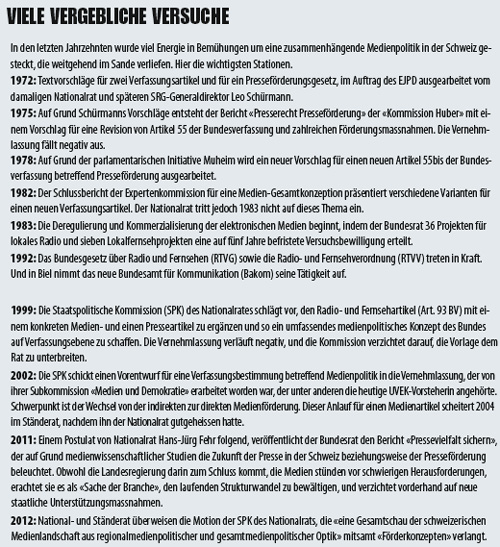
It has happened before: When cable television emerged in the 1970s, satellites were used for program distribution and the call for private radio stations became unmistakable, the media landscape was facing changes that were comparable in scale to those of today. Solutions for new framework conditions were necessary, but could not be found due to differing political and ideological positions in parliament. A commission of experts was therefore appointed in August 1978 to present a possible media article with implementing provisions by 1981. The final report was 700 pages long, but presented majority and minority views on many points. The value of the exercise lay elsewhere: because exponents met directly in the commission meetings, they were able to speak, listen and understand, which had previously not been possible when positions were only defended from a distance. As a result, the various players and their organizations and companies continued to form opinions in the background. And in the fall of 1981, the draft for a broadcasting experiment regulation met with broad approval. It brought about a cautious opening of the SRG monopoly and paved the way for the numerous private radio and television stations we know today. Today, the media policy challenge is greater because the media are converging with digitalization. "Convergence" is the keyword for both SRG and publishers, who are merging editorial teams from different types of media. A media policy that does justice to the dynamic developments surrounding digitization and, above all, wants to enable a vital media industry in Switzerland will also have to be convergent. This will require thoroughly new concepts that go beyond the current structures.
Christoph J. Walther