Online moving image content is good - classic TV is better
Internet use continues to grow. This is due to the boom in smartphones and tablets and the growing popularity of the Internet among older adults. The Internet is also increasingly being used to watch videos.


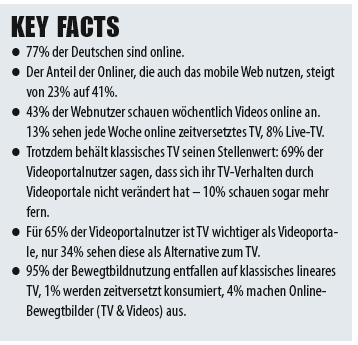
Nevertheless, consumers continue to use and value traditional television the most. These are key findings of the «ARD/ZDF Online Study 2013,» for which Enigma-GfK surveyed 1,800 German consumers aged 14 and older on behalf of the two broadcasters. The study first shows that 54.2 million Germans are online. That represents 77 percent of consumers aged 14 and older—an increase of 800,000 people compared to 2012. While 100 percent of 14- to 19-year-olds and 98 percent of 20- to 29-year-olds show consistently high internet usage, the older generations are experiencing the greatest growth. Among 50- to 59-year-olds, the proportion of internet users rose by 6 percentage points to 83 percent, while among those over 60, the proportion increased by 3 percentage points to 43 percent.
Most Internet users access the Internet via a PC or laptop (96%). However, other devices have also established themselves as alternatives: 45 percent of Internet users use a smartphone to browse the web, and 16 percent go online via a tablet. While a total of 23 percent of Internet users accessed the Internet via mobile devices last year, that figure has now risen to 41 percent. In fact, 21 percent go online via mobile devices every day. Another option for Internet access is the television, which 12 percent now use to go online. As internet usage continues to grow, so does the demand for video content on the web. 74 percent of internet users watch videos online at least occasionally—43 percent do so weekly. Popular options include both time-shifted TV (36%; 13% weekly) and live TV (26%; 8% weekly) as well as video libraries (28%; 9% weekly). People aged 14 to 29 are particularly avid online TV consumers: 49 percent of them occasionally watch time-shifted TV, and 37 percent occasionally watch live TV online.
Mobile devices are also shaping TV viewing habits: 11 percent of mobile users have already used apps from TV stations—6 percent even do so at least once a week. Due to the rapid proliferation of mobile devices, using a second screen while watching TV has also become a habit for many Germans. 31 percent of internet users use a second screen at least once a week while watching TV. Ten percent of internet users engage in parallel activities related to the TV program at least once a week, and 7 percent chat with others via social media about programs currently airing.
How is the growing importance of video streaming sites on the Internet affecting TV viewing? According to the study, TV continues to hold a prominent place in consumers’ lives: 69 percent of Internet users who use video streaming sites say that their TV viewing habits have not changed as a result of these sites. 10 percent say they now watch even more TV. A comparison of traditional TV and video platforms shows that video platform users are more likely to find food for thought on TV (44%) than on the platforms (32%), and they are also more likely to use TV (74%) than video portals (44%) for informational purposes. Similarly, more users find something to relax with in TV programming (49%) than on video streaming platforms (42%). Additionally, 53 percent say they frequently discuss TV shows, while only 34 percent talk about content from video streaming platforms. Furthermore, according to the study, 70 percent of video portal users are glad that their favorite shows have fixed broadcast times on TV. It is therefore not surprising that even 65 percent of video portal users consider traditional TV more important than video portals, and that only 34 percent see video portals as an alternative to TV. Last but not least, media usage time confirms that traditional TV remains the top choice: On average, Germans watch 242 minutes (95%) of traditional linear TV per day, 2 minutes (1%) of time-shifted viewing, and spend 10 minutes (4%) watching moving images (TV shows and videos) online.
Clemens Koob