
Not one, but two crises at the same time
"I registered for the congress to watch the newspaper industry die," said an online representative. He may have been mistaken. The 10th European Newspaper Congress in Vienna highlighted ways to make newspapers more appealing to readers.


Of course, the crisis in the newspaper industry was a pervasive topic at the anniversary conference held in the ballroom of Vienna’s New City Hall and a major point of discussion among the more than 500 participants from 16 countries. The grim news from the U.S. delivered by Professor Russ-Mohl of the University of Lugano—such as the bankruptcy of once-prominent newspapers like the Chicago Tribune, the decline in circulation, ad revenue and stock market valuations, and editorial staff cuts of up to 30 percent—have long since caught up with Europe.
In reality, this isn’t just one crisis—it’s two. The current economic crisis, which even the most innovative newspaper concepts can’t solve. And the structural crisis facing the industry: changing consumer behavior, with readers migrating from newspapers to news websites. But there’s one thing no one can take away from the newspaper: its role as a medium that provides an overview. Erich Ortner, editor-in-chief of the Vorarlberger Nachrichten, summed it up: In 30 minutes, print gives you an overview of 40 topics. By that time, you’ve barely clicked through one or two websites online. And his colleague at the Frankfurter Rundschau is convinced that if only the web existed today, whoever invented the newspaper as a medium for providing an overview would be revered as a pioneer.
«Less talk, more action»
So there isn’t necessarily any reason to be as pessimistic as Matthias Geering, editor-in-chief of the *Basler Zeitung*, who expects circulation figures to continue falling. And it’s certainly more than just a voice crying out in the dark forest when men like Rupert Murdoch continue to invest in newspaper publishers. Or when a company like Antonio Giner’s Innovation International Media Consulting Group launches a new print product somewhere in the world every two weeks. What do these men believe in? What does it take to succeed with a newspaper today? Giner says «less talking, more doing» and agrees with all the other speakers: Cost-cutting alone won’t save the industry. It needs innovation. And it needs quality. Today, it’s more important to be the best than the fastest—provided you’ve cut costs quickly enough to still be around to experience the economic recovery when it comes. “Better” doesn’t mean smarter, more elitist, or more traditional. Better means relevant to the reader, visually appealing, enticing, diverse, surprising, well-written, service-oriented, more professional, and media-appropriate—that is, tailored to the consumption habits of the respective target audience. For example, this includes today’s 20-year-olds, who have never known a life without the web and the Game Boy. And the newspaper will be more compact, because it’s a fact: Traditional media are losing advertising revenue because more and more brands are investing an ever-larger portion of their advertising budgets in their own media assets—such as BMW in corporate publishing (BMW Magazine), web TV, blogs, Facebook groups, the iTunes Channel, and corporate TV. All of that money is lost to traditional media. “Compact” doesn’t mean “bite-sized.” Long-form articles are what define the newspaper and are important—provided the story is compelling and well-written. “Compact” means focusing on the important, engaging topics.
Online – on time – full time
Tomorrow’s newspaper is no longer just a print medium. It stays in touch with its target audience throughout the day—as a print product, an online channel, via iPhone, cell phone, and blog. And it doesn’t primarily deliver news, but rather what lies behind it. After all, today anyone can get news anytime, anywhere. For Giner, therefore, publishing yesterday’s news is a surefire way to hasten the demise of newspapers (see box on the left). He says: «We are not in the news business. We are in the understanding business.» Renowned media designer Mario Garcia sees it exactly the same way, and from this he derives a news cycle: Web – Print – Web. The initial news appears on the Web, the in-depth story in the newspaper, and further variations back on the Web, along with feedback and suggestions from readers. The Basler Zeitung also values reader participation; during extraordinary events, it has repeatedly published pages full of cell phone photos submitted by its readers—comprehensive photo coverage that the BaZ photo editorial team could not have achieved on its own.
Experts also agree that newspapers should not look like websites. Only the issue of navigation—formerly known as reader guidance—has taken on even greater importance due to the habits of the Internet generation and now makes use of the presentation techniques found on websites.
Multifunctional Officials Under Scrutiny
The speakers disagreed on how online content should be created. While at the Austrian *WirtschaftsBlatt* every journalist produces content for all platforms, *20 Minuten* believes in specialization. A good print journalist simply has neither the time nor the expertise to adapt their story for several different platforms—as text, a streamed interview, a podcast, or a video clip. The online offering is not simply an additional distribution channel for print; it runs its own stories or expands on print stories. That is why 20 Minuten does not have a joint newsroom. As a result, the print and online editorial teams work in competition with one another, albeit in coordination. This way, the print editorial team knows at all times how online stories are performing; it can thus assess—better than a traditional daily newspaper editorial team—how a topic is resonating with readers, whether the story should be pursued further, and what priority it should be given in the print edition. Conversely, the print editorial team drives traffic to the online platform or develops new relatable characters for that purpose. Print and online are two manifestations of the same overall brand for the same target audience, but using different methods. According to print editor-in-chief Marco Boselli, it is crucial for the brand to maintain a presence across all channels—from print to iPhone. It’s unclear today which of these channels will prevail in the future, but the publication is well-positioned for anything. Of course, this comes at a price, as evidenced by the size of the two editorial teams alone: About 60 people currently work on the print edition, and 40 on the online edition.
"20 Minuten" and the "WirtschaftsBlatt" have found success with their concept: "20 Minuten" is now profitable online, says Hansi Voigt, head of online operations. The "WirtschaftsBlatt" not only generates twice as many print subscriptions online, but also sells significantly more of its paid online newsletters today than before.
A pile of crumbs instead of a slice of cake
Tomorrow’s newspaper is closely connected to its target audience through feedback channels—such as Twitter, forums, or online platforms. That’s why it knows exactly what content the community is engaged with at any given time, as Dieter Rappold of the agency Knallgrau, New Media Solutions, puts it. For example, some newsrooms let their readers help decide which questions to ask the interviewee in a major newspaper interview, and can therefore be confident that the printed interview will be of interest. In addition, they offer their readers the opportunity to interact with one another on these platforms. Established editors-in-chief have called this «nonsense.» The fact is that people of all ages and social classes interact in this way—which isn’t a bad thing if the newspaper is represented in this community, says Rappold—and the ORF editorial team, for example, takes this approach.
The online channel offers another advantage: Newspapers are, by their very nature, designed to reach larger audiences with identical content—and this at a time when the market is shifting from a mass market to a mass niche market. The online platform makes it possible to address this fragmentation—that is, to offer small and very small groups a “special dish” in addition to the standard menu. Rappold says it’s becoming increasingly difficult for newspapers to carve out a whole slice of the market. So they’ll just have to make do with a pile of crumbs.
Trends in Newspaper Design
The editors agree that newspaper design is becoming more magazine-like. Large images dominate the pages—even on the front pages of quality newspapers. The front page is turning into a poster. In addition, there are more infographics and a greater focus on the day’s key issues. «More of less,» says Giner.
Since the Vienna conference was attended by newspaper producers rather than publishers, the discussion focused less on funding models and more on how to create a truly good, engaging newspaper.
The Vienna conference was attended by newspaper editors, not publishing executives. That is why there was more discussion about what tomorrow’s newspapers should look like than about how they will be financed. It was also striking that many of the beautiful newspapers that won awards in Vienna contain virtually no advertisements. They rely on other sources of funding—large publishing houses that provide cross-subsidies behind the scenes, as well as direct or indirect government press subsidies. Whether these sources will continue to flow in the future is uncertain. We can only hope that the strategies outlined for attracting readers to print products and retaining their loyalty will prove successful. For if there is one logic in the media business, it is that products with more and more satisfied readers have a better chance of generating advertising revenue. The idea that newspapers might end up begging for government aid, much like the auto industry, was certainly on everyone’s mind in the room, but no one wants that to happen—because it would likely mean government influence over editorial content, and that would spell the death of free journalism.
Urs Zeier
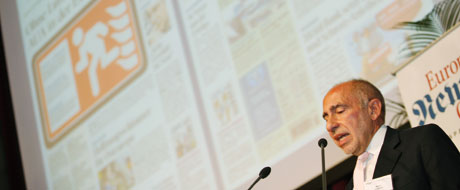
Star designer Mario Garcia describes scenarios for newspapers to survive in the multimedia age.
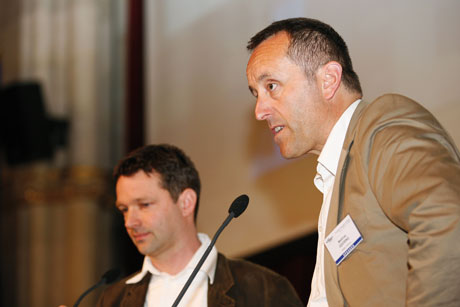
The Basler Zeitung wins the European Regional Newspaper of the Year award (from right: Michael Admas, Art Director; Matthias Geering, Editor-in-Chief).
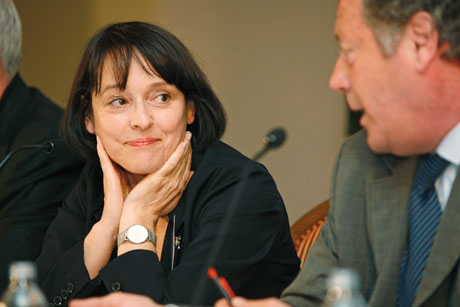
Ursula Fraefel, editor-in-chief of the Thurgauer Zeitung, can imagine that online content might eventually require a fee.
Trends in Newspaper Design
Networking
Print and online are two different manifestations of the same media brand for the same target audience.
Focus
Print isn't the place for a little bit of everything. It's the place for a lot of one thing. Some front pages are dedicated to a single topic.
Design
The newspaper's layout is becoming more magazine-like. A newspaper,
If it isn't beautiful, it's dead.
Navigation
What used to be called "reader guidance" is now emphasized even more and makes use of techniques from the Internet.
Interaction
Readers and the newspaper are in contact with one another. This increases the editorial staff's understanding of readers' interests and strengthens their bond.
Background
Print is the place for well-written, relevant stories. News is everywhere.
Relevance
Readers want to be taken seriously in all their areas of interest. Topics such as family, relationships, social circles, and services—for example, related to video games—are becoming more important.


