
Now is the time for identity resolution management
In their guest post, Alexander Haymann and Dimitrios Haratsis of Elaboratum explain how identity resolution management helps build customer-driven marketing.


Cookies were indispensable in digital marketing for many years. They provided valuable information about users and their behavior on the Internet. Now the age of cookies, especially third-party cookies, is coming to an end. The EU General Data Protection Regulation restricts the collection of data via cookies and requires explicit consent to be obtained from users.
But this is proving difficult. A study by Ruhr University Bochum shows that only 0.1 percent of all users would actively consent to the use of third-party cookies if cookie tracking were legally compliant. No data can be collected from users who refuse to accept cookies. Marketing decisions are then based on a much smaller database, making campaign evaluations much more difficult. In addition, more and more browsers are blocking third-party cookies from the outset.
The entire set-up of the data-driven marketing that has prevailed to date therefore needs to be reconsidered. After all, minor adjustments to tried-and-tested marketing strategies and changes to tracking are not enough. Successful marketing will require customer-driven marketing in the future. To achieve this, however, it is necessary to have sovereignty over the data and to bring it in line with the use and analysis of your own collected data. In addition, existing silos in the user approach must be broken down.
Addressing customers according to the dramaturgy of storytelling
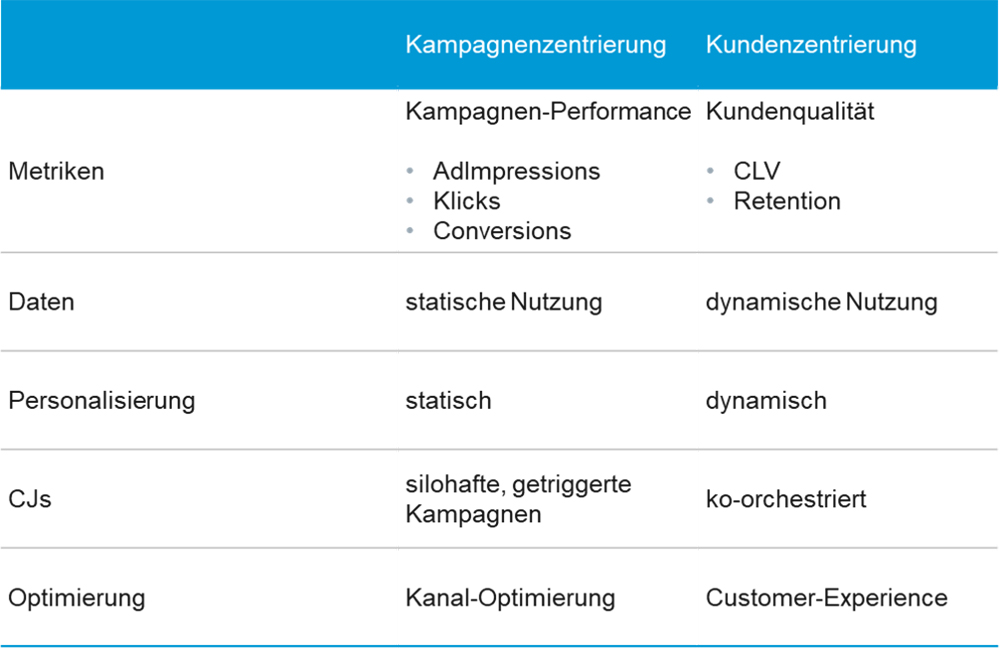
For many years, the cross-channel user approach along the entire customer journey has been considered the ideal. However, reality still lags behind this image. A linear, siloed, single-channel and episodic user approach is still frequently found. Customer communication in the cookie era was always campaign-centered. The decisive factor for specific measures was the current (website) behavior of the user, detached from the phase of the customer journey.
The focus on fist-party data is provoking a paradigm shift: the customer and their customer journey are becoming the new maxim. A holistic customer experience is to be created, taking many individual factors into account. The goal: customized coordination of all channels and a customer approach based on the dramaturgy of storytelling. Marketing automation thus gives way to marketing co-orchestration.
Create all-encompassing customer profiles
This requires all-encompassing customer profiles. Only with these can customer expectations be met and marketing measures used efficiently. To achieve this, advertising companies, advertisers and publishers must, on the one hand, try to retain users and awaken their willingness to use data. On the other hand, information from different channels and data sources must be aggregated, normalized and unified in compliance with data protection regulations. The data collected differs between:
- personalized data (Personal Identifiable Information (PIIs)): Data that the user leaves behind (login, registration, purchase process)
- anonymized dataCookie-based information without personal reference
Identity resolution management is the order of the day. This refers to the process of creating customer profiles, taking into account all databases. This process requires interdisciplinary cooperation between advertising companies. This is because a customer's points of contact with a company take place via several channels and departments, for example via the website, the call center or marketing campaigns.
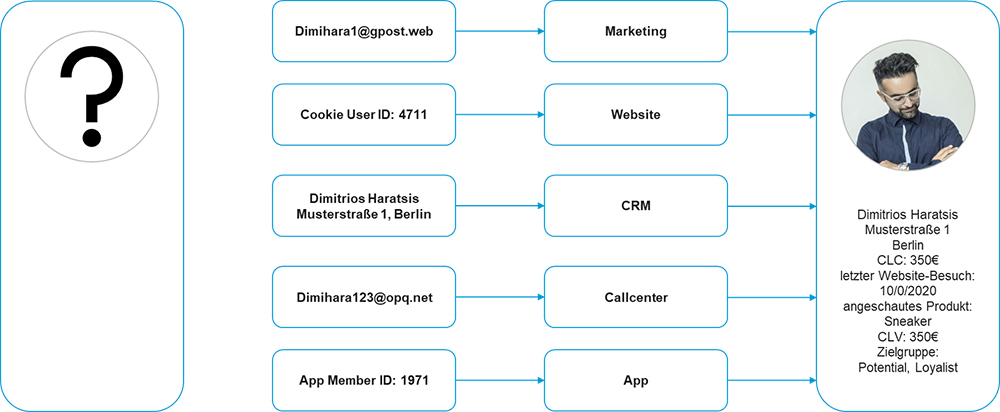
Combining this data into a single profile (rather than many individual profiles) has many advantages:
- Basics for the creation of a multistep and multichannel approach
- ROI improvement through the efficient use of channels
- Brand reputation by avoiding unnecessary communication
- Improving conversion through the creation of stringent storytelling
Building up comprehensive knowledge about the customer
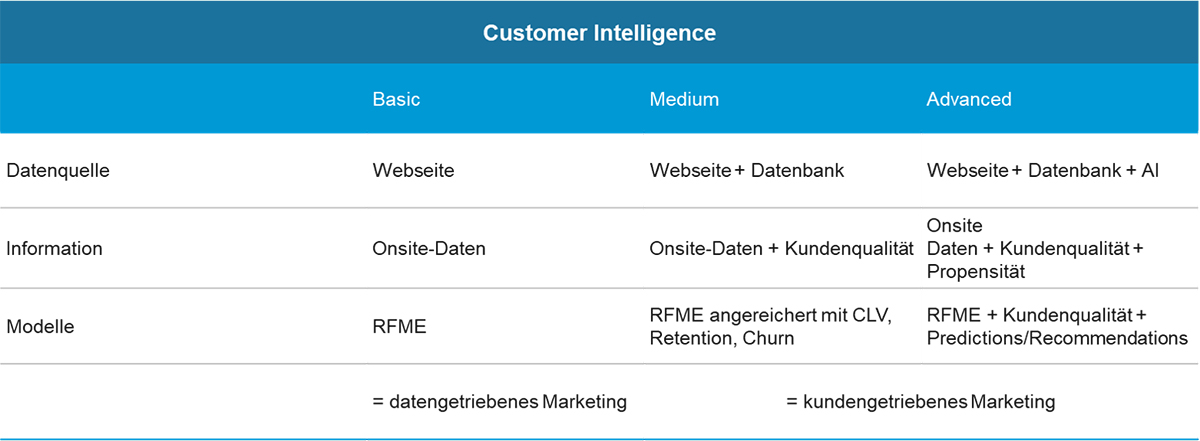
After the creation of customer identities, comprehensive knowledge about the customer should be built up. Two databases form the basis for this:
- Website dataall data that the customer leaves behind when visiting their own website
- Database dataall data that the customer leaves behind in the company's systems (data warehouse, CRM, POS)
By linking these databases, customers can be easily classified and segmented. Not only affinities and socio-demographics are taken into account, but also attributes relating to customer quality. In the future, forecasts of future customer behavior will also be part of every customer profile. Forecasts (conversion probability, churn probability) and recommendations (next best product, next best channel) will further sharpen the customer profile. This brings advertisers ever closer to a holistic customer experience.
Identity Resolution Management is the decisive step
The customer himself, not the mere data, is the new focus. Identity Resolution Management is the first and decisive step in this process. In future, the customer approach will be based on centralized and holistic customer intelligence. Tailor-made customer experiences are the logical consequence and the guarantee of success of the new data normality.
* Alexander Haymann is Senior Consultant at Elaboratum suisse, Dimitrios Haratsis is Advisor Customer-Driven Marketing at Elaboratum.


