Directors Collective: Streamlined Processes and Executions That Stand Out
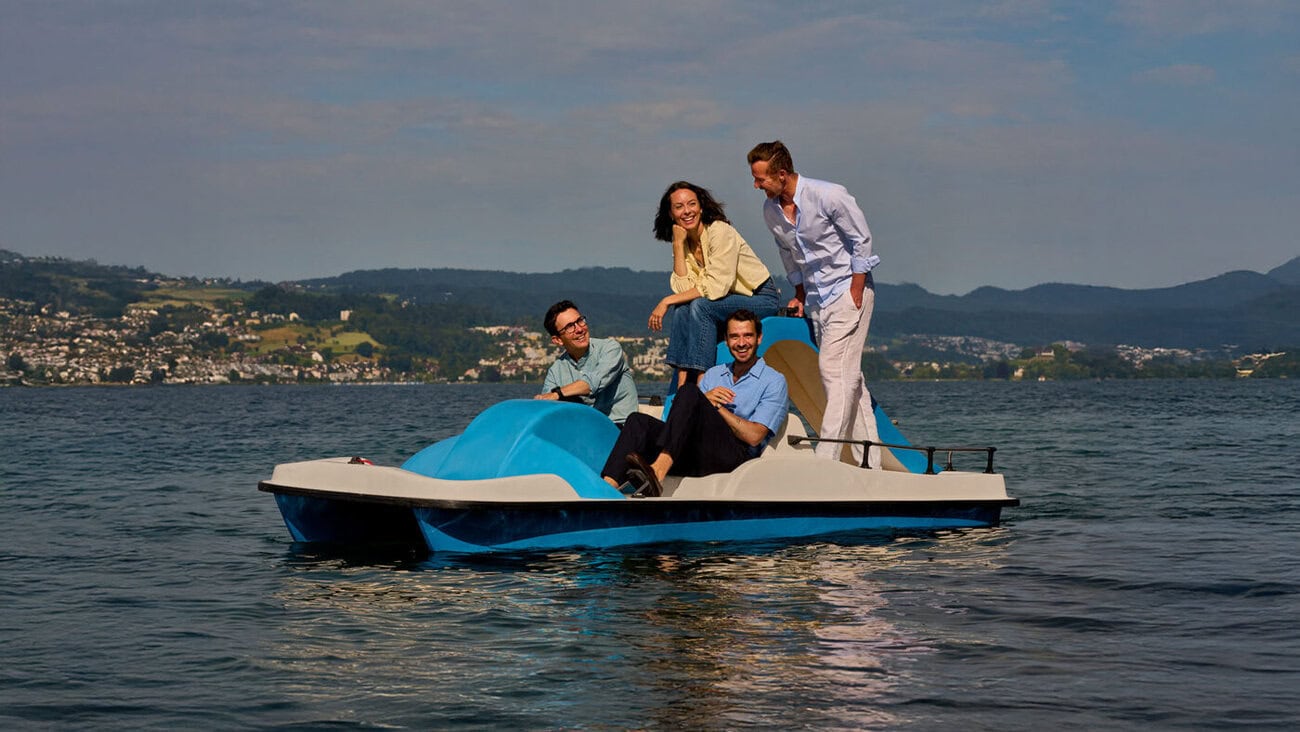
Wolfgang, Julia, Constantin, Rainer, and Pia have all held leadership positions at major agencies. Why did they form a collective instead of starting an agency? m&k spoke with Wolfgang Bark and Julia Fischhaber about the model.


m&k What led you to deliberately move away from the traditional agency model?
Wolfgang Bark: As a collective, we’ve been providing a pragmatic response to current market needs for nearly a year now: At our core, we’re all about «Big Ideas» within a lean organization. However, our model wasn’t conceived on the drawing board, but rather grew out of shared client relationships, specific projects, and—above all—the realization that certain companies today are looking for exactly this kind of collaboration: experienced, direct, fast, and without a large bureaucracy. Of course, there was also a personal element to it. We were all already working as freelancers, knew each other from previous roles, and realized through joint projects just how well we complement each other. The collective combines the freedom of self-employment with the joy of collaboration.
Specifically, you cite «close ties to the creators» as your USP—what’s the idea behind that? In many conversations with marketing leads, you’ve heard that they want direct access to experienced professionals. How does this differ in practice from what traditional agencies offer?
Julia Fischhaber: Behind this lies what is probably the simplest way of working: whoever sits at our table is the one doing the work. We all communicate directly with the teams on the client side, so nothing has to be filtered through multiple layers. For our clients, this means that their input goes directly to the people who produce the output. Questions can be answered right away, ideas can be developed immediately, and decisions can be made more efficiently. For us, this isn’t some elaborate method—it’s simply the way we want to work: close to the action and without any detours.
What needs from advertisers have you heard most frequently in your market discussions? You mention «Big Ideas with Speed» and «collaborative work with internal teams» as key needs. How did you systematically gather these insights—and what surprised you the most in the process?
WB: We didn't conduct any large-scale market research (laughs). Each of us had already gathered similar insights through personal client relationships even before we founded the company. These were then confirmed in further one-on-one conversations with marketing leads. Two needs became clear in the process. First: We still need big ideas, but they need to emerge faster, be decided upon faster, and be implemented within the organization faster. For us, «Big Ideas with Speed» means fewer detours between the problem, the decision, and the idea. Second, many companies today have strong internal teams. This makes peer-to-peer collaboration, inclusive teamwork, and shared ownership all the more important.
WWF, Daylong, Arval—how does a young collective without an agency brand win clients like these? With WWF, you came out on top against 120 competitors. What role does the personal reputation of individual members play, and what was the deciding factor in the pitch?
JF: If you’re not operating under an agency brand, clients need to have even more confidence in the people behind the work. In our case, everyone in the collective brings many years of experience, a portfolio of visible work, and strong industry connections to the table. But personal reputation alone doesn’t win a pitch. In the end, it’s the work that counts. We can only speculate as to what ultimately convinced the WWF to choose us. We’re guessing it was precisely this combination: the pitch concept, the collaboration model, and the people who stand behind it. WB: And one note: Daylong was developed in collaboration with the agency We’RR, which had approached us to reposition the brand.
How does collaboration with internal marketing teams work? One of your core promises is collaborative work. What does that look like in a specific project—do you work on-site at the companies, remotely, or a combination of both?
WB: We see ourselves as part of the company’s communications team. For us, therefore, it’s not the location that matters, but our involvement. In our experience, the best results come when decision-makers, subject matter experts, and implementers jointly drive and shape the process. This creates a way of working that doesn’t run parallel to the organization, but rather alongside it. What this looks like in practice depends on the project. Milestones benefit from workshops, co-creation, joint decision-making, and on-site collaboration. Much of the work in between works just as well remotely.
What’s wrong with today’s agency market—from the client’s perspective? You explicitly founded the collective «in response to the current needs of advertisers.» What no longer works in the traditional agency model, and why now?
JF: Traditional agency models inherently involve certain structures—different disciplines, processes, and coordination. Of course, this still has its place, especially when large volumes, complex rollouts, or long-term support structures are required. But it simply no longer works equally well for every task. In recent years, many marketing and communications teams have significantly built up and expanded their capabilities and are now stronger operationally and significantly faster on their own. At the same time, their demands have grown: more output, greater efficiency, and more internal stakeholders—often with a smaller budget. In this situation, many are looking for flexible and experienced support. A collective like ours works optimally in this setup. We step in where the task lies and bring together the right people for the job.
How is AI changing your work—and that of your clients? You are all senior professionals who combine craftsmanship with strategic thinking. In what ways do you see AI as a tool, and in what ways does human experience protect against what AI cannot do?
WB: AI is neither creative nor empathetic. For us, it is primarily a tool for gaining a broader understanding of topics and testing different approaches. This does not diminish human contribution; rather, it makes it more important. Because when many options emerge in a short period of time, fundamental questions take on even greater significance: What is relevant? What fits the brand? What is strategically sound? This is where experience is needed. And: AI bears no responsibility for a brand and has no sense of internal politics. It makes processes more efficient, but it does not automatically solve the problem of differentiation. For us, therefore, the value lies not in the use of AI, but in the ability to manage it well.
What do you envision the Directors Collective will look like in three years? Will it remain a small, exclusive collective—or will the model grow? And: Would you recommend that other experienced creatives take the same step?
JF: Our goal is to meet the market’s demands and needs. If that means staying small, so be it. If it means working with other experienced people on a case-by-case basis, we’re just as happy about that. For us, it’s not growth that matters most, but quality, fit, and impact. And would we recommend that other creatives take the same step? If you enjoy struggling on your own, then YES!
More info: >directorscollective.ch