
CMOs hardly increase advertising expenditure and rely on content marketing instead
Last week, the advertising and marketing consulting firm NewBase released its latest report, «The Evolving Marketer.» NewBase spoke with 120 global CMOs and asked them for their opinions on everything from budget trends to data usage and the quality of their teams.



- Only four out of ten CMOs will increase their advertising spend, but almost three quarters (72 percent) will increase their budget for content marketing.
- 80 percent of leading global marketers will spend more on data, but only a quarter say they fully utilize the data they have access to.
- Only three percent of global CMOs believe they currently have the perfect in-house capabilities and a third have no plans to bring more services in-house.
The global study of leading marketing managers highlights five key topics that are firmly on the CMO agenda: Revenue generation, customer experience, data, content and processes.
Focus on growth
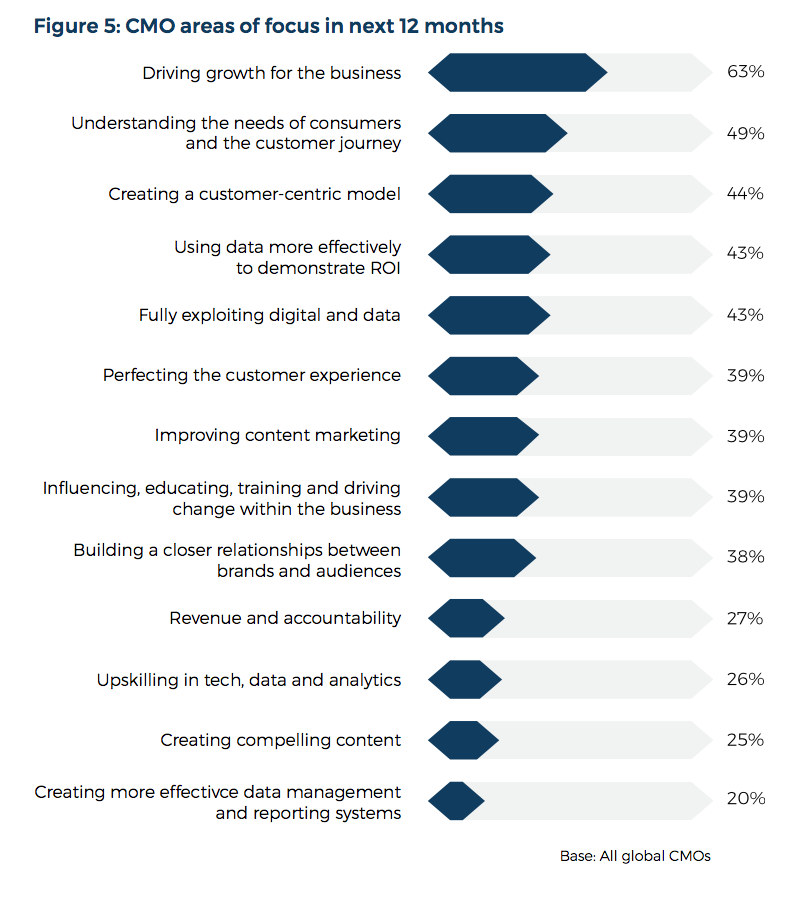
Business growth is a given, and driving it forward is undoubtedly a central part of the marketing director's remit, as illustrated by the renaming of CMOs as "Chief Growth Officers". The fact that the main focus is on sales is very clearly felt by senior marketers. More than eight in ten (82 percent) of CMOs state that the function has become more focused on financial results. Almost two-thirds (63 percent) of marketing leaders say that their top priority is to drive business growth. With this focus on the bottom line, it goes without saying that the importance of marketing must increase: 82 percent of CMOs think that the influence of marketing has increased internally.
Customer-oriented
It's understandable that those focused on growth will turn their attention to understanding customer needs to determine whether problems need to be addressed or processes optimized. Looking at the customer journey is top of the list for one in two CMOs, and almost half (44 percent) of marketing leaders also say they plan to use a customer-centric model. Two thirds of global CMOs state that marketing decisions should be based on how they affect the customer, not the company.
Everything revolves around data
With the increased focus on the customer and growth, data is more important than ever. One in two leading marketers currently say they have control over the budget for data and analytics. However, the proportion will increase as more than 80 percent of CMOs say they are getting more money to invest in data. This budget will no doubt be gratefully received, as more than three quarters say that data management and analytics take up a lot of their time. But having more data available doesn't necessarily mean it can be used more effectively.
Data mountain
Global CMOs highlight that more than half of the data available to companies is not being used to its full extent. Three quarters agree that they are only able to use a small proportion of the data available. This presents an opportunity for leading marketers, as more than nine in ten (92 percent) say that design and analytics need to work more closely together to drive business success. As the budget for data has increased, but more than half of the data is not being used to its full potential, there is an opportunity for CMOs to unite the "magic and math" by leveraging brand awareness, storytelling and experience with data to drive revenue.
Internal/External
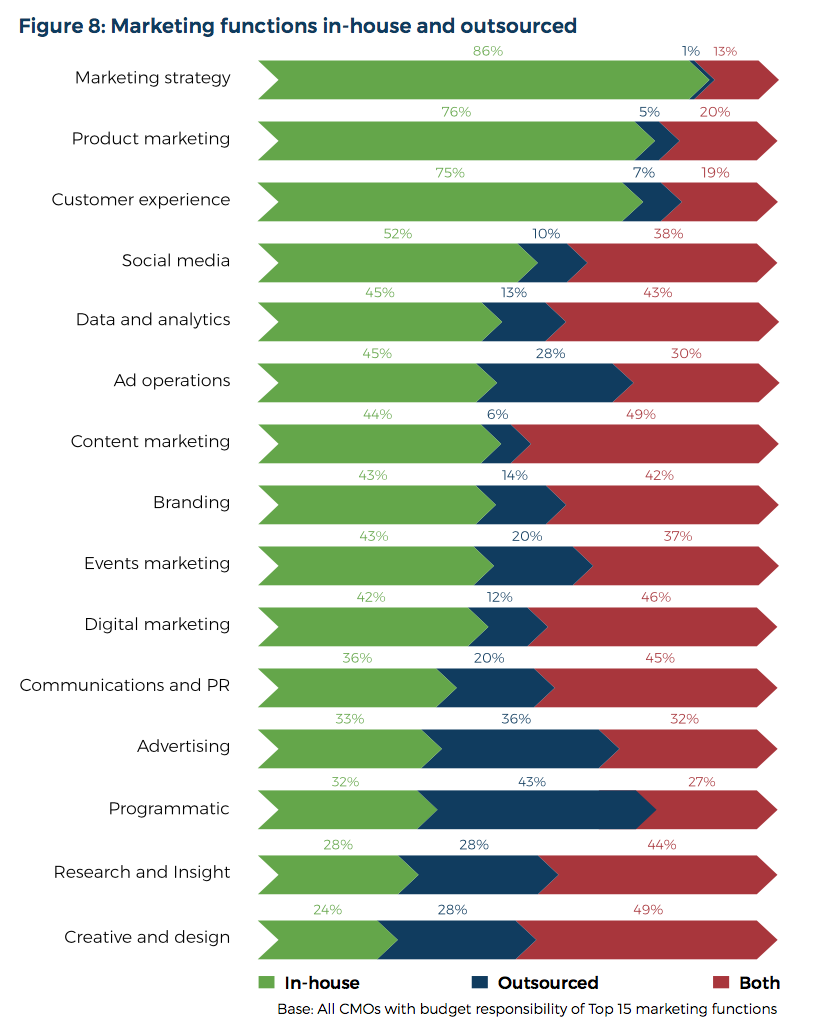
Two-thirds of CMOs are leaning towards more in-house marketing services, but only 3 percent say they currently have the perfect in-house capabilities. Chief marketing officers who want to bring more functions in-house face challenges with budget and team capabilities.
Slightly less than half of CMOs have good internal team skills, and 68 percent say it's important to have people on board who are skilled enough to keep up with technological developments. However, with the martech explosion and the dramatic growth of digital marketing and programmatic advertising, more than half of CMOs (55 percent) say they have an internal skills shortage.
Due to the skills gap and implied talent shortage, it seems that outsourcing to service providers (agencies, martech providers, etc.) is still essential for CMOs to actually achieve their goals.
The results show that 43 percent of CMOs still fully outsource programmatic advertising. It is the most fully outsourced function. More than a third of leading marketers (36 percent) outsource advertising, and more than a quarter fully outsource creative and design as well as research and insight (28 percent each).
Key elements such as marketing strategy, pricing, product marketing and customer experience are generally handled in-house. Of the top 15 areas in which marketing managers have budget responsibility, marketing strategy is the function that is most frequently performed entirely in-house (86 percent), followed by product marketing (76 percent) and customer experience (75 percent).
Budgets
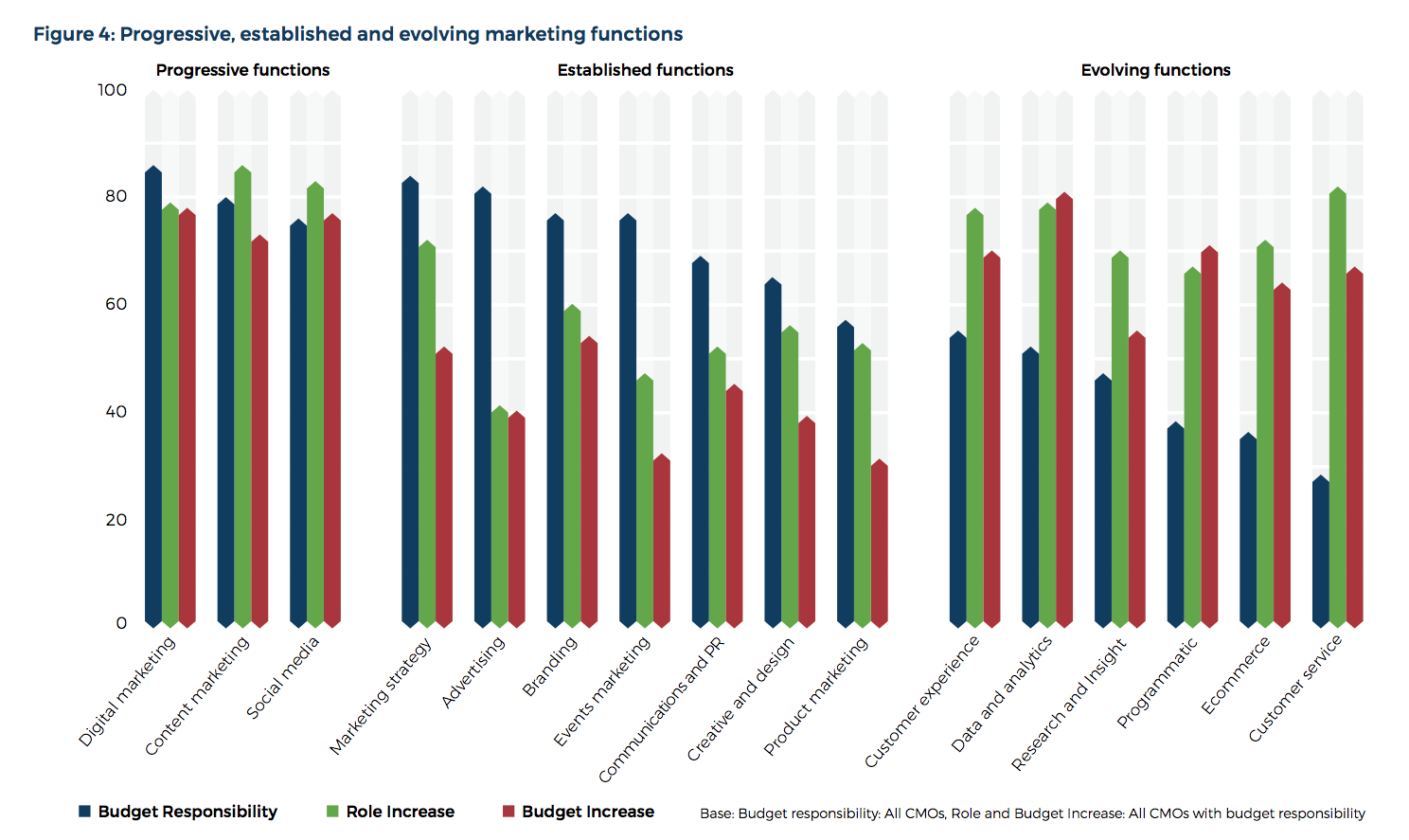
While CMOs overall say they need to do more with less, there are some functions where engagement is already high and budgets and time spent on marketing are increasing. Marketing leaders expect to spend more on digital, content marketing and social in the short term. Three quarters of marketing managers allocate a higher budget to these channels. They also expect the time spent on these functions to increase similarly. They are described as "progressive marketing functions".
Only a small proportion of CMOs expect budgets to increase for "established marketing functions" such as marketing strategy, advertising, brand development, PR, design and product marketing. Four out of ten leading CMOs expect spending on advertising to increase. One in two forecast an increase in investment in brand building, and almost 40 percent will spend more on design. Slightly less than half want to invest more in communication and PR in the coming year.
There are some "evolving functions" where CMOs are currently seeing their expertise in demand and where budgets are increasing: customer experience, customer service, e-commerce, data and research are now becoming increasingly important. However, as these areas are not exclusively marketing tasks, CMOs do not currently have full control over these budgets, but this is likely to change.
Three quarters of CMOs say they will receive a higher budget for customer service, and a similar proportion expect an increase in customer experience.
"The evolving marketer shows significant differences in the agenda of global CMOs based on length of tenure. The priorities of established CMOs who have been in the role for more than five years differ significantly from those of newer CMOs (less than five years in the role), with the exception of the priority "growth". Every second established CMO is focused on building internal collaboration (45%) and improving the customer experience (47%).
Newer CMOs (less than five years in this role) are still in the start-up phase of their role. Their focus is therefore on organizing the infrastructure, introducing new systems and processes and creating models for using the data they have access to.
Newer CMOs emphasize the customer journey (57 percent), while only 39 percent of established CMOs do so, and creating a customer model that is aligned with the business strategy (52 percent vs. 33 percent). Realizing the full potential of data is a priority for half (49 percent) of new CMOs, but only for a third (35 percent) of established CMOs.
Revenue and accountability are almost three times more likely to be prioritized by established CMOs compared to newer marketers (41 percent vs. 17 percent).
Show effect
84 percent of newer CMOs say it takes less than five years to make a real impact, while just under half (49 percent) of established CMOs are of the same opinion.
Mike Jeanes, Global Head of Insight at NewBase, explains: "In recent years, the CMO's remit has expanded from a predominantly promotional and creative role to a centralized corporate elevator pitch, serving all levels and functions of the business and providing the data-driven connection between the brand and the consumer. The role of the CMO is multifaceted and complex. They are increasingly faced with the challenge of driving business growth and adapting their resources to keep pace with industry change and consumer demands."


