On all channels
Over the past few months, UBS has been steadily expanding its digital solutions. The ultimate goal: to become Switzerland’s leading multichannel bank. What does this mean? UBS executives provided an insight into this for *Werbewoche*.


I n 2000, UBS was the market leader in Switzerland with half a million e-banking customers. In the mobile sector, the big bank set new standards. Even then, UBS customers could place stock market orders on the move via WAP. But it was not a success, and mobile banking was discontinued in 2006 (source: Schweizer Bank). The next big thing was a long time coming. Until recently, UBS's web presence was more like an electronic catalog than an interactive platform, and Postfinance was the leader in mobile banking.
Now UBS is getting back in touch. Since last fall, the big bank has been gradually revamping its online offering. In addition to new websites, various solutions for e-banking and mobile banking have been launched. The mobile area with the core element mobile banking app is being pushed strongly, but the strategy goes far beyond the mobile channel. UBS's goal: to become the "leading multi-channel bank in Switzerland." Specifically, the bank is working on three focal points, as Andreas Kubli, Head of Multichannel Management & Digitization, explains.
1. the digital service is expanded
In the future, simple services will be comprehensively available electronically - via online or mobile banking. Instead of asking the customer advisor about savings potential at the bank branch, the new e-banking system will allow users to create a budget plan and set savings targets using the personal financial assistant. And via mobile banking, you can keep an eye on your budget wherever you are.
2. website and online marketing
A second focus concerns the website. Ubs. com is being expanded in the direction of an e-commerce site, a site where products can be experienced and ordered directly. In addition, the entire keyboard of online marketing is played. Online campaigns, email marketing, social media, web analytics, search engine marketing, etc. While online campaigns have been an appendage to the traditional campaign, they are now becoming a main component. "We want to be constantly present at the point of interest," explains Daniel Hünebeck. The former managing director of the agency Adisfaction Switzerland has been driving online marketing at the bank as Head Client Dialogue Management since the fall. If a customer searches the Internet for information on buying a house, he is offered mortgage topics - regardless of whether a campaign is currently running or not.
3. all channels are linked
The third hobbyhorse is linking online and offline. For example, if a customer fills out a form online, she shouldn't have to enter the same information again the next time she visits the branch. That sounds banal. However, the transition from one channel to another is more challenging than one might think, as Kubli says. The technical prerequisite is that the data is not stored in separate silos (e.g., one for e-banking, one for the branch offices), but that you can more or less draw from one data bucket. That was not the case in the past.
The callback function also provides an example of the dovetailing of channels. Whereas customers previously had to search for a phone number to contact a customer and then wait in the loop until a customer advisor became available, there is now a "call me back" option. Enter a phone number - and within a few minutes, you'll get a call back. Kubli presses call back in his app. "Let's see how long it takes." (In five minutes, the phone will ring and Kubli will comment, "It's busy this afternoon, so it's a good thing we didn't have to wait by the phone, but could continue talking in a relaxed manner.")

UBS - soon to be a pure digital bank?
The digital service is being continuously expanded. Once the first advisory service has been digitized with the personal financial assistant, other areas will soon follow. Kubli doesn't want to reveal too much, but he does say: "In principle, all simple advisory services can be implemented digitally. Instead of the information reaching the customer via the advisor, the data is made directly available to the bank customer via an application.
Last but not least, digital services offer great savings potential. After all, the online financial assistant incurs lower costs than the bank employee in the branch, which makes offering such services economically feasible. Will the customer advisor soon be superfluous? Kubli answers in the negative. "It's not about saving the advisor, it's about offering customers a choice." If the branch is closed on Sunday, bank customers can access information digitally. In addition, he said, a distinction must be made between different services. In the future, Kubli estimates that simple processes such as making payments, reporting complaints or changes of address will be handled exclusively digitally. The situation is different for mortgages, investments or pension plans. "I'm thinking here, for example, of a 60-year-old who is faced with the choice of whether or not to cash out his pension fund. For such important decisions, customers will probably prefer to get personal advice in the future," says Kubli. "That's why multichannel banking. "
How do you convince customers?
Kubli and his team have many ideas for new services. However, whether and when the new services are launched depends not only on (financial) resources, but also on customers. After all, they have to want to use the new services. In the case of mobile banking, the conditions are not bad at all. Mobile Internet usage in Switzerland has risen at an above-average rate over the last two years, with 39% currently online while on the move (IPMZ, World Internet Project Switzerland 2013). The only problem is that Swiss bank customers have so far relied mainly on online banking.
"Customer acceptance of the new mobile services is very high," says Kubli. The mobile segment has almost doubled in the last year. At the moment, it is growing significantly more than 1% per week. In the third quarter of 2013, about 145,000 UBS clients used mobile banking, and by the following quarter 4, that number had risen to 160,000, representing slightly more than 10% of UBS's main clients, Kubli calculates (UBS has 2.5 million clients in total, but that includes those who have only a rental deposit account, for example). Kubli considers 10% a success, but at the same time says that a comparison with other countries shows that much more could be done.
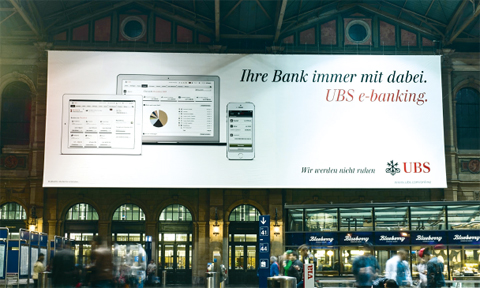
A lot is also being invested in bringing the new services closer to clients. In an initial wave last year, UBS drew attention to the new services on the bank's own channels and on social media platforms. Since February 2014, it has also been present with TV commercials, print ads and an online campaign. UBS relies heavily on moving images to provide information, as Julia Stefanides explains, who as Strategy & Business Development Director is responsible for marketing all digital channels. On the microsite Ubs.com/banking short info films explain the digital solutions to customers. For e-banking, the bank has also created tutorials that explain the individual functionalities in detail. Hünebeck is satisfied with the videos, saying that the dropout rate is very low. And internally, the videos are just as well received, adds Kubli. In October 2013, an info video was sent to the 22,000 employees in Switzerland. It was downloaded 17,000 times. "Even if you assume that one or the other watched the video several times, the figures are very pleasing, " says Kubli. "With a PDF brochure, we probably wouldn't have come close to that number."
//www.youtube.com/watch?v=q6SXZHOayMA
What are the benefits and risks of mobile banking?
In terms of communications, the bank faces two challenges in particular. The first is to convince customers of the benefits of the new services. Many bank customers are still skeptical about whether they even need the new tools, explains Hünebeck. Why do I need a mobile app when I can do my finances at home on my computer? At the beginning, everyone said, "I don't need a smartphone because I only need my cell phone to make calls. Once you have a smartphone, you don't want to give it up," says Hünebeck. "I think we'll see the same thing with mobile banking. Once customers experience the convenience aspect, the use of mobile services will certainly increase."
The second construction site is the security aspect. Here, too, UBS needs to do some convincing. Security concerns are already one of the main reasons why customers decide not to use e-banking. In addition to phishing attacks (spying on access data), the loss of the device or infected apps are further risks in the mobile area. For the mobile banking app, UBS therefore relies on a two-stage model. If, for example, only the account balance is to be called up, it is sufficient to log in using a password. The information is anonymized to such an extent that any hacker who gains access will not obtain any valuable data. A code is only required for the second security level, which provides the same access as e-banking and allows payments to be made. As with e-banking, the bank customer accesses this code via a card reader or a credit card-sized hard token (a hardware component for identification and authentication). This is an advantage over systems where the code is sent via SMS, Kubli said. "Once the app is infected, the SMS is not far away. With our technical solution, e- and mobile banking are equally secure."
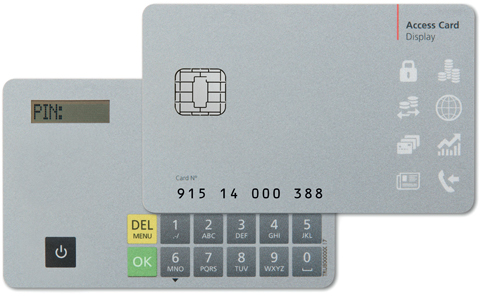
However, Kubli is aware of one thing: The security measures do not guarantee that the customer's need for security is thereby fulfilled. "The need for explanation is enormous," says Kubli. "But it's probably a matter of time: we've been discussing online banking for 15 years, and mobile banking for just a few months."
What happens to the data?
For bank customers, the new solutions open up new conveniences and additional information. For example, the personal finance assistant shows how much money one spends on housing, how much on traffic and transportation, on communications and media. In addition to the current account balance, planned income and expected expenses are also displayed.
At the same time, it becomes obvious how much data the bank collects about its customers. Regular media reports about IT breakdowns and data leaks don't exactly inspire confidence (PwC, Bank Coop, St. Galler Kantonalbank, NSA affair ...). What does Kubli say about concerns about data protection? "Banks know a great deal about their customers - this is already the case today." The decisive factor, he says, is that the bank agrees with the customer what it will do with the data. It is conceivable, for example, that customers will be able to release their data for certain purposes in the future. Someone who is interested in savings offers would then receive special offers, for example. However, any change to the existing practice would be made transparent and would not take place without the customers' consent.
When UBS puts out feelers in other business areas, companies from outside the industry become active in the financial sector. Not only Google, Apple or the eBay subsidiary PayPal. Telecom providers such as Sunrise and Swisscom are also currently testing cashless payments. "From my point of view, banks have to be on their guard that they don't lose valuable shares in payment transactions and thus a large and important part of customer relationships to possibly completely new competitors (from the non-banking sector)," writes Andreas Dietrich, professor at the Institute for Financial Services Zug (IFZ) at the Lucerne University of Applied Sciences and Arts, for example, in a blog post.
"Kubli is also convinced that "the value chain will become more fragmented. In this regard, he locates UBS's strength over competitors from outside the industry in two areas. "One advantage is trust. Various studies show: If you ask people who they are willing to trust with their finances, banks and bank-related companies such as credit card companies are in the top ranks" (e.g., unpublished study by Mastercard). Kubli considers the existing infrastructure as well as the large research department and the IT platform to be another advantage. Competitors would have to build all this up first. 300 offices in Switzerland, UBS is present in 50 countries worldwide.
How does the information reach the customers?
And what does Andreas Kubli see as the biggest challenge posed by digitization for UBS? "First, that we can't start on the greenfield. UBS is a huge tanker with 2.5 million clients on board. It works well, to be sure. But: if you want to change course, you have to pull a lot of levers." The second challenge, he said, is communicating the new services. "When I ask around in my environment, I realize again and again: even there, newly launched services are partly unknown." This shows that you have to communicate in a much more segmented way in order to reach the customer at the right time with the right message.
In any case, bank customers can look forward to further developments in banking. Various financial service providers are currently upgrading digitally - or have announced this. Last but not least, digital competence is a way for banks to differentiate themselves from competitors in a market with virtually identical products.
Isabel Imper
Agencies:
- Namics Supported UBS with e-banking, mobile banking app and partial overhaul of Ubs.com
- Hinderling Volkart realized the microsite and the first communication wave
- Alpha 245 is responsible for the TV spot and the ongoing communication wave