Aldi and Lidl have not yet conquered Swiss hearts
Aldi and Lidl have been operating in the Swiss market for about 20 years. A recent EmoCompass study by Zutt & Partner shows that, despite their push into the Swiss market, the German discounters lack an emotional connection with their customers. Migros and Coop continue to lead by a wide margin in terms of emotional connection—although Migros has surprisingly lost a significant amount of favor.


Aldi (since 2005) and Lidl (since 2009) have been present on the Swiss market for around 20 years and have put the high-price island under noticeable pressure. Initial skepticism has turned into establishment: with Swiss product ranges, local producers and organic offerings. Despite a reduced product range, as discounters they are now in direct competition with the supermarkets Migros and Coop.
However, it's not just what's on the shelf that counts, but what happens in the mind and gut. Over 80 percent of purchasing decisions are driven by emotions. How deeply are Aldi and Lidl emotionally anchored in Switzerland today? How do they differ from Migros and Coop? A recent EmoCompass study by Zutt & Partner reveals where retailers stand in Switzerland's emotional coordinate system.
Migros loses its popularity lead
To determine how strongly a brand has reached the heart, the emotional dimension of sympathy, emotional closeness and warmth is considered. This is the dimension that also characterizes family, friendship and love in private life and creates a genuine connection.
These feelings about a brand are fluid, are shaped by actions and can change over time. In the case of Migros, not for the better: A comparison with an EmoCompass study from 2017 shows a marked shift in the Swiss duopoly. While Coop has managed to keep its emotional closeness and likeability almost stable over the years, Migros has seen a decline of over 50 percent. In 2017, Migros was still 14 points ahead of Coop. Nine years later, the tide has turned: Migros now has less emotional closeness and likeability than Coop - with a gap of a full 27 points.
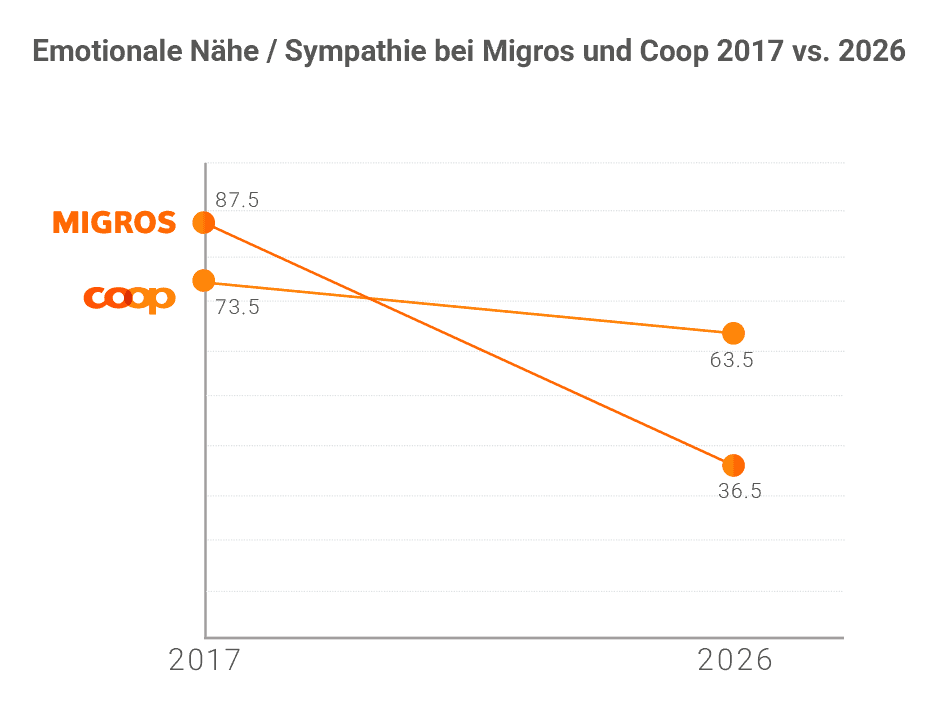
Possible reasons for this decline lie in the major structural and strategic changes of recent years: store closures, streamlining of the product range, discussions about the Group's direction and a noticeably stronger focus on efficiency and performance. Where community, closeness and a sense of «we» used to be at the forefront, the brand was perceived more rationally and therefore more emotionally distanced.
Emotional distance at the discounters
The comparison of Migros and Coop with Aldi and Lidl provides an additional exciting perspective. A clear picture emerges here: Migros and Coop still have an above-average profile in the «emotional closeness and sympathy» dimension, even at Migros. Aldi and Lidl, on the other hand, do not excel in this dimension. Emotional closeness and warmth are much less pronounced and not noticeable at the two discounters.
Instead, they are dominated by a more performance and price-oriented emotion: power. The original «cheap from Germany» perception still seems to have an emotional impact. The heart of the Swiss has not yet been reached.
Swiss origin and sustainability: there is still some catching up to do
An important reason for the emotional closeness and sympathy at Migros and Coop is their strong emotional connection to Swiss origin and sustainability.
Aldi and Lidl have been on a consistent Swiss and sustainability offensive for years. Both have «Switzerland» in their names, rely on local producers and are continuously expanding their organic ranges. These efforts are visible and actively communicated.
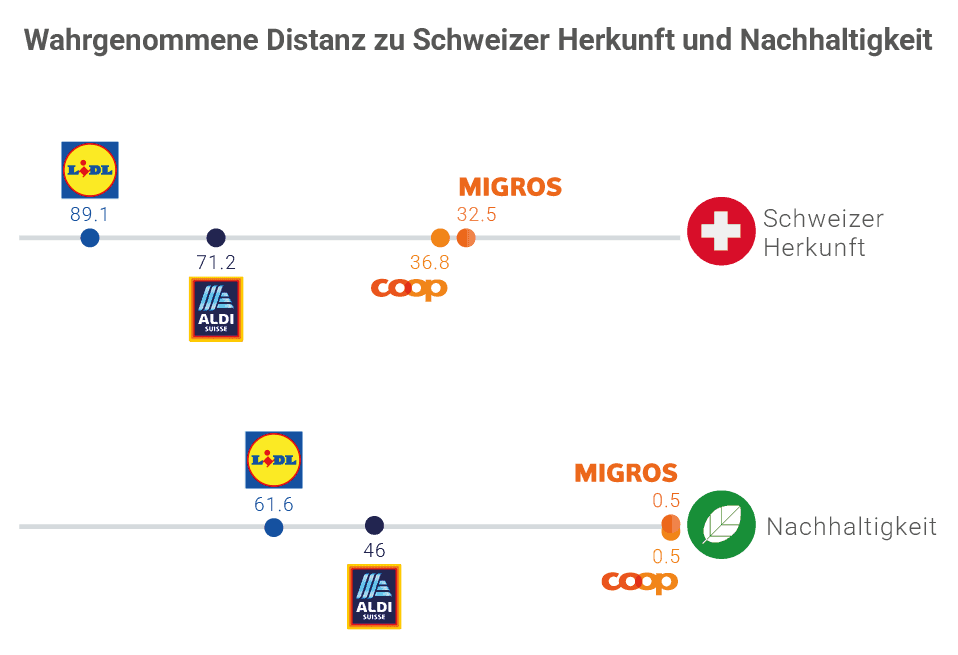
Emotionally, however, this is not enough. They clearly lag behind Migros and Coop. At Aldi and Lidl, these issues have not yet become firmly anchored in the customer's mind. Consistent communication alone is not enough. The decisive factor is whether and how quickly it is emotionally received and internalized.
A look at Germany shows: What is not yet can still be
Is the lack of emotional closeness and sympathy at Aldi and Lidl a permanent feature or can the Swiss market still be conquered emotionally? A look at Germany provides a clear answer.
There, unlike in Switzerland, Aldi and Lidl are perceived as emotionally close and likeable. This is particularly evident at Aldi. This means that Aldi and Lidl are fundamentally capable of building emotional closeness. In their home market, they have long since found their way into people's hearts. In Switzerland, however, not yet. But emotional development takes time. It is quite conceivable that with new generations - with «Aldi and Lidl children» - their emotional closeness and sympathy will also grow here and become firmly established in the long term.
Conclusion
The EmoCompass study shows that Aldi and Lidl have not yet reached the hearts of the Swiss, but that changes and a future catch-up cannot be ruled out. The emotional ranking in the Swiss retail sector is in flux: Migros has lost its proximity lead to Coop. At the same time, Migros and Coop are still clearly ahead of Aldi and Lidl emotionally. An important reason for this is their strong emotional connection to Swiss origin and sustainability. Despite huge efforts, Aldi and Lidl are not yet able to keep up. However, a look at Germany shows that Aldi and Lidl are also able to establish an emotional connection.
The results are based on a qualitative EmoCompass survey conducted in January and February 2026 by Zutt & Partner, a consultancy specializing in neuromarketing based in Bubikon in the Zurich Oberland. The moods of 140 people living in German-speaking Switzerland were analyzed. A side survey in Germany with 50 people provided insights into the perception of Aldi and Lidl in Germany. The surveys were conducted in individual online interviews - completely non-verbal using neuropsychologically coded patterns.