99 design proposals
On the design marketplace 99designs.com, more than 320,000 freelance designers from around the world offer their services at low prices. This is especially good news for customers on a tight budget. Nevertheless, the crowdsourcing platform is not without its critics.


The principle of 99designs is as simple as it is obvious: The customer describes in detail what he needs on the platform. The range of offers is broad: logos, websites, business cards, mobile apps, book covers, illustrations... anything to do with design is traded on 99designs. After the briefing, the competition for the financial award starts. Designers interested in the job now submit their creations. After seven days, the client chooses the proposal he likes best, signs the usage rights transfer contract and can use the purchased graphics. In most cases, the participants who are not considered are left empty-handed.
The customer can influence the number of proposals and the quality of the designers: From four categories - bronze to platinum - he chooses the amount of prize money. The cheapest option costs 279 francs and promises about 30 designs from "good" designers. A "gold" competition generates about 90 proposals and usually mobilizes the "very good" designers. In the platinum version, only designers selected by 99designs are let loose on the project. Cost: 1099 Swiss francs. In platinum contests, designers who are not considered also share in the prize money.
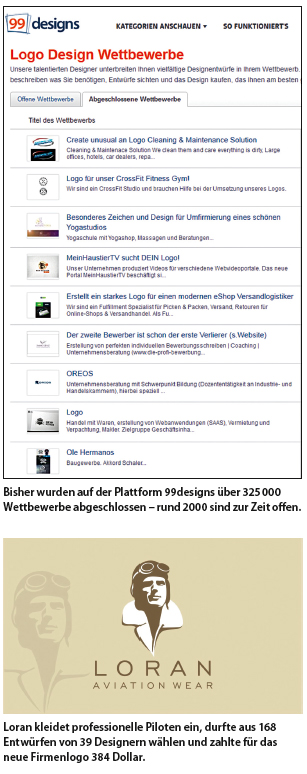
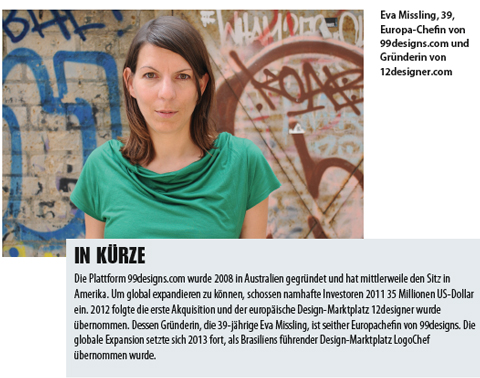
In addition, the customer can increase the attractiveness of the competition by waiving the "money back" clause and awarding the prize money even if none of the proposals satisfies him. The advantages from the customer's point of view are obvious: in addition to the speed and variety of the selection, he receives a product that meets qualitative standards for a fraction of the usual cost. Since numerous talented designers from low-wage countries also take part in the competitions, the chances of success are great even for low budgets. In most of the competitions, the number of submitted works is significantly higher than the benchmarks given by 99designs. Eva Missling, General Manager Europe, confirms, "The prize money is naturally more interesting for designers from countries with a lower cost of living, so you can get designs from all over the world." However, Missling says that communication with the designer and the potential to work together on follow-up orders also play an important role in the selection process. This, of course, is where designers from the home country benefit. Around 4,500 graphic artists and designers from Switzerland participate in the digital marketplace, and 30,000 in the DACH region. The German-language version of 99designs was launched in September 2012. The domain 99designs.ch together with the currency Swiss Franc has been offered since September 2013. For good reason. "The Swiss market is a very open-minded market, so many Swiss entrepreneurs used 99designs even before September 2012, before 99designs became active in Europe," reveals Missling. In total, he says, more than 3000 design competitions have already been carried out by Swiss people.
One of them is David Christen, founder and COO of Receipt.ch. The portal makes it possible to correctly insure household helpers and settle the contributions with just a few clicks. The company commissioned an infographic from 99designs. Although Quitt.ch works in-house in the web area or falls back on classic graphic designers for print jobs, it sees 99designs as the ideal complement for some work. "Full-service agencies are too expensive for a start-up," Christen says. He finds the design marketplace business model exciting because it offers some disruptive aspects. "They're sure to generate some conversation among graphic designers," he is convinced. In addition, he says, the company has no fear of crowdsourcing, as it itself handled part of the financing round via a crowdfunding platform.
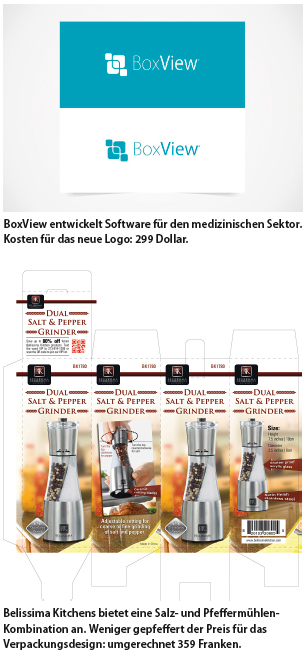
Christen sees difficulties, for example, in writing invitations to tender in English in such a way that they are correctly understood despite cultural differences. In the case of Quitt.ch, for example, a certain understanding of what the Swiss mean by "dä AHV" is important. On the other hand, he was positively surprised by the personal support in German. This would have a completely different quality than other international crowdsourcing offerings.
Max Meister from the start-up Incuray, which was launched in 2012, had logos created at 99designs. As a follower of the lean start-up approach, i.e. a start-up with the leanest possible processes, they wanted a good and cost-effective result in a short time. The cost/benefit evaluation spoke in favor of 99designs at this early stage, he said. "Unfortunately, there are few agencies that are willing to offer special conditions for startups ", says Meister. "When it comes to a specific, rudimentary need, 99designs offers a viable alternative." However, the more a start-up develops in the direction of a "strong brand," the more it should work with a good agency, in his opinion, since 99designs does not offer all-round support. This often goes hand-in-hand with a startup's financial capabilities, he said. "Agencies should adjust their pricing according to the lifecycle of the venture. " Which in turn means a certain risk for the agencies, he says, since many start-ups quickly disappear again. The management consultant and HWZ lecturer sees "CI fo equity" approaches, for example, as a possible solution - agencies would be paid for their expenses in shares in the company. European head Eva Missling does not see 99designs as direct competition for classic agencies, but rather as a supplement: "We specialize in selected products such as logos, web design, infographics, and business stationery - our designers are very good at this and our briefing process is also optimized for this. However, the customer has to know what he wants - the process of developing the idea first is a typical agency task that we don't perform."
Curse and blessing for designers
The platform also likes to emphasize the advantages for the supply side: Since only one's own creativity counts, even designers without a network can get orders from all over the world. "Not every designer lives in a bigger city with access to diverse companies that need design," Missling says. "For designers from more rural areas, we offer unlimited access to clients and opportunities to pursue their passion." This also applies to designers who are time-bound by children, for example, and don't want the 40-plus hour work week of an agency, he said. The argument for total creative transparency should be obvious even to critics. The best will prevail - what counts is professional ability, not networking or self-marketing. Independent designers can concentrate on their actual work. Ratings, history and statistics additionally ensure that they can build up a reputation.
However, there are many critics of crowdsourcing platforms like 99designs.com. The main criticism is the accusation of price dumping and "exploitation" of independent designers. If there is a report online about 99designs, negative reader comments are not long in coming. The tone ranges from critical to spiteful. "Who can still afford to simply be creative today and come away empty-handed in many competitions?" wonders one designer who can "only shake her head" at the business model. "Sometimes one gets the 200-euro contract and the other participants get nothing. Do the participating designers, creatives or programmers have then no mindfulness before their achievement and the investment of their life time?", so the critical statement on the Website Gruenderzeit.de further. User Silvia even calls for a boycott of the platforms and forgets netiquette in the emotion: "You deviant exploiters should all go broke!"
Eva Missling takes criticism from all sides seriously, but doesn't think that 99designs is destroying the market in terms of price. She emphasizes that 99designs is far from being the cheapest provider of design services. Rather, she says, there is an oversupply of graphic designers today, and this becomes transparent on the platform. "We hear from clients that they appreciate the variety of designs they can choose from - even though they have a cheaper quote, they want to try crowdsourcing." The market for design is very opaque and has a wide price range, he said.
Missling also does not want to accept the argument that the competitions are unfair because many designers are not paid for their proposals. "I think designers weigh up whether they want to try for new commissions themselves - after all, there is often a lot of unpaid work to be done here for a self-employed designer, starting from self-marketing to the presentation appointments and the preparation of proposals. And then sometimes you're still waiting to get paid after the work is done." 99designs takes care of client acquisition and guarantees payment security, she says. From her many years of agency experience, Missling remembers paid agency pitches, but they in no way covered the expenses incurred at the agency if you wanted a chance to impress a client and stand out from the competition.
Cooperation with agencies and large companies
While many designers and graphic artists tend to take a rather cool view of 99designs, the platform also seems to be attracting interest from advertising agencies. Agencies use 99designs to outsource tasks that are not part of their core area of expertise, to find new freelancers, and also to simply have things done, such as images cropped. For agencies that outsource to external parties for graphic design, 99designs launched a special tool in spring 2013. At the time, CEO Patrick Liewellyn explained that the company was overwhelmed by the popularity it was receiving from agencies and larger companies and therefore wanted to make collaboration as convenient as possible. Because even though the platform is particularly popular with start-ups and individual companies due to its attractive price-performance ratio - the customer base is diverse. "From self-employed carpenters to start-ups and large corporations," says Eva Missling.
"Medium-sized and large companies often use us to get new ideas and get in touch with many creatives - for example, to build a freelancer pool." The Pro tool offers simplified processing and, most importantly, protected privacy. The private "invite only" contests make it possible to assemble a pool of designers for a call for entries with whom one would like to collaborate in the future. Only the graphic designers see the RFPs, they cannot be accessed outside the community - the contests cannot be found via search engines. Confidentiality agreements must be signed. By request, designers do not see competitors' proposals. So it seems that the development potential of crowdsourcing portals like 99designs is far from exhausted. Whether the virtual design marketplaces will continue to act as a supplement rather than direct competition to established agencies remains to be seen.
Thomas Häusermann