
2010 is set to become the year of the eReader
To this end, the major Swiss publishing houses are collaborating with Swisscom.


For media pioneer Roger Fidler, one thing has long been clear: In the 21st century, newspapers will be produced as interactive editions designed to be read on mobile devices. He outlined this vision as early as 1981 at a conference of leading editors in the United States. In the early 1990s, he founded the Information Design Laboratory, where he developed concrete concepts and prototypes for the tablet newspaper that are still groundbreaking today. But he was ahead of his time—way ahead of his time.
Fast forward to the present: The smartphone boom, led by Apple’s iPhone (see article on page 26), and the success of Amazon’s Kindle have brought Roger Fidler’s vision a huge step closer to reality. And although new devices for the e-newspaper have been announced time and again in recent years, repeatedly delayed, and then failed to catch on in the market, many industry experts are predicting a golden age for e-reading gadgets in 2010.
Pilot project to begin in 2010
Switzerland doesn’t want to be left behind, so the major publishing houses (Ringier, Tamedia, Edipresse, the NZZ Group, and the book publisher Orell Füssli) and Swisscom have launched a collaboration (internal project name: «Code-X»). The goal is to «be the first platform offering up-to-date Swiss content» and thus create «a truly Swiss customer experience,» according to the initial announcement in November. For now, this alliance among newspaper publishers seems to be working well, as investigative journalists are now receiving coordinated responses—a first in the media landscape. The previously rival publishers demonstrate self-awareness in this regard: «None of the partners would be large enough on its own to undertake such a project.» Beyond that, however, there is little concrete information: The goal is a solution that «works on various platforms regardless of device,» that «is also open to all other interested publishers,» and that is intended to «establish certain standards.» A pilot project in 2010 will show whether—and which—e-reader solutions will catch on or flop among the Swiss, who are typically gadget enthusiasts.
The various announcements of prototypes and partnerships demonstrate one thing above all: three entire industries—consumer electronics, telecommunications, and media—have long since embarked on a race to secure the best starting positions in this future market. After all, the stakes are high—very high: Technology companies are betting on weaning publishers off their traditional distribution media and channels. Whoever can establish a foothold in this new market first will have the best long-term prospects. That’s why Amazon sells e-books for $9.99, even though publishers list them at $17.99. The strategy seems to be paying off: Although Amazon hasn’t yet released sales figures for the Kindle, demand is clearly exceeding all expectations. And the device is catching on in the U.S. not only among younger tech enthusiasts but also among an older, supposedly paper-loving audience, since it allows users to easily enlarge the text and adjust it to their declining eyesight.
The success of e-readers in America should give publishers, printers, and distributors pause for thought: In a New York Times interview, Amazon founder Jeffrey P. Bezos stated that for every 100 physical books sold, 48 electronic editions are sold, provided the titles are available in that format. And he expressed confidence that e-books would soon outsell traditional books. Just as the compact disc, introduced in 1982, dealt the vinyl gramophone record a fatal commercial blow after only a few years, e-readers could checkmate paper. In both cases, the issue is the physical medium for content, and most consumers don’t care about that: they simply choose the solution that offers the most overall benefits. And soon, only a handful of enthusiasts will still yearn for the supposedly «warmer» sound of vinyl records or the «tactile experience» of paper—and they’ll continue to be catered to in specialty stores.
When will the breakthrough come?
But it remains to be seen when e-readers will make their big breakthrough. The wish list—especially from newspaper publishers—is long: While the screens on today’s devices, with a diagonal of 15 cm, are suitable for books, they are not suitable for news content; furthermore, they cannot display colors or videos. New, better display technologies are on the horizon, but it’s hard to estimate when they’ll reach mass production. Another issue is the tension between supported (open) file formats on the one hand and payment systems and digital rights management (DRM) on the other. For example, PDF files are difficult to view on the Kindle. It is also not possible to easily transfer content from one device to another (for example, to share articles with family members while reading the Sunday newspaper).
It is also uncertain whether consumers will accept e-readers as a middle ground between smartphones and netbooks/laptops. According to data from an American consulting firm, more consumers today read e-books on cell phones and PCs than on e-readers. Since these devices are good enough for many people, there will soon be not only more and more e-reader apps for smartphones and PCs, but also for game consoles such as the Sony PSP and Nintendo DS.
e-readers vs. print circulation
It’s becoming clear: e-readers can no longer be dismissed as a pipe dream. But for publishers, they could easily turn out to be Trojan horses. Although publishing industry representatives, both in personal conversations and in their joint statement, firmly reject the idea that print editions will come to an end—even in the long term— But investments in e-readers ultimately come at the expense of profitable print circulations. Once new digital distribution channels have eroded print’s profit margins, the remaining print circulation will come up against the fixed-cost barrier. Then, as industry insiders speculate, newspaper publishers could quickly switch entirely to e-reader editions, which could be financed within a year using the savings from print costs. But what role will publishers still play then? Will they have to settle for being mere information providers with a 30 percent share, as Amazon currently offers? Or will they dominate the e-reader platforms to such an extent that they can continue to set the rates for advertisers and readers?
The Swiss-Concordian publishers« alliance with Swisscom is likely to face a severe test soon. Speaking to Radio DRS, Swisscom project manager Britta Reinhardt not only criticized the 80 metric tons of newsprint consumed daily in Switzerland, but also stated plainly: »The network is there, and by digitizing the content, we can eliminate the distribution of today’s print newspapers.” Just as publishers are losing readers, telecom giants must replace declining landline revenues with new business areas. This is where e-readers come in handy, as they allow companies to earn money not only from the networks but also from additional services such as billing. But the “Blue Giant” must be able to quickly roll out and capture the e-reader market in Switzerland. That’s because Swisscom’s competitor Orange began gaining experience in France last year with its Read&Go platform and, in partnership with publishers, offers newspaper content—including advertising—via subscription there. Such foreign offerings can easily be introduced to the Swiss market, as demonstrated by the Amazon Kindle, whose data communications are handled worldwide by the U.S. telecommunications company AT&T. For example, French book publishers will prefer to distribute their e-books in French-speaking Switzerland via the Orange platform and will only partner with Swisscom if the latter holds a dominant market position in the domestic e-reader business.
Publishers need to invest
To compete with foreign competitors—who are traditionally strong anyway—publishers must also invest in the e-reader business. They need to invest in new production processes to create the appropriate data formats (EPUB), in new products (such as the separate sale of individual sections or special reports), and in new marketing and sales strategies. And above all, in content—in more daily editions, more multimedia, and more interactivity.
Just as with mobile devices, e-readers should not simply be viewed as an extension of online or print media, but must be understood and managed as distinct media genres in their own right. This is nothing new: Roger Fidler demonstrated such concepts in practice as early as 15 years ago.
But are Swiss publishers willing to do this, or can they only succeed if they also collaborate on content?
Christoph J. Walther
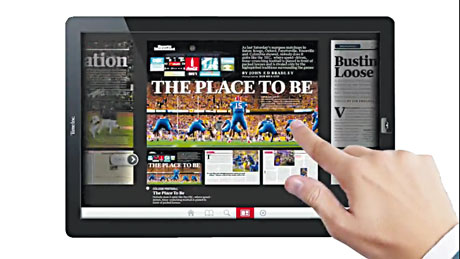
There are many rumors about an Apple tablet—maybe it looks like this: like a jumbo-sized iPhone. The U.S. media company Time Inc. demonstrated in a concept study for its flagship sports magazine, Sports Illustrated, how publications could be consumed on such a device (video on YouTube: http://bit.ly/tabletdemo).


