Out of the Niche
Five Strategies to Finally Sell More Sustainable Products.


Many sustainable products and services today do not face an innovation problem. They are available, technologically mature, and in many cases have long been capable enough to compete with conventional alternatives. And yet they often remain where they shouldn’t: in a niche market. This poses a major challenge for marketing professionals. After all, the key question for growth is no longer simply: How do we convince those who are already convinced? Rather, it is: How do we reach the broad middle ground—those who view sustainability positively in principle but do not consistently align their behavior with it?
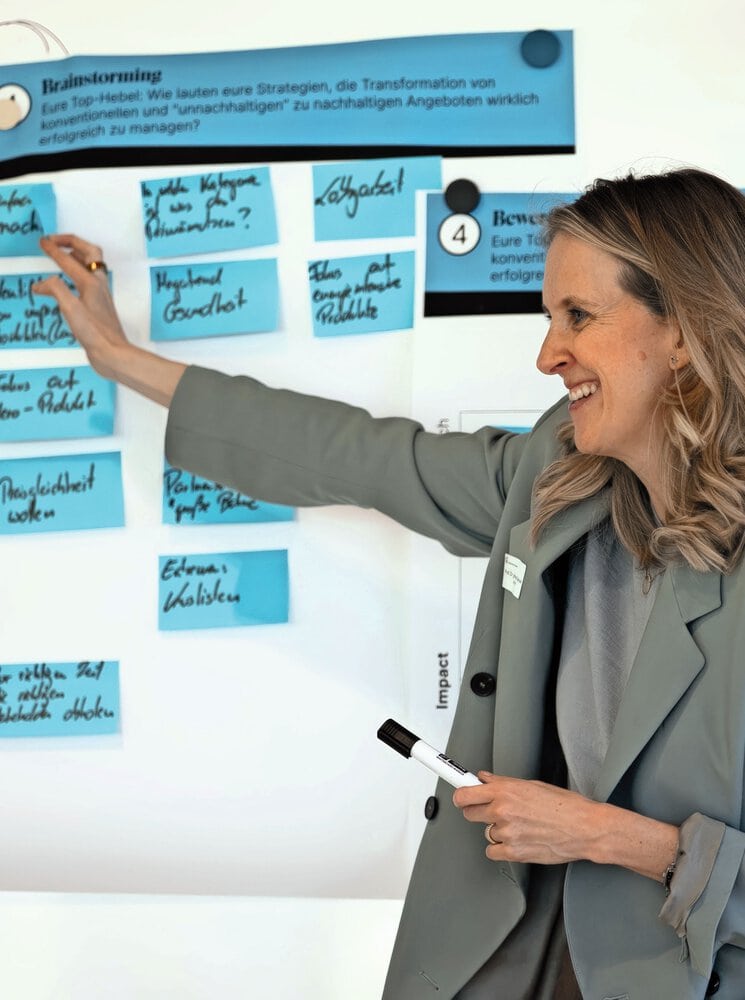
In my book *The 60 % Potential*, which I co-authored with Jan Pechmann, we describe precisely this target group, which makes up about 60 % of the population: Consumers who value sustainability but often associate sustainable products with higher costs, sacrifices, or reduced practicality in everyday life. These people are neither die-hard eco-enthusiasts nor fundamental opponents of sustainability. Rather, they are pragmatic and seek solutions that fit into their lives: affordable, convenient, attractive, available, socially compatible, and free of moral connotations. This idea also formed the basis for the 60 % Symposium, which we organized at the Institute for Marketing and Customer Insight at the University of St. Gallen in collaboration with BAM – Bock auf Morgen. We invited decision-makers from various industries to discuss a common question: What prevents sustainable offerings from actually becoming mainstream—and what specific levers can help achieve the 60 %? The focus was on real-world business challenges from corporate practice. Our goal was to derive concrete solutions from these challenges—specifically, five key business levers for bringing sustainable products and offerings into the mainstream.
The key takeaway from the symposium is that sustainability alone is rarely a sufficient reason to buy. For the general public, sustainability must be linked to tangible customer benefits. Anyone who wants to reach the 60 % must «reframe» sustainability. Five key levers can be derived from the discussions that can help companies bring sustainable offerings out of the niche market.
Embedding sustainability as a business priority within the organization
The first lever doesn’t start with the customer, but within the company itself. Many sustainability initiatives arise from the convictions of individuals or teams. However, as soon as these initiatives are to be scaled up, they often come up against operational realities: margin targets, existing KPIs, established sales strategies, production processes, or short-term revenue targets.
In my view, this is a key point. After all, a sustainable offering can only be presented to the outside world in a credible and consistent manner if it is not treated as a special project internally. A crucial lever, therefore, lies in framing sustainability not as an additional moral obligation, but as an integral part of the business logic. Anyone who wants to gain internal support must demonstrate how sustainable offerings contribute to growth, differentiation, employer attractiveness, risk reduction, or innovation capacity.
Incorporating Sustainable Options into the Consideration Set
The second lever concerns market perception. While many sustainable offerings are generally known, they are not considered genuine alternatives. This is a classic marketing problem. After all, offerings that do not make it into the consideration set are not actively compared in the first place. Consumers don’t have to consciously reject a product for it to fail—it’s enough for it simply not to be present at the decisive moment. For sustainable brands, this means they cannot define themselves solely by their values; instead, they must become relevant in specific decision-making situations.
What we see time and again in our research: The 60 % are less interested in abstract sustainability promises than in concrete benefits. Their primary question isn’t, “Is this product good for the world?” but rather: “Is it good for me, my family, my daily life, my budget, my image, or my convenience?” Successful sustainable offerings therefore combine environmental benefits with clear personal benefits—such as better taste, easier use, appealing design, higher quality, lower risk, or a sense of well-being without the perceived sacrifice.
Demonstrating the Economic Value of Sustainability
The third lever is particularly evident in the B2B context: Sustainability often remains a «nice-to-have» as long as its economic value cannot be clearly demonstrated. Many companies face the challenge that customers focus primarily on price, while sustainability is perceived as an additional cost factor. In my view, this presents a key task for marketing and communications. It’s not enough to talk about CO2 reduction, corporate responsibility, or future viability—these arguments must be translated into business terms.
The «return on sustainability» must be as concrete and tangible as possible. Even if not every impact can be quantified immediately and precisely, the following still holds true: The closer the benefits align with customers’ decision-making logic, the more likely sustainability is to be included in the budget. Successful sustainability arguments are therefore not only emotional or reputation-based, but also commercially viable.
4
Jointly Managing the Core Business and the Sustainable Future Offerings
The fourth lever concerns portfolio management. Many companies face a structural dilemma: On the one hand, they must continue to operate existing cash cows profitably. On the other hand, they must build sustainable offerings for the future. These two approaches often come into conflict. If the sustainable offering is separated too much from the existing business, it remains small. If it is integrated too closely, it loses its distinct identity or is held back by existing structures. If it is scaled too aggressively, there is a risk of cannibalization and internal resistance. If, on the other hand, it is handled too cautiously, it remains a pilot project.
In my view, one possible approach lies in a clearly defined portfolio architecture. Sustainable offerings can, for example, be positioned as a complementary entry-level option, as a standalone innovation brand, or as a step-by-step evolution of the existing core offering. It is crucial that the underlying logic is transparent to customers and that there is internal clarity regarding the role each offering plays in the transformation journey.
Breaking Down Stereotypes and Normalizing Sustainability
The fifth lever is cultural in nature. Sustainable offerings are often burdened by stereotypes that hold little appeal for the general public: too expensive, too complicated, too moralistic, too preachy, too ascetic, or not powerful enough. This is precisely where I see a key role for marketing. It can help break sustainable offerings out of narrow identity niches and make them more widely accessible. The key here is not to communicate against consumers, but for them.
Anyone who wants to reach the 60 % should moralize less and focus more on normalization. That means: less guilt-inducing communication, more emphasis on practicality for everyday life. Less rhetoric about sacrifice, more positive usage scenarios. Sustainability becomes more appealing to the mass market when it is perceived not as an expression of a worldview, but as a better, simpler, or more attractive choice.
Conclusion: What Marketing Managers Can Learn From This
For me, the key takeaway from the 60 % Symposium is clear: Sustainable initiatives do not scale simply through better arguments. They scale when they are integrated into existing decision-making processes, routines, budgets, portfolios, and identities.
Anyone who wants to reach the 60 % must bring sustainability out of the niche of the already convinced. Not by watering it down, but by making it accessible to the masses.
The author
Prof. Dr. Johanna Gollnhofer is Associate Professor of Marketing and one of the co-directors of the Institute for Marketing and Customer Insight at the University of St. Gallen (IMC-HSG).
Compact
Five Key Questions for Marketing Managers
1
Is sustainability firmly established as a business priority in our organization—or does it depend primarily on individual people?
2
Does our sustainable offering even make it into the consideration set in relevant purchasing situations?
3
Can we communicate the economic value of sustainability in a way that CFOs, sales teams, and B2B customers can understand?
4
Do we have a clear strategy for how our sustainable future offerings can grow alongside our existing core business?
5
What stereotypes are preventing potential customers from trying out our products or services?
More info:
«For the general public, sustainability must be linked to tangible customer benefits.»