

Schulthess washes with Rembrand


Valais/Wallis Promotion was founded at the end of 2012 as a cross-industry marketing structure with the aim of creating a high value-added economy in Valais. The organization sees itself as a joint, independent, innovative and efficient promotional instrument. Its aim is to help position and market Valais sustainably and thus create an attractive platform for tourism, agriculture, trade and industry.
In this context, the Valais brand is also on the move in terms of communication. "The aim is to strengthen the brand both externally and internally," says Damian Constantin, who has been at the helm of Valais/Wallis Promotion since September 2013. The objectives are clear: "We want to position Valais and the diversity of its offers and products with relevant messages". The focus in the coming months will therefore be on developing communication and designing specific offers. The 47-year-old knows exactly where the Valais must start: "In the future, we need to become more professional in many areas, especially in proving the tourism service. This requires all destinations, partners and service providers involved. They need to be mobilized and sensitized for the joint project."
Nadine Borter, Managing Director and owner of Contexta, also speaks of a starting position that should not be underestimated: "The complex task with numerous target and stakeholder groups makes even the marketing of our own canton a demanding but extremely interesting challenge. We can only make the 13 stars shine if everyone on site pitches in and delivers on the future brand promise.
Both the communicative positioning and the overarching campaign are being created in collaboration with the Bern agency and are currently still being developed. The first measures will be seen in spring 2014. One year later, the 200th anniversary of the canton of Valais will be an absolute highlight.
Insider tips from the Valais
As an immediate measure for the coming winter, Valais ski instructors are revealing insider tips from Valais. On posters, advertisements and in conjunction with tactical online measures, the Valais experts are drawing attention to the advantages of the Alpine canton. The campaign is an adaptation of Switzerland Tourism's winter campaign. Here too, ski instructors from the respective regions reveal the best secrets.
Responsible at Valais/Wallis Promotion: Damian Constantin (CEO), Madeleine Savioz (Head of Marketing & Communication). Responsible at Contexta: Nadine Borter (overall responsibility), Tobias Wasmuth, Jan Ehrenreich (creative direction), Ulysse Schnegg (art buying, FFF), Livio Canonica (graphics), Michèle Borter, Delia Zeiter (consulting). Production: Photography: Caspar Martig. Media: Mediaplus, Bern.


Use is thus directly related to personal attitudes and the emotionality attached to these new media. The aim of this study was to analyze not only the conscious uncertainties in dealing with social media, but also the unconscious barriers on an emotional level.
The Link Internet Panel used for the survey made it possible to reach a representative sample of executives specifically in their private environment. This made it possible to interview the 538 participants not only as the mouthpiece of a company, but also in terms of their personal attitudes and experience. More than 75 percent of the respondents work as managing directors, marketing or IT managers, and one-third each represented smaller (up to 49 employees), medium-sized (up to 249 employees) and large companies (250 employees or more) in all industries.
Social media is used by executives primarily for building a private and business network and exchanging information. In terms of business use, the new media are most frequently used as an information channel for products and services. Integration into other business tasks, such as communication with partner companies or customer service, is rarely found and is only used by 21 percent and 24 percent of companies, respectively.
Knowledge of social media was surveyed with an assessment of technical knowledge, strategic understanding, organizational requirements and the possible uses of the platform. Here, the person responsible for IT is the person who rates his or her knowledge the highest.
The potential loss of control in social media due to the disclosure of public data, the time that has to be spent and the fear of unwanted information becoming public are the most common emotional barriers to use. Nevertheless, in an explicit survey, the respondents' own sense of security when using social media is rated as high.
The statements become more differentiated when using the Implicit Association Test. This makes it possible to measure unconscious emotional attitudes as part of the online survey and to compare these with the explicit statements. This clearly shows a difference in perception: emotional barriers are unconsciously strong and influence attitudes, which have been shown to be a driver for the use of new media.
According to the evaluation, the barriers in social media can be summarized as follows: Uncertainty and lack of knowledge, unclear legal situation / data protection, no discernible benefit/sense and purpose, lack of resources, no reliable measurability and little to no integration into corporate processes.
For practical purposes, a cluster analysis can be used to describe six user types who have individual prerequisites for using social media for themselves personally and for successful use in the company. The social media competence model derived from the findings of the study enables this targeted analysis.
Graph 1: Study design. Composition of the sample

Figure 2: User structure and motives. Use broken down by function and private and business use

Figure 3: Motives for the use of social media in companies

Figure 4: Reasons against the use of social media in companies

Figure 5: Own assessment of competence: technical know-how, strategic understanding, organizational requirements, possible uses of platforms. Broken down by functional areas.

Graph 6: Measurement of emotional factor. Implicit Association Test IAT.

Making room for individuality - this is the motto under which the Rapid Spaceback from Skoda aims to set standards in the compact mid-size market in terms of design, passenger comfort and affordable versatility. With its striking panoramic rear window and surprisingly spacious dimensions, the short rear model impresses both inside and out. As part of the current launch campaign, DD Com links the new perspectives for viewers and passengers with the values of emotionality and individuality - a first in campaign communication for the entire Skoda brand range.
Within just three weeks of receiving the image material, the two agencies put together a national campaign that confidently showcases the model with a broad media mix. The new Skoda Rapid Spaceback can now be seen in large format on billboards, ad screens, in cinemas, in various special and standard formats on YouTube, mobile and online media, within Google and in print.
Responsible at Amag: Jeannine Micheli (Marketing Manager Skoda) Mario Montanari (Advertising Manager Skoda), Marc Bislin (ECommerce Manager Skoda). Responsible at DD Com: Daniel Müri (CD), Florian Brand (AD), Peter Gehrig (Text), Sandy Pfuhl (Junior AD), Christoph Pfister (Graphic Designer), Mathias Lingenhel (Motion Designer), Marcus Dickenmann, Nicole Baumann (DTP), Maurizio Feraco (Image Editor), Matthias Städeli (Head of Consulting), Jasmin Jost (Consultant). Responsible at The House Agency: Andreas Jorgella (Concept & Consulting), Michael Booz (AD), David Roth (Text/Concept) and Jasmin Kaltenegger (Multimedia Producer). Responsible at Mediacom: Katharina Momani (Planning Manager), Corinne Schneiter (Strategy and Planning), Andreas J. Bartneck (Head of Interaction). Responsible for sound and post-production: NJP Studio.


He previously wrote for Weltwoche for five years until mid-2013. Kunz began his journalistic career in 2004 as a trainee at the Sonntagszeitung. In 2006, he moved to the news magazine Facts, returning to the Sonntagszeitung the following year as news editor. After training as a teacher, Kunz studied history and literature at the University of Basel. In 2006, he graduated from the Zurich University of Applied Sciences ZHAW with a degree in journalism and organizational communication.
Simon Bärtschi, previously Deputy Editor-in-Chief, will take over as Head of Editorial Management for the expanded Editorial Board. Dominic Geisseler, Deputy Editor-in-Chief since 2010, will assume responsibility for editorial supplements.
New sheet architecture from 2014, Tagi cooperation to be expanded
From spring 2014, the Sunday newspaper will also be published with a renewed design and page architecture with six new newspaper bundles. The usual variety of topics will be retained, but at the same time the editorial team will increasingly focus on specific topics and simplify reader guidance with new topic bundles.
Bettina Weber, who most recently worked as Culture & Society Editor at the Tages-Anzeiger for more than four years, will take over as head of the newly designated Society section. The 39-year-old started her career in 2000 as a fashion and feature journalist at the fashion magazine Bolero, before joining the Sonntagszeitung as editor Trend in 2005. Before joining Tages-Anzeiger, Weber spent a year as head of the society section at Weltwoche.
Cooperation with the Tages-Anzeiger, with which the SonntagsZeitung has shared a sports section since its launch in 1987, is being expanded. A new competence center for data journalism at the Sonntagszeitung is being examined, which could also supply the Tages-Anzeiger with current infographics. Increased exchange between the two editorial teams, which will remain independent, is also to be examined for the topics of society and lifestyle, knowledge and culture.
In a statement, TBWA is not only pleased with the inclusion of the two subjects, which aptly showcase the compassion of cat and dog owners (Werbewoche.ch reported), into the current archive, but also about the success of the product launch so far with the appearance on billboards in front of numerous pharmacies and in SI ads. PHA was founded in Switzerland by veterinarians, pharmacists and biologists and their products for dogs and cats are also distributed in Germany.
Responsible at PHA: German Theler (CFO). Responsible at TBWA\Zurich: Frederick Rossmann, Tizian Walti, Danielle Bürli, Chan I. Au, Laura Haas (creation), Matthias Kiess, Friederike Lehmann (consulting), Kilian Kessler (photo).



But that was a year ago - a long time for water dog fans. Well, the Swedish insurance company Volksam is now remedying the situation by releasing a cool diving commercial. Incidentally, Volksam achieved worldwide viral fame with its last campaign:
//www.youtube.com/watch?v=f9OUFS9uTb4
The parachuting cats caused such outrage among many (naive, but at least animal-friendly) people that even CNN had to do educational work. The diving dogs should not cause any heated tempers. Even though the entire marine environment was probably added afterwards - they dived voluntarily. And they really dived. (hae)
Dailydeal belonged to the Google Group from September 2011 to February 2013. Nine months ago, company founders Fabian and Ferry Heilemann bought the shopping portal back from the internet giant, as company spokesperson Michael Hensch explained on request. However, Hensch is unable to provide any information on the purchase price at the time or the current sale price to Deindeal. The Heilemann brothers launched Dailydeal in September 2009. Like the creators of Deindeal, they drew inspiration from the US bargain portal Groupon, which is also active in Switzerland. Dailydeal is also available in Germany and Austria. In the two neighboring countries, it will continue to operate independently of Deindeal and thus Ringier. Deindeal has been in existence since February 2010 and currently has around 600,000 registered customers in Switzerland. (SDA)
What is self-evident must not be specially advertised
"Without 1,4-dioxane/ethylene oxide" is how a cosmetics company advertised its body care line. Two retailers adopted this manufacturer's claim in their communication without any further ado. However, the ingredients in question are generally prohibited under Art. 2 para. 3 of the EDI Ordinance on Cosmetic Products (VKos). If a company advertises with such self-evident ingredients, it acts misleadingly and unfairly in the sense of SLK principle 3.6. The fact that the defendant companies had relied on the correctness of the manufacturer's information was of no use to them. Everyone is responsible for their own communication.

Advertising kills - is that fair to say?
Admittedly, the claims "Advertising kills," "Advertising makes impotent" and "Advertising causes cancer" are borderline radical. But that does not make them unfair. The average addressee perceives the offending statements as exaggerations and does not see any real call to action in the claim "Advertising kills". All the more so, as the reference to smoking prevention is obvious and individual advertising statements should not be viewed in isolation, but only in the overall context.
The Golden Lady does not like hamburger
What comes to mind when you see a barely clothed young lady with golden colored skin? Hardly a particularly hearty hamburger. According to principle 3.11 of the Fairness Commission, a sufficient factual connection is not given if the two subjects are depicted together, as in the objectionable advertisement of a large burger chain. The woman had a purely decorative function; the advertisement was therefore discriminatory and unfair.

The average consumer is the decisive factor
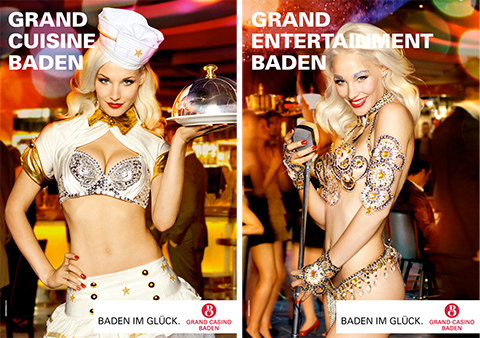
If, on the other hand, lightly dressed ladies advertise the gaming, entertainment, restaurant and bar offerings of a casino, this is not gender discriminatory. According to the First Chamber, the average consumer nowadays no longer expects only prize games in a casino and is also aware that singers and barmaids can be rather lightly dressed there. The objectionable subjects would therefore indicate how the advertised services are actually provided.
About the Swiss Fairness Commission
Any person is authorized and legitimized to complain to the Swiss Fairness Commission about commercial communications that they believe are unfair. The SLK has been the self-regulatory body of the advertising industry since 1966. In addition to the industry associations, it includes the Federal Office of Public Health, the State Secretariat for Economic Affairs SECO, the Equal Opportunities Office of the City of Zurich, the Lottery and Betting Commission Comlot, the Institute of Intellectual Property, and consumer associations. The Swiss Commission for Fair Trading has been chaired by National Councilor Christine Bulliard-Marbach since 2012.
Lausanne's M2 metro is celebrating its fifth anniversary. A good opportunity for Lausanne's public transport company to draw attention to the rebuilt metro trains, which are designed to cope with the steadily growing passenger flows with more standing room.
A campaign was to sensitize passengers to the new travel habits, and the agency Franz & René won the agency pitch announced for this purpose.
Welcome aboard!
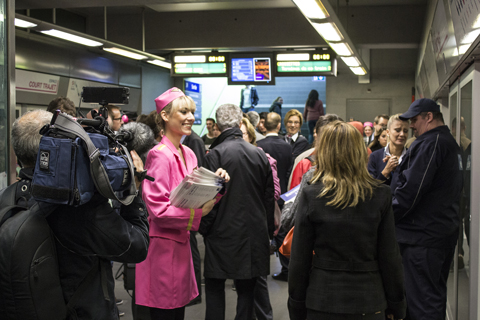
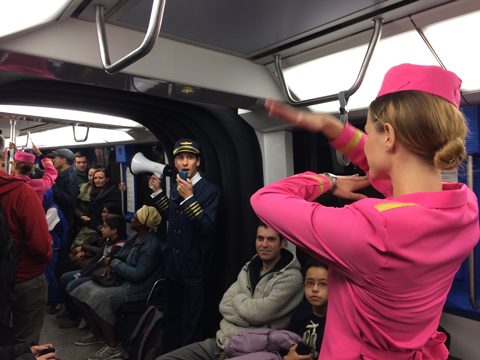
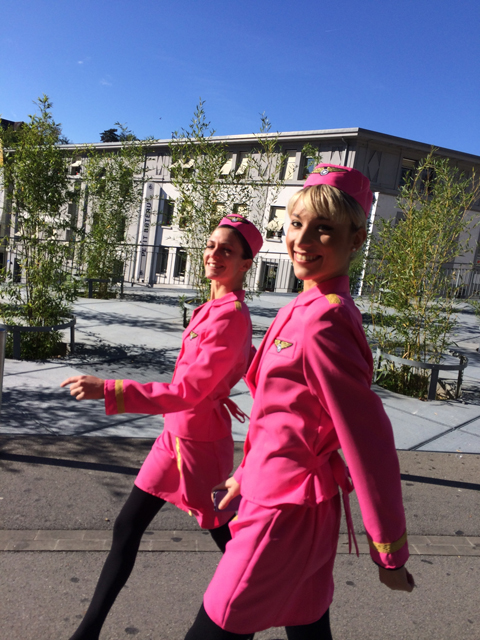
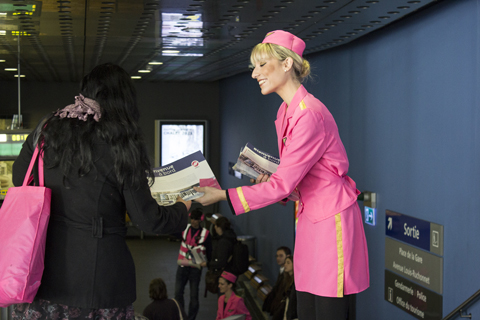
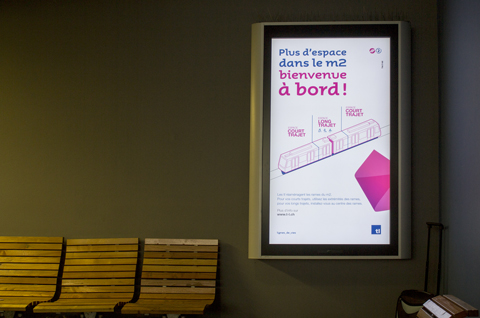
Franz & René planned and staged a street marketing campaign with actors who introduced passengers to the new carriage concept. Between October 30 and November 1, these actors patrolled the platforms and trains and welcomed passengers boarding the M2. The look and gestures of the actors were reminiscent of airline employees: as flight attendants and ground staff in the M2 colors, they showed passengers the way to the new carriage zones for short and long distances and distributed brochures specially designed for this campaign. New signage inside the car is also designed to direct passengers to the right zones and encourage them to adapt their boarding habits to the new conditions. At the stops, ePanels support the campaign. A multichannel action with charm that will be well remembered and that succeeded in conveying the message of Lausanne Public Transport in a positive way.
The campaign started live on site early in the morning on October 30 in the presence of around ten invited media representatives and the cult figure of French-speaking Switzerland, Marie-Thérèse Porchet, as a surprise guest. In the course of the day, the various media (20min.ch, La Télé and RTS see below) about the event, which put the spotlight on the Lausanne public transport company's efforts to constantly adapt to the needs of its customers, even after five years.
Responsible at Transports Publics de la Région Lausannoise: Frédéric Zamofing (Head of Communications), Elodie de Kalbermatten and Virginie Meusy (Communications Officer). Responsible at Franz & René: Valérie Pecalvel (Strategic Direction), Luciano Gerber (Client Service Direction), Vincent Eichenberger and Olivia Divorne (Event Management), Daniel Rödel (AD), Basile Z'Graggen (CR), Samir El Bourachdi (Junior AD), Pierrick Allan (Junior AD), Noam Perakis and Céline Rey (Direction and Coordination of Actors and Actresses).


If a politician's wife argues in court with a domestic worker, the press is allowed to report on it and identify the politician. The Press Council has rejected a complaint to this effect. However, the media report must be related to the political activity.
24 Heures reported in several articles about a domestic worker who accused the wife of an SP politician in court of withholding her wages, paying her below the legal minimum and abusively dismissing her. The politician under attack and his wife then complained to the Press Council that their privacy had been violated. For the Press Council, there is an interest in identifying reporting that outweighs the protection of privacy in the specific case. Even though the domestic worker was formally employed by the wife and her pharmacy, the politician was in fact also an employer. And as a lawyer specializing in labor law and as a member of parliament for a party that recently launched a campaign to improve the position of domestic workers, he had to put up with his private behavior being publicly discussed in this context.
Vigousse: Protect those affected from themselves
Is a satirical magazine allowed to denounce wrongdoing in a public office? Of course, says the Press Council. But this does not absolve the editors from hearing those responsible for the office before publishing serious allegations. In addition
he reminds that media should protect affected persons from themselves under certain circumstances and therefore refrain from identifying reporting despite their consent.
The satirical newspaper Vigousse in French-speaking Switzerland reported in several articles on abuses in the Youth Protection Department of the Geneva Youth Office. The Geneva Education Directorate then complained to the Press Council about false insinuations, the mixing of facts and commentary, the failure to hear serious allegations and an inadmissible mention of the name of a family concerned. The Press Council partially approves the complaint. Despite some inaccuracies, a violation of the duty of truth was not created. And the readership of Vigousse was able to recognize the commentary character of the reports in view of the sarcastic tone. In contrast, the magazine would have been obligated to confront those in charge of the criticized authority before publication, for example, with the accusation of having abusively placed a large number of children and of acting outside the law. In addition, from the standpoint of protecting the children involved, it would have been appropriate to refrain from identifying coverage of a family affected by the criticized measures, despite the consent of the parents. (PD)
Weltwoche: No Correction Necessary in "Chüngel-Gate
In the third case, the Verein gegen Tierfabriken (VGT) filed a lawsuit against Weltwoche. In the article "Swiss 'Chüngel-Gate'" Philipp Gut denounced deceptions and disregard in connection with foreign agony rabbit meat in the Swiss gastronomy. In the introduction, he praised Swiss regulations and laws regarding rabbit husbandry. VGT President Erwin Kessler subsequently demanded a correction, as rabbits are also allowed to be kept in solitary confinement in Switzerland. - a form of animal husbandry that cannot be reconciled with the Swiss Animal Welfare Act and is cruel to animals. The fact that Swiss rabbits are less well off than Gut claims in the introduction is not disputed either by experts or by the Press Council. However, since the main topic of the article was a different one, Weltwoche was not obliged, in the opinion of the Press Council, to reflect the legal-political criticism of the provisions of the Animal Protection Ordinance on rabbit keeping in Switzerland. Furthermore, the author had not based his statement on an absolute standard, but only on a comparison of the laws of Switzerland and abroad. (hae)
The management of Le Temps had developed the idea of a management buyout on its own initiative and informed the two main owners Ringier and Tamedia as well as the public about the idea at the end of October. From the point of view of the two main owners Ringier and Tamedia, the initiative shows that the management of Le Temps is motivated and highly committed to the future of its newspaper and is prepared to contribute its entire journalistic and publishing experience to the further development of the newspaper.
However, in talks over the past few days, media companies Ringier and Tamedia have agreed not to pursue the idea of a management buyout at Le Temps, according to a statement. The goal of a strong majority shareholder continuing to run Le Temps in its own name and at its own risk is not realistic with a management buyout given the lack of financing, it said. Furthermore, a simultaneous search by the management of Le Temps for possible financial investors in the background would lead to a conflict of interest between the management and the main owners of Le Temps.
Ringier and Tamedia will only admit interested parties to the sales process who wish to finance a takeover of Le Temps with their own funds. Individuals or companies that are apparently interested in a takeover of Le Temps on behalf of third party investors in the background will not be considered. The goal of Ringier and Tamedia is to create the best conditions for the continued existence and further development of Le Temps in view of the structural challenges facing the media industry. This decision was communicated to the management and the entire staff of Le Temps at a meeting in the editorial office in Geneva.