Cannes Lions awards work in the fight against poverty

"Cannes Chimera," an initiative of Cannes Lions Festival, awarded eight ideas for creative projects dedicated to improving living conditions in developing countries. The projects will be implemented in the coming months.

The Cannes Lions Festival, which will take place in Cannes from June 15 to 21, 2014, is now awarding prizes to eight project ideas that address the fight against poverty as part of the "Cannes Chimera Initiative". The finished works are to be shown at the Cannes Lions Festival.

The winning concepts aim to draw the public's attention to existing problems and motivate them for possible charitable commitments. A total of 900 entries were received from 79 countries. The eight winning projects will be rewarded with up to 100,000 US dollars.

The winning projects are:
- "The Share Exchange" by Young & Rubicam, Singapore
- "Good Cents" by Joe Public, South Africa
- "The GAP Index" by venturethree, Great Britain
- "The Act Button" by Naked Communications, Australia
- "$.125 cube experience" by JWT, Israel
- "Gamers VS Poverty" by DFCB Digital, Philippines.
- "One Two Five" by PHD International, Great Britain
- "We See Women" by Vital Voices Global Partnership, USA.

Descriptions of the winning projects can be found here.

"Marketing is too focused on the individual"

The consumer goods industry is in despair, says Simonetta Carbonaro. Many brands no longer know who they are—or what customers want. *Die Werbewoche* spoke with the consumer psychologist about brands that have lost their way, overwhelmed consumers, and marketing mistakes.

carbonaro1

WW: Simonetta Carbonaro, you have been advising companies on brand management and communication for over 20 years. What keeps you most busy at the moment?
Simonetta Carbonaro: Something I would call brand archaeology. Many of the big historical brands have lost their identity in the last two decades. I work with them to excavate the core of their brand again - hence the term archaeology. I advise them strategically on the level of brand management and revitalize the core cell of the brand. This means first and foremost to establish brand principles and to cast them into operational business rules for all core areas of the company - from innovation management to sales. This is the only way to ensure that the brand can once again fulfill its leadership function and become tangible for both employees and customers. Communication comes second. If you know who you are and why you do what you do, it is easier to appear convincing and up-to-date.

Why have brands lost their identity?
Many were seduced by lifestyle marketing and the very fashionable experiential marketing. They followed short-term trends, ran after the wishes of the customers and called it all customer orientation. In the process, they forgot what their real role is in business and in society: namely, to give the customer orientation. As a result, these brands stopped being what they were and became what they thought they had to be according to customers. A good example of this is greenwashing, which marketers used to try to appeal to new critical consumers. But people don't want greenwashing, they want honesty.

Can you give an example of a brand that you have revitalized?
Coop Italia. About four years ago, the cooperatively organized retail chain wanted to raise the profile of its brand in an increasingly competitive environment. We accompanied them in the repositioning of their communication and brand identity and developed a radical but very authentic new form of communication together with them. The primary aim was to convey the values of the Coop brand to customers in a simple, direct and honest language (see figure). For example, on posters featuring private-label products, we expressed what Coop stands for: good, safe, ethical, affordable, and ecological products. On other posters, we conveyed the brand's principles: "Foie gras, no grazie." - "Test on animals, no thank you." - "GM food, no thank you ..."

coop_italia
(Coop Italia, PoS Communication, ©REALISE/Fragile)

//www.youtube.com/watch?v=a1pSDXX83Nw

In other words, companies must define their own values, pursue them consistently and communicate them to the outside world?
You can sum it up like this: "Being what you say you are. And saying what one is." It is no longer a matter of communication of seduction. Just the idea that communication should seduce is passé ... The emotional dimension in communication remains, of course. If customers know what is essential about a brand, what it stands for, they are quite receptive to emotional stimuli or rather "emotive messages".

What is the trigger for the reconsideration on the part of the companies?
The crisis. It may be less noticeable in Switzerland so far, but it is very present in many neighboring countries. Sales have plummeted dramatically. The wake-up call, as we all know, always comes from the Excel spreadsheets. But there is also a second dimension. People have realized that we are not in a temporary crisis, but in a profound transformation. We don't come back to the starting point like in Monopoly and start all over again. This has arrived on the brand management floor. Brand managers who understand something about brand management recognize that the upheaval has to do not only with the market economy, but with society as a whole. And that they cannot simply adapt to it, but must also see themselves as a kind of agent of this transformation.

What does this transformation look like?
In times of crisis, as history has shown time and again, people realize that they cannot make it as individuals. Under uncertainty, people instinctively tend to band together. Not for altruistic or ideological reasons, but purely pragmatically on the basis of selfish altruism. It is understood that public spirit is needed. Societies historically have always been based on communities. The sense of community was only temporarily lost in modernity, which was oriented towards individuality.

What about politics?
This no longer represents a reference point. People have understood that they have to take their fate into their own hands.

For years, they have been talking about the affluent society, about "over-muchization. Material abundance overtaxes people and makes them tired. Now a change in thinking is taking place. This change is limited to Western countries, right?
Yes, especially Europe. The emerging markets currently want to experience the same fairy tale of the economic miracle as we did in the 1950s. That is, of course, their right. But: While it took half a century for our Western societies to achieve this abundance, the emerging markets have adopted our consumption habits much more quickly. At the same time, criticism has also been sparked more quickly. Many people in Brazil, China and India are already questioning our consumption model and the values behind it.

How did "over-multiplication" come about?
The "over-multiplication" is a result of hypersegmentation. Marketing has been too focused on the individual for years. First it was target groups with a certain lifestyle. Suddenly we had arrived at one-to-one categorization. Finally, the target group was the individual. It's exasperating to stand in front of the store shelves today and see the countless products that all claim to be different, and yet in the end are all the same. Consumers are overwhelmed by the range of products on offer. And for companies, it's very expensive. Because the cost of hyper-differentiation is not offset by sales. This shows how desperate the consumer industry is. It no longer knows what the customer wants, nor who it is.

Given the large number of consumer surveys, isn't that downright paradoxical?
Very! It's time to reorient ourselves. Consumer research with conventional methodology is old news.

What is the problem?
Consumers should no longer be viewed top-down, from above, and analytically deterministically divided into market segments, as is often done in market research. People are not the monsters described in marketing manuals. He is not a multi-optional, volatile, schizophrenic being whose needs are unpredictable. Especially in uncertain times, consumer needs can be anticipated very well. But to do so, it is necessary to understand the sociocultural drivers of our society via social science approaches and their impact on people's lives via participatory methods. This is an inductive process and contrasts with the deductive mechanistic practice of classical marketing, which includes neuromarketing, which has become fashionable. In analyzing the response of individual brains to external stimuli, I learn very little about people's actual concerns and problems.

Isn't the problem also that marketing has become distanced from the rest of the company?
Yes, marketing has become a separate department in many places in recent years, interpreting and seductively implementing customer surveys and benchmark studies. Marketing runs parallel to other departments - and comes too late in the value chain. This results in product ideas that have little to do with the brand. How can new products be designed if you don't start with the brand? It is the brand that designs products from the idea. The brand i s the company.

We have now talked about brands that have lost themselves. Surely there are also those that have remained true to themselves...?
Sure, let's take the fashion industry as an example. Here there are some brands that have held on to their identity. Some of them very cynically. Diesel, for example, has even allowed itself to mock the big wave of responsible consumption - ecology, fair trade, climate change. For example, with a big campaign in which colorful parrots flew around Venice instead of pigeons. The example shows: Sticking to brand values does not mean being a sustainable brand. That is independent of any morals.

diesel

At the same time, new fashion brands dedicated to sustainability have emerged in recent years.
Yes, I find Honest By by Bruno Peters, a young designer, particularly interesting, for example. His fashion is based on sustainability and transparency - without becoming health food fashion. On the website (Honestby.com), the entire value chain can be tracked transparently. Not only where the material comes from, but also the profit margin becomes visible. Complete price transparency. A model like this is a bomb! Let's imagine that all brands were at this level of transparency ...

Patagonia also has an interesting culture of transparency. The brand is not only known for the Footprint ChroniclesThe other thing that's interesting is the disclosure of the supply chain. What also impresses me is that the brand communicates in which areas it has managed to be sustainable - and where it is not yet sustainable. That's very bold. Most big brands only highlight their assets.

What advice do you have for brands that have lost their core - and not yet found it again?
I always ask my customers the following question: "What would the world be missing if they didn't exist? "If you can't think of anything clever to say, goodbye! Today, we are flooded with products and services. There is less and less room for brands that don't make sense. Consumers today no longer define themselves by what they buy. It's no longer "I store, therefore I am," but "I am, therefore I store." When we're willing to spend our money today, we don't just want to consume. We want to invest in something meaningful. In something that helps us as human beings.

Interview: Isabel Imper

carbonaro2_0
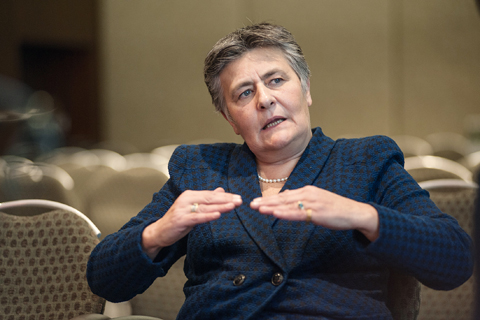
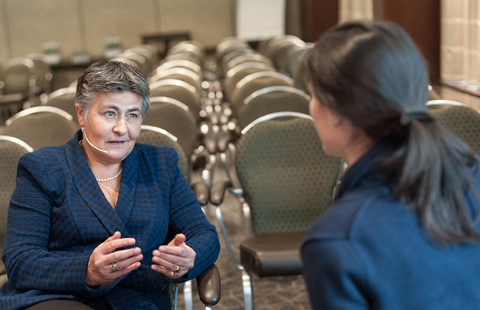
Simonetta Carbonaro (Photos: Dominik Fricker)

In a nutshell
Simonetta Carbonaro is one of the thought leaders and pioneers in today's world of retail and the consumer goods industry. She is a consumer psychologist and expert in innovation and brand management. As Professor of Humanistic Marketing and Design Management in Sweden and Visiting Professor at the London College of Fashion, she researches in the fields of consumer behavior and social and cultural change in our global societies. She is a member of the Advisory Board of the International Trade Conference (IHT) of the Gottlieb Duttweiler Institute (GDI) in Rüschlikon/ Zurich and has been advising international companies on brand management, communication and product development for over 30 years. 

New business models

//www.youtube.com/watch?v=pYX65D0ceXA

Sharing Economy. Why buy it when you can borrow it? App "WHY own it".

Crowdsourcing Website Quirky.com.

Changemaker: Ethics kisses aesthetics: Changemaker.ch.

Clothes with a story: Iouproject.com.

Merci: Merci-merci.com.


"Management changes and sales thinking prevent sustainable brand management"

At the invitation of Ogilvy & Mather, Simonetta Carbonaro gave a talk in Zurich at the end of January and gave clients and potential new clients of the agency an understanding of "over-multiplication" and the transformation process (you can find an article on this in here). This has shown: The developments mentioned by the consumer psychologist also concern the Zurich communications agency.

Gaby Zimmerli, Managing Director of Ogilvy & Mather, elaborated on four topics for Werbewoche.

zimmerli_0

Brands in search of identity

We repeatedly experience that companies or customers "work" on their brand identity, but that frequent management changes and short-term sales thinking prevent sustainable brand management. Many companies prefer to initiate short-lived initiatives and activities instead of reflecting on the real identity of the brand and working out how this brand identity should be expressed and presented in today's world. To engage with the brand means to deeply engage with the brand and also to closely observe, study, understand and interpret the relationships that the target groups have with the corresponding product or service. And that is hard back-breaking work.

"Over-multiplication"

The "over-muchization" presents us with great challenges every day.

  • I'm thinking of the ever-changing new channels, new technologies, new information to communicate and report on that we all have to deal with.
  • But I'm also thinking of customers and companies that want to communicate as much and as extensively as possible about their products and services over and over again instead of limiting themselves to the essentials.
  • And I am thinking of the countless product range extensions, product variations and other "optimizations" of a product or service, which clearly contribute to "over-multiplication" and whose sense and purpose could be questioned.

(Too) many channels to interact with customers - (too) little budget

"Essentiality" is the answer here. We persistently try to get the customer to focus on what is most important and essential and to set clear priorities. It's imperative to avoid getting bogged down. A clear message, a clear communication and media strategy and a strong idea are key. Most of the time, less is more or, to quote Simonetta Carbonaro, "perfect enough" is good enough.

New sense of community?

We clearly perceive this change. Social media are nothing other than a clear expression of the "Me" to the "We. The more anonymous, multicultural and multi-optional society becomes, the greater the desire and longing for security, orientation and community. Social networks, associations, spiritual or religious communities, etc. are possible answers. Crowdsourcing is another good example. We also create platforms for customers, which in turn are forums for exchange and promote a sense of togetherness.
 

Seduce with strategy and magic

Rebekka Rauscher helped set up the Geneva office for SelectNY. The globally active agency specializes in brand building and communication in the premium and luxury sector.

rebekka
(Photo: Isabel Imper)

Fine fashion and accessories, perfumes and cosmetics - Rebekka Rauscher, Managing Director of SelectNY, moves in the world of premium and beauty brands. The agency's location in Geneva, home to many international companies, luxury hotels, jewelers and watch stores, is made for this.

The SelectNY office at 5 Rue Rousseau is centrally located in a discreetly renovated old building. The Four Seasons, on the other hand, promises more splendor just around the corner. The hotel lobby is a comfortable place to linger. The shoes sink into a royal blue carpet, a golden pendulum draws attention to itself every quarter of an hour. Rauscher's white sneakers provide a refreshing contrast.

The glamorous environment suits her work at SelectNY well. After all, premium brands like to present themselves in a dazzling environment. "Storytelling is particularly important in the premium and luxury sector," says the managing director. A product should never be sold clumsily, but must seduce the consumer. Legends are often used as a starting point for the story. "Half true, half myth, they give an explanation of how it all began, but you never know everything," says Rauscher. "Passionate and intrigued, the consumer becomes part of the brand as a confidant, can identify with it, and will come of their own accord."

"SelectNY has an eye for beauty and has a unique approach to storytelling, " says one client's business manager.

Rauscher is convinced that communication in the luxury sector means more than just a glamorous facade. It needs a logic, a clear strategy behind it. This combination is called "Magic with Logic" at SelectNY. "This is understood to mean the combination of passion and principles, style and substance. That's the only way to create strong brands that are emotionally, culturally and commercially compelling." The in-house tool "Brand Epic" is the key to transforming the brand essence into an inspiring text and image story. A kind of "brand bible " that condenses a complex brand story into a brand story for consumers to understand and remember. Not only can marketing managers in the various regions use such a tool as a guide later on, but it also provides clarity for other service providers, such as packaging or PR agencies. The tool helps to pursue a long-term strategic and creative vision and should prevent "actionitis".

Such a set of rules was developed for jewelry and crystal manufacturer Swarovski, for example. "The brand was perceived as bogged down and inconsistent," says Rauscher. SelectNY's "Brand Epic" romanticized and unified the production of its gemstones under the claim "The poetry of precision." "Today, crystals are considered valuable even though they are artificially created." And the brand became strong enough to expand its offer with new licenses (e.g. fragrances and watches).

SelectNY operates on the principle of international reach, local expertise. "La petite agence mondiale." Global campaigns are created for international clients and adapted to a country on the spot - in collaboration with the local client. For example, SelectNY represents an internationally active consumer goods group with various perfume and cosmetics brands in Switzerland. In Geneva, the agency is represented by four account people. For strategy and creation, Rauscher works mainly with the SelectNY team from the French fashion capital. "This structure allows us to work with the best beauty and fashion talent," Rauscher explains. However, she can also work with SelectNY offices in other cities, depending on her needs and expertise. "SelectNY combines the service of a large agency, but at the same time it is flexible like a small agency ", says the client side.

Between chief designer and licensee

But how creative can you be when you're working on brands that employ creatives themselves? "It is indeed a challenge," Rauscher says. "We have to be very flexible." On one side is a chief designer who has a precise idea. On the other, the licensee, who does the marketing - and has his own idea.

SelectNY primarily represents the interests of the licensee. In the end, however, both sides have to be happy. "Our work requires a culture of openness and collaboration. We have to be adult enough to discuss an idea - regardless of whose idea it was. It's all about what's best for the brand."

Rauscher's commitment, passion and enthusiasm for her work, for brands, but also for the wishes of customers is unique, say responsible people on the customer side. She loves to share ideas. "Every conversation with her opens up new solutions and possibilities for the brand." The managing director is extremely flexible and always up to date with developments. She adapts to changes effortlessly, she says. "Rebekka has a positive attitude, an eye for what is feasible. To find the best solution, she also doesn't hesitate to plunge into the unknown." Rauscher's interest in fashion and jewelry is a big part of why she is in her element at Select- NY. She's a watch fan. Right now, she's wearing a vintage Omega - made at the Geneva manufacture back in the day. It's a nice metaphor for her move from Switzerland's largest city to its second-largest. Her latest acquisition: a Nautilus Patek Philippe. It would be a dream for her to communicate for big Swiss luxury watches like Vacheron Constantin or Patek Philippe. For her, the combination of global fame and history is what makes it so appealing. There's also a bit of patriotism and pride involved, she says, because after all, the watch industry has made Switzerland famous around the world. But it is difficult to get into this closed circle.

Before joining Select-NY, Rauscher's career had little to do with fashion and beauty. During her seven years at McCann, she worked as an account supervisor for international clients such as Microsoft and Saab Automobile. When the request came from SelectNY - the agency was in the process of opening an office in Geneva - she didn't have to think twice. "It was a chance to work in a domain that appeals to me personally."

At the lean owner-managed agency, the opportunity arose to advise international clients on a global strategy. In the years that followed, Rauscher helped build SelectNY's business in Switzerland.

Far away from the advertising cake

At the moment, Rebekka Rauscher is pursuing two goals in particular: On the one hand, she would like to win more Swiss companies as clients. "I am convinced that our 'Little worldwide agency' concept is also interesting for other Swiss companies with a global orientation." On the other hand, she wants to make SelectNY more visible within the industry and the media. Here, the CEO feels that Geneva is far away from the "traditional advertising pie," from ADC and BSW. "We are like a free-floating magnet."

Nevertheless, Rauscher would not want to miss Geneva. The internationality combined with the "savoir vivre", that people take time for a lunch to enjoy themselves, appeals to the homesick native of Zurich. Added to this is the proximity to the Alps, where it is possible to ski in winter and climb in summer.

Has her relationship with fashion and luxury changed as a result of her work? "I think I've remained a down-to-earth person. For me, the little plaisiers mean more than the latest bag from Marc Jacobs."

Isabel Imper

parfum


Rebekka Rauscher about luxury brands and ...

... Celebrities
"Celebrities can be extremely helpful to a brand - as long as they are paired with the right brand at the right time. For example: a perfume is a product that transports you into a world, but doesn't provide any rational benefit. Here, it's about finding a celebrity who just embodies a certain lifestyle or stands for certain values. I would be more careful with a luxury watch, because it is a valuable product, with a tradition, built thanks to the craftsmanship of the watchmaker. If you advertise there too often or not in the right context with Hollywood mainstream celebrities, you can increase the brand's visibility, but it loses depth over time and it dilutes its story."

... China
"The fact that many Chinese buy high-end watches when they travel to Europe has a particular influence on distribution (e.g. in duty-free, boutiques in tourist resorts) and product design: certain luxury watches design with the Chinese in mind. For example, they produce watches in a double pack. Chinese like to buy a watch for the lady and a matching one for the gentleman to go with it. That makes sense. In brand positioning and communication, however, the brand absolutely has to remain true to itself. You can't 'Chineseize' the brand, otherwise it will no longer be attractive to the Chinese. They are attracted to European luxury."

... Social Media
"Social media is a weapon that should be used very carefully in the luxury sector. Luxury brands must not relinquish the sovereignty of interpretation. Social media should give the customer an experience without damaging the qualitative and exclusive aspirations of the brand. A successful example is Burberry 'Art of the Trench'. There, a website was created where fans could upload a photo of themselves wearing their trench coat. The campaign allows viewers to 'like', comment or share with friends. A new and surprising way to celebrate Burberry's most important iconic product and inspire their fans."

... fashion trends
"Much more than whether green or blue will be the trend in two years, as branding specialists we are interested in social, technological, cultural and economic change. We follow what moves people. In times of crisis, for example, people like to go back to the tried and true; traditions combined with rituals convey security and become important again in such times. This inspires us in the development of our ideas and concepts."

tissot
sebastian

In a nutshell
The agency founded in 1991 SelectNY specializes in brand building and communication and serves clients from the beauty, fashion, luxury and lifestyle sectors in particular. The agency employs over 400 people worldwide. In addition to its main office in New York and its Swiss office in Geneva, it has offices in Los Angeles, Paris, London, Koblenz, Hamburg, Hong Kong and Shanghai. Its portfolio includes brands such as Cavalli, Davidoff, Balenciaga, Maurice Lacroix, Lancaster and Villeroy & Boch.

In a nutshell
After completing his commercial training, he worked Rebekka Rauscher in the publishing industry, including at Jean-Frey Verlag. She then joined Wirz Werbeberatung as an account assistant. In 1998, she joined McCann Erickson Geneva as an account supervisor. Rauscher joined SelectNY in 2005. As Group Account Director, she helped establish the Geneva office and has served as Managing Director since June 2012.
 

How do Swiss cities use social media?

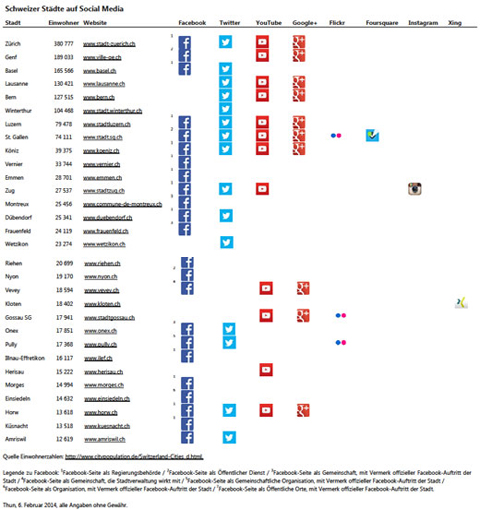
The article by social media consultant Jürg Kobel focuses on the use of social media in public administration. His online research from late January 2014 highlights how Swiss cities are currently using various social networks.

The authorities of Switzerland’s eight largest cities have a presence on social media. Of the 100 most populous cities, about one-third are officially active on social media. Facebook is the most popular platform, ahead of Twitter and YouTube. However, social media is also of interest to smaller cities. These are the findings of an online survey conducted in late January 2014.

Facebook before Twitter

Facebook is not only the most widely used social network among private individuals, but also among city governments. Twenty-three municipal authorities in Switzerland’s 100 largest cities have an official Facebook page. The city of Zug tops the list of cities with the most fans. Cities such as Bern, Thun, Chur, and Aarau do not operate an official Facebook page, but some of their departments do attempt to engage with their users on Facebook.

So far, 15 of the cities surveyed have taken the plunge on Twitter. The city of St. Gallen is the most active, with over 3,300 tweets. These tweets are also followed by over 3,100 users. The city of Basel has the highest number of followers, although it shares its Twitter account with the canton of Basel-Stadt.

YouTube and Google+

Twelve city governments have set up a presence on YouTube. Here, politicians share their views, construction projects are presented, and general profile and promotional videos of the cities are shown.

The number of Google+ pages—ten—may come as a surprise, but this is because setting up your own YouTube channel requires a Google account, which automatically leads to a Google+ account. A closer look at the Google+ pages reveals that only the cities of St. Gallen, Lucerne, and Horw post regularly.

Flickr, Instagram, Foursquare and Xing

During the online search, other social networks were discovered at a few authorities. St. Gallen, Gossau and Pully show photos on Flickr, Zug square pictures on Instagram. St. Gallen runs the location-based network Foursquare and the city of Kloten publishes its job advertisements on Xing.

Active and passive cities

St. Gallen actively maintains six social media channels. The cities of Lucerne, Zug, Köniz, and Horw share news on four networks. However, the number of social media platforms is only of limited significance for a successful social media strategy. After all, simply creating accounts is not enough. What matters is how they are managed afterward.

The need to communicate with citizens is not limited to large cities. The towns of Gossau, Pully, Horw, and Amriswil also serve as role models for modern dialogue.

Resources are likely the main reason why city administrations are often absent from social media. The City of Zurich states that, due to resource constraints, its Twitter account is used only in emergencies. However, inquiries via Twitter are answered. Olten does not operate a social media channel at all and explains this as follows: «As far as social media is concerned, our current staffing levels in the communications department do not allow us to professionally manage a Facebook page for the entire city administration.»

Outlook

Some cities have only recently become active on social media. In the future, the number will increase, because social media undoubtedly belongs in a communication concept of a city administration. The effort required to operate social media must be properly assessed. There will be additional work, especially initially, when the social media strategy and guidelines are being drawn up. However, social media should become more and more a matter of course in the public relations of a city.

You can find the table as a PDF here.

tab_verw

Author: Jürg Kobel

Jürg Kobel is a freelance social media consultant and runs a Blog.
 

13 Questions for... Stephan Oehen

Does Stephan Oehen, Managing Director of Oehen PR Switzerland, fall for advertising? Has he ever bluffed? And how much does he earn? Find out the answers to these questions and 10 more in our Q&A series.

oehen-stephan01

1. what inspired you to enter the communications industry?

Using words to influence people. Whether in politics, through the media or with consumers.

2. what would you most like to communicate for?

Next to all the mainstream we see in marketing communications, to build a true luxury brand worldwide would be great.

3. where and how have you ever bluffed in your life?

I do not bluff, but shape truth until it becomes credible.

4. was there a moment in your life when you thought: Wow. This is great. And it's from me!

When the Federal Council decided in favor of the Swedish Gripen in 2011. As a political advisor and strategist, I have played a key role in shaping the campaign since 2002.

5. who was the most fun lunch partner?

Again and again, my youngest. Recently he confessed to me that he wasn't Spiderman, but that I was definitely and demonstrably Superman. Convincing him that this is not the case was impossible.

6. what does not come to the office under any circumstances?

Slippers.

7. the best testimonial ever?

Marilyn Monroe in 1960, because she wasn't even paid for it: "You know, they ask me questions. Just an example: 'What do you wear to bed? A pajama top? The bottoms of the pajamas? A nightgown?' So I said, 'Chanel No.5,' because it's the truth."

8. how has your media behavior changed in the last three years?

Today, I also read paid media exclusively electronically. That didn't exist in the past. That's why the people at the waste paper collection hardly enjoy me anymore, but all those who used to take care of it do.

9. what do you see as the biggest challenge for PR at the moment?

Finding the right balance between digital PR, traditional PR and content.

10. do you fall for advertising?

Again and again! For example, when a new technical gadget comes on the market and I have to realize after the first hour that it is neither faster nor better than the old one. Fortunately, there are excellent tech journalists today.

11. which websites do you use regularly?

Hootsuite, Evernote, Google Analytics and Pulse. Privately, I love the FT app "How to spend it".

12. what is impossible for you to do without?

On chocolate and enough sleep.

13. do you tell other people how much you earn?

No. I don't know for sure myself.

In the next installment of our series, Markus Gut, CCO of Advico Y&R, takes on the 13 questions.

Stephan Oehen founded Oehen PR in 2006. For the past two years, he has also been Managing Director of the PR agency Grayling (formerly Trimedia). Oehen PR, based in Zollikon with offices in Munich and Vienna, is an affiliate of Grayling.

To the point: heaven and hell

In the past week, I was at several events. I would like to highlight two of them in particular.

Firstly, the traditional meeting of the Tages-Anzeiger in the Schiffbau in Zurich and then the joint event of the Zürcher Presseverein and the Zürcher PR-Gesellschaft in the Audimax of the ETH Zurich, the ComSum14, which is also already a tradition.

Let me start with the Shipbuilding Meeting. A high-profile event with celebrities from business, politics, advertising and the media. As always, the focus was on a prominent speaker. This year it was the German philosopher and publicist (including "Who am I - and if so, how many?"; "The art of not being an egoist") Richard David Precht. At the beginning, Pietro Supino, Chairman of the Tamedia Board of Directors, gave a presentation. Among other things, it was about the importance of journalism and about the freedom of the press, which is increasingly endangered also in Switzerland. The presentation was concise and had the right length or brevity. I thought it was good. Then the appearance of Richard David Precht. In terms of appearance and styling, belonging to the faction of fashionable salon intellectuals, he spoke about egoism and morality. Philosophy, a topic that makes very few listeners - as Precht also said in his welcome address - fall into ecstasy with enthusiasm. But what Precht made of it in his detailed lecture was, in my opinion, remarkable. He "lectured" on what is in itself a rather dull topic - and in a good sense - in such a way that he had the unrestricted attention of the audience. His trains of thought were clear and coherent, the examples impressive. And all this in free speech, without a manuscript and ready to print. Even in the subsequent discussion with TA editor-in-chief Res Strehle, Precht remained calm. Not even with questions on specifically Swiss topics. I liked it.

This week, ComSum14 took place under the theme "The Digital Challenge. Frank Schirrmacher, Pietro Supino, Christine Maier and Veit Dengler were announced. Miriam Meckel, who had originally been announced, sent her apologies in advance. Schirrmacher, who was to have given an introductory talk, dropped out due to illness. Supino thankfully stepped in and gave an interesting presentation. But that was it. A completely chaotic Lipp moderated a boring, sprawling talk far removed from the topic. Ironic a Twitterer: "Maier has nothing to say, Supino is attacked, Dengler doesn't care. Was a great evening." He's right. Sorry colleagues: I didn't like it.

Pierre C. Meier, Editor-in-Chief
[email protected]
 

How can media budgets be generated alternatively?

Book advertising—and pay not only with money but also with your own products. Limmatkontor, an agency founded in 2013, makes this possible. In this interview, the managing directors explain how it works.

limmatkontor
(Christoph Schneider (l.) and Claudio Lumbiarres)

WW: Limmatkontor refinances media services, i.e. you buy products from companies in return for media services. Why media services in particular?
Christoph Schneider CS: This goes back to our previous work in the media industry. Claudio Lumbiarres was most recently at Tamedia as Head of Sales & Business Development at Newsnet, and I was in my last position as Advertising Market Manager Online at Axel Springer Schweiz. From time to time, advertisers would tell us that their media budget had been cut due to sales problems. One product didn't run, another was only worth half as there was already a successor product on the market... For these budget problems, we looked for a solution - and found it abroad.

Where.
CS: In the USA, the "corporate trading" business model has been around for many years. It means something like: Give me goods and you get media in return. Or vice versa: You buy media from me and pay for it proportionately with goods. In German-speaking countries, a few companies are active in this field, including Rheinkontor in Cologne. With Limmatkontor, we are now bringing this service to Switzerland - together with our partner Rheinkontor, which has been active in corporate trading and the refinancing of media services for over ten years.

What media services are involved?
Claudio Lumbiarres CL: Geographically, we focus primarily on the Swiss media. However, we also have the possibility to organize international campaigns especially in Germany and Austria. In terms of media, we are neutral: online, print, mobile, billboard, radio, TV - we offer all genres.

Can customers determine which services they receive?
CL: We work with clients to find a solution that fits their brand strategy and reaches the target audience with the least wasted coverage, and optimize everything in coordination with the agency.

Especially in the TV and online sector, remaining seats can be bought very cheaply. Does Limmatkontor work with such offers?
CL: We do not sell filler or remnant advertising, but offer media services in all areas.
CS: In doing so, we are bound neither to a publisher nor to a genre.

So Limmatkontor does not deal in media remnants?
CS: No, we are not a remnant marketer. We do not have any pre-packaged or residual space that we offer to the customer. For us, each project is unique. We analyze the goods with the customer and set the price for them - if the goods are already depreciated, the customer can generate an extraordinary return. In any case, we find a fair market price for both parties. Then we go into campaign planning with the marketing manager and with the agency and look for opportunities in the media to place the advertising in the best possible way. Here, we benefit from the network of relationships we have built up over many years. We see ourselves as partners of the client and the agency.

Can you describe a customer project?
CS: We promise our customers confidentiality. They come to us with problems. We do not want to make these public. But I can describe a case to you.

Gladly.
CS:
We resolved a merchandise issue with an electronics supplier late last year. Due to downstream products, the value of the electronic goods dropped. We took them off the customer's hands at their selling price and resold them, outside of their distribution network. Our customers always give us restrictions on resale. In this case, we were not allowed to sell the goods in Switzerland. It was finally sold in a non-German speaking country.

Do the goods end up on the free market in each case?
CS:
The goods do not enter the B2C market directly. It doesn't show up at the POS or on a bargain portal in our customer's country of distribution. We are always looking for new distribution channels, e.g. closed user groups, such as a large company doing an employee incentive. Thanks to our Cologne partner Rheinkontor, we have access to a unique international trade network.

Where are foods with a short shelf life sold?
CS:
These reach institutions such as universities or hospitals, for example, meaning that the end customer ultimately does not consume the goods via the brand.

How does Limmatkontor earn its money?
CL:
On the one hand with commissions of the media services, on the other hand with the resale of the goods.

Why should companies hire Limmatkontor? You could also give the goods to a dealer and finance an agency with the proceeds...
CL:
If I give the goods to the remnant dealer, I usually get a very low price and have to write off the loss. The marketing measures are then bought from a second supplier with money. With us, customers receive a higher price for their goods in the form of a credit note. As a rule, there is no depreciation for the customer. Future marketing services can be paid for proportionately with the credit bill.

CS: What's more, when companies hand over goods - at a big discount - to a remnant retailer, they often end up on online platforms or on bargain tables. This cannibalizes the future business. We sell the goods where they are not sold. And in return, customers receive a credit that can be used for investments in the future, i.e. advertising budget.

In which cases is it worthwhile to engage Limmatkontor?
CS:
It is advantageous if a company offers products or services and at the same time is active in advertising. Usually we have customers who have a commodity problem and want to advertise new products, but lack the money to do so.

Is cooperation with agencies conceivable?
CS:
We want to remain as neutral as possible and not be tied to a single agency. In the US, some agencies have integrated our business. We always work with the client's agency.

Limmatkontor is a young company. What about the financial basis? Is there a guarantee for the media services?
CS:
If desired, we conclude the contracts together with Rheinkontor. This covers the risk of financing media services. We are organized as a classic limited liability company with three shareholders. Rheinkontor owns shares and so do we as managing directors.

What goals have you set yourself for the next few months?
CS:
The first goal is to build up and expand awareness in Switzerland. We want to offer a reasonable alternative to generate media budget. By the end of the year, we are aiming to establish the business model in a similar way to Germany and the USA - although we will not use the term "corporate trading", but will make our service known as "media for inventory". In the long term, we want project business to develop into lasting customer relationships. We will then have customers who think of us when they once again have a merchandise problem or a budget bottleneck.

Interview: Isabel Imper

In a nutshell
Christoph Schneider has been working in the media since 1996. In his last position at Axel Springer Schweiz, he was responsible for the marketing of digital products as Advertising Market Manager Online. Claudio Lumbiarres has been working in the Swiss media industry for twelve years, most recently at Tamedia in the online network Newsnet in the position of Head of Sales & Business Development. In September 2013, Schneider and Lumbiarres set up their own company, Limmatkontor. In cooperation with their Cologne-based partner Rheinkontor, they are managing directors of the agency, which specializes in marketing and sales. 


Jumbo Expands Its Sponsorship of the Tour de Suisse

IMG, the organizer and marketer of the Tour de Suisse, has agreed with Jumbo to expand their collaboration for the 2014 Tour de Suisse. Jumbo has acquired the last available jersey package and has been promoted to the second-highest sponsorship category as an Official Sponsor.

As early as 2013, the home improvement chain Jumbo served as an official co-sponsor of the Tour de Suisse and drew attention to itself through various promotional activities. For 2014, Jumbo is expanding its sponsorship activities for the Tour de Suisse and is now also advertising on the jersey of the top Swiss rider in the general classification. In addition to the extra advertising on the jersey, Jumbo will receive various advertising spots and features in TV trailers as part of the live broadcast.

Once again this year, the Tour de Suisse will be broadcast LIVE on all three of SRG's national channels. In addition, the race is expected to be broadcast in well over 100 countries.


Ideart designs educational concept

Ideart has developed a set of key arguments in support of media education in schools for the Department of Education and Culture of the Canton of Lucerne.

Digital media are present in all areas of life today. Schools are challenged in many ways. As part of media education, it must demonstrate the potential and opportunities of digital media, but also address the possible dangers of using social media or computer games.

For this reason, the Department of Education and Culture of the Canton of Lucerne has developed an educational concept entitled "Pegasus - Personal devices connected to the school network". Ideart has summarized the topic graphically in a 56-page brochure. Illustrations by Ludek Martschini liven up the whole thing.

Responsibility at the Department of Education and Culture of the Canton of Lucerne: Markus Michel. Responsible at Ideart: Peter Martschini (production and organization), Ludek Martschini (illustration and creation.

1.ideart.bild_

Heroic deeds of Jumana Issa and Nicolai Spicher

The concept by Jumana Issa and Nicolai Spicher took first place at the SDV Junior Award in the spring of 2013. As a prize, the two interns were given the opportunity to bring the campaign to life at Ogilvy.

Fight the rampant direct marketing mainstream with new, fresh, surprising, unusual - in a word: creative - ideas! This was the challenge of this year's SDV Awards. Jumana Issa and Nicolai Spicher accepted the challenge and convinced the jury with their ideas.

Now the three DM Heroes, Captain Creative, Mailing Man and Web Woman, have been inspiring and challenging creatives to heroic deeds in the fight against mainstream zombies in ads, brochures and stationery, as well as on flyers, posters and banners for several weeks. The characters were developed by Jumana Issa and Nicolai Spicher themselves, and professionally realized by illustrators Carsten and Torsten Odenthal.

Responsible at Ogilvy: Jumana Issa and Nicolai Spicher (Art Direction) Barbara Kottmann (Consulting).

1.ogilvysdabild

Wirz Corporate: Rebranding for Denner

Wirz Corporate is developing a new brand identity for the Swiss food discounter, thereby supporting its growth strategy.

Denner is growing successfully: the discounter has outperformed the industry average in recent years and continuously gained market share. However, the expansion has also presented Denner with challenges in terms of brand identity: The very different store situations made individual solutions necessary in many places with the existing corporate design and led to a heterogeneous overall effect at the POS, the most important point of contact and experience for the brand.

Denner therefore commissioned Wirz Corporate to comprehensively analyze and revise its brand identity. The newly developed corporate design is characterized by two key qualities: On the one hand, its high functionality, in that it can be implemented flexibly yet visually consistently across a wide variety of store locations. On the other hand, the new appearance sharpens the brand's profile: the simplified logo, freed from the old-fashioned ellipse, the striking use of the typical brand color red and the generous images at the POS are intended to strengthen the perception of Denner as a contemporary, likeable Swiss discounter that stands for quality.

Several test stores throughout Switzerland were successfully converted and rebranded in 2013. Following the positive experiences from this test phase, the new look will now be rolled out step by step in 2014. In addition to rebranding the stores, Wirz Corporate has also developed the basis for the design of all marketing and corporate communication tools and media. The changeover will take place gradually from 2014.

Responsible at Denner: Petra Gayko (Head of Marketing Communications), Sabine Gassmann (Project Manager Marketing Communications), Paloma Martino (Head of Corporate Communications). Responsible at Wirz Corporate: Michel Reichmuth (Head of Brand Identity), Diana Kiesel (Consultant), Thomas Wolfram (Design Director), Christina Widmann, Marcel Morach (Design).

1.dennerbild.1
1.dennerbild.2

Last but not least: #AmericaIsBeautiful becomes #fuckcoke

Brands like Coca-Cola shell out millions to air their TV commercials during the Super Bowl, a major marketing event. With this year’s commercial, Coca-Cola has now sparked what is likely the most expensive social media backlash of 2014. It’s almost hard to believe that this came as a surprise.

The commercial draws inspiration from the wholesome classic Coke ad from the 1970s, in which people of different skin colors gather in a meadow to sing Billy Davis’s song «I’d Like to Teach the World to Sing» together. The new commercial also celebrates the sense of community among people of different backgrounds and has them sing along to the song «America Is Beautiful.» The key difference from the original: The Americans in the current commercial don’t sing in English, but in their own native languages—including Spanish and Arabic.

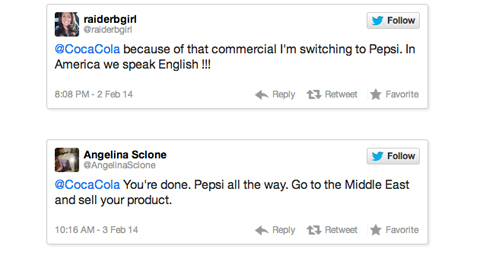
Coca-Cola has thus left behind its vacuous, idealistic optimism and taken a political stance. By celebrating the country’s linguistic diversity, the commercial calls into question the U.S.«s »melting pot” integration strategy. This is particularly controversial given the immense growth of the Hispanic population, which is increasingly demanding that the Spanish language be preserved. The fact that devout Muslims are given significant screen time in this multicultural ad hasn’t exactly earned it widespread acceptance either. If one takes the tweets on Twitter at face value, this has prompted countless people to spit out their Coke in disgust and drink only Pepsi from now on. (sis)

140203_bild
 

get_footer();