Publishers can clarify copyrights with new online tool

Representatives of the International Publishers Association and the International Publishers Union have unveiled an online tool for managing access and copyright rights. Several executives from Swiss news portals learned about the ACAP system and its benefits for their websites.

On Thursday, representatives of the World Publishers Association and the International Publishers Union presented an online tool developed on their behalf for regulating access rights and copyrights. At the event, various managers of Swiss news portals learned about the ACAP (Automated Content Access Protocol) system and its benefits for their websites.
ACAP contains a technical language: rights and authorizations are communicated in such a way that computer systems can interpret and automatically implement them. ACAP follows the principles of copyright law: the rights holder can define how search engines and other Internet services may search and reuse the texts. The re-use of content on the Internet is not prohibited by ACAP, and access by search engines, which is important for publishers, is not prevented. It merely defines differentiated reuse criteria. This can be helpful for clarifying rights, for example.
To date, around 200 Internet portals, mainly in Europe, have implemented ACAP. The system, which is free of charge and, according to the provider, easy to install, will soon be introduced worldwide by Ringier. Further Swiss portals are to follow. The Swiss Press Association wants to actively support ACAP. The search engine giant Google has not yet got on board, citing technical problems.
New Mobile Portal at Swiss Teletext

Teletext is now also available on cell phones. The most important information is available on a new mobile portal provided by the teletext provider Swiss Txt.

Teletext is now also available on cell phones. The most important information is available in a new mobile portal, offered by the teletext provider Swiss Txt. The spectrum ranges from current events at home and abroad to the most important news from the fields of business and finance or the latest happenings from the world of sports. The portal also offers services such as real-time flight data, weather forecasts and the daily horoscope. The mobile portal can be used free of charge. Any charges incurred are the normal data transfer fees of the mobile phone operators. The mobile portal was developed and realized by Swiss Txt. According to the press release of Swiss Txt, more than 1 million people in Switzerland use the information in Teletext every day.

Matter & Gretener promotes the Radisson SAS Hotel to CEOs

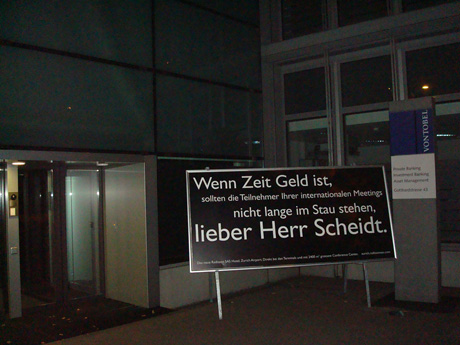
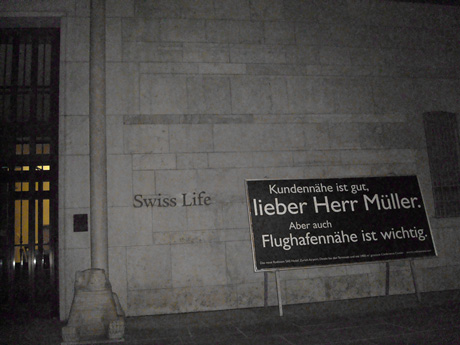
The Matter & Gretener agency has launched a campaign for the Radisson SAS Hotel, Zurich Airport. Through digital billboards, the hotel promotes itself at Zurich Airport as a venue for international meetings. The campaign directly targets CEOs.

The Zurich-based agency Matter & Gretener has created a campaign for the Radisson SAS Hotel, Zurich Airport. On mobile posters placed in front of a total of 29 company entrances, the hotel at Zurich Airport recommends itself as a location for international meetings. The headlines are aimed directly at the respective CEO.
Responsible at the Radisson SAS Hotel, Zurich Airport: Werner Knechtli (General Manager), Holger Herrmann (Deputy General Manager), Stefan Schaer (Director of Sales & Marketing). Responsible at Matter & Gretener: Daniel Matter (Creative Direction), Dominik Imseng (Text), Karin Beerli (Art Direction), Jochen Hennecke (Consulting).
1290582598_img080828_mattergretener
1290582598_img080828_mattergretender2
img080828_mattergretener3

Zattoo offers additional channels as a subscription

Zattoo now also offers the 20 most popular channels in full TV resolution. The channels, with a bit rate of 1.5 Mbps, can be subscribed to from CHF 3.75 per month.

Zattoo now also offers the 20 most popular channels in full TV resolution. The channels, with a bit rate of 1.5 Mbps, can be subscribed to from CHF 3.75 per month.
In addition to the basic offer, which remains free of charge and comprises 74 channels, the following channels are now available in High Quality (HiQ):
SF 1, SF zwei, SF info, Pro7, RTL, Sat.1, ARD, ZDF, Eurosport, VOX, TSR1, TRS2, TF1, M6, France 2, France 3, TSI1, TSI2, Canale 5, Rai Uno.
However, receiving HiQ channels also requires a larger bandwidth (at least 2 Mbps is recommended) and a powerful computer. In a press release issued on Thursday, Zattoo therefore recommends trying out the free HiQ test channel before subscribing to the additional service. The HiQ offer is free of charge for Swisscom VDSL customers.
Zattoo's basic product has so far been well received by 800,000 users in Switzerland. According to the press release, Francesco Vass (Head of Free & Pay TV) stated that the new HiQ offer is the first step towards addressing specific viewer needs. Zattoo plans to expand its premium offering in the near future with additional channels that will be available for a fee.

Regulatory authorities want more power in the telephone market

In light of the slow progress in the Swiss telecommunications market, regulatory authorities are seeking more power from the Federal Council. Swisscom would face restrictions. Sunrise and Orange are generally pleased with this development. Swisscom intends to review the demands made by the Competition Commission (Weko), the Communications Commission (Comcom), and the Price Supervisor.

In view of the sluggish progress in the Swiss telecoms market, the supervisory authorities want more power from the Federal Council. Swisscom would be restricted.
The Federal Communications Commission (ComCom) will now be able to review the forwarding and access prices for Swisscom's competitors ex officio, as was announced at a media conference in Bern on Thursday, according to SDA.
Until now, ComCom has only been able to review access prices following a complaint from a provider. The authorities are now seeking to amend the Telecommunications Act (TCA). If there are indications that other providers are not receiving non-discriminatory and cost-based access to the networks, ComCom wants to be able to intervene on its own initiative in future.
The requested change to the law concerns access or interconnection prices at the so-called wholesale level, i.e. between telecommunications companies. According to the authorities, the aim is to ensure that providers can no longer agree among themselves on a price at an excessive level and thus hinder competition.
With ComCom's timely intervention, the framework conditions would be the same for all market participants. This would improve legal and investment security in the market. In addition, price reductions for network access decreed by the authorities could be passed on to consumers more quickly.Sunrise and Orange generally pleasedSunrise and Orange are generally pleased with the attempt by three supervisory authorities to reduce network access prices. Swisscom intends to meet the demands of the Competition Commission (ComCo), the Communications Commission
(Comcom) and the price watchdog.
"In principle, we welcome every step that leads to a more consistent implementation of telecoms liberalization," said Orange spokesperson Therese Wenger. But now we need to see how this is actually implemented by the Federal Council and Parliament. A key point, however, is access to future infrastructures such as the fiber optic network, which is not mentioned in the three authorities' proposal.
Sunrise is calling for a fundamental change in the system of state supervision: the simplest solution would be to regulate in advance instead of after the fact, as is currently the case. This would allow ComCom to intervene independently and correct anti-market behavior. However, this was rejected by Parliament in the last revision of the Telecommunications Act.
"This is urgently needed because the existing regulatory system has meant that procedures dating back to the year 2000 have not yet been finally concluded," Sunrise writes in a communiqué. This situation is unsatisfactory and prevents investment in new technologies. For example, the broadband Internet market was only opened up around seven years after liberalization in the EU. Like Orange, Sunrise would also like to regulate access to fiber optic networks in the revision of the Telecommunications Act.
The infrastructure competition between Swisscom and the cable network operator Cablecom has proven to be insufficient. Swisscom is still dominant in many areas. For its part, Swisscom is keeping a low profile on the demands of Weko, Comcom and the price watchdog: "We will analyze the proposals," said spokesman Olaf Schulze.

Zürichsee-Zeitung expands coverage area

Starting September 1, 2008, the Zürichsee-Zeitung will be published throughout the entire Horgen district, thereby completing its distribution area around Lake Zurich. With the new regional edition, the Zürichsee-Zeitung Sihltal-Thalwil, the lower part of the Horgen district now also has a daily full-service newspaper from the Zürichsee Presse publishing house.

As of September 1, 2008, the Zürichsee-Zeitung will be published in the entire district of Horgen, thus completing its coverage area around Lake Zurich.
With the new regional edition Zürichsee-Zeitung Sihltal-Thalwil, there is now also a complete daily newspaper from the publishing house Zürichsee Presse in the lower district of Horgen (in the municipalities of Kilchberg, Rüschlikon, Thalwil and Sihltal). In the upper district of Horgen (Richterswil, Wädenswil, Hütten, Hirzel, Schönenberg, Horgen, Oberrieden) the Zürichsee-Zeitung linkes Ufer will continue to be published. Local advertisers have the option of booking the two editions separately or together.
In addition to the two daily newspapers, Verlag Zürichsee Presse continues to publish the Sihltaler and Thalwiler Anzeiger in the Horgen district. These are two subscription-based local newspapers that appear three times a week.
In the Linth region, the Linth-Zeitung will also become a regional edition of the Zürichsee-Zeitung and will be renamed accordingly, according to SDA. The former Linth-Zeitung will become the Zürichsee-Zeitung with the subtitle Linth-Zeitung. This standardization is intended to strengthen the Zürichsee-Zeitung brand in the advertising and reader markets. The content concept will not change.
In addition to the three regional editions mentioned above, two more are published: one for the right bank of the lake (Meilen district) and one for Ausserschwyz. This means that the Zürichsee-Zeitung has five regional editions with a total circulation of 45,519.

Gemi records growth in radio and Internet in July

According to the Goldbach Index (Gemi), advertising pressure in July rose by one index point to 200 for the total of media covered by Media Focus. Electronic media increased in radio, Internet and teletext, while TV lost one index point.

According to the Goldbach Index (Gemi), advertising pressure in July rose by one index point to 200 for the total of media covered by Media Focus. Electronic media increased in radio, Internet and teletext, while TV lost one index point.
The Gemi shows that the advertising pressure recorded by Media Focus developed positively in July between the European Football Championship and the Olympics. The indexed development of radio is striking, with growth of 6 to 263 (257) points and teletext up 7 to 140 (133) index points. Internet increased by one point to 292, while TV fell by one point to 463.
The overall market recorded an increase of one index point to 200, with eMedia reaching the previous month's figure of 439 index points.

Redesign and expansion of the NZZ executive job pool

Starting September 6, 2008, the NZZ executive job supplement will be published in a new and expanded format. This supplement for executives and specialists is included with the Saturday edition of the Neue Zürcher Zeitung and subsequently with the NZZ am Sonntag.

From September 6, 2008, the Stellenbund NZZ executive will be published in a new and
expanded form. This bundle for managers and specialists is included in the Saturday edition of the Neue Zürcher Zeitung and subsequently in the NZZ am Sonntag.
In addition to optimized reader guidance, Stellenbund will feature regular columns on the topic of "Working in . . .". For these articles, the
foreign correspondents of the NZZ, the NZZ's foreign correspondent
world of work. NZZ executive also includes a section on jobs abroad
offered. Job offers abroad appear in an introductory phase
additionally in this section. The interview on the front page will be retained, but split up and continued in the inside section. The expansion of content will also be supplemented by regular articles, which will be made possible in collaboration with the Chair of HR Management at the University of Zurich under the direction of Prof. Dr. Bruno Staffelbach.
The last page of the 2nd issue of NZZ executive is dedicated exclusively to NZZ campus. The new NZZ campus back page reports on the latest news from the world of higher education and features columns on studying and student life. The weekly page for studies and careers complements the magazine, which is published four times a year
NZZ campus.
For the advertising market, new advertising options such as header fields
and premium placements.

Vizner Borel: Campaign for a clean environment

The Interest Group for a Clean Environment (IGSU) has gained a new member in the Swiss Press Association. The Vizner Borel agency has created a new ad campaign for this occasion, which is appearing in daily and free newspapers.

The recycling company Igora and the association PRS PET-Recycling Schweiz founded the IGSU (Interest Group for a Clean Environment) to jointly tackle the problem of littering. After Vetroswiss, McDonald's, Migros, Coop and Tetra Pak, the IGSU has now also been able to gain the Swiss Press Association as a member. The Zurich agency Vizner Borel has designed a new motif for the association, which will appear in daily and free newspapers.
With the poster campaign, the anti-littering ambassador, as well as PR and public relations work at events and schools, the IGSU raises awareness among the population to respect public spaces and the environment and thus ensure a better quality of life.
Responsible at IGSU: Markus Tavernier, Daniel Frischknecht (Igora). Réne Herzog, Jean Claude Würmli (PET). Responsible at Vizner Borel: Lajos Vizner, Guillaume Borel (overall responsibility), Livio Reutlinger, Gian Maurizio (art direction), Andrea Vizzarro (consulting). ScheffoldVizner (photography).
img080828_igsu

Spot advertising launched iPhone - optimized website

Apple's iPhone sparked euphoria and record sales across Europe. The Spot Werbung agency in St. Moritz and Destination Davos Klosters responded to the trend by launching a website tailored to the iPhone for the Swiss mountain vacation destination.

Apple's iPhone caused euphoria and record sales throughout Europe. The Spot Werbung agency in St. Moritz and the destination Davos Klosters have responded to the trend and launched a website for the Swiss mountain vacation destination tailored to the iPhone. From now on, iPhone owners can find information on events, restaurants and mountain railroads in Davos Klosters on their cell phone display. In addition, the route to restaurants, events, etc. can also be viewed on Google Maps.
For all non-iPhone owners, the Davos Handy Channel has been available since 2004, which can be accessed on almost any cell phone via the Davos homepage. The content of the iPhone-optimized website can also be viewed on a PC.

St. Gallen cultural magazine Saiten receives recognition award

The cultural magazine Saiten has been awarded the City of St. Gallen’s Recognition Prize, which comes with a prize of 10,000 francs. The magazine has become an established fixture in the cultural life of the city, the region, and beyond.

The cultural magazine Saiten receives the recognition prize of the City of St. Gallen, endowed with CHF 10,000. The city also awards three sponsorship prizes to creative artists. The awards ceremony will take place on November 10.
The magazine has become a permanent fixture in the cultural life of the city, the region and beyond, according to a press release issued by the city on Thursday. With its focus on current social issues, Saiten is more than just a calendar of events. The visual presentation is also impressive.

Last but not least: Coop resorts to Plan B

Coop has launched a new product line. With 50 products, «Plan B» is designed to appeal to young people between the ages of 15 and 25. This means the major retailer now offers product lines for nearly every lifestyle.

Coop has launched a new product line. "Plan B" is intended to appeal to the group of young people between the ages of 15 and 25 with 50 products such as meatballs, Turkish pizzas, hamburgers, ravioli, bircher muesli, toast sandwiches, fruit mixes, various desserts, energy drinks and green tea. According to the company's own advertising, it is the "young and inexpensive line" and is expected to be a success, because "young people are already under time pressure and want to eat quickly," as Coop spokesman Nicolas Schmied told the Berner Bund.
With Plan B, the wholesaler now offers 24 product lines for almost all styles and tastes, for every lifestyle and trend and for almost all stages of life. There's My Baby for babies, Jamadu for children, Plan B for teenagers, Fine Food for the better-off, Prix Garantie for the worse-off, Naturaplan or Ökoplan for the environmentally conscious, Weight Watchers for the fat, and Jamie Oliver for the trendy gourmets. The whole program, from the cradle to the grave. Almost. What's still missing is the line for seniors. Why not Geronto plus?
get_footer();