
TV forecasts missed by the majority in the 3rd quarter


TV ADVERTISING MARKET While TV performance figures generally developed very positively in the first half of 2015, the third quarter showed a significant deterioration. With the exception of SRFzwei, 3plus and 4plus, all major channels in German-speaking Switzerland fell well short of the forecast for prime time. Accordingly, advertising clients received less performance for their money than planned.The table "Forecasts target/actual" shows the indexed performance development of selected TV channels. It is based on the average advertising block ratings in the target group of people aged 15-49 achieved in prime time (7.00 p.m. to 10.30 p.m.) from July to September.
The index shows the extent to which the effective values deviate from the forecast values. An index of 100 or more means that the forecast values were achieved or even exceeded, while an index of less than 100 means that the effective values were below the forecast. For comparison purposes, the overview was supplemented with the index for the first half of 2015: while SRFzwei only fell slightly short of the forecast in August, the effective values for SRF1 were significantly below the forecast value in all months, despite Publisuisse's conservative forecasts. RTL, on the other hand, expected significantly higher ratings based on developments in the first half of the year, but also clearly missed these in the third quarter. RTL2's ratings also deteriorated massively compared to the forecast for the first half of the year. Pro7 performed even worse. The summer of the century certainly had an influence on these developments that should not be underestimated, with some RTL2 and Pro7 formats in particular performing very poorly regardless of the weather. This can also be seen in Germany, where the channels also failed to meet expectations. By contrast, 3plus and 4plus performed well for advertising clients and TV planners. In contrast to RTSdeux and TF1, RTSun and M6 have clearly missed the forecast figures in French-speaking Switzerland, with a particularly large deviation in July. The trend at RTSun has continued since April, with RTSun performing better in its price-setting target group of 15- to 59-year-olds, where the forecast was missed by just 3% in the third quarter. TF1 has clearly outperformed the forecast since the beginning of the year, so the development here is not surprising. In August and September, however, the overperformance was at a significantly lower level than in the previous months.Outside prime time, most channels - in particular SRF1, RTL and Kabel1 - achieved a better ratio between forecast and effective values. However, advertising clients generally invest significantly more money in prime time than in non-prime time, meaning that these more positive developments are only partially reflected in campaign performance. Accordingly, the price-performance ratio based on CPP will increase for most advertisers, meaning that the effective inflation will be significantly higher than the planned inflation. As a reminder, most major broadcasters have already raised their planned CPPs in prime time by double digits compared to the previous year.Moderate price increases in 2016A more moderate price trend is emerging for the coming year, at least at plan level. The table "Price development 2015/2016" shows the changes in planned CPPs for selected channels. It is based on the planned CPPs in the 15-49 target group, which are compared with the planned CPPs from the first half of 2015. In German-speaking Switzerland, the price-performance ratio in prime time (7 p.m. to 10.30 p.m.) increases by 0.9 % to 6.2 %, depending on the channel. The 24-hour average price increase is slightly more favorable at 0.3 % to 4.1 %. These figures are still considerable, especially when you consider that the Federal Statistical Office is assuming an inflation rate of 0.1 % for 2016! Compared to the previous year, however, the price increases in 2016 are at a significantly lower level.
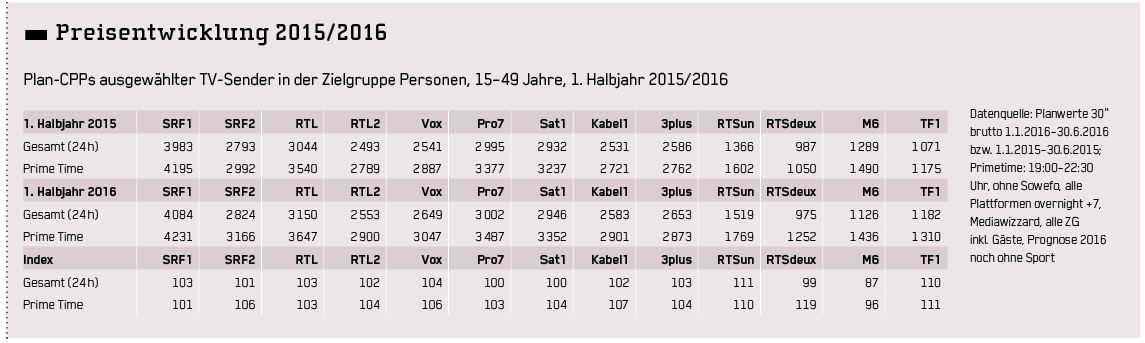
French-speaking Switzerland: Higher TV pricesThe situation is different in French-speaking Switzerland, where SRG stations and TF1 are increasing prices significantly. However, it should be noted that both the SRG broadcasters and TF1 base their pricing on the 15-59 age group. In this target group, the increases are also considerably lower, ranging from 3.5 % (RTSun, 24 h) to 7.8 % (TF1, prime time) The price increases are of course only so moderate overall if the marketers' performance forecasts are actually achieved! These forecasts were set rather conservatively by most broadcasters for both prime time and non-prime time for the first half of 2016. As the weather, at least in the first quarter, does not usually have such a high influence on the development of performance figures, the forecasts should therefore be achieved to a large extent. Readers of Marketing & Communication can find out more about this here, and we would like to thank Konnex AG and MediaCom Switzerland for their support in this important issue for the SWA and its members.Authors: Monica Jäggi, Konnex AG and Roland Ehrler, SWA




