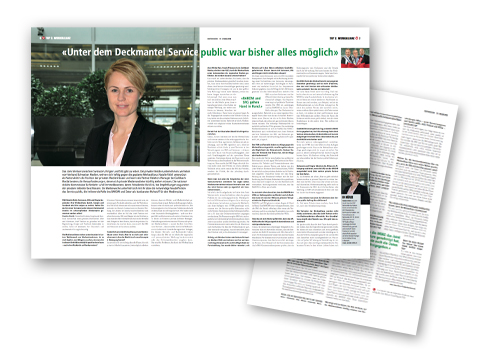
"Under the guise of public service, anything has been possible so far"
Advertising alliance: Werbewoche talked to Natalie Rickli about the necessary redefinition of the public service, the irritating role of OFCOM and data as the most precious raw material for the media center.


The private media companies, represented by the Swiss Media Association, are resisting the planned advertising alliance. As a member of the National Council, Natalie Rickli supports the position of the private media houses and, as Partner Relation Manager at Goldbach Media, knows the challenges that private media providers will have to face in the future. The National Council's Commission for Transport and Telecommunications, of which Rickli is president, has adopted recommendations in favor of the private providers.
Werbewoche: Natalie Rickli, Swisscom, SRG and Ringier justify their advertising alliance by saying they want to stand up to Google and Facebook. Do you think that's a pretext to gain share in the shrinking advertising market?
Natalie Rickli: In fact, Google and Facebook now have a large market share. But to set up a Swiss joint venture with the justification of wanting to fight Google and Facebook is, in my opinion, illusory on the one hand and untrustworthy on the other.
Media providers are in fierce competition with each other for advertising revenues. Isn't it legitimate to look for ways to position oneself as best as possible in this environment - even without regard for competitors?
Swiss companies have to be innovative, they have to offer good products, also for advertisers. Of course, they can join forces, either in the area of content or in the area of advertising; the approach is absolutely understandable and comprehensible. But in the case of the joint venture between Swisscom, SRG and Ringier, the problem is that two of the three companies are state-owned enterprises. Ringier is not an issue, it's a private company that can do what it wants. SRG and Swisscom are a different matter.
Indeed, the advertising alliance is putting private media houses under pressure. But isn't it also desirable for the market to get moving with new concepts?
Yes, of course. It's important that the players who finance themselves privately in the market can work in the best possible way, that they enjoy advertising and media freedom, that they have good framework conditions, which is why I'm also politically committed to this. But the difficulty in the Swiss media landscape is that it is very regulated. We have a lot of financial dependencies - and now SRG and Swisscom are also encroaching on domains where private providers already operate. That's why, as far as I know, all private media providers - except the three joint venture partners - argue that they themselves are in danger from the advertising alliance. Especially the regional publishers, the local TV and radio stations are afraid that the SRG will compete with them in the market for regional and personalized advertising or that it will be able to circumvent the online advertising ban. These are the problems created by the advertising alliance.
Mirko Marr, Head of Research at Goldbach Media, also wrote in the NZZ that the advertising alliance would endanger regional media in particular. So you would agree with that?
I would sign that. I think the private media providers could credibly make the case that their existence is threatened if this joint venture is approved without conditions. In terms of media policy, we are moving in a dangerous direction: More and more smaller, private providers are now hanging on to the fee pot. And if you now set up another joint venture like this, there is a great danger that at some point it will be said: "Now we have less advertising, in order to continue to exist, we need more fees." I am very afraid of that. In the past, many politicians thought they were doing good by paying more fees to the private stations. But it is wrong to want to secure media diversity with as much state intervention as possible.
At the moment, however, the state has its fingers everywhere.
Exactly, which is why we keep coming back to the regulatory problem with the advertising alliance. People always say that Swisscom is independent, and that SRG is, too. But the Federal Council directly sends two representatives each to the board of directors of SRG and Swisscom - you can hardly speak of independence of the state, but also independence at the operational level. Instead, the state penetrates the advertising market with two representatives each from the Federal Council. In addition, the SRG does things that are not service public, because private companies already offer them. Perhaps the problem is not even the SRG, but the politicians who have waved it through for years.
But if you now take the perspective of the joint venture partners: You say yourself that media companies have to be innovative and the joint venture would actually be an innovative approach ...
Of course, the basic idea behind the joint venture is understandable. But the big problem is regulatory. In terms of media policy, 2016 is one of the most important years in recent decades, and if the advertising alliance is approved by DETEC without conditions, we will no longer have to have the public service discussion. Because then facts will be created, such as the fact that the online advertising ban can be circumvented. The financing of SRG is guaranteed, the fee pot is getting bigger and bigger, because everyone has to pay and the population is growing. The private broadcasters would come under even more pressure. It must also be said: The idea of the advertising alliance is a good one, but no one knows exactly what it entails, because the private broadcasters are denied access to the files.
Correct. Since October, the Swiss Media Association (VSM) and several publishers it represents have been demanding access to the files and the possibility of becoming parties. This has been denied so far, with reference to business secrets contained in the files. Why won't Swisscom, SRG and Ringier let us look at their cards?
I don't find either Swisscom or SRG particularly transparent. For example, the accounts of Billag, a subsidiary of Swisscom, are not transparent. Only after repeated inquiries in parliament and pressure from the media did the department disclose that Billag earns millions in profits from fee payers every year. SRG does not have to account to parliament or the public at all. The department always says in response to political requests: SRG is independent and OFCOM has an overview, everything is fine. Parliament is switched off. But when taxpayers' money flows somewhere, it has to be controlled by the state. That's why I'm so in favor of free media, because I don't think they should have to be controlled at all. The media policy so far has, of course, been a matter of political will. In the run-up to the Competition Commission's decision, the responsible media minister also expressed her approval of the joint venture and the participation of SRG and Swisscom. It is logical that the administration should not contradict this.
The VSM and Tamedia have now filed a lawsuit against the advertising alliance, primarily concerning the possibility of inspecting the files. Do you think the association has a chance of getting away with the lawsuit?
The judges will decide that. From a political point of view, I can say this much: We had a hearing on this topic in the Commission for Transport and Telecommunications and heard all positions, from the joint venture partners to data protection officers, the Competition Commission and, of course, the private providers. As a result, we drafted a recommendation to the Federal Council with the request that the private parties be granted access to the files. The majority did not understand that this was not possible. What OFCOM decides in March will be decisive.
Yes, it does seem absurd that OFCOM asks VSM to comment and then in response sends back a paper that has been mostly blacked out by SRG.
OFCOM and SRG often go hand in hand in my eyes. OFCOM could have demanded that SRG disclose the details. But if the administration and the responsible Federal Councillor do not do that, then that is clear political will.
But this is highly dangerous, because OFCOM should actually control the SRG and not protect it.
Exactly. In my eight years in the National Council, I have found that OFCOM's answers are usually very SRG-friendly. We parliamentarians have practically no leverage here. We can exert pressure and adapt the laws, but this is of course a longer process. For example, the commission wants to examine a dual SRG concession competence, i.e. a framework law from parliament and the details by the administration. Until today, the parliament could not say anything about the concession. So far, everything has been possible under the guise of public service.
WEKO had approved the advertising alliance last December because it did not expect the joint venture to undermine effective competition. Was that a misjudgment?
I do not think this judgment is correct. And perhaps we should remind ourselves once again that the Competition Commission is a federal authority. In recent years, Swisscom has repeatedly been fined after the fact, for example because it charged too high prices for broadband Internet. But of course it's no use to the other companies if, seven years later, they're told "the prices were too high, we're lowering them now and Swisscom has to pay a fine in the millions". Because the fine that Swisscom has to pay simply passes from one federal treasury to the other. We should question this.
On the same day as the WEKO gave its go-ahead, OFCOM prohibited SRG from participating in the joint venture. A final decision is now expected by the end of March. What do you think OFCOM will decide?
For me, it would be untenable in terms of regulatory policy if DETEC were to approve the joint venture without conditions. However, it is almost certain that it will approve the advertising alliance. That fits in with its media policy orientation in recent years. I think it would be right to postpone the decision until the public service debate has been conducted.
Swisscom and Ringier could raise the alliance on their own if SRG is outmaneuvered by OFCOM. Or bring other private partners on board.
Yes, they could. But of course there is no other player as big as SRG with as many stations. But we have to make it clear once again: Advertising marketing is not part of the SRG concession. Online series or advertising on SRF info were not in it either, and they were adjusted afterwards.
... so the very first thing that needs to be done now is to clearly define the public service mission?
Yes, and when private companies do something, I think they do it according to the principle of subsidiarity.
The representatives of the advertising alliance never tire of emphasizing that the joint venture is open to other media providers. But their basic attitude radiates defensiveness. How does that go together?
I don't think the three players expected the opposition to be so great. They now seem to have opened up a bit, but the last I knew, the VSM was looking for a discussion and the SRG didn't get back to me. What is certainly a good development is that we are now having this important media policy discussion. In recent years, private stations with fees have not dared to make media policy an issue and to speak out critically against the administration. Now the private stations have a chance to show what good work they do and how innovative they are. To do this, they need good framework conditions, which politicians should ensure.
The private publishers are supported by the National Council's Commission for Transport and Telecommunications, of which you are President. You're the perfect person for this, in your dual role as a politician and an employee of Goldbach Media, which means you know the media industry from the inside.
That's the beauty of the militia system. You can also bring your professional know-how to bear in parliament. The disadvantage of being president is that I can no longer express myself much in terms of content in the commission. I always liked to make motions and ask critical questions, but I can't do that anymore. But the advantage is that I can plan the meetings and introduce topics - and I decided to put the joint venture between Swisscom, SRG and Ringier on the agenda. We listened to all those involved so that we could get a comprehensive picture. We did that and have now made three important recommendations to the Federal Councilor responsible.
Following the VSM's announcement that it intends to take action against the advertising alliance, Ringier withdrew from the association with immediate effect. And in the rest of the Swiss media industry, too, fissures are opening up in heated debates: pro or contra joint venture. Doesn't this create unnecessary imbalances in the Swiss media industry?
From the media policy perspective of the past few years, I actually have the feeling that the private media providers have gotten their act together for the first time. When 50 media companies get together and act in concert to find a minimum consensus, that's a good development. Especially since it's not about money from the state, but about good framework conditions. So for the private sector, this conflict can now also be an opportunity, in line with my credo of "innovations instead of subsidies". I now see that the private sector is much more united.
User data is the treasure of the digital world and fertile ground for value creation. The VSM therefore proposes that, as an alternative to the joint venture, it should be examined whether all advertising-relevant user and usage data, which only Swisscom currently has, could be made available to all media providers. From the point of view of the media companies, this is a grandiose idea - but what does data protection have to say about it? And can this be in the consumers' best interests?
Indeed, we have to take a very critical look at this. Our Commission has therefore decided, firstly, that data protection must be guaranteed in the joint venture. And secondly, if data protection is guaranteed, the data must be made available to the other Swiss media companies via an independent platform. Furthermore, the data should only be allowed to be stored in aggregated form, so that privacy for the consumer is guaranteed.
No one else in Switzerland has the kind of data that Swisscom has. And the company naturally wants to turn this enormous competitive advantage into money. Why should Swisscom give away its data?
If it hadn't been for the joint venture, we wouldn't even have started discussing this data. Now, understandably, the private sector is also registering its interest in the data. Since Swisscom is majority state-owned, one can conclude that they have to make the data available. And since the WEKO has approved the joint venture, I think it has also released the data. Now it's a matter of deciding who gets access to that data. I don't think it's absolutely necessary to use this data for advertising purposes, but it's certainly lucrative for the advertising industry. And customers benefit from receiving advertising tailored to their needs.
That depends very much on which customer you ask: one finds advertising that really concerns him better than advertising that doesn't interest him at all and only annoys him. And the other doesn't want any advertising at all, certainly not using his data. It's not for nothing that ad blockers are booming.
Ultimately, it's up to the customer to decide. But the issue goes even further. Ultimately, it's about net neutrality, the revision of the Telecommunications Act and questions such as "does the citizen have the right to his or her data?", "how much can he or she get involved in this debate?" etc. That is why the Commission has explicitly and separately referred once again to the guarantee of data protection.
What would be wrong with fee-financed content bringing in advertising money at the same time, in order to further increase the revenue of the company - in this case SRG? After all, the profit could flow into new content, which in turn would benefit the audience. DETEC could impose this as a condition on SRG in the joint venture.
SRG has practically the same advertising conditions as private media providers, and the restrictions are minimal. In the current debate, various publishers have called for stronger ones. That's why the public service debate is so important. I am also prepared to discuss models in which, for example, the Internet is excluded from fee financing. Then SRG would have to face competition in these areas and finance itself through advertising. Then, of course, the other media providers won't be happy. But as it is now, it is simply an unpleasant cross-financing because it is not transparent. The online advertising ban can be circumvented if, for example, SRG content is broadcast on Blick.ch or Bluewin.ch and these capitalize on content that was originally financed via fees. These are questions that have not been answered and will not be answered until the details of the deal are known. In addition, if the joint venture were approved, it would not be under OFCOM supervision. Then no one would control what goes on there.
How long will it take to decide on the basis on which media providers will work and make decisions in the future - i.e. data protection law and public service, joint venture and Billag?
I can't say, it depends on how the discussion develops. But it's certainly positive that we're debating it and that we're no longer committing blasphemy in parliament when we question the SRG. Until now, SRG and public service were under homeland security - that has now changed. The next year and a half or two years will be very exciting overall in terms of media policy; I don't think we'll have any final decisions this year.
Do you think the dispute over the advertising alliance would have made such waves if SRG hadn't been involved?
I don't think so. Of course, the data from Swisscom would also have been a central point. But the main reason why the matter caused such a stir was that it became known that the joint venture was being set up against the backdrop of the RTVG vote, i.e., while we were being led to believe that it was only about a collection model and not about public service. And behind the scenes, the three players bypassed the politicians and the public to create a joint venture. That was the straw that broke the camel's back. This is not appreciated by many sides. Swisscom, Ringier and SRG have certainly completely underestimated the situation.
What would it mean for your employer Goldbach if the advertising alliance goes through?
Of course, we are affected just as much as the other media providers, but especially the stations we market. If the Swisscom data is not made available to all participants, the joint venture will know more about the broadcasters than the broadcasters themselves. For example, who watches what, when and where. For the private providers, this represents a competitive disadvantage, because they would not have this data at their disposal. The broadcasters are coming under pressure.
If you had one wish: How would this conflict end?
I've learned in recent years that you have to separate what's politically feasible from what's desirable. Idealistically, I would like us to have a discussion on media and regulatory policy, at the end of which the SRG takes over the minimum basic public service and private companies drive the industry forward through innovation, independent of the state. In terms of realpolitik, I hope that OFCOM will impose a clear condition on the joint venture that the data must be made available to everyone on a non-discriminatory basis, taking into account data protection.
Interview: Anne-Friederike Heinrich