At the film hotel
Catherine Ann Berger is the new director of SWISS FILMS. She has been a successful film dramaturg until now and now hopes to ensure that as many films as possible feature suspense, action, and a happy ending.


She has just returned from Cannes. "Visiting this festival is really very exciting. But of course I got to know a completely different Cannes than the spectacle you see in the media." Catherine Ann Berger is referring to the stilettos, the red carpet, evening gowns and stars who really are "bigger than life".
However, the newly appointed director of the Swiss Films promotion agency was even more impressed by the market in her first assignment: "2000 stands and country pavilions where people are working hard." Since June 1, Catherine Ann Berger's new job has been to design and manage this work and to represent Swiss filmmaking at similar events.
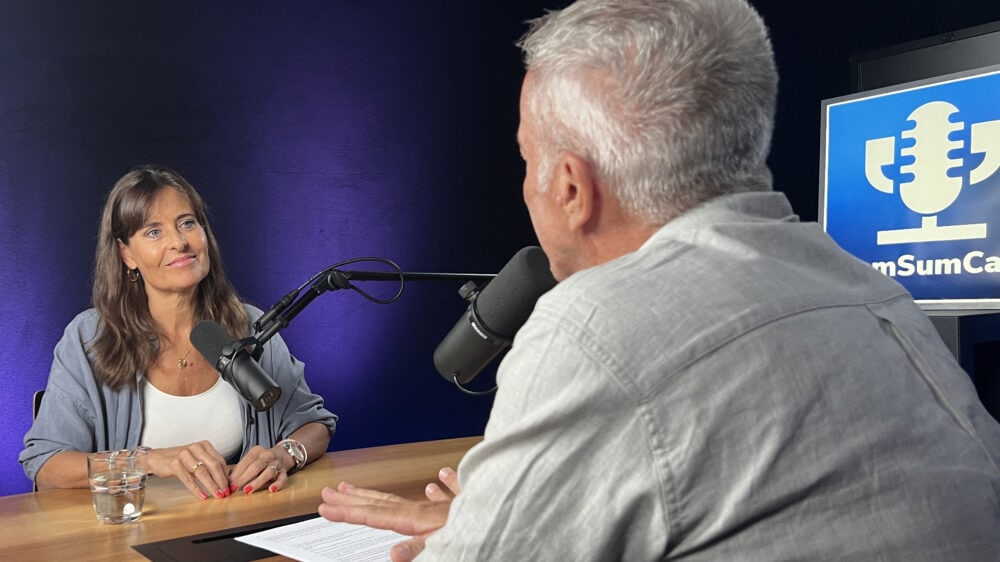
"I've been invited to a farewell aperitif at Swiss Television this afternoon," the filmmaker begins during our interview. In addition to SRF, her stations have included SF, SPlus, Schweiz 4 and 3sat over the course of her career. "This morning I reflected on what it means for me to say goodbye now."
SRG is a large organization and large organizations are usually a bit cumbersome. "But at the same time, it has to be said that I was able to work in an organization that gave me a lot of opportunities. If you look at how Google is set up today, SRG has a very similar attitude. I was able to develop in the midst of a high level of professionalism. I am incredibly grateful for that."
Catherine Ann Berger entered this world at SPlus, the first second channel on Swiss television at the time. She applied as a trainee shortly before completing her degree in theater studies at the University of Vienna. The application process took over three months. In the end, they took someone else. I liked that a bit."
An internship with Heiner Müller in Berlin was more than a nice consolation. The seven-hour production of "Hamlet/Maschine" at the Deutsches Theater turned out to be an unrepeatable insight not only into the world of the stage, but also into contemporary history shortly after reunification. "It was exciting and I am still connected to the theater today, on the board of directors of Theater Neumarkt. I love the live character. But I'm also very much in love with the magic of the movie theater. Sitting in a dark room, immersed in the screen and in the stories of these people. So I was drawn more into the world of media and movies." Stories where you can press "stop", "replay" and "fast forward".
After SPlus, she quickly moved on to SF, where she made purchases in the documentary film department and was then able to produce reports for the youth magazine "Zebra" relatively quickly. "A great format where young people could experiment and let off steam cinematically. Sabine Boss's first film was made in this way, as was one of Jacqueline Zünd's first."
After two years, the magazine was discontinued. So Berger applied for a job as a reporter at 3sat. However, they were looking for a presenter. "They took me by surprise with a test and I passed. " This was followed by an invitation to a second test in Mainz and soon Catherine Ann Berger was the Swiss face of "Kulturzeit". In rotation with her colleagues from ORF and ZDF, she presented this cultural "10 to 10" show in Mainz one week a month for six years. Live every day in prime time. "Our aim was to react to current events from a cultural point of view and to take a stand."
After six years of everyday journalism, Catherine Ann Berger has realized "that I no longer have to put my two cents in on everything". The "Kulturzeit" feature section is very broad and has quality. But for Berger, things have changed. "My time was over. I wanted to concentrate more again, focus and go deeper." The bottom line: "I wanted to get back to cinema and work for film."
Berger started again as a film critic on the "Kino aktuell" program and as an editor for the discussion show "Filmclub", which was hosted by Samir and others at the time.
"There have always been times in my life when I was fully focused on a task and others when I wanted to have a free leg. That was the case again now." At the same time as working as a film critic, the presenter who left the industry has resumed her training as a film dramaturge. Berger founded her own company, "Framing Words", and increasingly saw herself as a script coach. In this role, she has worked for many well-known productions and also co-authored the hit film "Die Herbstzeitlosen" by Bettina Oberli.
As a film dramaturge, Berger remained associated with the "Film and Series" department at Swiss Television. In today's "Fiction" department, she was most recently responsible for editing, but above all for co-productions in the animated film sector. Her expertise was also in demand as a jury member for the Swiss Film Prize, the Oberhausen Short Film Festival, the Diagonale Graz and in Vienna she was on the project commission of the Austrian Film Fund for the screenplay section.
Viennese philosophies
Culture was Catherine Ann Berger's great passion even as a teenager. She grew up bilingually in Bern in a "culturally very interested home". Her father comes from the Emmental. Her mother from England. "With two passports, I am now a European." In 1984, she graduated from the Bern gymnasium. One month later, she was already in Vienna. "I had to leave Bern. The city was incredibly cramped for me. I found it claustrophobic that everyone always knew where you were on Friday evening." She followed her dance teacher's call to Vienna.
"There have always been moments in my life when people have called me. That was first the case in Vienna, later in Mainz and now in my new job as Director of Swiss Films. I wasn't explicitly asked, but I knew that this opportunity and task was waiting for me."
After a year in ballet in Vienna, Berger realized relatively quickly that standing in front of a mirror for a day is not really what interests her. "My brain would like to be switched on a bit more again."
The best opportunity for this was in theater studies. "I saw this subject as an ideal complement between theory and practice. And you couldn't study theater studies in Switzerland at that time. Luckily for me, I was able to stay in Vienna a little longer."
During his studies, Berger also discovered relatively quickly that this ideal combination of theory and practice is a bit of wishful thinking. "Nevertheless, I learned a lot about my way of thinking in Vienna. I studied philosophy, political science and sociology. Gender studies also emerged during my time there. I also picked up the specific aspects of film studies from many different subjects."
In Vienna, Berger felt like the "gschaffige Schweizerin" for a long time. She therefore had to learn what it meant to say: "This is never going to end." It means something like: "I think we should take a break now and go back to the coffee house. " This mentality gave her a bit of a hard time at the beginning. "Then I learned that sometimes you have to let things go a little. Then it somehow keeps working inside you. And the next morning you might get to the point faster. So I learned a lot from my approach in Vienna and took a lot with me. The sitting, the philosophizing and the debating."
She completed her degree with a thesis on the phenomenon of the "panorama". These are circular paintings, such as the 360° depiction of the Bourbaki army in Lucerne's rock garden. Berger sees such paintings as a kind of "very early cinematic experience" for people. "And it's a democratization of the view." The panorama, where you go underground to the center, offers everyone the same panoramic view of the world. " Today, Catherine Ann Berger seeks to discover this view out into the world in film. As a script coach, what does she think of local creation? "I've read a handful of grotty scripts and a handful of excellent ones. With most projects, however, the following applies: they are scripts in which you can find interesting aspects. But with many of them, I can't see any compelling necessity for the film to be made. I have the impression that, due to the production landscape in Switzerland, people are more quickly satisfied with the script - or are more quickly forced to transfer it to a production phase so that the production company can continue working."
The situation of Swiss screenplays
To summarize, the film dramaturge would generally like to see "one more round of work on most Swiss scripts". But Berger sees it the same in every country. "There were rounds in the Austrian project commission where I read up to forty scripts. Ten or twelve of them made it through. It's no different in Germany either. A few more scripts simply get through there because the country is much bigger."
And now? No more building films, but selling the finished product, which can no longer be changed, to as wide an audience as possible?
The new director of Swiss Films wants to take a more differentiated approach to her job. "A film doesn't come to me completely finished. I often see a rough cut, where we can give feedback again." In this phase, can decisive improvements be made to the positioning of the film? "Are there opportunities to tighten up a certain aspect a little? To accentuate something?" For Catherine Ann Berger, it would be a great wish "that we can build up a relationship of trust between production and promotion".
Moreover, the dramaturgy of a film does not end with the final cut, but a process begins again at the launch: What is my logline, what is my short synopsis? What does the title, the poster promise? "Once again, it's about storytelling, namely: What is the essence of this film?" Berger wants to sharpen the focus in all these areas: "How do we brand a film?" She wants to analyze this again: Where can networks be connected? How can Swiss Films create lobbying for films, positioning and consider together with the industry? What is the quality of the film? Where can it best develop?
The services of Swiss Films
In principle, Swiss Films is open to all projects. "I'm only at the beginning of my work. But I have formed an image for myself: We are like a hotel. There are suites and VIP guests, there are double rooms and single rooms, because the couple in the double room have split up. Then there are the attics. Every guest comes to reception and can expect a bed and a certain amount of basic facilities, because we are a service company. Of course, there are many who are a bit more famous and have a bit more money. They may also have a different potential. You can place them somewhere else. But for me it's important to say: only a full hotel is a good hotel. And it happens again and again: very often you can suddenly go from a suite to a mansard with the next movie. And it doesn't mean that it's any less good. Perhaps the attic has a wonderful view and a quality of its own, a small, quirky, perhaps autobiographical quality. One that surprises and amazes, that he or she would make such a work again, documentary, biographical, poetic. And suddenly you get together with someone and end up in a really great double room and everyone thinks: wow, they're married now!"
In such a "Filmhotel Schweiz", there are many stories that can be made up. The central concept for Berger is "the development and development opportunities of every film". She knows that everyone wants to go to Cannes and Berlin "and that's very exciting and great". It's a great honor to be told: We're voting you into the competition. "But let's be realistic: not every film is suitable for developing in this environment and being able to withstand this competition. It can also break a movie. It goes down the drain and never makes it to theaters again."
So you can say you were in Cannes, "but so what?". Swiss Films knows that there are other festivals where film is appreciated, welcomed and honored. The actors are celebrated. "Our job is to consult with the producers and directors there: Where can the film develop best? Where is it appreciated? This is a collaboration, a discussion. And we also put ourselves at the service of the producers and directors so that the film can have the best life it could possibly have."
Andreas Panzeri