
Advertising in red light
Companies invest a lot of money in advertising so that consumers will find their products appealing—and buy them. But the fact that Cablecom, Coop, and Ackermann’s advertising banners have now appeared on porn sites on the Internet was just too much sex appeal.


Advertising is not always everything. It can also backfire badly. This is when banners and slogans appear in an environment that casts the advertising company in a false (in this case reddish) light. This has happened several times in recent weeks: Coop, for example, fell out of favor with its advertising banner on the website of the Swiss web host Wuala.com on. Wuala offers its users virtual hard disks, which they can use to exchange data with other users of the website.
Coop and the blonde nudes
It's actually a great service. The catch: as this is user-generated content, illegally copied films and music files or nude photos and porn may also change hands via the platform. For example, Coop was emblazoned in the most beautiful orange next to films of Brit, Babe and Scarlett, naked women in blonde, brown and red. Coop Porno instead of Coop pronto? Embarrassing. The irritated retailer reacted promptly: it was assumed that the commissioned advertising agency would only display the Coop advertisement "in legally impeccable and reputable environments", it said. Said and quickly deleted, the rogue banner.
The advertising agency Coop is talking about is Initiative Media, which in turn has commissioned AdLink Internet Media to market the Coop banners. The outstretched index finger is therefore also directed at AdLink. "We generally only include websites in our network after a detailed check and guarantee our advertising customers that no religious, sexual or political environments or topics are covered," explains Stephan Suter, Managing Director of AdLink Internet Media. "However, the responsibility for the content of the website in question lies with the operator - who must also guarantee AdLink Media all possible content checks. If we ourselves become aware that a website contains illegal or immoral content, we immediately draw the operator's attention to this, stop campaigns and immediately remove the website in question from the AdLink Internet Media network.
media network."
AdLink also acted accordingly with Wuala. "The day before this matter became public, I would have put my hand in the fire for Wuala," says Suter. "Wuala is still in the beta phase and is supported by ETH Zurich. But it is a service with user-generated content. Anyone can post content on such sites within seconds that doesn't belong there."
Of course, Wuala.com is constantly checked for unwanted content such as child pornography. The web host is even supported by the Internet police Kobik (Swiss Coordination Center for Combating Internet Crime). Users can also report suspicious content, which is then immediately checked and deleted if necessary. Nevertheless, if you want to be on the safe side, you should not advertise on websites whose content is created by users, advises Suter. However, companies like to advertise on sites with user-generated content, preferably on the industry giants YouTube or Facebook. This allows them to quickly and cost-effectively address target groups that they would otherwise not reach.
Banner in the penalty area
Like Coop, the Swiss online mail order company Ackermann recently felt embarrassingly exposed: Its advertisement appeared on the website Celeblounge.net, which offers nude videos of stars, among other things. "This placement happened without Ackermann's knowledge," emphasizes Karin Müller, press spokeswoman for Ackermann-Versand. "We immediately contacted our media agencies in Switzerland and Germany and prohibited the placement. We do not want advertising on such sites." Müller does not want to give the names of the agencies responsible for media marketing. But she does reveal how the ad was placed incorrectly: Apparently, an intermediary had placed the mail order company's pop-up next to the porn without permission.
The banner of the telecommunications service provider Cablecom ended up on a no less dubious site: Despite the ban, many Internet portals make copyrighted content available for download, for example films, books or magazines. Anyone who wanted to download an issue of Psychologie heute from one of these sites in recent weeks would see a Cablecom banner at the bottom of the screen - and within clicking distance of the link "Tip: free vibrator & condoms". Wow. Like Coop, Cablecom is retreating to the island of the unsuspecting: a company spokesperson told the free newspaper 20 Minuten last week that they knew nothing about all this: "The registration was made by a partner who has set up an affiliate program himself. Our terms and conditions state that it is forbidden to place Cablecom advertising on sites that show pornographic or racist content. This partner in turn works with an agency that also places advertising on such sites. We have stopped this with immediate effect."
Knowledge does not protect against mistakes
All of the companies affected by the incorrect placements have now emphatically forbidden their media agencies from advertising on dubious websites. It was Coop, Cablecom and Ackermann themselves who booked advertising placements in this form with their agency - with the decision to advertise on sites with user-generated content. Apparently, however, the companies were not aware of the potential problems that this advertising channel could cause. Not even the operator can guarantee content on a user-generated content website one hundred percent of the time, even if they constantly monitor their content and delete unwanted content immediately. Companies should bear this in mind when planning their advertising.
At Coop, the advertising nuisance will probably already be forgotten. Wuala.com, however, is a small fish with 6000 users - compared to other user-made Internet sites such as YouTube or Facebook. The tiny glitch could turn into a big bite for the web host, which could ultimately choke it to death.
One more thought at the end: How dramatic is the misplacement of advertising banners really? Of course, it is not good for a company's image if it becomes known that its advertising is appearing on dubious websites. Accordingly, the companies react sensitively to the cases described. After all, they pay their media marketers to reach the desired target groups via advertising on the right channels. But the average Coop shopper, Cablecom phone user and Ackermann customer probably didn't notice much of the misplaced ads. And people who are in the process of illegally downloading newspapers, magazines or pornographic films from the Internet are also unlikely to be interested in the banners from Coop, Cablecom and Co. that pop up at the same moment. The only tenable accusation that could be made against the media agencies concerned would therefore be: target group missed.
Anne-Friederike Wilhelm
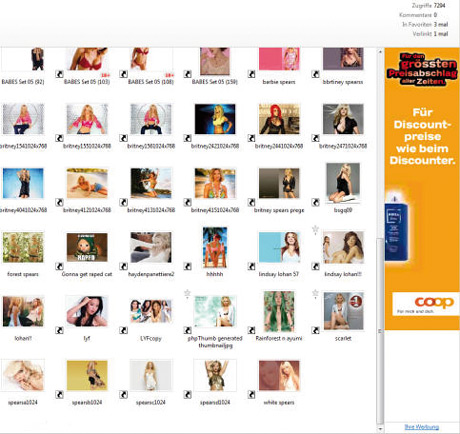
Coop's now deleted advertising banner on Wuala.com.

Die Zeit, Spiegel, Stern and Fibratoren in perfect harmony with Cablecom.


