Make subjects really work
The analytical method presented here by Zurich-based BildKom GmbH measures advertising effectiveness in both the narrow and broad senses, evaluates it, and thereby enables its management. This approach differs fundamentally from the conventional method: Traditionally, an advertising spot or campaign is produced first—and only afterward does one attempt to determine whether the spot or campaign is actually effective.


Here, we’re turning the tables: We first identify the strategy with the most compelling rationale for its impact and then ensure high-quality implementation. The question of impact should be answered not by a pretest, but by the financial results.
In terms of advertising impact, the message is the cause of the effect, and the advertising objective is its effect. If the advertising objective is influenced by the message, we refer to this as advertising impact. Since we do not know the advertising objective of each of the analyzed ad campaigns, we derive it—along with the strategy—from the advertisement itself. To make this approach easier to understand, we will focus the next six installments of this analysis on quality assurance—specifically, on the quality of visualization.
In the three previous issues, we examined how messages are seen (15/2010) and understood (17/2010), and how the perception situation relates to media planning (19/2010). Next up are the special features «Integrating Messages Across Media» (1/2011) and «Measuring in a Timely Manner» (3/2011). In each case, the analysis briefly explains what the focus topic is about and then applies the underlying concepts to a specific advertisement.
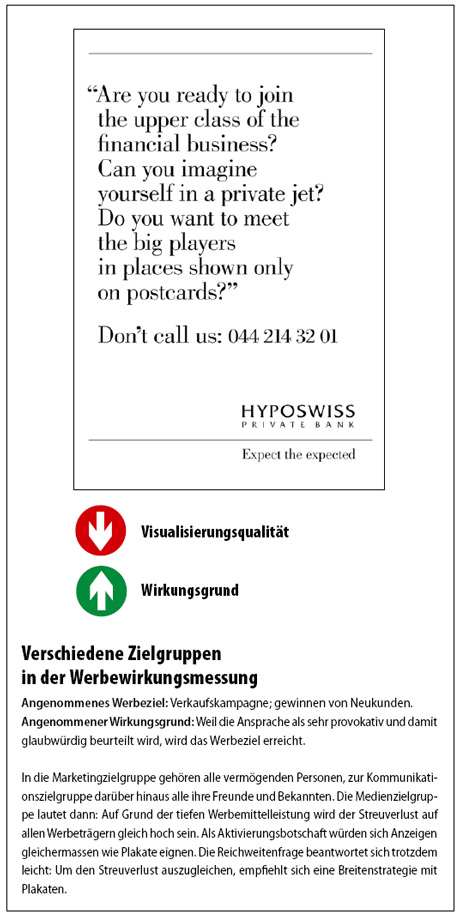
Part 4: Different Target Audiences in Advertising Effectiveness Measurement
In communications, it is important to distinguish between three target audiences: one for marketing, one for communications, and one for media planning. Let’s take the example of a hearing aid manufacturer that wants to launch a waterproof device. The marketing target audience is defined by those directly affected who are willing to spend money on such a device.
When it comes to communication, however, it’s a waste to limit yourself to just the marketing target audience. After all, the reach can be multiplied if even the wife—who has good hearing—realizes that her husband could use the new hearing aid in any weather. Close relatives and friends have a very significant influence on decision-making, and often it is precisely these people who actively intervene: partners, parents, children, friends, coworkers, etc. Social networks are important groups that influence decision-making and therefore, together with those directly affected, define the communication target audience.
A particular advertising medium is selected because it is assumed to be the best way to reach a specific marketing target audience. This selection is based on proprietary usage studies conducted by the respective media providers—with the result that each medium has its own target audience profile and thus cannot be compared to others (as an extreme example, billboards do not have a target audience at all). This dilemma prevents fact-based, cross-media campaign planning and evaluation.
This unsatisfactory situation is resolved when advertising material performance—rather than the advertising medium—is used to determine reach and contact frequency. In this sense, the media target group is derived from the measurable advertising material performance, the advertising material’s function, and the communication target group. With these three target groups, it is now possible to evaluate the advertising material in relation to marketing objectives and media planning in relation to media strategy prior to publication, and to optimize them in a timely manner.
> For a detailed analysis of the topics