
Voice creates atmosphere - and expert knowledge
Just like the candidates, experts also need to prepare for exams. That’s why marketing specialists who serve as examiners for the «Presentation and Communication Techniques» course attend an annual «training camp» for quality assurance. This spring, the experts received a concise introduction to the tools of the human voice from an expert who is both knowledgeable and skilled in the field.


What good is it if a presentation is technically accurate but delivered in such a staccato of words that nothing of what is said sticks with the recipient? Or when a head of marketing wants to get his staff on board with a new course, but instead of using the voice of a lion, he uses the voice of a mouse? This spring, the "Presentation and Communication Techniques" seminar of the professional examination for marketing specialists with a federal certificate dealt with this subject - the voice and all its situations. While at last year's seminar it was TV personality Patrick Rohr who brought the experts up to date with the latest communication techniques, Peter Gilli took his specialists into completely new territory for many of them. The voice - possibly a somewhat exotic topic at first glance - but definitely one that comes into its own in every presentation and plays a key role in oral examinations: "The voice in and of itself is not graded in the examination," said Peter Gilli before the event, "but it plays a key role when performing in front of an audience - for newly qualified marketing specialists, experts and in everyday practice." For the Head of Presentation and Communication Techniques, a topic that deserved to be explored in greater depth: "Although all of our experts have their theoretical tools together and gain practical experience on the job every day, quality assurance also involves constantly staying on the ball." The topic of voice, said Gilli, "has not been addressed very much so far, but there is certainly plenty of scope for in-depth study and new learning here."
The doctrine of the "sounding breath"
The first few minutes of the speaker's appearance confirmed just how right Gilli was with this assumption. Michael Berndonner, former stock exchange trader, later choirmaster and current lecturer at the University of St. Gallen for speech technique, speech design and performance skills, shed light on the topic of "voice" from every angle and in a manner that didn't let the audience get bored for a second. Especially not at the beginning, when he instructed the 60 or so surprised experts to rehearse a song and then perform it. Two volunteers actually ventured forward. The purpose of the exercise was to show what a personal organ the voice is. Building on this, Berndonner went on to talk about the organ itself, including medical issues, listening exercises and vocal theory - and didn't forget the practical tips: clearing your throat, the experts learned, is a no-go. Instead of mistreating the vocal chords in this way, it is better to hum. Coffee and orange juice can make the vocal chords worse; speakers are better off drinking lukewarm water and apples. And if you always want to get a message across vocally, you should speak slowly enough, add dynamics to your speech with loud and quiet passages and set breathing caesuras. "Singing and speaking is sounding breath," Berndonner proclaimed. The experts took away from this afternoon that the voice is one of the match-deciding soft factors in lectures, talks and presentations. Voice coach Berndonner, who is never at a loss for a vocal interlude, was able to demonstrate how closely the psyche and voice are related and how much this organ deserves to be cared for and trained. His advice and tips are likely to have been doubly valuable for experts in the field of presentation and communication techniques. Firstly, they helped future candidates to understand the role of the voice better - and secondly, there were certainly takeaways for their own next speech or presentation. A win-win situation in a class of its own.
Insights for experts
It can be assumed that the examination experts in the subject "Presentation and Communication Techniques" have gone through life differently since this event - and therefore also refocused their eyes and ears when it comes to seriously assessing the next generation of marketing specialists. What does a candidate's jaw posture reveal? What does the candidate's voice sound like, what does it reveal about their current state of mind and their actual personality in addition to the actual message? And, probably most importantly: is the candidate also convincing vocally during the presentation, are facts and emotions conveyed in such a way that the recipient "buys" what is being communicated? Voice creates mood - this essence has become ingrained in the hearts and minds of experts. Just like Peter Gilli. The head of the "Presentation and Communication Techniques" course for marketing specialists was pleased with the lively, always informative and sometimes unorthodox way in which speaker Michael Berndonner got his message across. The event, which was anything but a "revision course", but rather a seminar with a refreshing and refreshing character, fits in with Gilli's line and the way he sees the professional examination for marketing specialists with a federal certificate and their examination professionals: "It is important that the experts - just like the candidates - prepare intensively for this federal professional examination, which is carried out by Swiss Marketing (SMC) under the supervision of the Federal Office for Professional Education and Technology (OPET). Here and today, the experts were able to get professionally fit, learn new things and gain important insights that can be directly applied to the exams. That's how it should be." After Berndonner's inspiring presentation at the end of the day, an aperitif was held at the end of the day where, in addition to the voice, another detail was cultivated that can be decisive in practice: a good atmosphere.
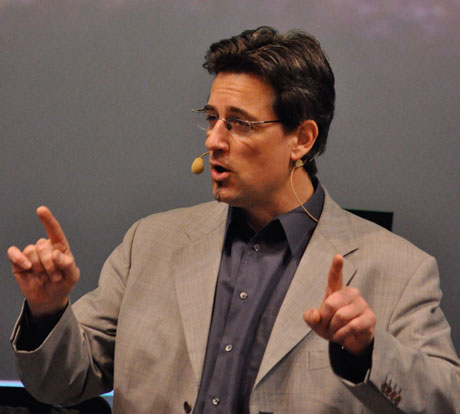
There is always something of the personality in his voice: former stock exchange trader Michael Berndonner during his presentation.


