Social media use increases viewer engagement
What effect does using social media while watching TV have? Various surveys and observational studies have recently explored this question. A recent neuroscience study from Australia is now examining this in even greater detail.


Researchers from Neuro-Insight, MEC Australia and Seven Network use brain activity analysis to show that the simultaneous use of social media and TV leads viewers to engage even more with TV content - good news for program makers and advertisers.
In the multiscreening age, it is commonplace for many consumers to use social media while watching TV. It is therefore important for TV broadcasters and advertisers to know whether this parallel use distracts viewers from the TV program or has a complementary, positive influence. The Australian research team investigated this question on a neuroscientific basis. 36 consumers between the ages of 18 and 32 took part in the study. Spread over four evenings, the test subjects each watched a 35-minute episode of the TV show "X-Factor" in a setting close to everyday life. At the same time, they were able to use social media on their smartphones and tablets without any restrictions. During the sessions, the participants' brain activity was measured using electrodes. The focus was on the areas of the brain that reflect consumer engagement (= personal relevance of the content received). Previous studies have made it clear that this engagement is closely linked to long-term learning processes and therefore to consumers' purchasing behavior. At the same time, the use of the mobile devices was recorded via a synchronized camera. Compared to traditional surveys and observational studies, this method has the advantage that it firstly recognizes cognitive activities that take place subconsciously, secondly enables a synchronous analysis of both screens in real time and thirdly examines the viewers in a realistic situation.
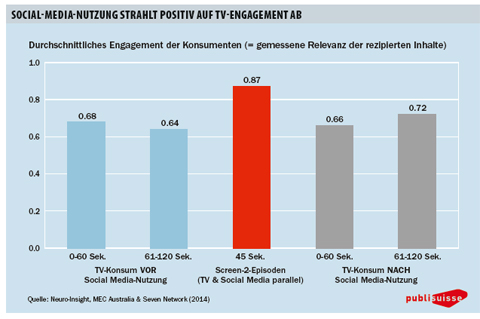
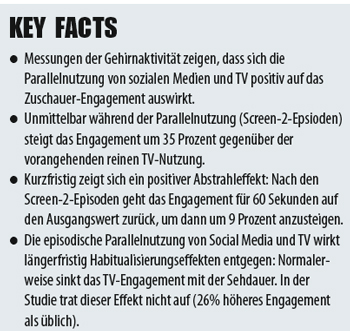
First of all, the study shows that consumers accessed their mobile devices an average of 4.25 times during the 35-minute TV episode. On average, these Screen 2 episodes lasted 45 seconds each. 76 percent of the episodes took place during the TV program, 24 percent during the commercial breaks. According to the study, consumer engagement increases significantly during Screen 2 episodes. During the parallel use of social media and TV, engagement is 35% higher than during pure TV use, which directly precedes the Screen 2 episode (0.87 compared to 0.64). So what happens when attention shifts back to TV? This shows that Screen 2 episodes have a positive effect on TV engagement. In the first 60 seconds after the parallel use, the measured personal relevance drops to the level that was given on average before the parallel use (0.66). However, TV viewer engagement then increases by 9 percent (0.72).
In the short term, the use of social media has a positive effect on viewer engagement. But how does it behave over the entire 35-minute TV episode? Past analyses by Neuro-Insight have shown that the engagement of TV viewers usually decreases with increasing viewing time - in other words, a habitualization effect occurs. In the current study, the occasional parallel use of social media and TV counteracts this habitualization effect. Compared to the values that are usual for primetime programs when only TV is watched, the engagement values were 26 percent higher.
Clemens Koob